See it! Moon and morning planet photos
Source…www.earthsky.org
Natarajan
The listening or viewing of a musician singing in Delhi in thousands of homes simultaneously, is rendered possible by technology. But when we read in the Bhagavata that Sri Krishna appeared to the Gopikas, simultaneously in thousands of homes, questions are asked whether this is credible. If man-made gadgets (yantras) can be so powerful, why doubt the power of mantras? Sound waves are converted into electrical waves and transmitted through ether. The waves have a permanence in space and can be received by one who can tune in to the vibrations. Likewise, if the all-pervasive Divine is received in the radio receiver of the heart by tuning in with one-pointed devotion, the bliss of that experience will reveal Him to you. It is because the Gopikas were experts in this technology, they could experience the omnipresence of Krishna. Their hearts were filled with the form and name of Krishna who was their unfailing friend in all situations.
Source….http://media.radiosai.org/
Learn to live in harmony and unity. The village (society) is to the villagers (members of the society) what the body is to the individual. Every organ in the body functions in cooperation with every other part. If the foot steps on a thorn, the eye feels the pain and sheds tears. If the eye notices a thorn or stone on the road, it warns the foot to avoid it. Villagers should develop the same sense of unity and share their joys and troubles as one organic body. There is nothing you cannot achieve with unity as your strength. With purity and unity, you can unravel your Divinity and develop genuine devotion to God. You should fill your hearts with love and make your lives holy and purposeful. When everyone works in this spirit of unity and charity, the village would become a model for all the rest.
Source …..http://media.radiosai.org/
In our daily experiences, there are a number of instances which reveal the existence of Divinity in every person. Consider a cinema; on the screen we see rivers in flood engulfing all the surrounding land. Even though the scene is filled with flood waters the screen does not get wet by even a drop of water. At another time, on the same screen we see volcanoes erupting with tongues of flame, but the screen is not burnt. The screen which provides the basis for all these pictures is not affected by any of them. Likewise in the life of man, good or bad, joy or sorrow, birth or death, come and go, but they do not affect the Atma. In the cinema of life, the screen is the Atma – it is Shiva, it is Sankara, it is Divinity. When one understands this principle, one will be able to understand, enjoy and find fulfilment in life!
Source………http://media.radiosai.org
Today I found out that the British once planned to construct a massive aircraft carrier during World War II… made of ice. Surprisingly, it wasn’t as crazy as it sounds at first glance.
Britain was taking a beating from the German ships and submarines and were looking for something to build a ship out of that couldn’t be destroyed by torpedoes, or at least could take a major pounding without incurring a fatal amount of damage. With steel and aluminum in short supply, Allied scientists and engineers were encouraged to come up with alternative materials and weapons.
A scientist named Geoffrey Pyke was the king of alternative ideas (as you’ll see in the Bonus Facts below). One of his ideas was to build a 2,000 foot long, 300 foot wide and two million ton carrier. Pyke named his project Habbakuk, a biblical reference that seemed to mirror the project’s goal: “…be utterly amazed, for I am going to do something in your days that you would not believe, even if you were told.” (Habakkuk 1:5, NIV) Unlike in the Bible though, the ship’s name was spelled with two b’s and one k, which is thought to be simply a spelling error that was repeated so many times that it became official.
Besides the ship’s size, what was so different about Pyke’s vessel was that it would be built of ice. There is no real limit on the availability of ice; it’s easy to make, fairly durable (except in warm temperatures), buoyant, and very easy to repair when damaged. Further, repairs can be made extremely quickly with the right equipment, even during a battle.
The ship was also to include 40 dual-barreled gun turrets, as well as other anti-aircraft guns, and an airstrip that could accommodate up to 150 fighter planes or twin-engined bombers.
Pyke was able to sell Winston Churchill on his plan in 1942, including Churchill stating it should be given the highest priority.
In testing, though, it was discovered that ice might not be as strong as the ice-bergs that Pyke modeled his idea on. It turned out that ice frozen into blocks for the hull could be broken very easily with something as small as a hammer. The project was temporarily abandoned as a result.
However, later that year, a New York polytechnic firm added cellulose- sawdust, wood chips and paper shreds- to water and froze it for a much more promising base structure for such a ship. Not only was it stronger than straight frozen water- with as little as 4% of wood pulp added it made it as strong as concrete, pound for pound- it was also much slower to melt and more buoyant. Pykrete, named after Geoffrey Pyke, could also be cut like wood and easily milled into shapes like metal.
There was one problem though- melting and refreezing would cause warping in the structure. Tests showed that a pykrete ship would eventually sag unless consistently cooled to around 3° Fahrenheit. To maintain this, the ship’s surface would have to be covered in insulation and it would need a refrigeration plant and duct system.
To test the feasibility of getting around this problem, a small scale version of the Habakkuk was constructed in Alberta, Canada’s Lake Patricia to experiment with insulation and refrigeration possibilities and to see how it would stand up to artillery shelling. The test ship was 30 feet wide by 60 feet long, weighed 1,000 tons and was kept refrigerated with a one-horsepower engine, which was sufficient to keep it from melting even through the hot summer months.
In ballistic testing, it was determined that a direct torpedo hit would only cause about a 10 foot crater in the hull, which was insignificant given the size of the proposed ship. Thus, it would be nearly impervious to torpedo attacks for all practical purposes, as it would take a huge number of torpedoes and other bombs to sink the ship. So even if the ship was broken up, the Axis powers would have had to invest a massive amount of their resources in a given area to do it (particularly considering the arsenal of aircraft the ship carried), which would have weakened them significantly on other fronts during the attack. If they were unsuccessful, the ship could be easily and quickly repaired right on the spot.
So overall, the test ship made the full size version seem like it might actually work out.
At this point, it was estimated that construction on the real Habakkuk would cost $2.5 million (about $32 million today), which is a bargain for a ship like this.
There were still some hurdles to overcome, though. The rudder on such a ship would have to be massive. How to effectively mount this in the structure in a way that would be resistant to attack was a problem, as was controlling such a rudder. Also, the amount of wood pulp needed would have impacted paper production; while this ship used significantly less steel than most, the steel tubing it did need for reinforcing the structure would have depleted reserves for conventional, proven warships; a huge amount of cork would also be required to insulate the ship; and, finally, the ship’s top speed of just six to seven knots (6.9 to 8.1 mph) was deemed too slow, even with it being fairly torpedo-proof in terms of the main structure itself.
In the end, these problems, combined with the fact that during the planning phase the range of aircraft had increased significantly to the point where the need for a floating island became less necessary, ultimately sunk the plan.
While the plan to build Habakkuk was short-lived, its prototype was surprisingly resilient. It took three hot summers to completely melt the smaller version of the boat.
Bonus Facts:

Yet another oddball invention Pyke came up with to help in the war was a screw-propelled snow vehicle. The vehicle would be propelled by having two cylinders with flanges in a screw thread-like fashion spinning in opposite directions and varying their speed to facilitate turns. The M29 Weasel put an end to the potential of Pyke’s snow vehicle seeing the light of day.
Source….. http://www.today i foundout.com
Natarajan
The peace or distraction, calm or anxiety that you experience today is the product of your own thoughts and deeds, and your attitude or behaviour towards yourself and others. Many take up the process of regular meditation on the name and form of God, and are able to quieten the agitations of the heart and open the way to inner realisation. Dhyana should not be wavering from one ideal to another; nor should it be reduced to a mere mechanical textbook formula, or a rigid time-table of breathing or meaningless staring at the tip of the nose! It is a rigorous discipline of the senses, the nervous current, and the wings of imagination. That is why it is aptly said, Dhyana is the valley of peace that lies on the other side of a huge mountain range of peaks called the six foes – lust, anger, greed, attachment, pride and envy. You must climb over the range and reach the valley beyond.
Source…..http://media.radiosai.org
The value of a brand is in the imagery it creates in your mind–the stronger the recall, the stronger the brand.
In this day and age of branding noise, I was surprised by the kind of reaction that one particular brand evoked in my 92-year-old grandmother. That, for me, proved the strength of the iconic mixie brand–Sumeet.
With great enthusiasm, she told me about how she had spent about Rs 1,000 in buying the mixie, how it came with steels jars and not plastic ones, as is the case today.
Even today, the Sumeet mixie sits in her kitchen, used by her every day. Her only complaint is that it is a tad noisier than the newer ones in the market.
However, in terms of efficiency, Sumeet wins hands-down.
Not just that, as part of the trousseau that she gave my aunt and mother–this mixie sat right on top.

No wonder they say that necessity is the mother of inventions.
In most Indian kitchens, the mixie plays a prominent role–whatever the cuisine, we need a good mixer-grinder to get all our masalas pounded well.
As someone who enjoys cooking, I remember my mother cleaning and taking care of the mixie with utmost care. It was one of her prized possessions, after all, and she hated anyone else meddling with it.
This certainly was one brand whose appeal cut across generations of Indian women.
Contrary to popular belief that Sumeet was a brand born in Southern India, Sumeet was actually developed and designed in Mumbai.
Mrs Madhuri Mathur used the Braun blender from Germany for most of her cooking. While it was efficient, she noticed that it could not break down the spices used in Indian cooking.
By the early 80s, 50,000 Sumeet mixies were being sold every month!

Mrs Mathur, unable to find any Braun service centres in India, challenged her husband to repair the machine at the earliest.
Although an engineer, Mr Satya Prakash Mathur was unable to fix the mixie. He, however, took the challenge sportingly and designed a new mixie with a motor powerful enough to withstand the rigours of Indian grinding.
In 1963, Mr Mathur floated a company called ‘Power Control and Appliances Company’. Four employees from Siemens India joined him.
Within two years, they had a workable electric motor, and by 1970, they had designed a single jar for dry mixing as well as wet grinding.

What is also interesting is how Mrs and Mr Mathur worked together to build the brand. They put up collateral for an initial loan amount, and with no designers involved, the conceptualisation and the execution were all taken care of by Mr Mathur.
While Mr Mathur provided the engineering inputs, his better half provided the user’s perspective – and thus was born Sumeet, a word which in Sanskrit, means ‘good friend’.
In one of the many testimonials available online, a loyal user says, “Sumeet was my first mixer in 1974, and it is still there. Over the years, while I have used various different makes and models of brands, the comfort and ease of operation my Sumeet mixie gave me was missing. I am strongly of the opinion that Sumeet is the one and only mixer grinder for Indian kitchens, particularly for south Indian dishes.”
For households across the length and breadth of the country, Sumeet has truly been a good friend.
If you have any memories of using this mixie or the brand, do let us know in the comments.
(Edited by Shruti Singhal)
Source……Vidya Rajan in http://www.the betterindia.com
Natarajan
For an entire generation, the radio and the All India Radio hold a very cherished place. I remember my grandfather tuning it each evening listening to the news. My mother tells me stories of how she and her sister would huddle around the device to hear the latest songs.
What strings all these memories together is the signature tune that would play at the break of dawn.
Based on raag Shivaranjini, the lilting violin notes playing to the background of a tambura evokes a sense of nostalgia – almost eight decades since its composition.
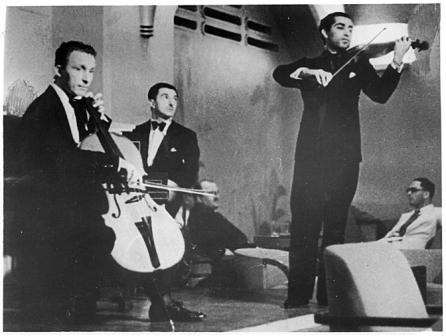
A Czech national, Walter was born in 1907 in Karlsbad, today known as Karlovy Vary. His father, Julius Kaufmann, was Jewish while his mother had converted to Judaism. Julius died near the Czech border after they fled Karlsbad under the Nazis.
In 1934, after Hitler’s invasion of Prague, 27-year-old Walter Kaufmann arrived in Mumbai. A refugee, Walter perhaps did not intend to stay on in India for as long as he did. He was in India’s city of dreams for fourteen years.
One may wonder why he landed in Mumbai of all places in the world. In one of the letters that were later published, he even says, “I could easily get a visa.”
However, having come to India, his initial years were not easy. As a trained musician, he was hoping to find takers for his talent, but his initial tryst with Indian music was not pleasant. He found it beyond comprehension.
Undeterred, he founded the Bombay Chamber Music Society within months of his arrival, which performed every Thursday at the Willingdon Gymkhana. Walter’s correspondence with his family back home confirmed that he stayed at Rewa House, a two-storied bungalow off Warden Road (now Bhulabhai Desai Road) towards Mahalaxmi temple.
According to Scroll, in the same letter, Walter is disarmingly honest in describing his initial reactions to Indian music. The first records he heard were “alien and incomprehensible.”
But he wasn’t willing to give up.
“As I knew that this music was created by people with heart and intellect, one could assume that many, in fact, millions would be appreciating or in fact loving this music…I concluded that the fault was all mine and the right way would be to undertake a study tour to the place of its origin,” he wrote
From 1936 to 1946, Walter worked at AIR as the director of music, and it was here that he composed the iconic signature tune with noted Indian orchestra conductor Mehli Mehta, who played the violin for it.
It is amazing that the tune that generations of Indians grew listening to was created by a European – proving that music knows no boundaries, and is truly a universal language.
Walter moved to Mumbai at a time when there was a shift from silent movies. His adept mastery over western music helped him in the Indian film industry as well. He composed the background score for several films by Mohan Bhavnani (a friend he had met in Berlin).
Albert Einstein, in a letter dated 23 January 1938, wrote a recommendation letter for Walter Kaufmann.
In that letter in German, he wrote, “Mr Walter Kaufmann of Prague, currently in Bombay (India), has been known to me for years as an inventive and gifted musician. He has already written many compositions, he is an authority on Eastern music, and he has had extensive experience as a teacher as well. With his youthful energy and likeable nature, he would be eminently suited for the position of director of choirs and orchestras in schools or universities.”
In 1946, Walter left India and went on to spend a year in England, where he was a guest conductor at the BBC. From 1948 to 1957, he was the Musical Director and Conductor of the Winnipeg Symphony Orchestra, Winnipeg, Manitoba, Canada.
He joined the School of Music at Indiana University in Bloomington as Professor of Music in the Department of Musicology, where he taught till 1977. He died there in 1984.
While it has been over three decades to Walter Kaufmann’s demise, he has been immortalised through his signature tune that millions of Indians continue to wake up to.
(Edited by Shruti Singhal)
Source…..Vidya Raja in http://www.the betterindia.com
Natarajan

