Battle of Jumbo Jets…..who is the winner?!!!!

BATTLE OF THE JUMBO JETS: Airbus A380 Vs. Boeing 747_81


airbus a380 vs. boeing 747-8i

Boeing / Airbus

In recent years, Airbus has put itself at the top of the aircraft-building world with the A380, the whale of a plane that is the largest passenger jet in the world. 

Last year, Boeing has introduced the 747-8 International, the revamped version of the class 747 it calls the “Queen of the Skies.”

But which is better? To come up the answer, we broke down the numbers in 11 categories, picking the winner based on size, power, capacity, luxury, availability, and more.

The Boeing 747-8I is new and the A380 has been in service for several years, which accounts for some of the differences. But for travelers trying to decide how they want to fly now, here are the facts as they stand today.

CAPACITY: Boeing’s 747-8I has a maximum capacity of 467 passengers.

CAPACITY: The A380 usually holds around 500 passengers, but has room for as many as 853.

CAPACITY: The A380 usually holds around 500 passengers, but has room for as many as 853.

© Airbus S.A.S 2012

CAPACITY: Airbus wins this round.

CAPACITY: Airbus wins this round.

© Airbus S.A.S 2012

Boeing: 0

Airbus: 1

WING SPAN: The Boeing’s wing span is 224.6 feet.

WING SPAN: The Boeing's wing span is 224.6 feet.

Cathay Pacific

WING SPAN: The A380 spreads out over 261.7 feet.

WING SPAN: The A380 spreads out over 261.7 feet.

© Airbus S.A.S 2012

WING SPAN: Airbus wins again.

WING SPAN: Airbus wins again.

© Airbus S.A.S 2012

Boeing: 0

Airbus: 2

LENGTH: The 747-8I is more than 250 feet long.

LENGTH: The 747-8I is more than 250 feet long.

Cathay Pacific

LENGTH: The A380 measures 238 feet.

LENGTH: The A380 measures 238 feet.

© Airbus S.A.S 2012

LENGTH: Boeing gets on the board.

LENGTH: Boeing gets on the board.

Cathay Pacific

In fact, the 747-8I is the world’s longest passenger aircraft.

Boeing: 1

Airbus: 2

WEIGHT AND POWER: The 747-8I can take off with a weight of 987,000 pounds, and produces 66,500 pounds of thrust.

WEIGHT AND POWER: The A380’s maximum takeoff weight is 1,235,000 pounds, and it produces up to 70,000 pounds of thrust.

WEIGHT AND POWER: The A380's maximum takeoff weight is 1,235,000 pounds, and it produces up to 70,000 pounds of thrust.

© Airbus S.A.S 2012

WEIGHT AND POWER: Point to Boeing.

That gives the 747-8I more power per pound, and the win.

Boeing: 2

Airbus: 2

RANGE: Boeing’s jet can go 11,443 miles in the air.

RANGE: The A380 can only do 9,756 miles.

RANGE: The A380 can only do 9,756 miles.

© Airbus S.A.S 2012

RANGE: Boeing wins.

The difference means the 747-8I can fly New York to Sydney without stopping, but the A380 cannot.

Boeing: 3

Airbus: 2

AVAILABILITY: So far, Lufthansa, Cathay Pacific, Korea Air, and a few other airlines have placed orders with Boeing.

AVAILABILITY: So far, Lufthansa, Cathay Pacific, Korea Air, and a few other airlines have placed orders with Boeing.

Boeing

AVAILABILITY: The A380 has been around longer, and is flown by Air France, Emirates, Quantas, Lufthansa, British Airways, Korea Air, Virgin Atlantic, and more.

AVAILABILITY: The A380 has been around longer, and is flown by Air France, Emirates, Quantas, Lufthansa, British Airways, Korea Air, Virgin Atlantic, and more.

© Airbus S.A.S 2012

AVAILABILITY: Airbus ties it up.

AVAILABILITY: Airbus ties it up.

© Airbus S.A.S 2012

Because the A380 has been around longer, it’s easier to get on board.

Boeing: 3

Airbus: 3

NICKNAME: Boeing’s new plane is also known as the “Queen of the Skies.”

NICKNAME: Airbus’ monster has been dubbed the “Superjumbo.”

NICKNAME: Airbus' monster has been dubbed the "Superjumbo."

© Airbus S.A.S 2012

NICKNAME: No contest, Boeing wins.

“Queen of the Skies” may sound a bit too fancy, but anything would beat “Superjumbo.”

Boeing: 4

Airbus: 3

TROUBLE: The National Transportation Safety Board recently recommended inspections of 747-8Is equipped with General Electric engines, after a string of failures.

TROUBLE: Wing cracks in many A380s discovered this summer, though not immediately dangerous, took weeks to repair.

TROUBLE: Wing cracks in many A380s discovered this summer, though not immediately dangerous, took weeks to repair.

© Airbus S.A.S 2012

Source: Bloomberg

TROUBLE: Boeing has the shorter, but better, record.

In November 2010, an A380 engine failed in flight and damaged a wing. The plane landed safely and no one was hurt, but Boeing gets the point.

Boeing: 5

Airbus: 3

1st CLASS LUXURY: First class on a Lufthansa 747-8I includes a personal locker and an especially wide seat that goes fully flat for comfortable sleeping.

1st CLASS LUXURY: Emirate’s A380’s first class includes two lounges, private suites, and a shower spa.

1st CLASS LUXURY: Emirate's A380's first class includes two lounges, private suites, and a shower spa.

Emirates

1st CLASS LUXURY: An easy point for Airbus.

1st CLASS LUXURY: An easy point for Airbus.

Emirates

For travelers looking for top of the line luxury, there are better choices offered by airlines flying the A380.

Boeing: 5

Airbus: 4

COST: Boeing sells the “Queen of the Skies” for $351.4 million.

COST: Boeing sells the "Queen of the Skies" for $351.4 million.

Boeing

COST: A new Airbus is more expensive, at $389.9 million.

COST: A new Airbus is more expensive, at $389.9 million.

© Airbus S.A.S 2012

COST: Airbus is the better deal.

COST: Airbus is the better deal.

© Airbus S.A.S 2012

When the price is divided by the number of passengers each plane can carry.

Boeing: 5

Airbus: 5

GAME CHANGING POTENTIAL: Boeing’s latest represents a new day for the 747, long one of the best ways to fly a lot of people a long way.

GAME CHANGING POTENTIAL: But Airbus broke the mold with the A380.

GAME CHANGING POTENTIAL: But Airbus broke the mold with the A380.

© Airbus S.A.S 2012

GAME CHANGING POTENTIAL: Airbus pulls ahead.

GAME CHANGING POTENTIAL: Airbus pulls ahead.

© Airbus S.A.S 2012

The A380 is the world’s largest passenger jet, and dwarfs the competition.

Boeing: 5

Airbus: 6

And the winner is…

And the winner is...

© Airbus S.A.S 2012

Boeing’s jet has a lot going for it, especially the fact that it is the newer aircraft.

But for those looking to get in the air today, the Airbus A380 is bigger, more luxurious, and more available.

Airbus takes the prize.

source:::::::::businessinsider.com…..natarajan

Read more: http://www.businessinsider.com/airbus-a380-v-boeing-747-8i-breakdown-2012-9?op=1#ixzz27B4hPJvg

Concorde is Out…But Supersonic Jet may Take Off !!!!!!

source:::: bbc .com….travel

Natarajan

On a gusty March day in 1969, the future of air travel was revealed.

A spontaneous burst of applause could just be heard over the deafening roar of the plane’s four giant engines as they sped the sleek aircraft into the sky. Twenty seven minutes later the screech of wheels and a whoosh of a parachute, signaled the end of the maiden voyage of Concorde, one of only two supersonic passenger planes to ever fly.

When the slender, beak-nosed aircraft entered service seven years later they whisked champagne-sipping passengers across the Atlantic in just three and a half hours. The twenty craft went on to fly routes for another 27 years to South America, Malaysia and beyond, proving a hi-tech vision of glamorous, fast-living. But it all came to an end in 2003, when the fleet was retired over concerns about high operation costs, limited demand for the expensive tickets and the jets’ safety, following a deadly crash three years earlier.

But supersonic, commercial air travel still holds an allure for passengers, pilots and engineers alike. And now, with the help of modern materials and advanced computer simulations, aerospace researchers hope they will be able to overcome some of the issues that Concorde faced, providing a blueprint for the next generation of supersonic planes.

Big bang theory

Two of the main problems facing any supersonic aircraft are increased drag, meaning increased fuel consumption, and that famous “sonic boom”, a loud gunshot-like noise that disturbed anyone unfortunate to be under the flight path.

The blast, which occurs when the plane breaks the sound barrier, is why Concorde was limited to routes over the ocean. You could travel from London or Paris to New York at high speeds, but there was no onward connection to Los Angeles. And several other countries were forced to ban the plane from its airports or even airspace, for the disturbance it caused.

“Although the aircraft is moving faster than the speed of sound, it generates pressure waves that only move AT the speed of sound” explains Professor Karthik Duraisamy, from Stanford University, an expert in modeling this type fluid flow.

“The pressure waves start bunching up together, and create a so-called shockwave. If you’re standing on the ground and the plane flies above you, the wave passes over you. That’s the sonic boom.”

Big names in the aviation industry are trying to find solutions, including Boeing, Lockheed Martin, and Nasa. The space agency recently conducted wind tunnel tests of designs from both manufacturers that showed the showed the boom could be reduced to levels that are generally thought to be acceptable for routine overland flights. But an engineer at MIT, believes that a radical idea from the 1950s may hold the key to ‘boomless’, fuel-efficient craft.

Professor Qiqi Wang is part of a team that has shown that a bi-plane – essentially two, stacked wings – could bring huge improvements over the traditional delta-wing seen on Concorde. The idea was first proposed by German engineer Adolf Busemann, an influential aerospace designer who among other things first proposed the use of ceramic tiles to protect the Space Shuttle on reentry. According to theory, the Busemann bi-plane, when travelling at supersonic speeds, should produce less drag meaning it should use less fuel. Plus, the triangular wings can be “tuned” so that sonic boom is almost entirely eliminated.

“When we have two wings, if we place them in a carefully designed manner, the shockwaves from the two wings can cancel each other” says Prof.Wang.

However, the design has a major limitation for a plane – it lacks lift. The two wings create a narrow channel that limits the amount of air that can flow between them. When the plane accelerates through the sound barrier it becomes “choked” with air, causing an incredible amount of drag – much larger than a traditional Concorde-like design. This effectively means that a supersonic bi-plane works beautifully on paper, it could never reach supersonic speeds in the first place. Not only that, but the sonic-boom cancellation only works at a specific speed. If you are not at that exact speed, you don’t get the desired effect.

Shape shifters

To address these problems Wang turned to computer modeling to come up with an optimum wing shape for different speeds. The researchers then crunched through the 700 different shapes to produce an optimal configuration that would work at all speeds. Amongst the design tweaks they came up with were a smoothed inner surface for each wing to help air flow. The overall result is a wing that could fly at supersonic speeds, with half the drag of Concorde; something that could significantly cut fuel use.

Whilst it sounds like Wang and his team have cracked the problem, there is still a long way to go. So far, Wang has only shown the bi-wing concept working in two dimensions. Scaling this up to a three-dimensional prototype is more of a challenge. And expanding wing design to plane design, and getting everything to work together will be harder still.

“We are experts in designing components, and we are experts in designing something for a specific condition” says Duraisamy, who was not involved in the MIT work. In a supersonic aircraft though, nothing is constant. The conditions at take-off and landing are very different to the conditions at cruising speed. The plane encounters a whole range of possibilities, from different temperatures to different air densities.

“When you think about a supersonic aircraft it has to take-off at zero velocity, and has to reach a supersonic velocity and keep flying there,” says Duraisamy. “It also operates at zero altitude to extremely high altitude.”

But a Japanese group at Tohoku University may hold the key. The group has also been working on a Busemann bi-plane called Misora (Mitigated Sonic Boom Research Airplane and the Japanese for “beautiful sky”). However, unlike the MIT project that aims to design one wing for all uses, the Japanese project has proposed movable control surfaces so that the wings could change shape at different speeds. And if that sounds far-fetched, consider Concorde’s “drooping nose” that could be raised and lowered at different stages of flight. Of course to shape and sculpt a wing will take much more sophisticated technology and materials, but these shape-shifters could hold the key to next-generation supersonic air travel.

“I think that’s very likely” says Wang.

However if you are holding off booking that dream transatlantic trip in the hope of the shorter flight time in the near future, you may have a long wait. Duraisamy believes it will be “15 to 20 years” before anything like Concorde is seen in the skies again. And even then, it probably won’t get around all of the problems Concorde encountered.

“Maybe a supersonic business jet will come first,” he says, “because people are willing to pay the money.”

Stowaway Pet Cat Survives 10 hour Flight !!!!!!!

A U.S. woman says the pet cat that sneaked into her luggage for a flight to Florida has returned home safely and seems unaffected by his surprise vacation.

Ethel Maze tells The Circleville Herald newspaper that Bob-Bob the cat spent 10 hours in a suitcase before she opened it last week. She says the cat was lethargic and wet from perspiration, and at first she thought he’d died.

Eventually the cat perked up, and he spent the week in a crate at Maze’s hotel. He rode in a carrier near Maze’s seat for the return flight.

The man who handled the bags for Maze’s group at Port Columbus International Airport in Ohio told reporters he thought he saw the bag move but loaded it anyway.

source:::::BIGPOND TIMES , Brisbane

Natarajan

Lost in Aircrash… Found after 46 Years!!!!!

Copies of The Hindu found in diplomatic bag that went down with AI aircraft 46 years ago

LATE MAIL: A mail bag recovered from the Air India Flight 101 that crashed into Mont Blanc in France on the morning of January 24, 1966, displayed at the Ministry of External Affairs in New Delhi on Tuesday. Photo: Sandeep Saxena
The HinduLATE MAIL: A mail bag recovered from the Air India Flight 101 that crashed into Mont Blanc in France on the morning of January 24, 1966, displayed at the Ministry of External Affairs in New Delhi on Tuesday. Photo: Sandeep Saxena

A bag of Indian diplomatic mail, which went down with an Air India (AI) aircraft 46 years ago in the French Alps, was on Tuesday put on display in the Ministry of External Affairs.

A tough khaki sack with Ministry of External Affairs stencilled in fading black, it yielded not diplomatic papers but Air India calendars and newspapers, including copies of The Hindu, then priced at just 13 paise. Dated January 21, 1966, The Hindu’s slightly shrivelled front page indicated that the previous day had been newsy — Indira Gandhi, the Prime Minister designate, had said a new Cabinet would be sworn in on January 25 but declined to answer questions on the probable candidates.

The bag was in the cargo hold of an Air India flight, named Kanchenjunga, which crashed on Mont Blanc in the Swiss Alps while descending for a stopover at Geneva killing all the 117 aboard, including noted nuclear physicist and father of the Indian nuclear programme Homi Jahangir Bhabha and upcoming trade union leader Satish Loomba. Eerily another Air India plane, the Malabar Princess, had crashed on the same south-west face of Mont Blanc in 1950.

There has been virtually no trace of the Malabar Princess. But in the case of Kanchenjunga, there was a shoe, cables and a jute bag stamped ‘Diplomatic Mail’ and ‘Ministry of External Affairs’ “sitting as if someone had just placed it there,’’ said mountain rescue worker Arnaud Christmann and his neighbour Jules Berger who chanced upon the debris on August 21.

Glaciers and mountain faces pose forbidding challenges for human beings seeking to explore them. Nature in the form of snow drifts tends to cover the tracks only too well. If this bag took 46 years to recover, closer home it took 35 years before a salvage team reached the remains of sepoy Bali Ram who, along with his comrades at Garhwal Rifles, died when a Leh-bound Indian Air Force troop lifter crashed on the South Dhaka Glacier near Manali, Himachal Pradesh in 1968.

7 Innovations in Air Travel….

SOURCE:::::BBC TRAVEL SITE…  writeup by Sean O ‘Neill….

Natarajan


Between 5 and 7 September hundreds of representatives from airlines and airports around the world will visit Vancouver for the 2012 Future Travel Experience, an annual conference that showcases the latest technologies for making air travel easier.

Getting ahead of the event, I checked in with major airports and airlines to find out about some of the previously presented travel tech innovations that they’ve been testing this year.

Do-it-yourself boarding at gates
On 27 June, Las Vegas’ McCarran Airport opened a third terminal for domestic and international flights. At all 14 of the terminal’s gates – whereJetBlue is the primary airline — there are self-boarding stations where passengers scan their boarding passes to open the automated clearance gates and board planes on their own.

Other airlines are eyeing the same technology as a replacement for gates overseen by personnel. Last year, Lufthansa installed similar gates at its three hubs in Frankfurt, Dusseldorf and Munich.

Never lose another piece of luggage
McCarran’s third terminal has also put in place a high-tech baggage-handling system, where airport workers attach a tag embedded with a radio-frequency identification (RFID) chip to each checked bag. The RFID chip broadcasts a unique signal, similar to a radio transmitter.

The RFID tags can be scanned more easily and quickly than tags with bar codes, helping crews correctly route bags and find misplaced ones. The airport has installed 55 sensors at the airport to track a bag at every stop, from conveyor belt to carousel. It is the first US airport to embrace the technology, though some non-US airports, such as in Lisbon and Milan, and airlines like Qantas, have experimented with RFID tags.

Instant upgrades while queueing for your flight
This autumn, budget carrier Easyjet will be testing “Halo” devices — tablet computers that are connected wirelessly to the airline’s reservations system and enable the airline crew to walk among passengers in the terminal and process simple transactions without being confined to their podium’s desktop computers. These transactions could include upgrades, such as priority boarding or more legroom, and the airline is testing the technology at airports in Amsterdam, Barcelona, Basel, Edinburgh and Geneva.

Tag your own bag
This summer Alaska Airlines became the first US airline to install machines that allow passengers to tag their own bags. After a successful trial at Redmond Airport, in Oregon, the machines were put into use at the airline’s hub, SeattleTacoma International, in Washington.

While the machines are standard practice outside of the US, automated baggage checking is a new process for Americans. Passengers use an airport kiosk to print out a bag tag, put the tag on the luggage and then hand the bag to an agent to put on the conveyor belt. While technically giving the traveller more work, the automated procedure gives frequent fliers a chance to avoid becoming mired in queues behind inexperienced travellers while checking luggage.

Alaska Airlines plans to add the machines this year to airports in Fort Lauderdale, Florida; Philadelphia, Pennsylvania; Monterey and San Diego, California. Other airlines are also investigating the technology. American Airlines is debuting the self-tagging kiosks slowly over the next two years, with airport devices already operational in Austin, Texas, and being added to New York City, Chicago and Los Angeles.

Facial scans
Londons Heathrow Airport needed a security solution for its joint departure area, where passengers leaving on domestic and international flights both wait before being summoned to their gates. The airport worried that an international passenger might swap boarding passes with someone in the lounge and sneak onto a domestic flight, therefore evading an immigration check.

So starting in September, passengers at Heathrow’s terminals one and five (which cover many, but not all, international flights), will have his or her face scanned for identification upon entering and leaving the departure area.

For example, to go to a gate to catch a flight, passengers will step up to an automatic gate and wave their barcoded boarding pass over a scanner. Then, an infrared light will flash across each flier’s face, taking about five seconds on average to identify a person — even a twitchy one — from up to 3ft away.

The machine will match the images of the passenger’s face with the images in the database, recorded when the passenger passed through an earlier set of automated gates to enter the departure area. If the identity match is successful, the automated doors will open

But facial scanning can also be used to achieve other efficiencies. If successful, airports may use facial scanners to supplement other methods of verifying a passenger’s identity, such as to detect who has permission to enter a first class lounge.

Next-generation iris scans for identification
Meanwhile, London’s Gatwick Airport has been experimenting with iris scanning to solve the same problem. Its south terminal’s departure area is also a joint lounge where domestic and international passengers mix, so it has outfitted the entrances and exits to the lounge with 34 AOptix InSight VM iris recognition devices, which can record the unique patterns formed on the irises in a passenger’s eyes, which the airport stores temporarily as a form of identification. Similar to what Heathrow does with face scans, passengers must be scanned to go in and come out of the departure lounge.

Old iris scanners required passengers to stand still to work, which often caused delays and errors. AOptix claims its next-generation machines at Gatwick are much faster and can quickly scan a person at a distance, even a restless person standing up to 6ft away. It takes around eight seconds to record the pattern for both eyes on a passenger’s first scan and about two seconds in subsequent scans to recognise them later.

Turn your mobile phone into a boarding pass
About 15% of Android phones, or about one million new ones sold every day on average, now contain near-field communication (NFC) chips, which can emit a short-range signal that transmits data even when a device is off.  These chips turn a phone into a payment tool, similar to the cards that subway commuters use to open turnstiles in Hong Kong and London, and these chips also allow phones to be used as a replacement for a barcode-based boarding pass.

The iPhone does not yet have an NFC-enabled chip, though the next edition, being unveiled this autumn, might.

This summer Japan Airlines began installing NFC equipment at its major hubs in Tokyo, Osaka, Nagoya, and Okinawa, becoming the first airline globally to enable smart phones with NFC chips to act as boarding passes for passengers flying domestically, relieving travellers of the need to fumble with an airline app or the relevant email to find the barcode currently used on mobile boarding passes. Of course, if your gate, airport or airline hasn’t yet installed NFC sensors, you’ll still need to rely on the old barcode boarding pass system.

The technology is being closely considered by other airlines, which are eager to use NFC chips to store frequent flier account numbers, which could enable the device holders to access private lounges.

Most prominently, SAS Airlines has, since March, been inviting the 50,000 members of its EuroBonus frequent flier program to use NFC-enabled readers at its gates at airports in Scandinavia for flights within the region. Frequent fliers whose phones are not yet NFC-enabled can instead receive stickers that contain the NFC chips to attach to their phones for the same benefit.

Other airports testing NFC technology include France’s Toulouse-Blagnac airport and several Australian airport gates run by Qantas. Forty of the 50 largest airlines say they will experiment with NFC technology in the next two years, according to a January 2012 survey by SITA, or Societe Internationale de Telecommunications Aeronautiques.

Sean ONeill is the travel tech columnist for BBC Travel. 

Airplanes………Vision 2050….

SOURCE:::::BBC  News site……
Natarajan

In the future, airplanes might flock like birds

Future aircraft might flock on express skyways

Future aircraft might flock on express skyways
Toulouse-based aircraft company Airbus sees airplanes of the future flocking along express skyways to cut time and emissions.

On September 6, 2012, the Toulouse-based company Airbus – one of the world’s leading aircraft manufacturers – released its vision for what flying will be like in 2050. Airbus says it encourages its engineers to “think widely and come up with `disruptive’ ideas which will assist our industry in meeting … 2050 targets.” Read about five innovative ideas from Airbus, below.

The future of flying? This is Airbus’ Concept Plane and Cabin, part of its vision for 2050. Image via Airbus.

Airbus says the technology already exists to fly shorter and more precise routes. The five concepts will get passengers from A to B quicker, it says, while helping the industry meet its target to halve CO2 emissions by 2050. Airbus’ Smarter Skies concepts are:

1. Aircraft launched into continuous ‘eco-climb’ — Assisted take-off using renewably powered, propelled acceleration, would see aircraft climb rapidly to their most efficient cruising altitude, reducing emissions and noise. As mega-cities become a reality and space becomes a premium, runways could be shortened to minimise land use.

Airbus concept of the eco-climb, an assisted take-off using renewably powered, propelled acceleration. Airbus says this concept would include aircraft climbing steeply and rapidly to their most efficient cruising altitude, reducing emissions and noise. Click here to expand image. Image via Airbus.

2. Aircraft in ‘free flight’ and formation along ‘express skyways’ — Intelligent aircraft would be able to self-organise and select the most efficient routes (‘free flight’), making the optimum use of prevailing weather and atmospheric conditions. Planes could rendezvous in mid-air and flock like birds in formation to reduce drag and thus fuel consumption and emissions

Airbus concept of planes of the future, flocking along express skyways. Image via Airbus.

3. ‘Low-noise’ glided approaches and landings — In descent, aircraft could glide smoothly into airports with engines running in idle, significantly reducing emissions and noise. Slower landing speeds would make shorter runways a viable possibility at both ends of the journey

4. Low emission ground operations — Landing positions could be optimised with enough accuracy for autonomous, renewably powered taxiing carriages to be ready, clearing runways quicker and optimising terminal space to remove runway and gate limitations. Engines could be switched off sooner, further reducing on-the-ground handling emissions

5. Powering future aircraft and infrastructure — The use of sustainable biofuels and other potential alternative energy sources such as electricity, hydrogen and solar, will secure supply and further reduce aviation’s environmental footprint. This will allow the extensive introduction of regionally sourced renewable energy close to airports, feeding both aircraft and infrastructure requirements.

CHANGI Airport Singapore……..NOW…

SOURCE:::::: INPUT FROM ONE OF MY FRIENDS….
Natarajan
Singapore

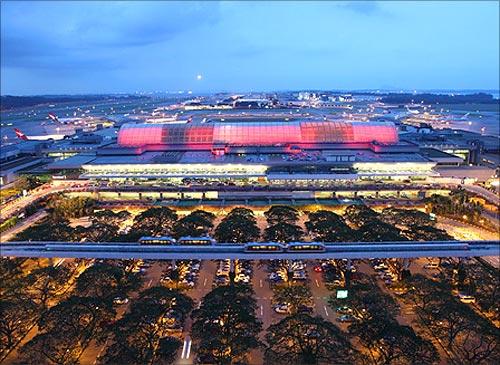
Changi Airport’s Terminal 1 gets a stunning makeover now.

Rooftop lantern.

One of the world’s most awarded airports is Singapore’s Changi Airport. There are 360 retail stores and 130 F&B outlets across the airport’s four terminals.  Changi handled more than 46 million passenger movements in 2011.Changi Airport’s Terminal 1 (T1) has received a S$500 million makeover. The work, which started in May 2008 was completed in July.The terminal’s interior design and decor has been revamped to offer more convenience for passengers at the departure check-in hall, departure transit mall and arrival hall. About 22,000 sq m have also been added to the building, bringing the total floor space of T1 to about 308,000 sqm.

The larger floor area provides for more spatial comfort, better passenger flow, additional facilities and expanded retail and food and beverage offerings.

Developed on the thematic concept of a ‘Tropical City’, the upgraded T1 reflects Singapore’s reputation as a garden city.
Photographs, courtesy: Changi Airport Group
Image: Rooftop lantern.

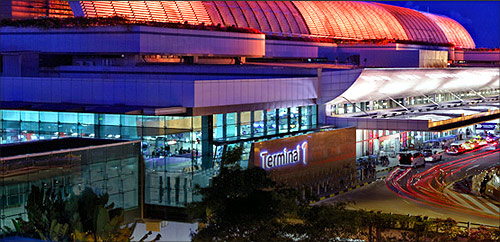
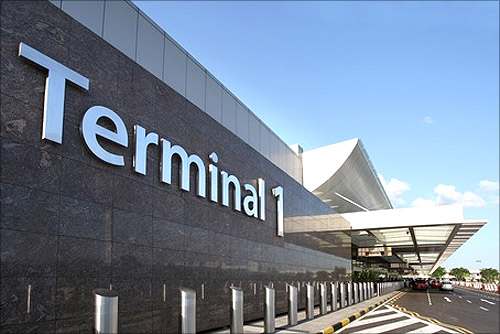
Terminal 1.

T1 was Changi Airport’s sole terminal when it opened in 1981.
Image: Terminal 1.

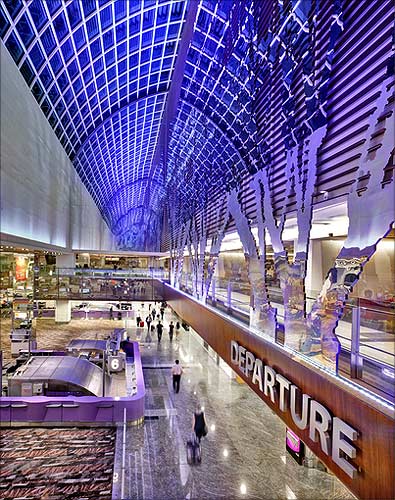
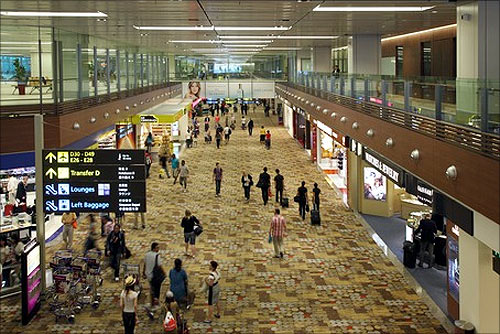
Terminal 1, departure hal.

The gate holdrooms and main thoroughfare at the finger piers have also been enlarged and widened to provide more space for waiting and passenger flow respectively.The thoroughfare has been widened by 2 metres on each side and the width of each gate holdroom by 3 to 5 metres.
Image: Terminal 1, departure hal.
Tags: Changi Airport

Changi Airport's Terminal 1 gets a stunning makeover

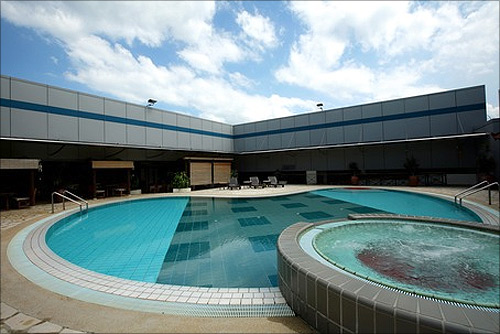
The refurbished departure transit mall is adorned with the ‘Tropical City’ theme. The airport has a roof-top swimming pool.
Tags: Changi Airport

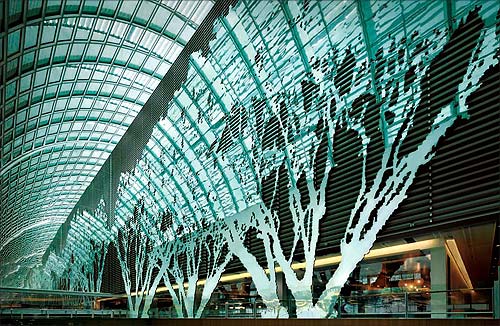
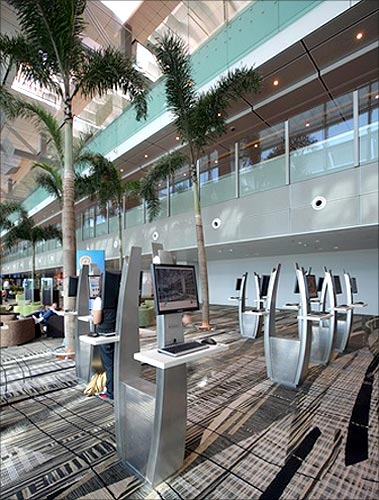
Sculptural trees in steel.

Reflective stainless steel sculptural trees make check-in a memorable experience. 
Image: Sculptural trees in steel.
Tags: Changi Airport

Changi Airport's Terminal 1 gets a stunning makeover

The Terminal 1 departure transit mall.
Tags: Changi Airport

Changi Airport's Terminal 1 gets a stunning makeover

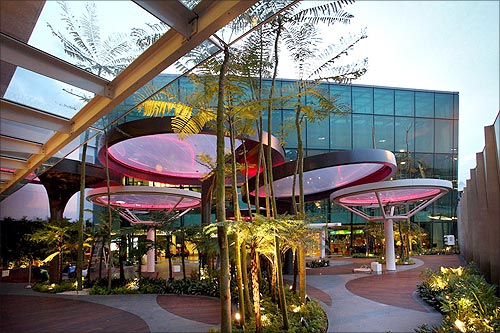
An oasis of calm at two new tropic-inspired gardens – Lily Pads at the West Outdoor Decks and Sculptural Trees at the East Outdoor Deck. 

Changi Airport's Terminal 1 gets a stunning makeover

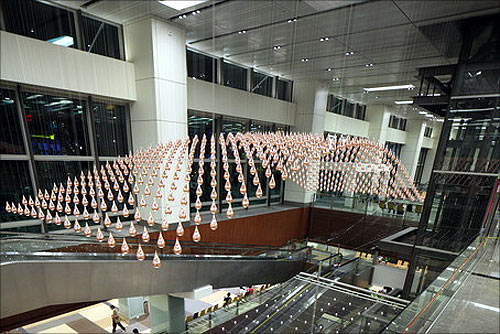
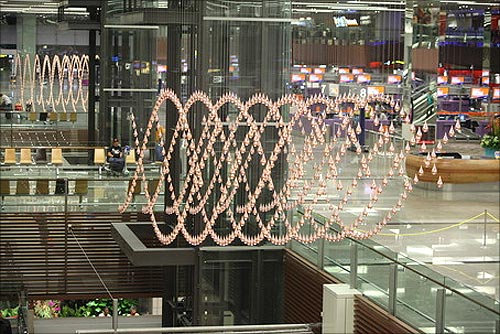
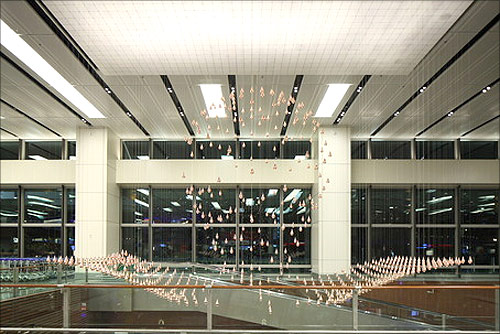
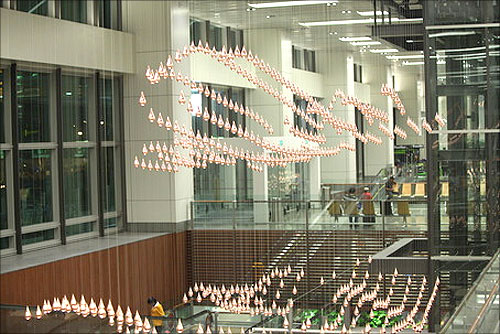
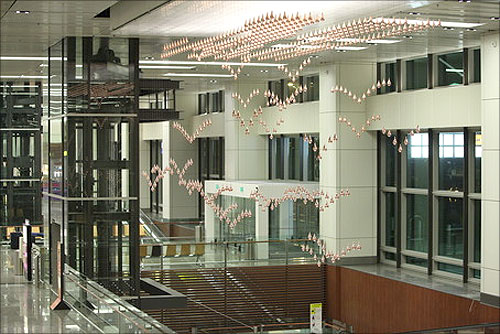
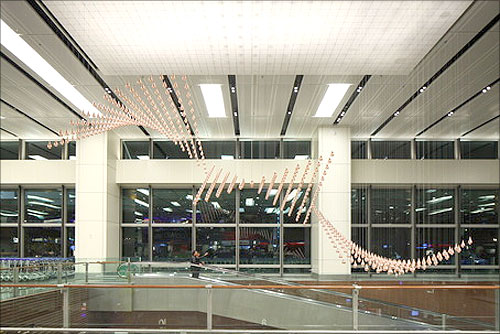
This unique design shows thousand copper raindrops dance through the air with precisely choreographed movements in the Departure Check-in Hall.
Tags: Changi Airport

Changi Airport's Terminal 1 gets a stunning makeover

A 204 metre long canopy was installed at the Departure Check-in Hall kerbside to provide more shelter.
Tags: Changi Airport

Changi Airport's Terminal 1 gets a stunning makeover

Kinetic rain
Kinetic Rain is made up of 1,216 bronze droplets that transform into multiple shapes. Carrying an aviation theme, the key element in every shape shows the movement of flight through slow, fluid movements.

Changi Airport's Terminal 1 gets a stunning makeover

 Kinetic Rain – Turbulence
This impression of turbulence is one of the formations in the sequence.  

Changi Airport's Terminal 1 gets a stunning makeover

Kinetic Rain – Hot Air Balloon
This hot air balloon is one of the formations in the sequence.  

Changi Airport's Terminal 1 gets a stunning makeover

Kinetic Rain – Aeroplane
This aeroplane shape is one of the formations in the sequence.  

Changi Airport's Terminal 1 gets a stunning makeover

Kinetic Rain – Flock of Birds
This pattern highlights a flock of birds.  

Changi Airport's Terminal 1 gets a stunning makeover

Kinetic Rain – Abstract pattern
This abstract pattern is one of the formations in the sequence. 
 

Changi Airport's Terminal 1 gets a stunning makeover

 see the impressive world monuments at the Changi airport…
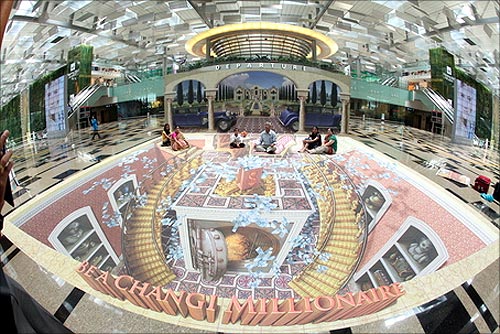
The Millionaire Life at Changi Airport
Passengers having fun having their ‘Millionaire’ photos taken at the art installation.

Changi Airport's Terminal 1 gets a stunning makeover

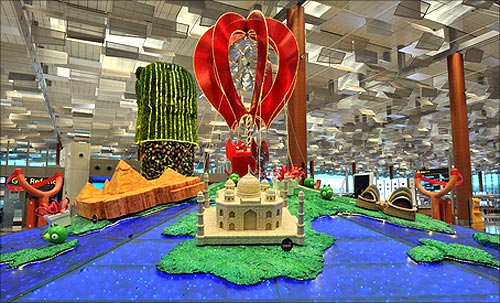
Miniature world landmarks
At the Merlion topiary site, an interesting display of quaint miniature iconic world landmarks complete viewers’ travel road map around the world. 

Changi Airport's Terminal 1 gets a stunning makeover

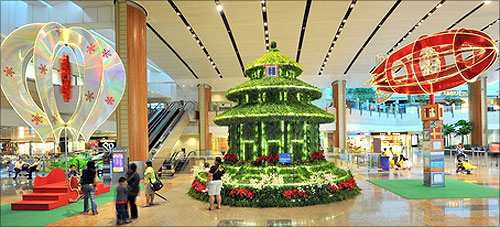
Temple of heaven
Temple of Heaven, the most holy of Beijing’s ancient imperial temples where emperors used to pray, has been brought to live in this gorgeous topiary structure.

Changi Airport's Terminal 1 gets a stunning makeover

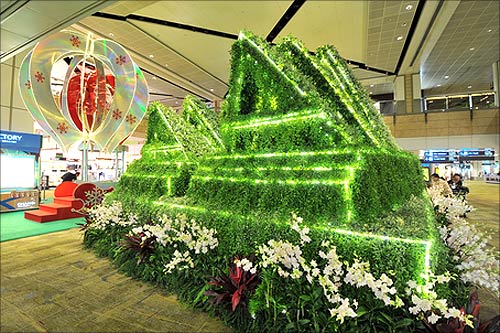
Sydney opera house topiary
Sydney Opera House at T2 Transit Lounge – The Sydney Opera House topiary, complete with the classic sculptural roof shells, is a charming reproduction of the greatest architectural masterpiece Down Under. 

Changi Airport's Terminal 1 gets a stunning makeover

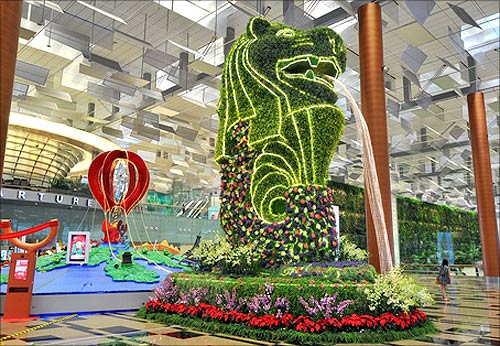
Merlion topiary
Merlion Topiary at T3 Departure Hall – Standing at 8 metres tall, the grand Merlion topiary beautifully decorated with colourful petals and lined with bright lights is a magnificent sight, befitting of its status as Singapore’s most iconic symbol. 

Changi Airport's Terminal 1 gets a stunning makeover

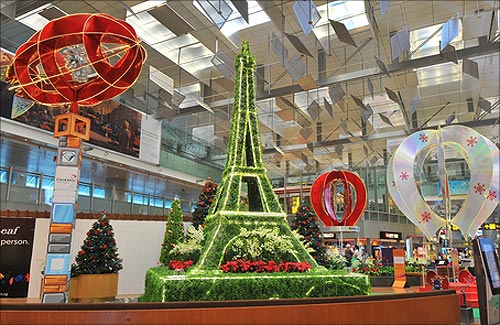
Eiffel tower topiary
Eiffel Tower Topiary at T3 Transit Lounge – Towering at 9 metres tall, the elegant Eiffel Tower topiary gives visitors a taste of the splendour of Paris’ real grand dame. 

Changi Airport's Terminal 1 gets a stunning makeover

Free internet area
Changi Airport offers seamless Internet access for those carrying laptops and iPads via free Ethernet LAN points. For those without laptops or iPads, they can enjoy free surfing at more than 550 Internet terminals located throughout the airport’s terminals.

Changi Airport's Terminal 1 gets a stunning makeover

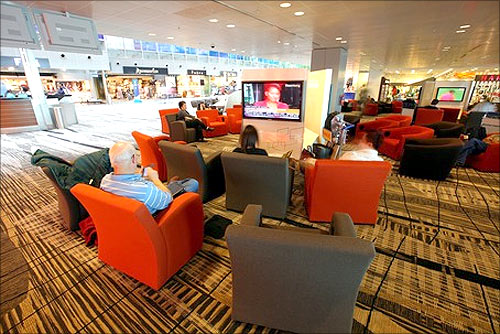
Travellers in Terminals 1, 2 & 3, Departure/ Transit Mall will be able to catch the latest happenings at the TV lounges.

Changi Airport's Terminal 1 gets a stunning makeover

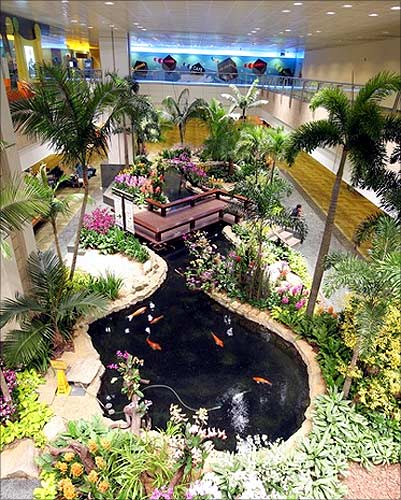
More than 15 species of orchids are displayed on different natural structures, including a number of them tied on natural driftwood overhanging the Koi Pond.Tags: Changi Airport , Koi Pond

Changi Airport's Terminal 1 gets a stunning makeover

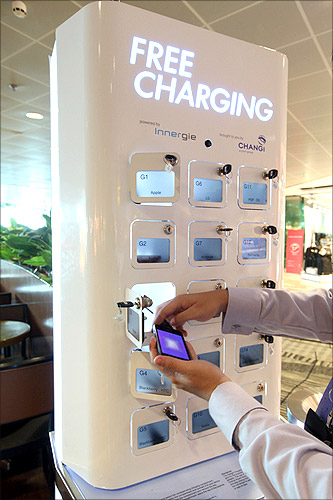
Free charging kiosks
With the mobile device charging stations, passengers can lock up their mobile devices while they charge and claim them later.

An Amazing Experience of the Passengers of Delta Flight 15 on September 11

SOURCE:::::INPUT FROM ONE OF MY CONTACTS….truly amazing experience …a different and pleasant one …under a difficult circumstance…..It is once again proving that there are Good and Godly people everywhere in this world….worth sharing this story from a flight attendant of Delta Flight 15…..

Natarajan

Here is an amazing story from a flight attendant on Delta Flight 15, written following 9-11:

“On the morning of Tuesday, September 11, we were about 5 hours out of Frankfurt, flying over the North Atlantic. All of a sudden the curtains parted and I was told to go to the cockpit, immediately, to see the captain.
As soon as I got there I noticed that the crew had that “All Business” look on the
ir faces. The captain handed me a printed message. It was from Delta’s main office in Atlanta and simply read, “All airways over the Continental United States are closed to commercial air traffic. Land ASAP at the nearest airport. Advise your destination.”

“No one said a word about what this could mean. We knew it was a serious situation and we needed to find terra firma quickly. The captain determined that the nearest airport was 400 miles behind us in Gander, New Foundland.
He requested approval for a route change from the Canadian traffic controller and approval was granted immediately–no questions asked. We found out later, of course, why there was no hesitation in approving our request.

“While the flight crew prepared the airplane for landing, another message
arrived from Atlanta telling us about some terrorist activity in the New York area. A few minutes later word came in about the hijackings.
“We decided to LIE to the passengers while we were still in the air. We told them the plane had a simple instrument problem and that we needed to land at the nearest airport in Gander, New Foundland to have it checked out.

“We promised to give more information after landing in Gander. There was much grumbling among the passengers, but that’s nothing new! Forty minutes later, we landed in Gander. Local time at Gander was 12:30 PM! …. that’s 11:00 AM EST.

“There were already about 20 other airplanes on the ground from all over the world that had taken this detour on their way to the U.S. After we parked on the ramp, the captain made the following announcement: “Ladies and gentlemen, you must be wondering if all these airplanes around us have the same instrument problem as we have. The reality is that we are here for another reason.” Then he went on to explain the little bit we knew about the situation in the U.S. There were loud gasps and stares of disbelief. The captain informed passengers that Ground control in Gander told us to stay put.

“The Canadian Government was in charge of our situation and no one was allowed to get off the aircraft. No one on the ground was allowed to come near any of the air crafts. Only airport police would come around periodically, look us over and go on to the next airplane. In the next hour or so more planes landed and Gander ended up with 53 airplanes from all over the world, 27 of which were U.S. commercial jets.

“Meanwhile, bits of news started to come in over the aircraft radio and for the first time we learned that airplanes were flown into the World Trade Center in New York and into the Pentagon in DC. People were trying to use their cell phones, but were unable to connect due to a different cell system in Canada. Some did get through, but were only able to get to the Canadian operator who would tell them that the lines to the U.S. were either blocked or jammed.

“Sometime in the evening the news filtered to us that the World Trade Center buildings had collapsed and that a fourth hijacking had resulted in a crash. By now the passengers were emotionally and physically exhausted, not to mention frightened, but everyone stayed amazingly calm. We had only to look out the window at the 52 other stranded aircraft to realize that we were not the only ones in this predicament.

“We had been told earlier that they would be allowing people off the planes one plane at a time. At 6 PM, Gander airport told us that our turn to deplane would be 11 am the next morning. Passengers were not happy, but they simply resigned themselves to this news without much noise and started to prepare themselves to spend the night on the airplane.

“Gander had promised us medical attention, if needed, water, and lavatory servicing. And they were true to their word. Fortunately we had no medical situations to worry about. We did have a young lady who was 33 weeks into her pregnancy. We took REALLY good care of her. The night passed without incident despite the uncomfortable sleeping arrangements.

“About 10:30 on the morning of the 12th a convoy of school buses showed up. We got off the plane and were taken to the terminal where we went through Immigration and Customs and then had to register with the Red Cross.

“After that we (the crew) were separated from the passengers and were taken in vans to a small hotel. We had no idea where our passengers were going. We learned from the Red Cross that the town of Gander has a population of 10,400 people and they had about 10,500 passengers to take care of from all the airplanes that were forced into Gander! We were told to just relax at
the hotel and we would be contacted when the U.S. airports opened again, but not to expect that call for a while.

“We found out the total scope of the terror back home only after getting to our hotel and turning on the TV, 24 hours after it all started.

“Meanwhile, we had lots of time on our hands and found that the people of Gander were extremely friendly. They started calling us the “plane people.”
We enjoyed their hospitality, explored the town of Gander and ended up having a pretty good time.
“Two days later, we got that call and were taken back to the Gander airport.
Back on the plane, we were reunited with the passengers and found out what they had been doing for the past two days. What we found out was incredible.

“Gander and all the surrounding communities (within about a 75 Kilometer radius) had closed all high schools, meeting halls, lodges, and any other large gathering places. They converted all these facilities to mass lodging areas for all the stranded travelers. Some had cots set up,
some had mats with sleeping bags and pillows set up.

“ALL the high school students were required to volunteer their time to take care of the “guests.” Our 218 passengers ended up in a town called Lewisporte, about 45 kilometers from Gander where they were put up in a high
school. If any women wanted to be in a women-only facility, that was arranged. Families were kept together. All the elderly passengers were taken to private homes.

“Remember that young pregnant lady? She was put up in a private home right across the street from a 24-hour Urgent Care facility. There was a dentist on call and both male and female nurses remained with the crowd for the duration.

“Phone calls and e-mails to the U.S. and around the world were available to everyone once a day. During the day, passengers were offered “Excursion” trips. Some people went on boat cruises of the lakes and harbors. Some went for hikes in the local forests. Local bakeries stayed open to make fresh bread for the guests. Food was prepared by all the residents and brought to the schools People were driven to restaurants of their choice and offered wonderful meals. Everyone was given tokens for local laundry mats to wash their clothes, since luggage was still on the aircraft. In other words, every single need was met for those stranded travelers.

“Passengers were crying while telling us these stories. Finally, when they were told that U.S. airports had reopened, they were delivered to the airport right on time and without a single passenger missing or late. The local Red Cross had all the information about the whereabouts of each and every passenger and knew which plane they needed to be on and when
all the planes were leaving. They coordinated everything beautifully. It was absolutely incredible.

“When passengers came on board, it was like they had been on a cruise. Everyone knew each other by name. They were swapping stories of their stay, impressing each other with who had the better time. Our flight back to Atlanta looked li ke a chartered party flight. The crew just stayed out of their way. It was mind-boggling. Passengers had totally bonded and were calling each other by their first names, exchanging phone numbers, addresses, and email addresses.

“And then a very unusual thing happened. One of our passengers approached me and asked
if he could make an announcement over the PA system. We never, ever allow that. But this time was different. I said “of course” and handed him the mike. He picked up the PA and reminded everyone about what they had just gone through in the last few days. He reminded them of the hospitality they
had received at the hands of total strangers. He continued by saying that he would like to do something in return for the good folks of Lewisporte.

“He said he was going to set up a Trust Fund under the name of DELTA 15 (our flight number). The purpose of the trust fund is to provide college scholarships for the high school students of Lewisporte. He asked for donations of any amount from his fellow travelers. When the paper with donations got back to us with the amounts, names, phone numbers and addresses, the total was for more than $14,000!

“The gentleman, a MD from Virginia, promised to match the donations and to start the
administrative work on the scholarship. He also said that he would forward this proposal to Delta Corporate and ask them to donate as well. As I write this account, the trust fund is at more than $1.5 million and has assisted
134 students in college education.

“I just wanted to share this story because we need good stories right now. It gives me a little bit of hope to know that some people in a far away place were kind to some strangers who literally dropped in on them. It reminds me how much good there is in the world.”

“In spite of all the rotten things we see going on in today’s world this story confirms that there are still a lot of good and Godly people in the world and when things get bad, they will come forward.

Interesting Information on Airlines and Airport….

Source::::Input from one of my contacts ….being shared with you all.

Natarajan

• All International Airline Pilots speaks English.

• Flights longer than 8 hours require 3 pilots (1 captain and 2 first officers) to rotate flying duties. Flights longer than 12 hours require 4 pilots (1 captain and 3 first officers). They usually fly 3-4 hour shifts. (There are different norms of Indian companies Pilots)

•Each airline pilot flying the aircraft, eats a different meal to minimize the risk of all pilots on board being ill.

•On average, pilots fly between 9 to 14 days a month (Indian companies pilot fly 24 to 26 days)

•All airlines have an agreement to let each others’ travelling pilots occupy empty seats. If no seats are available, the travelling pilot can also occupy an extra seat in the cockpit that is usually empty.

•The main function of flight attendants are for the safety and security of their passengers, and passenger comfort is only secondary.

•The first female flight attendants in 1930 were required to weigh less than 115 pounds. In addition, they had to be nurses and unmarried.

•Flight attendants must not have any tattoos visible when a uniform is worn. These requirements are designed to give the airlines a positive representation.

•The normal ratio of Flight Attendants to passenger seats is one Flight Attendant for every 50 passenger seats.

•The height requirement for Flight Attendant is for safety reasons, making sure that all flight attendants can reach overhead safety equipment.

•An air traveler can lose approximately 1.5 liters of water in the body during a three-hour flight.

•The reason why the lights are turned out during takeoff and landing – Is for your eyes to adjust to lower levels of light. If there’s an accident and they have to activate the emergency slides, studies have shown that you will be able to see better and therefore be able to evacuate more quickly and safely.

•The World’s largest Airline in terms of Fleet Size is Delta Airlines (United States) with 744 aircraft and 121 aircraft on order as of March 2011.

•The largest passenger plane is the Airbus 380 – nearly 240 feet long, almost 80 feet high, and has a wingspan of more than 260 feet. The double-decker plane has a standard seating capacity of 555 passengers.

•The world’s busiest airport in terms of passenger volume or the number of takeoffs and landings, is Hartsfield–Jackson Atlanta International Airport, Atlanta, Georgia, United States – with more than 88 million passengers shuffled through the Atlanta airport in 2009, with another 20 million in the first three months of 2010, and with aircraft take-off and landings approximately every 37 seconds.

•The world’s Largest Airport is Kansai International Airport, Osaka, Japan (as of 2011). By 2013 Al Maktoum International Airport in Jebel Ali, Dubai, United Arab Emirates is planned to be the largest airport in the world.

•The airport with the longest runway in the world is Qamdo Bangda Airport in the Peoples Republic of China with 5.50 kilometers in length (as of 2011).

•American Airlines saved $40,000 in 1987 by removing 1 olive from each salad served in first class.

•Singapore Airlines spends about $700 million on food every year and $16 million on wine alone. First class passengers consume 20,000 bottles of alcohol every month and Singapore Airlines is the second largest buyer of Dom Perignon champagne in the world.

•KLM of Netherlands stands for Koninklijke Luchtvaart Maatschappij (meaning Royal Dutch Airlines).

•KLM is the worlds’ oldest airline established in 1919.

•QANTAS – Australia’s national airline, originally stood for Queensland And Northern Territories Air Service.

•QANTAS is the second world’s oldest airline established in 1920.

•QANTAS still has the world’s best safety record with no crashes as of 2011.

•Abu Dhabi Airport Services once did a complete turn-around for a Boeing 777 in under 40 minutes, as opposed to a normal minimum of one hour. They unloaded passengers, cargo, mail, cleaned the aircraft, and loaded outbound passengers, cargo and mail in that short time.

•In 2001, Dubai Duty Free sold 1,570,214 cartons of cigarettes, 2,003,151 bottles of liquor, 2,909 kilograms of gold, 101,824 watches, 690,502 bottles of perfume, 52,119 mobile phones.

Story of A Sleeping Pax who Has Failed to Disembark …

SOURCE::::: “BRISBANE TIMES”….a funny and strange incident….but who was really sleeping !!!!—the pax or the airlines !!!

Natarajan.

Sleepy passenger goes on 18-hour round trip after missing stop

A Frenchwoman endured an 18-hour journey from the Pakistani city of Lahore to Paris and back again after sleeping through her plane’s stop in the French capital, officials said on Wednesday.

Pakistan International Airlines (PIA) are investigating how ground crew failed to notice the woman during the plane’s two-hour stopover at Charles de Gaulle Airport in Paris.

The woman, named as Patrice Christine Ahmed, who is married to a Pakistani, left Lahore at noon on Tuesday to fly to Paris via Milan, but did not wake up to get off the plane, airline spokesman Sultan Hasan said.

The woman did not mention her mistake to cabin crew and the matter only came to light when she was stopped by immigration officials on arrival back in Lahore on Wednesday morning – after a 12,000-kilometre round trip.

Hasan said PIA were investigating the incident and the French subcontractor responsible for passenger handling in Paris.

“We have put questions to this French firm also about the incident but it is also the responsibility of the passenger to disembark at the destination,” he said.

“It is a passenger’s responsibility to check about the destination and disembark when the plane arrives at the particular airport.”

PIA later arranged to send the woman back to Paris with another airline because none of its own flights were available, but said that the party responsible for the negligence will pay for the extra ticket.

“It depends who is at fault. If it is a mistake by the local firm, they will pay and if the woman herself is responsible than she will have to bear the cost,” Hasan said.