Message for the Day…” Once You seek refuge in the Lotus Feet of God , You should never give up .”

The power of divine name is unparalleled. Once you seek refuge in the lotus feet of God, you should never give up. Wherever you go, the divine feet will protect you. If you install the divine name firmly in your heart, your life will become sanctified. That is true devotion (bhakti). That is your power (shakti). That will bestow liberation (mukti). It is only to make people realise this truth that the spiritual practice of akhanda bhajan is prescribed for devotees at least once in a year. The word ‘akhanda’ implies chanting the divine name non-stop for 24 hours. During Akhanda Bhajan you may go home for any purpose, for example, to take food. But continue to do namasmaranawhile attending to any work in your house. You may attend to all your needs, constantly remembering God while doing so. That is the essence of Lord Krishna’s message in the Gita, “Mam anusmara yuddhya ca” (keep Me ever in your mind and fight till the end).

Source….http://media.radiosai.org/

THE ACCIDENTAL DISCOVERY OF SACCHARIN, AND THE TRUTH ABOUT WHETHER SACCHARIN IS BAD FOR YOU…

Saccharin is noted as being the first artificial sweetener, outside of the toxic Lead(II) acetate, and the first product to offer a cheap alternative to cane sugar.  Interestingly enough, like the Chocolate Chip Cookie, it was also discovered entirely by accident.

The chemical was discovered in 1878/9 in a small lab at Johns Hopkins University. The lab belonged to professor of chemistry and all around chemical boffin, Ira Remsen. Remsen was hired by the H.W. Perot Import Firm in 1877, primarily so that the firm could loan the use of his lab to a young Russian chemist and sugar-nerd, Constantin Fahlberg.

The H.W. Perot company wanted Fahlberg to test the purity of a shipment of sugar they’d had impounded by the US government using Remsen’s lab. Fahlberg agreed and happily conducted the tests. After he’d finished, Fahlberg continued to work in Remsen’s lab on various things, such as developing coal tar derivatives.

On the momentous day in question, after working in the lab, Fahlberg was at home about to tuck into his meal when he noticed that the bread roll he’d just taken a bite out of tasted incredibly sweet. After ruling out the possibility of the bread roll being made that way, Fahlberg came to the conclusion that he must have accidentally spilled a chemical onto his hands. Rather than immediately sticking his finger down his throat and throwing up, then rushing to a hospital, Fahlberg reportedly became positively excited at the thought of his new discovery. (Yes, the first non-toxic artificial sweetener was discovered because a scientist didn’t wash his hands after getting chemicals all over them- not unlike how the effects of LSD were discovered.)

At this point, Fahlberg didn’t know which of the many chemicals he’d been working with that day had caused the sweet taste he’d experienced. With no alternative in mind, he resorted to going back to his lab and tasting every chemical he’d left on his desk, FOR SCIENCE! (Note: Nobel Prize winner Barry J. Marshall once did something equally daring, FOR SCIENCE, when he chose to drink the bacteria he thought caused ulcers to prove that they did.)

In any event, Fahlberg eventually discovered the source of the sweet chemical, a beaker filled with sulfobenzoic acid, phosphorus chloride and ammonia. This deadly sounding cocktail had boiled over earlier in the day, creating benzoic sulfinide, a compound Fahlberg was familiar with, but had never had a reason to try shoving into his mouth before that day.

Fahlberg quickly penned a paper with Remsen describing the compound and the methods of creating it. Published in 1879, the paper listed both Remsen and Fahlberg as the compounds creators. However, just a few short years later, after realising the compound’s massive commercial potential, Fahlberg changed his mind and when he patented saccharin in 1886, he listed himself as the sole creative mind behind it. Fahlberg had also applied for an earlier patent on a method of creating saccharin cheaply and efficiently in 1884.

There is no agreed upon consensus on who exactly came up with what in regards to saccharin; some sources say Remsen wanted to be listed as a co-discovered purely because saccharin was discovered in his lab. This is supported by the fact that it’s noted that by the time Fahlberg came onto the scene, Remsen was the president of John Hopkins University and was, thus, absent from lab most of the time. Others claim Remsen was instrumental in the discovery, supported by the fact that earlier in his life he had published many papers on sulfobenzoic acids.  As for what Remsen had to say of the matter, “Fahlberg is a scoundrel. It nauseates me to hear my name mentioned in the same breath with him.”

Regardless, Fahlberg’s new artificial sweetener, advertised as a “non-fattening” alternative to sugar, was fairly successful right off the bat in the states, though it wouldn’t be until sugar shortages in WWI that it would became a widespread hit.

For those of you who are curious, the body doesn’t metabolise saccharin, meaning it has no caloric or nutritional value, unlike sugar. And for all you health conscious types- no, saccharin isn’t dangerous to humans.

This may come as a surprise considering that starting in the 1970s, and as recent as a a little over a decade ago, the widespread belief was that it caused cancer. This was despite the fact that in 1974 the National Academy of Sciences performed a review of all the studies done on saccharin and determined that there was no sound evidence that saccharin was a carcinogen and that the only studies that claimed to show it was were flawed or otherwise ambiguous in their results.

One particular flawed study from the 1970s was nearly the final nail in the coffin of saccharin when the researchers found that saccharin could lead to bladder cancer in rats.  This spurred the Saccharin Study and Labeling Act of 1977, which managed to thwart efforts to ban saccharin outright, instead simply getting it a severe warning label: “Use of this product may be hazardous to your health. This product contains saccharin which has been determined to cause cancer in laboratory animals.”

The rats in the study did indeed have a high rate of bladder tumors.  However, beyond any potential flaws in methodology, there is the obvious caveat that, while similar in some ways, rodents and humans aren’t exactly the same (shocker); so further studies needed to be done to see if the same thing occurred in humans.

What was happening with the rats is that specific attributes in their urine (high pH, high proteins, and high calcium phosphate) was, combined with the undigested saccharin, causing microcrystals to form in their bladders.  This led to damage of their bladder lining, which over time led to tumors forming as their bladders were continually having to be repaired.

Once the exact cause of the tumors was determined, exhaustive tests were done to see if the same thing was happening with primates. In the end, the results came up completely negative, with no such microcrystals forming.

Thanks to this, in 2000, saccharin was removed from U.S. National Toxicology Program’s list of substances that might cause cancer. The next year, both the state of California and the U.S. Food and Drug Administration removed it from their list of cancer causing substances.  In 2010, the Environmental Protection Agency concurred, stating that “saccharin is no longer considered a potential hazard to human health.”

The 1970s wasn’t the first time this compound came under fire. A much earlier and equally as unfounded panic occurred as a result of the Pure Food and Drug Act of 1906. Harvey Wiley, the director of the bureau of chemistry for the USDA, considered saccharin inferior to sugar and lobbied hard against it, even going so far as telling president Teddy Roosevelt that “Everyone who ate that sweet corn was deceived. He thought he was eating sugar, when in point of fact he was eating a coal tar product totally devoid of food value and extremely injurious to health.”

While he got the “totally devoid of food value” part correct, the latter “injurious to health” part wasn’t actually backed by any vetted evidence at the time (or since).

Roosevelt, who ate saccharin regularly, stated, “Anybody who says saccharin is injurious to health is an idiot.”

Needless to say, Wiley soon lost much of his credibility and his job.

Bonus Fact:

  • Saccharin should technically be referred to as, “anhydroorthosulphaminebenzoic acid.” Fahlberg picked something different for obvious reasons. The name chosen, saccharin, is derived from the word, “saccharine” meaning “of or resembling sugar.”  This ultimately derived from the Latin “saccharon,” meaning “sugar,” which itself ultimately derived from the Sanskrit “sarkara,” meaning “gravel, grit.”

Source: http://www.today i found out .com

Natarajan
Message for the Day …

For Myself I can say, I shower more blessings on those who decry or defame Me. For, those who spread falsehoods about Me derive joy therefrom; I am happy that I am the cause for their exultation and joy! You too must accept this line of argument and be very happy when someone derives joy by defaming you. Do not respond by defaming that person; then, the chain of hatred will bind both and drag both of you down. Life will become a tragedy. Conquer anger by means of fortitude; conquer hatred by love. Do not feed anger with retaliation; do not feed hatred with fury. Forget and forgive all that has happened amongst you until this very moment; start a new chapter of love and brotherhood from now on. Goodness is Godliness. Never talk ill of others; spend your time in showering love, and in mutual help. Love, Love, Love, first Love.. Love as long as life lasts.

source….http://media.radiosai.org/

The Abandoned Canfranc Railway Station…

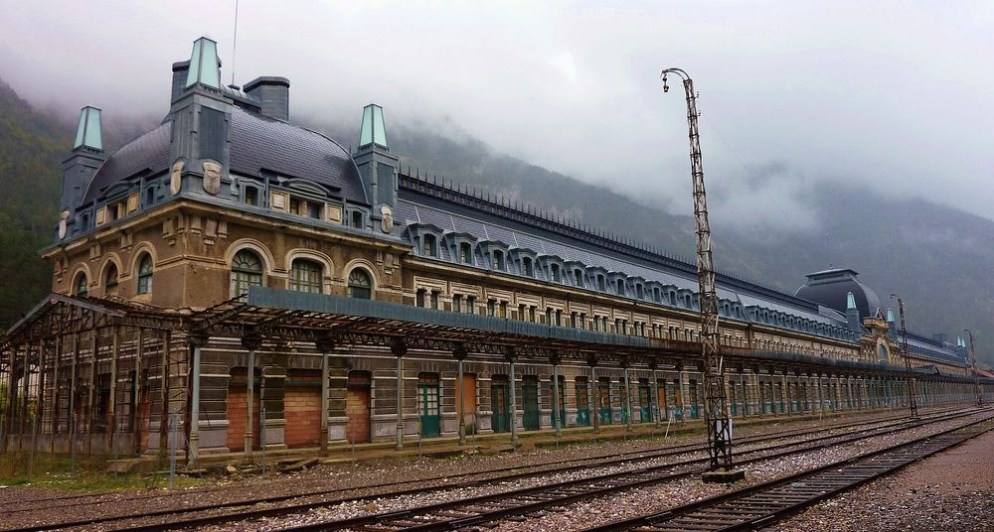
Sitting at the foothills of the Pyrenees mountains on the Spanish side of the French-Spanish border is an immense railway station. Built with iron and glass, the station’s art nouveau building stretches a quarter of a kilometer long, and its façade is decorated with more than three hundred windows. Inside the building there was once a luxurious hotel, an infirmary, a restaurant and living quarters for customs officers. Aside from the platform and the main building, there was a large locomotive depot, two sheds for the transshipment of freight between French and Spanish trains, various other outbuildings and an extensive layout of tracks. The station was nicknamed the “Titanic of the Mountains”.


Photo credit: thierry llansades/Flickr

The Canfranc International Railway Station was part of a larger plan to open up the border between Spain and France to enable more international trade and travel. The ambitious project involved dozens of bridges and a series of tunnels drilled through the mountains. The dream finally became reality in 1928, when the Spanish King Alfonso XIII and French President Gaston Doumergue inaugurated the newly built railway station— the second largest in Europe.

Unfortunately, the railway line never became profitable. Immediately after the line opened, Europe sank into an economic crisis, and things got worse when Franco ordered the tunnels sealed during the 1936’s Spanish civil war to prevent Republican opponents from smuggling weapons in. For the short period the station operated, it saw as few as 50 passengers a day.

The biggest flaw with the railway link was that gauges used by both countries were incompatible with each other. The French rail standard gauge was of 1,435 millimeters, while the Spanish gauge was of 1,672 millimeters. This meant that when passengers arrived into the station from one country, they had to change trains to continue their journey forward. Likewise goods and freight had to be unloaded and reloaded into another train. The process was excruciatingly slow.

After the end of the Second World War, the French lost interest in the line and allowed it to deteriorate. When a train derailed on the French side in 1970, the authorities saw it as a good pretext and closed the line for good.

But since the last few years, things have been in motion again. Some years ago, the Aragon government bought the place and promised to transform the building into a hotel. The plan is to build another station right next to it and relaunch rail service through the achingly beautiful Pyrenees. Already there are two trains bringing tourist and urban explorers from Saragossa to Canfranc every day. The French regional government based in Bordeaux is also eager to reopen the line on its side.

Source….Kaushik in http://www.amusingplanet.com

Natarajan


Message for the Day From Sai….

You must become your own tutor. Train yourself by using the spark of wisdom that has been implanted in you. Once you try with all your might, the Lord’s Grace will be there to help you forward. The first step in spiritual discipline is to cleanse your speech. Talk sweetly without anger. Do not boast of your scholarship or attainments. Be humble and eager to serve. Conserve speech and practice silence. It will save you from squabbles, idle thoughts and factions. Practice the attitude of joy when others are joyful and of grief when others around you are sad. Let your heart move in empathy. But the joy and grief have to be translated into service; they should not be mere emotions. When the sun rises, not all lotuses in the lake bloom; only the grown buds open their petals. Others await their time. It’s the same with people. Differences exist because of unripeness, but remember, all fruits will ripen and fall someday. Every being reaches its goal, however slow they walk or circuitous their road is! 

Source…..”Sai Inspires ” ….www.radiosaisai.org

Newton’s Apple Tree in Lincolnshire…

The story of Sir Isaac Newton and the falling apple is one of the most famous anecdotes in science. The young Isaac Newton was sitting under an apple tree in his garden when a fruit fell on his head, and in a sudden stroke of brilliant insight, he came up with the theory of gravity. The story is most likely embellished—at least the part where the apple hits Newton’s head—but there is also some truth to it.

The first written account of the apple falling incident appears on the notes of John Conduitt, who was Newton’s assistant at the Royal Mint and husband to Newton’s niece. In 1726, the year of Newton’s death, John Conduitt described the event:

In the year 1666 he retired again from Cambridge to his mother in Lincolnshire. Whilst he was pensively meandering in a garden it came into his thought that the power of gravity (which brought an apple from a tree to the ground) was not limited to a certain distance from earth, but that this power must extend much further than was usually thought. Why not as high as the Moon said he to himself & if so, that must influence her motion & perhaps retain her in her orbit, whereupon he fell a calculating what would be the effect of that supposition.

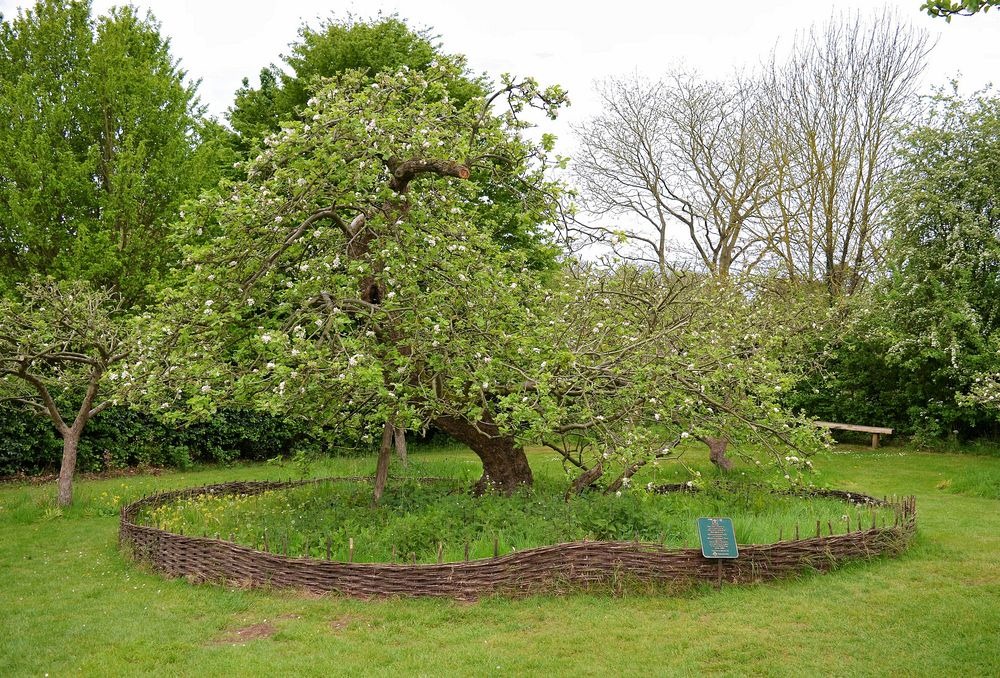
The tree from which the famous apple is said to have fallen, in the grounds of Woolsthorpe Manor in Woolsthorpe-by-Colsterworth, in Lincolnshire, England. Photo credit: Dun.can/Flickr

Newton appears to have himself perpetuated the apple tree story when he spoke about his discovery to several acquaintances. In another memoir on Newton’s life, published in 1752, writer William Stukeley wrote about a conversation he had with Newton:

We went into the garden, and drank thea under the shade of some apple trees, only he, and myself. Amidst other discourse, he told me, he was just in the same situation, as when formerly, the notion of gravitation came into his mind. “Why should that apple always descend perpendicularly to the ground,” thought he to himself: occasion’d by the fall of an apple, as he sat in a contemplative mood.

“Why should it not go sideways, or upwards? But constantly to the earths centre? Assuredly, the reason is, that the earth draws it. There must be a drawing power in matter. And the sum of the drawing power in the matter of the earth must be in the earths center, not in any side of the earth. Therefore does this apple fall perpendicularly, or toward the center? If matter thus draws matter; it must be in proportion of its quantity. Therefore the apple draws the earth, as well as the earth draws the apple.”

The year when this incident is said to have occurred, Newton was staying at Woolsthorpe Manor near Grantham in Lincolnshire. Woolsthorpe Manor is the birthplace and was the family home of Sir Isaac Newton. Newton returned here in 1666 when Cambridge University closed due to the plague, and here he performed many of his most famous experiments, most notably his work on light and optics.

Although Newton did not specify exactly where he observed the apple fall, there was one apple tree growing in the Manor’s garden and naturally, it was assumed that this was the famed tree.

The tree has been taken care of since the 1750’s by generations of the Woolerton family. In 1816, a storm blew the tree down, but major portion of the tree was left and it re-rooted. The tree still remains and is taken care of by the National Trust.

Grafts from Newton’s apple tree has been distributed and cultivated across the United Kingdom and beyond. There is one specimen—a descendent of the original tree—growing in the garden in the Physics Department in the University of York. Another grows outside the main gate of Trinity College, Cambridge, below the room Newton lived in when he studied there. You can also find one growing at the Bariloche Institute, in Bariloche, Argentina.

Source…kaushik in http://www.amusingplanet.com

Natarajan


Sai Message for the Day…

Meeting with fellow-pilgrims and kindred aspirants is a piece of rare good fortune. Every one of you is a temple, with the Lord installed in your heart, whether you are aware of it or not. The Lord is described in the Purusha Sukta scripture as ‘thousand headed’. It does not mean that He has just thousand heads and no more, no less. It means that the Lord is present in thousands of heads as just one loving heart, and gives life and energy to all! None of you must consider yourself separate from others; all of you are bound by the one same life-force, the same blood that flows through countless bodies. This is a precious message, a very special teaching of the Eternal Religion (Sanatana Dharma), which most of you have unfortunately forgotten. This is what the world needs today! Attach yourself to God fervently. Then all people on all days will be holy and special to you!

Source….www.media.radiosai.org

Ise Jingu: The Japanese Shrine That’s Torn Down And Rebuilt Every 20 Years…

The Ise Grand Shrine, also known as Ise Jingu, located in the city of Ise, in Japan, is one of Shinto’s holiest and most important sites. The shrine complex contains over a hundred shrines distributed over an immense area, but its two most important shrines are Naiku—the inner shrine, and Geku—the outer shrine. The inner shrine is believed to date from the 3rd century and is held in higher reverence than the outer shrine, due to it being the purported home of the Sacred Mirror of the Emperor.

What’s interesting about these shrine buildings is that the Naiku and Geku shrines, as well as the Uji Bridge, are rebuilt every twenty years—a tradition that has been going on for the past 1,300 years. The tradition is part of the Shinto belief of the death and renewal of nature and the impermanence of all things. It is also a way of passing down the skills and technique of building shrines from one generation to the next.


The general public is not allowed to access the shrines beyond sight of the thatched roofs of the central structures, hidden behind four tall wooden fences. Photo credit: N yotarou/Wikimedia

The rebuilding of the main shrine takes place on a site adjacent to the old, and each rebuilding alternates between the two sites. The old shrines are first dismantled and new ones built on the adjacent plot of land to exacting specifications so that the buildings remain forever new, yet original. The last rebuilding, which took place in 2013, was the 62nd iteration to date. The next rebuilding is scheduled for 2033.

In the lead-up to the rebuilding of the shrines, a number of festivals are held to mark special events. In the Okihiki Festival that is held in the spring over two consecutive years people from surrounding towns drag huge wooden logs through the streets of the city. The logs are prepared from Japanese cypress trees cut from a sacred forest surrounding the two shrines. These are eventually used in construction of the new shrine. As many as 10,000 cypress trees are cut down for the new building. Some of these trees cut are over 200 years old.

The cost of rebuilding is also enormous. Each rebuilding costs half a billion US dollars. The fund comes from tax payers and from private donations, including from business leaders and members of the royal family. The entire rebuilding ritual spans at least eight years.

The tradition of rebuilding the shrines every twenty years has its root in antiquity when old grain houses were demolished and reconstructed every 20 to 30 years. These grain houses had raised floors on wooden stilts and a thatched roof. The raised floor kept insects and water away while the thatched roof weighted down by rainwater pressed heavily down on the walls effectively sealing the inside and keeping moisture away. Eventually the roof and the pillars would start to show signs of decay, at which they would be torn down and a new granary constructed. This periodic reconstruction of these structures probably became customary, leading eventually to the rebuilding ceremonies of the Shrines in Ise.

Source….Kaushik in http://www.amusingplanet.com

Natarajan

A stray dog became the world’s first cosmonaut 60 years ago today…

Laika was a dog with humble beginnings who would become a global star. The first living being to leave the Earth’s orbit, taking off 60 years ago today in the Russian satellite Sputnik on Nov. 3, 1957, the stray mutt landed a place in history.

Discovered by a talent spotter from the Russian space program on the streets, the dog met all the criteria—docile, resourceful, peed without lifting a leg, and photogenic. One of six picked to train for space travel, Laika was ultimately chosen to go for her quizzical expression, her trainer, 90-year-old biologist Adilya Kotovskaya, told the Associated Press.

Indeed, in images Laika always looked gently confused, as if she already sensed her destiny and couldn’t understand why she’d die for her charms.

Kotovska grew close to the dog and recalls that the night before Laika took off was emotional. “I asked her to forgive us and I even cried as I stroked her for the last time,” she says.

Laika couldn’t have survived the trip, even if things hadn’t gone wrong. The charming dog had a one-way ticket to space, though this wasn’t made clear to the world at large.

According to Le Figaro (in French), international concern for Laika sparked conversations in which Russian officials reassured critics that the dog would be safely returned to Earth in eight days. The Russians were testing whether a living being could survive weightlessness, and Laika had been trained to be comfortable in ever-smaller boxes, surviving on space rations of jellied foods, ahead of her journey.

The dog was expected to orbit the Earth, surviving for eight to 10 days;, but she was never expected to return alive, according to the biologist who trained Laika. That just wasn’t possible at the time.

Laika didn’t last even a day. She lived only a few short hours after takeoff. The satellite wasn’t sufficiently insulated from the sun’s rays and the dog quickly began overheating. She died of radiation after only nine orbits around the Earth, much earlier than even her trainer had expected.

The death was kept a secret and fake news of Laika’s safety was provided regularly in official Russian broadcasts while Sputnik orbited. The dog was doing just fine, they reported. Le Figaro’s records show that there was skepticism of these accounts but no way to disprove the news out of Moscow.

Officially, Laika was poisoned through her food after about a week to prevent a painful death when reentering the Earth’s atmosphere. The satellite that carried her burned on April 14, 1958.

Kotovska, who now heads a laboratory at Moscow’s Institute of Biomedical Problems, and still works on preparing beings for space travel, knew the true story, of course. Still, she’s proud of Laika and her job training the cosmonaut dog, saying, “Those nine orbits of Earth made Laika the world’s first cosmonaut—sacrificed for the sake of the success of future  missions.”

Source….https://qz.com/

Natarajan

Message for the Day…”Being afraid of someone or something is an animal tendency and bullying others is a demonic tendency. You should have neither! Your human body is gifted to you for a grand purpose – to realise the Lord within”

Source: http://media.radiosai.org/

God has endowed you with a body and so every limb and sense-organ is worthy of reverent attention. Each must be used for His glory. The ear must exult when it gets a chance to hear the wonderful tales of God. The tongue must exult when it can praise Him. Else, your tongue is as effective as that of frogs on the marshy bank which croak day and night! An animal (pasu) fears; a beast (mriga) terrifies! Being afraid of someone or something is an animal tendency and bullying others is a demonic tendency. You should have neither! Your human body is gifted to you for a grand purpose – to realise the Lord within. If you own a fully loaded car in good running condition, would you keep it in the garage? Would you not drive it to where you need to go? So too, learn to use the faculties of body, senses, intellect, and mind, and achieve your goal!