Everyone craves for security, peace, joy and happiness. But most believe that these can be extracted from the world! The result is, people waste their years in eating and drinking, playing and resting, earning and spending. They rush from cradle to grave ad nauseam, drifting along, knowing neither the origin of their journey nor its destination, through the ages. Man has won unique qualities of head and heart through a series of effort-filled lives as members of inferior species; that victory is now reduced to ashes, by this supine sloth. You must have the skill to swim across the waves of joy and grief, of pain and profit. You must be a master of the art of being fully at ease, perfectly calm and unaffected, whatever may happen to your body, senses or mind! Learn the skill of achieving and maintaining inner peace, the art of being ever aware of your own inner Reality (Atma), then you can safely gyrate in the world!
The chief means to detach your mind from distractions and attach yourselves to the search of God are communion with God (Yoga) and sacrifice (Tyaga). Kama (desire) has to be got rid of by Tyaga, and Rama (God) has to be secured by Yoga. Desire discolours the intelligence, perverts judgement, sharpens the appetites of the senses, and leads to a false attraction of the objective world. When desire disappears or is concentrated on God, intelligence becomes self-luminous, and shines in its pristine splendour. That splendour reveals the God within and in the world outside. That is true realisation of the Self (Atma Sakshatkara). I bless you that you succeed in your sadhana (spiritual practices). If you are not practicing any now, I advise you to take up simple namasmarana (reciting the divine name), along with reverence towards parents, elders and teachers, and rendering service to the poor and the sick.
God is the source of all Love. Love cures pettiness, hate and grief. Love loosens bonds; it saves you from the torment of birth and death. Love binds all hearts in a soft silken symphony. Seen through the eyes of Love, all beings are beautiful, all deeds are dedicated, and all thoughts are innocent. Love God and Love the world as the vesture of God, no more, no less. The world is one vast kin. If you pay attention to the individual, differences thrust themselves on you. Fix your attention on the samasthi (the collective), then points of identity will be more apparent. If you concentrate on the outer labels – Hindu, Christian, Muslim, Parsi, Buddhist – then, you will develop pride or contempt or hatred! But if you focus on the struggle that man undergoes to raise himself from the flesh to reach the level of Divinity, you will find all labels insignificant. Then it is all love, co-operation, mutual encouragement and appreciation.
Stent, heart bypass surgery, heart attack…all of us have heard these painful terms amongst our loved ones at one time or another. But these were uncommon a generation ago.
So, what happened? How did we reach here?
In an attempt to understand the status of heart disease in India, Priyamvada Chugh reached out to India’s first and oldest cardiologist.
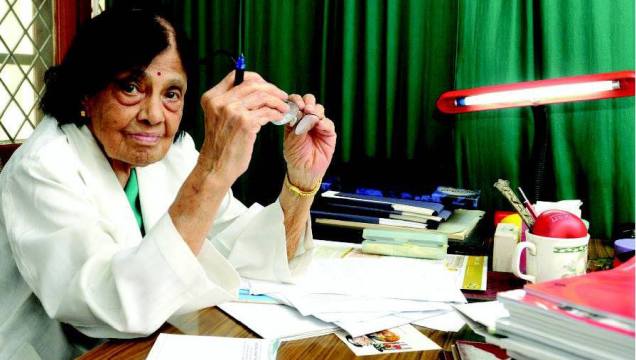
Meet Dr Sivaramakrishna Iyer Padmavati, who turns 101 this month, and still goes to the National Heart Institute in Delhi every day,which she founded in 1977.
Dr Padmavati is India’s first and oldest cardiologist. Photo
Born in 1917, Dr Padmavati fled with her family from Burma to Coimbatore in 1941 during World War II. With the passion to make a difference, she studied medicine at Johns Hopkins Hospital and Harvard Medical College in the USA with cardiology pioneers Dr Helen Taussig and Dr Paul Dudley White, respectively.
While returning to India in 1952 was a personal decision, it was the turning point for cardiology in India.
She has been the face behind several firsts:
The establishment of the first cardiac clinic and cath lab at the Lady Hardinge Medical College, Delhi.
The initiation of India’s first Doctorate of Medicine in Cardiology.
Setting up cardiology departments at the prestigious Maulana Azad Medical College, GB Pant Hospital, etc.
Founding the All India Heart Foundation, Delhi.
The list goes on. She accomplished all this in an era when cardiology was an unknown territory for most Indians, let alone for a woman.
To this Dr Padmavati says, “I pursued cardiology because there were very few courses available to women when I went to college, unlike today.” She was honoured with the Padma Bhushan in 1967 and the Padma Vibhushan in 1992 for her contributions to the field.
Having witnessed drastic changes in the incidence of heart disease in India over the last century, she says “Things were different earlier. Physical activity and a healthy diet were the norms. Now, times have changed.”
Burgers, fast food, and buttered paranthas, with eight hours of sitting in front of a computer, aren’t making things any better. As we move towards a machine-driven lifestyle characterised by increasing levels of stress, we invariably embrace unhealthy nutritional habits where heart diseases will only be on the rise.
Diseases of the heart have become the biggest killers of the modern times. According to reports from the World Health Organisation (WHO), heart diseases kill 17 million people around the world every year, and this figure is expected to rise to 23 million by 2030. The numbers are as horrific in India where 32% of all adult deaths are due to heart diseases.
Worryingly, heart disease in Indian youth is increasing rapidly, with 50% of all heart attacks occurring under 50 years of age and 25% occurring under 40 years of age.
So, what causes heart disease? Dr Padmavati answers, “The biggest reasons for heart disease are obesity, hypertension, diabetes and tobacco abuse.” High level of blood cholesterol is a common sign among obese people. Being a bad fat, cholesterol tends to get deposited in blood vessels, making them thinner and causing an increase in blood pressure, which weakens the heart.
Similarly, high salt intake also leads to increased blood pressure and eventually heart failure. Guidelines from the WHO recommend getting no more than 2.3 g of sodium a day, which is just one teaspoon of salt! As Indians, we are consuming almost twice that amount per day!
Another red flag for heart disease is high blood sugar, which gets converted to fat by the liver, raising the risk of heart disease. The American Heart Association suggests that we should consume less than 36 g of sugar per day, which is equivalent to just a single serving of a Rasgulla!
Can you imagine how many times the daily requirement of salt and sugar you have already consumed today? Studies show that exercising as little as 30 minutes every day decreases the risk of heart disease by up to 30%.
Limiting the intake of sugar and salt and increasing physical activity is the only way forward.
Another recommended strategy to strengthen our heart is by having at least 500 g of antioxidant-rich fresh fruits and vegetables such as tomatoes, pomegranates, spinach, grapes, etc. daily.
Several campaigns across the globe have been fighting these risk factors to reduce the incidence of heart disease. For instance, the Daily Mile Scheme, initiated in Scotland, is ensuring 15 minutes of morning run for school students across Europe. Norway has hiked the tax on sugar by 83% at the start of 2018, with products like candies and chocolates being taxed at almost $5 per kilo. In Finland, low-salt food options in the supermarket carry a “better choice” logo, and high salt foods have a mandatory warning sign.
In India, we neither have a sugar tax, nor a policy on salt consumption. So, for us Indians who worship food and love after-meal naps, it is time that we adopt something like Namak Cheeni Kam aur Exercize Zyada, karo apne Heart se ye Vaada (cut down your intake of sugar and salt and increase your exercise, make this promise for your heart).
Source….Health Heroes – This article is part of a series to celebrate some of India’s most amazing doctors and to understand the incredible work they are doing. http://www.the betterindia.com
Everyone is eager to be happy; everyone wants to work less and gain more, give little and get amply, but nobody experiments with wanting less and giving more! Every want is a shackle that hinders movement – it is a drag on your feet. A young college student roams free on his two legs; when he marries, he becomes four-footed! A child makes him six-footed; thus, further restricting the range of his movements. The more the feet, the less the speed, the tighter his grip on the ground – Remember, centipedes can only crawl! More objects means more hurdles and handicaps! Reduce wants, live simply – that is the way to happiness. Attachment brings sorrow in its wake; at last, when death demands that everything be left behind and everybody be deserted, you are overpowered with grief! Be like the lotus on water; on it, not in it. Water is necessary for the lotus to grow, but lotus will not allow even a drop to wet it.
God’s grace is just like the shower of rain and the sunlight. You must do some sadhana (spiritual practice) to acquire it; like keeping a pot upright to receive the rain, or the sadhana of opening the door of your heart, so that Sun may illumine it. Pray for grace and do little sadhana. Grace will set everything right. Its main consequence is Self-realisation (Atma sakshatkara); but there are other incidental benefits too like a happy contented life, and a cool courageous temper, established in unruffled peace (shanti). The main benefit from a jewel is personal joy but when one has come to the last coin in the purse, one can sell it and start life again! That is an incidental advantage. The plantain tree has bunch of fruits as its main gift! But its leaves, soft core of its trunk, flower bud, etc. are subsidiary items with profitable use. This is the nature of grace. It fulfils a variety of wants.
The universe, including the house within which you dwell, namely the body, is composed of the five elements: earth, water, fire, wind and ether – elements that act upon the senses as smell, taste, colour, touch and sound. Since elements are ‘divine emanations’, each of them has to be treated with reverence and circumspection. For example: take the earth. If you scatter seeds on the soil, or plant them too deep in the soil, they may not throw up their shoots! Pouring water down your throat can very well become torture, if the limit is crossed. You cannot breathe comfortably in a typhoon, nor can your eardrums stand the pressure of an explosion within earshot! Any use of the elements, over and above legitimate bounds, is a sacrilege. So too, each element must be used under some limitations, not as and how you like. Treat the elements as a vesture of the Almighty.
Attachment and hatred are the greatest enemies of progress in any scheme of social service, why, in any scheme of work. If a man is deluded into believing that he is saving others, then woe be to him, for there is no other at all. All are One, one person’s sorrow is everyone’s sorrow. The fundamental flaw is the ignorance of humanity. If only one is wise, one would know that all individuals are waves on the surface of the self-same ocean. Selfless action is the ideal to be aimed at. But now, everything is measured by the result, the gain that accrues. Study is also for the salary one can get on the basis of the degree earned. If the act is done without selfish desire (in the nishkama way); there is no aim to seek gain. The desire for gain is like the poison fangs; when they are pulled out, the snake of karma (action and reaction cycle) is rendered harmless.
Welcome all the blows of fate, the misfortunes and miseries, just as gold welcomes the crucible, hammer and the anvil, to transform into a beautiful jewel. Or as the cane welcomes the chopper, crusher, boiler, pan, sprayer and dryer, so that its sweetness may be preserved and used as sugar by all. The Pandavas never demurred when disasters fell thick upon them. They were happy that disasters helped them to remember Krishna and call upon Him. Submit to the will of God. Never seek power or position but submit to His Will so that you may be ever happy and unmoved. The Lord rushes toward the devotee faster than the devotee rushes to Him. If you take one step toward Him, He takes a hundred steps toward you! He will be more than a mother or father. He will foster you from within you, just as He has saved and fostered so many saints who have placed faith in Him!
There is iron and there is also the magnet. The magnet will draw the iron to itself; that is the destiny of both. But if the iron is covered with the rust, the grace of the magnet may not operate strong enough to draw the iron near. Greed for sensual pleasure will certainly act as rust! It acts as dust, which induces rust; the rust will ultimately burst the iron itself and change its innate nature. So iron has to be tested constantly and dusted. Then, when it contacts the magnet, it too earns the magnetic quality and finally gets rest from its quest. That achievement is the best, for both magnet and iron. The dust of sensual greed can be prevented by keeping good company (satsang), and putting into practice the principles of good conduct that one must imbibe from holy scriptures!
 Take off with Natarajan