Total eclipse of Blood Moon on night of October 7-8

TONIGHT FOR OCTOBER 7, 2014
There is a total eclipse of the full moon on October 8, 2014. This is the Northern Hemisphere’s Hunter’s Moon – the name for the full moon after the Harvest Moon. It’s also aBlood Moon, and this eclipse is the second in a series of four so-called Blood Moon eclipses. For North America and the Hawaiian Islands, the total lunar eclipse happens in the wee hoursbefore sunrise on October 8. For New Zealand, Australia and eastern Asia, the total eclipse is seen after sunset on October 8. A partial lunar eclipse can be seen before sunrise, October 8, from much of South America, or after sunset, October 8, from western Asia. Follow the links below to learn more about the 2014 Hunter’s Moon and the October 8 total lunar eclipse.
When is the October 2014 moon exactly full?
Who will see the October 7-8 total lunar eclipse?
Who will see the partial lunar eclipse on October 8?
Eclipse times in Universal Time.
Eclipse times for North American time zones.
Lunar eclipse computer courtesy of the US Naval Observatory
Eclipse calculator courtesy of TimeandDate
A double Blood Moon eclipse on October 8?
How is the Hunter’s Moon different from other full moons?
North Americans see partial solar eclipse on October 23
Hurry! Purchase eclipse-viewing glasses for the October 23 partial solar eclipse here.
Day and night sides of Earth at instant of the October 2014 full moon
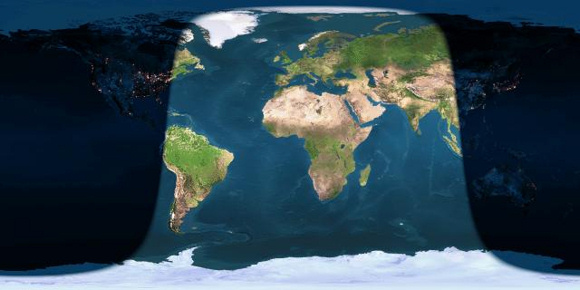
When is the October 2014 moon exactly full? Generally speaking, we in the Americas will say the moon stays full all through the night tonight, October 7-8.
But to astronomers, the moon turns full at a well-defined instant: when it’s most opposite the sun for the month.
That instant happens on October 8, 2014 at 10:51 UTC. At our U.S. time zones, that places the precise time of full moon on October 8 at 6:51 a.m. EDT, 5:51 a.m CDT, 4:51 a.m. MDT or 3:51 a.m. PDT. At that time, because there’s an eclipse happening, the moon will be totally submerged in the Earth’s dark umbral shadow.
Meanwhile, because of the difference in time zones, this same full moon happens at local midnight (October 7-8) for far-western Alaska and the Aleutian Islands. It’s sunrise (October 8) for northeastern North America and far-western South America, and it’s sunset (October 8) in Asia.
Watch the full-looking moon on the night of October 7-8 rise in the east as the sun goes down. Like any full moon, the Hunter’s Moon will shine all night long. It’ll soar highest in the sky around midnight and will set in the west around sunrise.
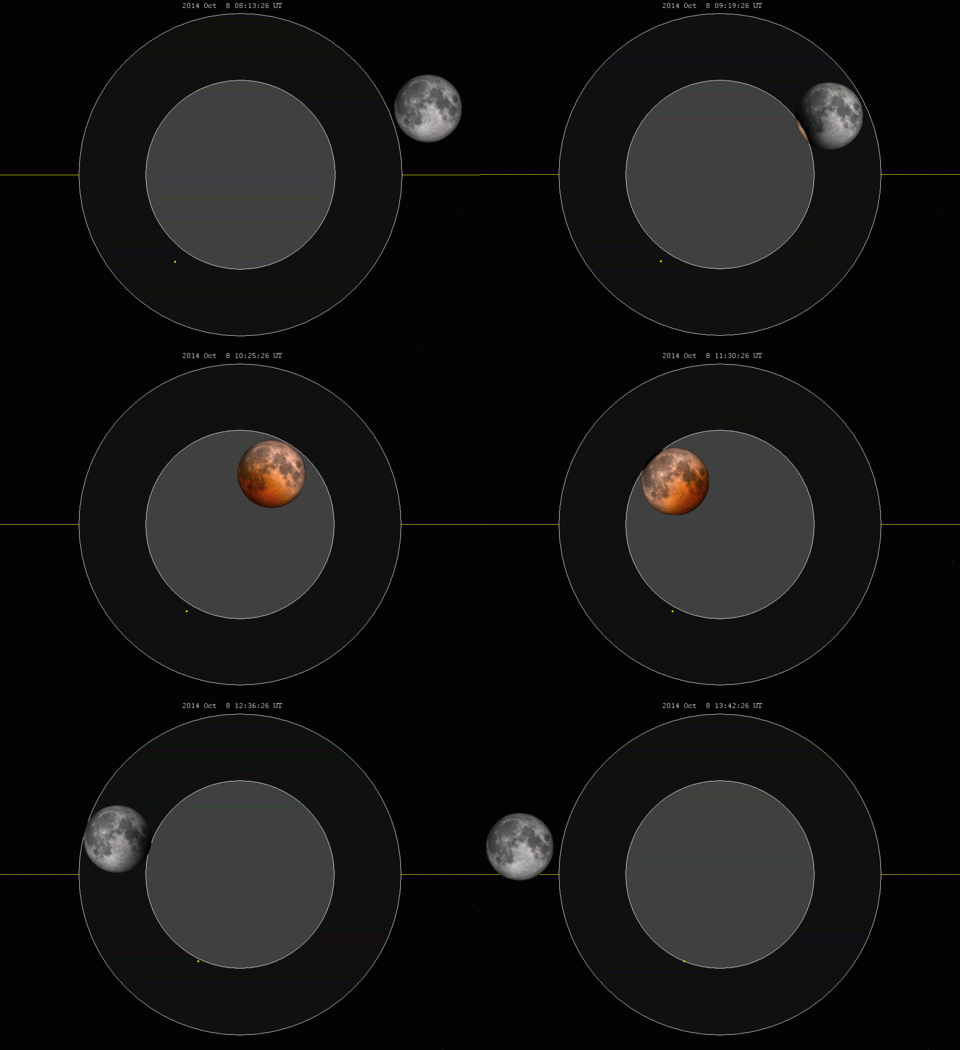
Who will see the October 7-8 total lunar eclipse? The October 2014 full moon passes directly through Earth’s dark (umbral) shadow. The total part of the October 8 eclipse lasts nearly 1 hour. A partial umbral eclipse precedes totality by about one hour and 10 minutes, and follows totality by about the same period of time, so the moon takes about 3 and 1/3 hours to completely sweep through the Earth’s dark shadow.
North and South America, the Pacific Ocean, New Zealand, Australia and eastern Asia are in a good position worldwide to watch the total eclipse of the moon on October 8. If you live in the Americas or Hawaii, the total eclipse happens before sunrise October 8. In the world’s eastern hemisphere, the total eclipse happens after sunset October 8.
A very light penumbral eclipse comes before and after the dark (umbral) stage of the lunar eclipse. But this sort of eclipse is so faint that many people won’t even notice it. The penumbral eclipse would be more fun to watch from the moon, where it would be seen as a partial eclipse of the sun.
Who will see the partial lunar eclipse on October 8? A partial lunar eclipse may be visible in the haze of morning dawn from the extreme eastern portion of North America (Newfoundland), before sunrise on October 8. A partial lunar eclipse can also be observed from western Asia (eastern India, Nepal, western China) after sunset on October 8.
source:::::earth sky news
Natarajan
 Take off with Natarajan