Binaca, the Iconic Toothpaste That Lives On Through India’s Most Loved Radio Show!!!

Years before the television set had people glued to it with Doordarshan’s iconic shows like Ramayana, Mahabharata, Buniyad, Humlog and Mungeri Lal Ke Haseen Sapne—one medium ruled the roost.

The radio.

In most middle-class homes, where a TV set was a distant dream, the radio took centre stage. And while the history of this wonderful medium that connected the masses is not something people usually Google about, it is incomplete without the mention of one particular radio programme.

One that aired for over 40 years, reigning over the hearts of millions of listeners. Not just in India, but also beyond borders–in South Asia, parts of the Middle East, East Asia, and Europe.                                                


Ameen Sayani live on air. Source: Facebook/Ameen J Sayani

Once a week, on Wednesdays, as the family neared supper time, a member, (often the youngest enthu-cutlet) would tune into Radio Ceylon at 8 PM. When tuned just in time, they would hear the closing lines of the Binaca toothpaste jingle, also the sponsor of the much-awaited programme to follow.

And then, a voice would resound through the radio set. A mix of baritone and warmth that broke away from the monotony of the All-India Radio (AIR) announcers, this living legend’s voice brought life to every household.

“Ji haan bhaiyon aur beheno. Main aapka dost Ameen Sayani bol raha hoon aur aap sun rahe hai Binaca Geetmala.”

A 30-minute programme, Binaca Geetmala was broadcast on Radio Ceylon from 1952–1989, and then on AIR’s Vividh Bharati network from 1989–1994.

Ameen Sayani, who is now 86, narrated the history of its inception on its silver jubilee.


Born to a devoted doctor who treated underprivileged patients free of charge and bought them medicines, and a mother who ran the periodical Rahber to propagate Gandhi’s vision, Ameen forayed into this earliest form of radio jockeying in the 1950s.

As a degree student of erstwhile Bombay’s St Xavier’s College, he applied for the role of a Hindi broadcaster on AIR. And as hard as it is for most of his fans to believe, he was rejected.

“Your ability to read from scripts is good but Mr Sayani, your pronunciation is defective with too much Gujarati and English influence in your pronunciation,’ was how he had been turned down, recalled Ameen in an interview with the Times of India.

Shattered, he turned to his guide and guru-his older brother, Hamid Sayani.

Hamid, a producer for Radio Ceylon, told him to listen to the station’s Hindi programmes during the recording.

Coincidentally, these recordings took place at a studio in the technical institute of St Xavier’s itself. Needless to say, the young Ameen would trade classes to learn and emulate the art of broadcasting.

This was also the time when sponsored radio shows made their debut on the medium.

Ameen was first noticed by Radio Ceylon’s Balgovind Shrivastav, the producer of the show-Ovaltine Phulwari. Unhappy with the voice for the Ovaltine advertisement, Shrivastav once got on to the stage and asked if anyone from the studio audience wanted to try reading out the script. Ameen volunteered. When the youngster read the words aloud, Shrivastav shut his ears to block his sound.

“This is not war,” he was chastised.

A second try impressed him. And thus began the young Ameen’s journey. He read advertisements every week. Was he paid? Well, if a small tin of Ovaltine could be considered a payment, then sure. What really marked his breakthrough into commercial radio was the absence of Indian film music on AIR. This vacuum was filled in 1951 by Radio Ceylon.

Using the concept of its already existing show-the Binaca Hit Parade which did a countdown of western songs, the brand decided to do a Hindi version for the masses.

The sponsors started looking for a less experienced individual who would have to write the scripts, present and produce the show. Additionally, he/she would have to read letters by the listeners, tabulate the requests and analyze the popularity of each song, based on the feedback from the listeners. It was a lot of work and the salary was a meagre Rs. 25 a week.

It wasn’t much but certainly more than Ameen’s prior payment of a small tin of Ovaltine.

He took a giant leap of faith. And then there was no looking back.

The first show raked in 200 letters. But into the second week, the number spiked to 9,000 letters and later 60,000 a week. In the year 2000, it also won the Advertising Club’s Golden Abby Award for being the most outstanding Radio Campaign of the Century.

The show 

Binaca Geetmala played seven contemporary songs in no particular order. But soon enough, it started ranking them based on popularity and feedback by the janta. The number of listeners shot up to 20,00,000 from the once 9,00,000. Over the years, the name of the show kept changing from—Binaca Geetmala to Cibaca Geetmala and later Colgate-Cibaca Geetmala—due to brand takeovers and change of sponsors.

But one thing remained constant. Ameen Sayani’s voice. For the lakhs of listeners, Ameen wasn’t just a radio jockey, he was a friend and confidant who played out their favourites, read song dedications, their heart-warming stories and letters. He also entertained the listeners with music trivia. Bets were placed on which song would top the week’s chart.

Every rank was referred to as a ‘paidan’  by Ameen—a staircase that led to the top of the Binaca Geetmala peak. Songs could either step up from one paidan to the other or climb down after losing its rank to newer competitors.

When he would announce, “Binaca Geetmala ke paidan ki choti par hai,” the suspense was built with the sound of a bugle. To be number one on the Binaca list was a sign of pride for music producers and directors.

The show’s popularity made Radio Ceylon extend its running time to 60 minutes from half an hour. And such was the media and public attention that it often caused crowds to gather in parks and traffic jams if someone played their radio loud.

“It was impossible to miss this weekly program on the radio during childhood. Even when outside my home, I could still hear the programme in remarkable continuity while walking, my only concern was to reach home before the top song was played. No other radio or TV programme in the world could have stayed popular for such a long time (four decades!) and in so many countries (India, Pakistan, Afghanistan, Sri Lanka, and so many other Asian countries). The magic was in the Indian music, deeply meaningful, heart-touching simple lyrics, fabulous presentation of Amin Sayani and melodious heavenly nostalgic voices of several artists,” writes a fan of the show on YouTube.

Binaca, the oral hygiene brand was launched in 1951 by FMCG brand Reckitt Benckiser. Before brands like Pepsodent or Colgate became a household name, in the 1970s, Binaca was one of the country’s favourite toothpaste.

What made the product memorable? Well, apart from the jingle and the radio show, the free toys and waterproof stickers that the brand gave out with the toothpaste and toothbrush packs made it a much-loved product among children.  Another marketing strategy was the free water picture sticker at a time when stickers or self-adhesive tapes had still not entered the market.

One of the brands most remembered print advertisement featured brave-heart Neerja Bhanot.                                                          

The Binaca ad featuring braveheart, Neerja Bhanot. Source: Facebook/Chandigarh : The City Beautiful

And while the brand couldn’t survive competition in the dental hygiene space and was bought by the Indian FMCG company Dabur in 1996 for ₹12 million, it continued to live on in the memories of thousands through the melodies of Geetmala.

(Edited by Saiqua Sultan)

Source…..Javita Aranha in http://www.the betterindia.com

Natarajan


Is Lemon A Cancer Killer ….?Don’t get carried away with hoax forwards and messages …pl read this blog.

Is Lemon A Cancer Killer That is 10,000 Times Stronger Than Chemotherapy?

Outline

Message purporting to be from the Institute of Health Sciences in Baltimore claims that lemon is a “miraculous product” that can kill cancer cells, is 10,000 times stronger than chemotherapy, and is “a proven remedy against cancers of all types”.

Brief Analysis

Scientific studies indicate that citrus (including lemon) contains compounds that may indeed be beneficial in preventing or combating some types of cancer. However, this message significantly exaggerates the potential of lemon as a cancer remedy, contains false and misleading information, and does not originate from a credible medical or scientific entity. The message did not originate from the Institute of Health Sciences as claimed.

Example

Subject: FW: Lemon – kills Cancer Cells

The surprising benefits of lemon!

================================

Institute of Health Sciences, 819 N. L.L.C. Charles Street Baltimore , MD 1201.
This is the latest in medicine, effective for cancer!

Read carefully & you be the judge.

Lemon (Citrus) is a miraculous product to kill cancer cells. It is 10,000 times stronger than chemotherapy.

Why do we not know about that? Because there are laboratories interested in making a synthetic version that will bring them huge profits. You can now help a friend in need by letting him/her know that lemon juice is beneficial in preventing the disease. Its taste is pleasant and it does not produce the horrific effects of chemotherapy. How many people will die while this closely guarded secret is kept, so as not to jeopardize the beneficial multimillionaires large corporations? As you know, the lemon tree is known for its varieties of lemons and limes. You can eat the fruit in different ways: you can eat the pulp, juice press, prepare drinks, sorbets, pastries, etc… It is credited with many virtues, but the most interesting is the effect it produces on cysts and tumors. This plant is a proven remedy against cancers of all types. Some say it is very useful in all variants of cancer. It is considered also as an anti microbial spectrum against bacterial infections and fungi, effective against internal parasites and worms, it regulates blood pressure which is too high and an antidepressant, combats stress and nervous disorders.

The source of this information is fascinating: it comes from one of the largest drug manufacturers in the world, says that after more than 20 laboratory tests since 1970, the extracts revealed that: It destroys the malignant cells in 12 cancers, including colon, breast, prostate, lung and pancreas … The compounds of this tree showed 10,000 times better than the product Adriamycin, a drug normally used chemotherapeutic in the world, slowing the growth of cancer cells. And what is even more astonishing: this type of therapy with lemon extract only destroys malignant cancer cells and it does not affect healthy cells.

Institute of Health Sciences, 819 N. L.L.C. Cause Street, Baltimore, MD1201

Detailed Analysis

This widely circulated message, which purports to be from the Institute of Health Sciences in Baltimore, details the “surprising benefits of lemon” as a cancer fighting agent. The message claims that lemon kills cancer cells and is 10,000 times stronger than chemotherapy. It further claims that lemon is a remedy for all types of cancer.

Legitimate scientific studies have shown that compounds in citrus may be beneficial in combating certain types of cancer. Thus, the message may have a grain of truth. However, it is nonetheless very misleading and inaccurate. Moreover, the information does not come from a credible scientific source.

As discussed in greater detail below, studies have indicated that citrus limonoids do have potential as anti-cancer agents. However, I could find no medical studies that validate the claim that lemon is “10,000 times stronger than chemotherapy”. Nor do any credible scientific reports indicate that lemon is a “proven remedy against cancers of all types”.

Moreover, the message did not originate from the Health Sciences Institute of Baltimore (also identified on its website as the “Institute of Health Sciences”) as claimed. A spokesperson for the Health Sciences Institute has denied any involvement, noting in a recent email:

The email and information in question did not come from the Health Sciences Institute. Whoever started this scam email did use some of our published material – which had nothing to do with lemons in any way – and inserted the information about lemons. It is erroneous and has caused us a great deal of trouble. However, most troubling is that it is giving false or un-tested medical advice to people suffering with cancer. Perhaps citrus fruits have some anti-cancer properties or perhaps they don’t (I’m not qualified to speak on that), but the one thing I know for certain is the provided “source” of this information – the Health Sciences Institute – did NOT publish this information. We had nothing to do with this email or the information it contains.

Thus, the message contains unproven, unsupported and significantly exaggerated claims about lemon as a cancer remedy and should not be considered a valid scientific report on the subject.

That said, a number of studies have indicated that compounds found in citrus (including lemon) may be effective as anti-cancer agents, at least for certain types of cancer. A December 2004 Science Daily article reports:

Research by Texas Agriculture Experiment Station scientists has shown that citrus compounds called limonoids targeted and stopped neuroblastoma cells in the lab. They now hope to learn the reasons for the stop-action behavior and eventually try the citrus concoction in humans. [……]


Harris explained that flavonoids and limonoids – nutrient-packed pigments that give color and taste to fruit – may work against cancer in any of three ways: prevent it from forming, slow the growth of existing cancer, or kill cancer cells.

“The limonoids, which differ structurally from flavonoids, seem to do all three,” he said of tests in his lab by one of Patil’s graduate students, Shibu Poulose, who also worked in Harris’ College Station lab. Their work emphasized the compounds’ ability to kill existing the neuroblastoma cells with the rationale that if the method and time limonoids take to obliterate the cancer could be found, perhaps scientists could exploit it to help cure the disease.

A May 2000 report about the potential of citrus limonoids as anticancer agents explains:

The experimental results describe above indicate that citrus limonoids may provide substantial anticancer actions. The compounds have been shown to be free of toxic effects in animal models so potential exists for use of limonoids against human cancer in either the natural fruit , in citrus fortified with limonoids, or in purified forms of specific limonoids . Although the initial studies are very promising , they have been conducted primarily with invitrocell culture and animal models. Thus , research is needed to determine whether the limonoids may be useful in preventing or treating cancer in humans .

And a report on the medicinal use of citrus published on the University of Florida EDIS website notes:

Citrus flavonoids have potential antioxidant (prevents aging), anti-cancer, antiviral, anti-inflammatory activities, effects on capillarity, and cholesterol-lowering ability. The principal carotenoids in pink grapefruit are lycopene and beta-carotene. Lycopene-containing fruits and vegetables have been shown to contribute to a significant reduction in prostate and mammary cancer risk. Recent studies have further shown that limonoids inhibit the development of cancer in laboratory animals and in human breast cancer cells as well as reducing cholesterol. Researchers have also suggested that, if ingested, limonoids may not be absorbed in the large intestine, and therefore could be distributed throughout the body, with beneficial effects.

So, in short, scientific studies indicate compounds in citrus, including lemon, have real potential as anti-cancer agents. However, it is not yet clear exactly how effective citrus will ultimately prove to be in preventing or fighting against cancer in humans. Certainly, it is premature and inaccurate to claim that lemon is a “proven remedy against cancers of all types.” Nor, at this point, can it be said that lemon is a viable alternative to traditional treatments such as chemotherapy. But lemon, like other kinds of citrus is likely to be a healthy addition to your diet and may even reduce the risk of cancer. However, these findings do not give validity to the exaggerated and unsupported claims made in this circulated health report. To be useful, health advice needs to be valid, accurate, and be supported by credible medical sources. Sending on spurious health information is unlikely to be beneficial.

Source…….Brett M. Christensen  in https://www.hoax-slayer.net

Natarajan

Ladakh’s ‘Manjhi’: Spent Life Savings, Sold Ancestral Property to Construct 38 km Road!

Everyone knows about the fantastic story of Dashrath Manjhi, the villager from Bihar who carved a path through a hillock using only a hammer and chisel.

It’s a story of resilience, grit, perseverance and dedication that has resonated with every Indian.

Well, 75-year-old Tsultrim Chonjor, fondly known as ‘Meme Chonjor, who comes from the remote village of Stongde in the Zanskar Valley of Ladakh, has a similar story to tell.

The former government employee, who was working with the State handicrafts department from 1965 to 2000, was unhappy at how remote and inaccessible the region was for the rest of the Indian mainland.

As a result of this, the entire region of Zanskar, which falls under the Kargil district and is located at an altitude ranging from 11,500 to 23,000 feet above sea level, was for decades neglected by both the local and State administration.

Earlier this year, the Border Roads Organisation completed the construction of a 140 km-long road between Darcha in Himachal Pradesh to Padum town, the administrative centre of Zanskar, via Shinkula pass perched at 16,500 feet. From Padum, the road goes on through to Nimoo village in Leh district.

Even though, for the time being, only small vehicles can pass, the NPD (Nimoo-Padum-Darcha) road is potentially a critical piece of infrastructure, and not just for civilian purposes.

After the recent Chinese incursions, it had also assumed massive importance for Indian armed forces to connect these areas better to ensure regular movement of troops and supplies.

“Presently there is a single way to reach Kargil via 474 km long Manali-Leh highway. But with the connection of Darcha Road with Shinku la Pass, the road will become an option to reach Kargil sector directly as the shortest route for army vehicles, which at present were forced to ply via Manali-Leh highway,” said a senior BRO officer, to the Hindustan Times, in 2016.

“The safety of Zanskar is also vital to the safety of Leh, Lahaul, and East Punjab… For as long as we hold Leh and Zanskar, we hold the entire district and guard Kashmir, Changthang (in eastern Ladakh) and Lahaul against possible invasion,” wrote historian HN Kaul in a letter to Jawaharlal Nehru.

Back in May 2014, however, the circumstances were very different. One of the most pressing issues was the lack of proper road connectivity that links this area with the rest of the region. The 292-km Darcha-Shinkula-Padam-Nimoo road was planned in 2001.

Despite repeated pleas to the authorities, there was little action on the ground.

However, Meme Chonjor wasn’t one to wait. He was determined to ensure that his efforts would make a difference to the lives of not just his fellow villagers, but also the rest of the region.

From May 2014 to June 2017, he singlehandedly led efforts to construct a 38-km stretch of road from Ramjak, an inhabited area on the Jammu and Kashmir side of Shinkula pass, to Kargyak village, the first properly inhabited village in the Zanskar region.

Spending Rs 57 lakh from his own pocket after dipping into life savings and selling his ancestral property, Meme Chonjor pressed a JCB machine into action, set forth with five donkeys and constructed the road.

The Border Roads Organisation (BRO) later undertook road widening construction on this stretch.

He even received funds from a few other locals, who were in favour of the road—Rs 5 lakh from the local councillor and another 2.5 lakh from a local merchant, among other locals. “Seeing the pain and suffering of others had inspired me to construct this road,” says Meme Chonjor.

There were some initial challenges when the construction process began.

Security forces stationed there enquired about where he was getting the necessary funding from for the construction of this road.

“After I briefed them about my financial source, there was no further objection,” says Meme Chonjor.

There were significant climatic challenges as well.

For starters, constructing the road at an average altitude of 3500 metres (11,500 feet) above sea level took its toll on Meme Chonjor’s health, even though he had lived most of his life in Zanskar.

Other challenges include a short working season of four to five months since there is absolutely no scope for work in the harsh winter months when the temperatures in these parts drop would drop to -30-35 degrees Celsius. However, he was unperturbed by all this.

How does Meme Chonjor sustain himself financially after nearly spending all his life savings?

“I believe in simple living, so I don’t need massive financial support. How much does one really need? I survive on the regular monthly pension I receive from the government,” he says.

On Republic Day, the Ladakh Autonomous Hill Development Council, Kargil, and the district administration honoured him for “playing an extraordinary role to construct the road between Padum to Darcha by himself.” They praised his “unflinching commitment towards public welfare.”

Such volunteerism and philanthropic gestures from the likes of Meme Chonjor are indeed inspirational, and empower others in his village to shape their own destinies.

(Edited by Gayatri Mishra)

Source……..  in http://www.the betterindia.com

Natarajan


Fort Kochi To Have 100 ‘Lantana’ Elephants. And Here’s Why You Need To See Them…

On February 7, if you are wandering around the popular South Beach in Fort Kochi, you are sure to come across a magnificent herd of 100 Asian elephants.

If you are wondering about the possibility of such a huge congregation of these beings at one place, let us break the news.

These are beautifully sculpted life-size elephants that have been made by tribal artisans from Thorapalli in Gudalur using Lantana camara or Lantana, a toxic invasive weed.


Highlighting the cause of nature and wildlife conservation at a global scale, the Lantana elephants are part of a greater initiative to raise funds for conservation and help people and elephants live together more harmoniously.

The collaborators of the project involve various non-profit organisations from across the world including the UK based Elephant FamilyThe Real Elephant Collective(TREC), the Ashoka Trust for Research in Ecology and Environment (ATREE), and The Shola Trust.

“Our vision is to bring Asia’s elephants and the issues they face out of India and the shadow cast by the African ivory crisis. With Asian elephants numbering only a tenth of their African counterparts, the importance of this unique migration cannot be underplayed. The survival of a species is at stake,” says Ruth Ganesh, principal trustee and the creative force of Elephant Family.

She had conceptualised the Lantana herd along with Shubhra Nayar of TREC.

Modelled on real elephants from the Gudalur-Pandalur region, in its bid to raise awareness and funds for the conservation of Asian elephants, this unique project is also clearing the harmful Lantana from the Nilgiri forests while providing livelihoods to about 70 artisans from the Paniya, Bettakurumba and Soliga communities.

With their inherent knowledge of wild elephants and their exceptional crafting skills with Lantana, these artisans are bringing life to the elephant forms, while earning a dignified income.

Lantana was introduced to the Indian subcontinent as an ornamental shrub by the British.

However, it has taken over forests at a disturbingly fast pace, and is threatening the survival of the pachyderms by reducing their fodder base in the region.


The tribal artisans. Courtesy: The Shola Trust.

“Lantana encroachment has a negative impact on the regeneration of native flora, fodder and also non-timber forest products. It pushes animals out of forests, causing crop damage for local people, with a huge negative impact on livelihood of the indigenous communities. This project provides them with a livelihood opportunity and also gradually clears the forests from Lantana,” says Dr. Siddappa Setty, a fellow at ATREE.

This magnificent herd will stay in Kochi for about a month and then travel across the world to be part of exhibitions at different locations for auctioning.

The proceeds will be routed to a newly created Asian Elephant Fund that will be governed by a panel of elephant specialists in Asia.


“This project is innovative in many ways—it uses traditional indigenous artisanry to create these beautiful forms which can raise both awareness and funds for conservation while contributing significantly to indigenous livelihoods and clearing an invasive species to restore ecosystems,” adds Dr Nitin Pandit, Director of ATREE.

To know more about the Lantana elephants and their global tour, click here.

(Edited by Gayatri Mishra)

Source…….LeksmiPriya.S in http://www.the betterindia.com

Natarajan


Meet The Incredible, Inspiring Odisha Chaiwala Who Just Won Padma Shri….

For every cup of tea sold at his stall, he used half the amount towards the education and health of the slum kids.

“For 54 years, I was a roadside tea-seller. But today, I am a Padma Shri tea-seller,” beams Odisha-based 61-year-old D Prakash Rao, who was conferred the prestigious award on Republic Day by the Government of India.

How did a tea-seller win the fourth highest civilian award in the Republic of India, you ask.

His beautiful story will move you.                     D Prakash Rao

Rao was only six-years-old when he started working at his father’s tea-stall. His father served during the second world war. When the war ended, he returned to his hometown, Cuttack. He hoped that his service during the war would help him find an alternate job. But to his disappointment, nobody wanted to employ him.

Pushed by unemployment and poverty, with a meagre capital of Rs 5, he started the tea-stall. One that Rao continued to run for the next five decades.

He tells The Better India, “Living and working in a slum, I witnessed the resistance of parents towards education first-hand. Living in their makeshift jhuggi jhopdis, they thought of their children as means of earning income. Instead of enrolling them in schools, these children were enrolled in menial labour. Working odd jobs and becoming domestic helpers, whatever money they earned was often snatched by the men in the home, who would buy alcohol and turn to domestic violence. It deeply affected me, every single day.”

He continues, “I was a good student. Bright in academics, adept at football. I wanted to become a doctor but landed up becoming a chaiwala. I knew what it was like to not have any opportunities. And I did not want these kids to have the same fate.”

For every cup of tea sold at his stall, he used half the amount towards the education and health of the slum kids.

He first operated from his two-room thatched house, with four children, where he provided them with food and education, completely free of cost.

He faced opposition from the parents who complained, “Yeh bacche kya kar lenge padh ke? Meri ladki ghar kaam karke Rs 700 leke aati hai mahine ka. Aap padhake kyun humaare pet par lat maarna chahte ho? (What will our kids do if they study? My daughter works as a maid and earns Rs 700 monthly. Why are you kicking our stomachs by educating her?)”

But he did not give up.

Slowly, the number of kids rose, and today his school, ‘Asha o Ashwasana’, has transformed the lives of more than a hundred kids.

The same parents who complained about education, gratefully look on as they watch their sons and daughters cycle to their colleges today.

“Every day I cook dalma for them (a preparation of dal, rice and sabji). It gives me immense joy to see them relish the home-cooked meal that is high in nutrition. When the Prime Minister visited Cuttack five months ago, we had a brief meeting where he told me this meal was one of the best, being served in schools.”

The humble tea seller found a mention in the PM’s radio show, Mann Ki Baat where he said that Rao embodied the spirit of ‘Tamaso mā jyotir gamaya’ which means, ‘From darkness, lead me to light.’

The Prime Minister referred to him as a diya (lamp) which guides underprivileged kids to the path of enlightenment.

When asked about his reaction on being bestowed the award, he sayExclusive: Meet The Incredible, Inspiring Odisha Chaiwala Who Just Won Padma Shri


He tells The Better India, “Living and working in a slum, I witnessed the resistance of parents towards education first-hand. Living in their makeshift jhuggi jhopdis, they thought of their children as means of earning income. Instead of enrolling them in schools, these children were enrolled in menial labour. Working odd jobs and becoming domestic helpers, whatever money they earned was often snatched by the men in the home, who would buy alcohol and turn to domestic violence. It deeply affected me, every single day.”

He continues, “I was a good student. Bright in academics, adept at football. I wanted to become a doctor but landed up becoming a chaiwala. I knew what it was like to not have any opportunities. And I did not want these kids to have the same fate.”

For every cup of tea sold at his stall, he used half the amount towards the education and health of the slum kids.

He first operated from his two-room thatched house, with four children, where he provided them with food and education, completely free of cost.

He faced opposition from the parents who complained, “Yeh bacche kya kar lenge padh ke? Meri ladki ghar kaam karke Rs 700 leke aati hai mahine ka. Aap padhake kyun humaare pet par lat maarna chahte ho? (What will our kids do if they study? My daughter works as a maid and earns Rs 700 monthly. Why are you kicking our stomachs by educating her?)”

But he did not give up.

Slowly, the number of kids rose, and today his school, ‘Asha o Ashwasana’, has transformed the lives of more than a hundred kids.

The same parents who complained about education, gratefully look on as they watch their sons and daughters cycle to their colleges today.

“Every day I cook dalma for them (a preparation of dal, rice and sabji). It gives me immense joy to see them relish the home-cooked meal that is high in nutrition. When the Prime Minister visited Cuttack five months ago, we had a brief meeting where he told me this meal was one of the best, being served in schools.”


The humble tea seller found a mention in the PM’s radio show, Mann Ki Baat where he said that Rao embodied the spirit of ‘Tamaso mā jyotir gamaya’ which means, ‘From darkness, lead me to light.’

The Prime Minister referred to him as a diya (lamp) which guides underprivileged kids to the path of enlightenment.

When asked about his reaction on being bestowed the award, he says,

“The adulation and support that people have extended is overwhelming. I am honoured and humbled all at once by their warmth and the place they gave me in their hearts. When people say that I have transformed the lives of these kids, I say that it is these 100 children who have helped me reach this point and improved the quality of my life. Today, my small school has become a temple of education, where I serve these living gods (children). Even at 61, I am as fit as a fiddle and consider myself the richest man in the world, because serving them gives me the joy that no bundles of cash or jewels in the world can buy.”

Apart from the people of Cuttack and Odisha, who have supported his initiative, Rao also attributes his success to the media, which he says has been highly instrumental in taking his story to the masses.

He signs off with a message to the youth and aspiring social workers:

“In today’s fast-paced world, where many youths are driven by the passion for becoming rich overnight, remember that money is not everything. There is no shortcut to success. You will encounter several obstacles, but only when you serve selflessly will you attain success. Live your own lives but don’t shy away from extending a helping hand to those less privileged than you. It is only when we join hands to uplift the downtrodden, will India really become the sone ki chidiya (golden bird) that we sing odes to.”

(Edited by Shruti Singhal)

Source………  in http://www.the betterindia.com 

Natarajan

 

Meet the Daredevil biker on Republic Day….2019

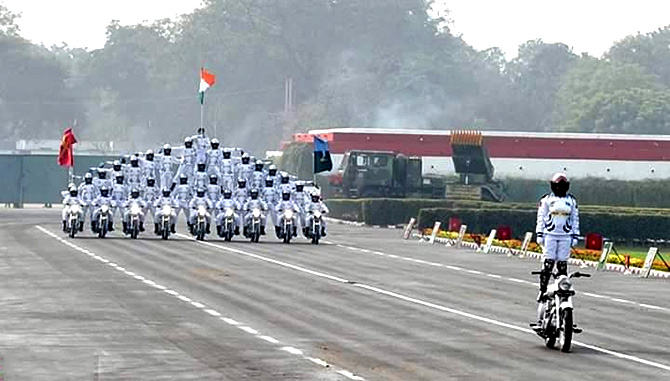
Captain Shikha Surabhi is the first woman to lead a formation of 36 men and 9 Royal Enfields of the Indian Army’s motorcycle display team on Republic Day.
She tells Rediff.com‘s Archana Masih how she made space for herself in a team that has never had a woman before. 

                                                                                                        IMAGE: Captain Shikha Surabhi is an officer in the Corps of Signals. She has also participated in three National Games. All Photographs kind courtesy Captain Shikha Surabhi                                                                                                                                 

It is after a long time that Captain Shikha Surabhi is getting two consecutive free days, and she is on her way to the railway station in New Delhi to pick up her father, an LIC agent in Bihar.

Her family is arriving to see her on Rajpath on the nation’s grand day when she will lead a formation of 36 men and 9 Royal Enfields of the Indian Army’s motorcycle display team on Republic Day.

She will stand on top of the bike for a distance of 2.4 kilometers to salute the President of India, the supreme comander of India’s armed forces. The bike will only be maouevered by her legs and will move at 22 to 23 km per hour.

The team called ‘Daredevils’ consists of 136 jawans, two male officers and 34 motorcycles.

She is the first lady officer to be part of the team.

Born in Arrah, Bihar and raised in Hazaribagh, Jharkhand, Captain Shikha learnt to ride a bike around her home as a girl and picked up serious biking after her first posting in Arunachal Pradesh.

She did a bike trip from Shimla to Ladakh over 8 days last year. “It brought strength to my arms and taught me how to handle rain, mud and difficult situations,” says the officer from the Corps of Signals who was encouraged by her commanding officer to be part of the Daredevils team.

Posted in Bathinda, Punjab, she volunteered to be part of the Daredevils team three months ago.

Selected after a month’s training in Jabalpur, Madhya Pradesh, the team has been undergoing rigorous practice for three months.

IMAGE: Leading a human pyramid formation that will be at the parade on Republic Day. Two male officers are leading other formations.


“My team members were initially worried about how they would teach me. They weren’t sure if I would be strong enough, but they now tell me I have learnt fast, perhaps faster than them,” says the officer who will soon complete four years of service in the army.

“It is tough to prove yourself. You have to put your mind and body to it, but they have accepted me as a Daredevil officer.”

“I have had some injuries, but thankfully nothing major,” she says over the phone from New Delhi.

The team arrived in Delhi on December 18 and has been practicing every day, rising at 3.30 am.

Not really nervous about the big day, her only concern is the chance of rain. Heavy rain can make the bike unsteady.

“Rain or no rain, we have to perform 100%.”

Captain Shikha’s main motivation to pursue sport and a career in the army was her mother, who is a sports teacher at a school in Ranchi.

“I am from a Hindi medium school and because of sports, I participated in three National Games,” she says.

Hand wrestling and kick boxing were her events. She was even part of the army’s mountaineering team that trekked to the Gangotri glacier in Uttarakhand.

“I wanted a job with some physical activity,” says Captain Shikha who earlier wanted to be an IPS officer but seriously considered the army as a profession while studying computer science in college.

“The armed forces are a very good profession for girls. You have respect within the army as well as outside.”

“It also gives you many opportunities like a life of adventure. I wanted to do something for the nation and nothing is better than the army.”

Her younger sister, who is in Class 12, wants to follow her in the armed forces while her brother is in Mumbai trying to pursue an acting career.

Such was the officer’s commitment to the Daredevils display on Republic Day that she and her fiancé, also a captain in the army, postponed their wedding from December to May.

Fiancé Captain Ankit Kumar will be there to watch the parade with his parents and has been her biggest pillar of support as far as biking is concerned.

He is immensely proud that she has worked hard and made space for herself in a team that up till now only comprised men.

As Captain Shikha Surabhi’s big day dawns, she is overwhelmed with the opportunity and the privilege given to her.

“I am too happy, nothing could beat this feeling but in life you should crave for the next thing — and there are more things to do ahead — for the country and myself.”

Source….. Archana Masih in http://www.rediff.com

NatarajanK


India Cracks Down Fake Food Videos: 5 Viral Hoaxes You Need To Keep in Mind….

How many times have you believed a video or a message you received without verifying its contents? I am guilty of doing this and can say that I have learnt my lesson.

While fake news and videos spread malice about all kinds of events, people and things, the FSSAI recently started a campaign to safeguard consumers against misinformation about food products in India.

To curb the spread of such content on social media, the government has instructed Google and Facebook to take down ‘false and malicious’ content that spreads wrong information about the safety and quality of food in India.

Here are 5-hoax warnings that have created panic among consumers:

1. Melamine in milk

Several news reports last year mentioned that the Food Safety and Standards Authority of India (FSSAI) CEO Pawan Agarwal had allowed the use of melamine in milk.

They spoke of a WHO advisory that ‘if adulteration of milk and milk products is not checked immediately, 87 per cent of citizens would be suffering from serious diseases like cancer by the year 2025 (in India)’.

A viral video shared by Rohit Borana on Facebook garnered a whopping 1.8 million views and was shared over 87,000 times.

Fact: FSSAI had ascertained that no such advisory was issued by the WHO at all. It appears that the report first appeared in one newspaper, and later was picked up by other newspapers. FSSAI and/or WHO was not even approached for clarifications.

Subsequently, as of November 2018, the advisory by which the messages were being circulated has been deleted.

2. HIV contamination in Frooti pack

I remember the scare this message caused. In 2013, a message was doing the rounds, allegedly from the Delhi police. It spoke about a worker adding his HIV/AIDS-contaminated blood to a batch of products and warned people to stay away from buying them.

Fact: The message turned out to be false. The Delhi police had neither sent it nor had such an incident occurred.

Subsequently, Parle Agro, the company, which manufactures Frooti, also issued a statement, which can be accessed here.

3. Plastic cabbage from China

There is a very high probability of your having seen this video and feeling enraged at the level of contamination in our fruits and vegetables.

A mobile video that emerged from Ambala in Haryana showed a man ladling colourful liquids in a large bowl of water and then shaping the substance to look like a “real” cabbage.

Several media houses picked up this story, and it invited outrage on the thought that a majority of the cabbage we were consuming was made of plastic and was being sneaked into the country from China.

Fact: A little bit of research revealed that the video was actually about wax food replicas used as displays outside restaurants in Japan. The video was also at least two years old and had Korean subtitles with a logo of SBS (Seoul Broadcasting System) and a dubbed voice-over.

4. Kurkure contains plastic

This is something I believed for the longest time after watching videos claiming that Kurkure contains plastic. PepsiCo, the company that manufactures Kurkure, had to legally take action and get a court order against Facebook, requiring the company to censor all posts linking the product to plastic.

Fact: Products like Kurkure are fried at a very high temperature to ensure their crispiness. A compound called acrylamide forms during the process of frying. Due to its presence, the final product burns when lit with a matchstick, also turning black due to the unburnt carbon particles. It does not, however, contain any added plastic.

5. Plastic rice   

Social media platforms like Facebook and Twitter were rife with speculations about the prevalence of plastic rice in parts of Andhra Pradesh and Telangana. While there was no real evidence to show that plastic rice existed, there were several videos online with tips on how to verify whether or not the rice was real.


Fact: According to the Rice Traders Association, the cost of rice is cheaper than the cost of plastic rice. Also, all scrutiny in a scientific lab also proved that there is no such thing called plastic rice.

While the videos and messages will continue to pour in, it is imperative that we exercise caution as well as restraint while believing in them and spreading them among others.

You could also report such messages by doing the following:

  1. Register complaints via the app

2. To complain via e-mail

Write to grievance_officer_wa@support.whatsapp.com.

As informed and conscientious citizens, we should report content that is malicious, false or even derogatory rather than being a part of the problem.

(Edited by Shruti Singhal)

Source…….Vidya Raja in http://www.the better india.com

Natarajan


Message for the Day….” What is a true Pilgrimage and the Benefits arising out of it ….”

If you visit holy places like going for a picnic without necessary mental preparation to receive God’s Grace, you will be a nuisance, spoiling the atmosphere of the sacred place. You go from place to place, like postal parcels, collecting impressions on the outer wrapper, not on the core of your being. You do not allow the holiness of the place to act on your mind. As a result of the pilgrimage, your habits must change for the better, your outlook must widen, your inward look must become deeper and become more steady. You must realise the omnipresence of God, and the Oneness of Humanity. You must learn tolerance and patience, charity and service. After the pilgrimage is over, sitting in your own home and ruminating over your experiences, you must determine to seek the higher, the richer and the more real experience of God-realisation. I bless you that you may form that determination and strive step by step to achieve that Goal.

Source………http://media.radiosai.org/

Message for the Day …..” All opportunities of service should be regarded as an offering to God and every opportunity to serve should be welcomed as a gift from God. When you serve in this spirit, in due course, it will lead you to attain self-realisation.”

The human body is like a chariot and the Atma (Soul) is the charioteer. The many million bodies in the Universe may have different forms and names. But the Atma(Soul) is one and the same. It is essential to recognise the unity that underlies the apparent diversity. For instance, hunger is common to all, though the food through which it is appeased may vary from an emperor to a beggar. Likewise, joy and grief, birth and death are common to all. Atma is common to everyone. Recognising this oneness, you must engage in service. Service as an act of Dharma (righteous duty) can be offered only by the one who is pure in heart, selfless and equal-minded towards everyone (Samatva). All opportunities of service should be regarded as an offering to God and every opportunity to serve should be welcomed as a gift from God. When you serve in this spirit, in due course, it will lead you to attain self-realisation.

Source…. http://media.radiosai.org/


This 12-Yr-Old Boy Has Invented A Device Which Can Help Rid Our Water Bodies Of Plastic Pollution…!

Shocked at the news of the death of a pilot whale in Thailand due to consumption of plastic bags, Varun Saikia, a 12-year-old boy from Vadodara, wanted to design a machine which could help in cleaning polluted water bodies. Curious about the causes of plastic pollution prevalent in water bodies, he started researching more about the topic. Soon, he realised that it was a major global environmental problem and many countries have been grappling with the issue.

h “I thought of making a machine that would clean and collect all the floating plastic waste in rivers, ponds and lakes. Plastic floats on water bodies which makes it harder to scoop up and collect”, shares Varun Saikia, an eighth class student from Navrachana School, Vadodara. He came up with this idea in an attempt to combat the increasing pollution problems. His innovative device is named Makara which is designed to sweep the polluted ponds of our cities. What sets this device apart is that it is completely battery-operated which would reduce the manual work involved in cleaning.

Concerned about the increasing environmental pollution, he kept reading about adverse changes that have taken place all over the world as a result of pollution. He also came to know about the Great Pacific Garbage Patch and how it impacted ocean bodies on a major scale. He was distressed to learn about water pollution and he finally decided to come up with a solution which could be implemented in nearby localities and polluted water bodies.

What is Makara?

Makara is a concept that uses the fluid mechanics of water to direct the plastic towards the receptacle without using any extra force other than the same mechanism which drives the machine forward. It is a simple machine yet sturdy in its structure. Propelled by a basic motor and remote, it can be customised to increase its capacity by using a heavy-duty motor and making adjustments to pulley.

Based on its current capacity, it can collect up to three kg of floating garbage in one go.  The machine is ideal for catching floating Styrofoam cups, plastic bottles and bags and dead floating insects. What makes it unique from other pond and ocean cleaning devices is its mobility in water bodies. Another added advantage of this machine is that unlike other models, it doesn’t need to be installed around the polluted water bodies. It could be effortlessly used to clean swimming pools as well.

Varun narrates, ”This model is made up of a paddle wheel operated by a motor and a pulley. It can be controlled using a remote. The paddle wheel pushes the vessel ahead and navigates the floating garbage to the net tail bin. The tail bin is attached to a basket which could be removed to unload the floating garbage collected inside it.”

He opines that using such simple models could extensively contribute in clearing garbage from polluted lakes and ponds. Apart from this, it would also be beneficial for the manual labourers working nearby dirty ponds or municipal workers cleaning these polluted water bodies as it is hazardous to their health and well-being. Scaled up, this model can work on larger bodies of water and even oceans. It could help to save our marine life and balance aquatic ecosystem largely. Talking of his future plans, he shares, “With heavy duty motor and bigger scale model, this vessel has the potential to clean up the coastal areas and it could be even workable on oceans. With proper funding, I wish to use this model to sweep oceans too. I even plan to make it energy efficient by generating hydroelectricity in future.”

He aims to develop this model so that he could view it working on a larger scale. What sparked his curiosity about increasing pollution has led him to design a model which would help to eliminate this problem. Such young ignited minds are taking the winds of change ahead.

Source….Ankita Singh in https://thelogicalindian.com/

Natarajan