Young moon, refracted by atmosphere
Pl click the link above and read the story as appeared in http://www.earthsky.org
Natarajan
Young moon, refracted by atmosphere
Pl click the link above and read the story as appeared in http://www.earthsky.org
Natarajan
Source: http://media.radiosai.org/
Human birth is most sacred and rare (Jantunam nara janma durlabham). The word manava (human being) also means one who is sacred. Why do we resort to debasing such a sacred human being? People advocate several good and sacred things, but when it comes to practice, they back out. When a conflict arises between precept and practice, you must have the courage to stand up to the situation and make every effort to tread the sacred path. You will, in your day-to-day life, encounter several people with bad qualities and wrong behaviour. Do not join their company. Offer them a salutation (namaskar) and move away. You may ask, why we should offer salutations to evil people. We salute good people, so as to not lose their company. We also salute the evil people requesting they move away from us. We must join the company of good people, cultivate good qualities, and lead a good life, thus sanctifying this precious life.
About 200 km northeast of the Sudanese capital, Khartoum, in a valley known as Nubia, lies the remains of three ancient Kushite kingdoms. Here, one can find the largest concentration of ancient Pyramids ever built.
Although less famous than the Pyramids at Giza in Egypt, and smaller in size than their Egyptian cousins, the Nubian pyramids are no less remarkable. These pyramids were built around 2,500 years ago, long after the Egyptians had stopped entombing their Pharos in massive tombs, a practice that nearly bankrupted them. The Nubian kings, however, were clearly fascinated by these mammoth structures and attempted to imitate them.
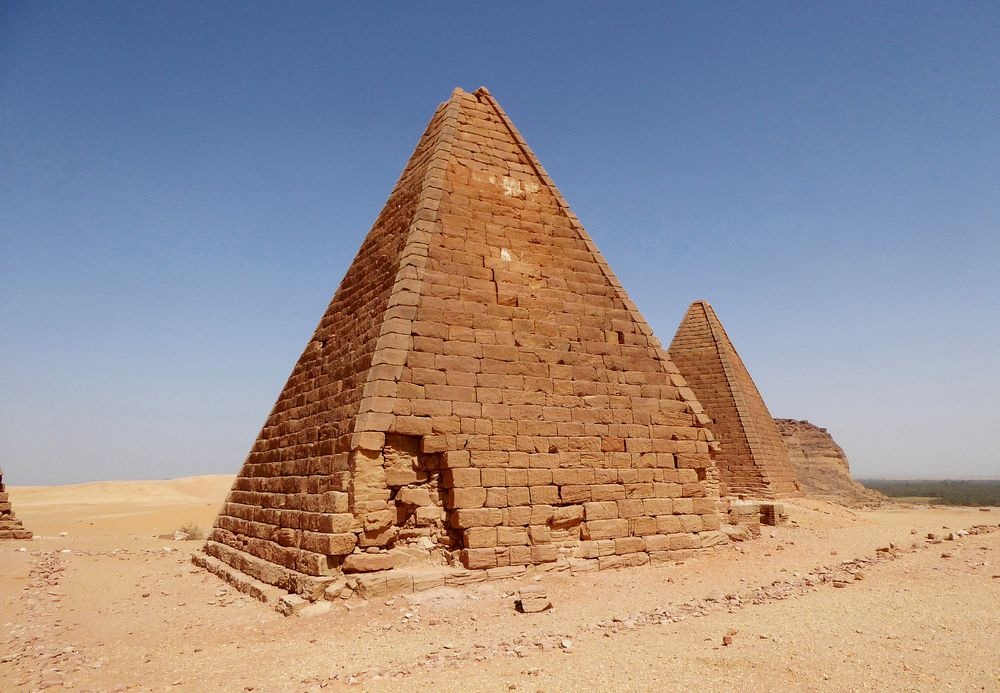
Photo credit: Hans Birger Nilsen/Flickr
The Kush Kingdom flourished for 900 hundred years from around 800 BC to 280 A.D. and held power over a vast area covering much of the Nile Delta and as far south as Khartoum. Meroe served as the capital during the final phases of the empire. Here, at their capital city, the Nubians built about 80 radically downsized pyramids over the tombs of kings and queens of the Kushite kingdom. They range in height from 20 feet to 100 feet, and rise from fairly small foundation that rarely exceed 25 feet, giving the sides of the pyramids steep angles. One of the largest of the pyramids built for the rulers of Kush was for a woman, Queen Shanakdakheto (170-150 B.C.E.). The sides of the pyramids are adorned with decorative elements from the cultures of Pharaonic Egypt, Greece, and Rome.
Altogether, the Kush rulers built more than 250 pyramids—more than twice the number of pyramids in the entirety of Egypt. They are distributed in a small region in the Sudanese desert.
Like the ancient Egyptians, the Nubian kings were mummified and laid to rest, covered with jewels, in wooden coffins, before they were entombed. Nearly all of the pyramids have been plundered ages ago. At the time of their exploration by archaeologists in the 19th and 20th centuries, some pyramids were found to contain the remains of bows, quivers of arrows, archers’ thumb rings, horse harnesses, wooden boxes, furniture, pottery, colored glass, metal vessels, and many other artefacts attesting to extensive Meroitic trade with Egypt and the Hellenistic world.
Today, Meroe is the largest archaeological site in Sudan, and one of the main tourist attractions in Sudan. But the country, devastated by civil war, now receives fewer 15,000 tourists per year.
Source….Kaushik in http://www.amusingplanet.com
Natarajan
Source: http://media.radiosai.org
Do not run after all and sundry who repeat textbook materials and wear the cloak of fakir-hood (mendicancy). Examine their daily conduct, motives, their advice, and the relationship between what they say and do. Stick to your faith; do not change your loyalty as soon as something untoward happens or someone whispers about somebody else! Do not pull down Sai Baba’s picture from the wall and hang some other picture at your first disappointment. Leave all to Him; let His will be carried out — that should be your attitude. Unless you go through the rough and the smooth, how can you be hardened? Welcome the light and the shade, the sun and the rain. Do not think that only those who worship a picture or image with pompous paraphernalia are devotees. Whoever walks straight along the moral path, whoever acts as they speak and speaks as they have seen, whoever melts at another’s woe and exults at another’s joy — they are devotees, perhaps greater devotees.
Three drunken guys entered a taxi after a heavy night of drinking.
Immediately realizing that the men were inebriated, he quickly thought up a plan to get rid of them.
He started the engine, turned it off again and said: “We have reached your destination”.
“Alright pal, here you go,” said the first guy as he gave him the money.
The second guy thanked him enthusiastically.
The third guy slapped him across the face with brute force.
“What was that for?” Yelled the surprised driver, thinking he was caught.
“Next time don’t go so fast! You nearly killed us!”
Source….www.ba-bamail.com
Natarajan
Source: http://media.radiosai.org
What exactly is the meaning of ‘Sai Baba’? Sai means Sahasrapadma (the thousand petalled lotus), it means Sakshatkara(realisation or direct experience of the Lord), Ayi means mother, and Baba means father. Thus, ‘Sai Baba’ means He who is both Father and Mother and the Goal of all yogic endeavour; the ever-merciful Mother, the All-wise Father, and the Goal of all spiritual efforts. My advent is to establish righteousness (dharma samsthapana). When you are groping in a dark room, you must seize the chance when someone brings a lamp into the room. You should hurriedly collect your belongings that are scattered there, or discover where they are located, or do whatever else you need to do with the light. Similarly make the best of the chance when the Lord descends in a human form and save yourself from disaster. The undue importance that you now attach to the satisfaction of sensual desires must diminish as a result of your association with sacred books and saintly personages.
We use phrases, expressions, and proverbs on a daily basis when conversing with each other. Whether you’re at home, hanging out with some friends, or at work, chances are that you’ve uttered one of the phrases below more than once in your life. But, do you ever stop to think about what these expressions really mean? Where they come from? The answer to this is probably no, so let’s take a look at 8 common phrases and learn where there came from.
1. It’s Raining Cats and Dogs
Houses used to have thatched roofs. These roofs had thick straw piled together to form a ceiling, but there was no wood underneath.
So how did this phrase come about? Well, according to a popular theory, on cold nights, animals such as cats, dogs, mice, and rats would climb onto these roofs in order to have a warm place to sleep. Unfortunately, when it started to rain, the thatched roofs got so slippery that cats and dogs would slip and fall off the roofs. Therefore, when it rained heavily, it would literally rain cats and dogs (and whatever other animals were on the roofs).
2. Mad as a Hatter
The average person will probably tell you that this famous expression comes from Alice in Wonderland, but they’d be sorely mistaken. The Mad Hatter character isn’t the reason you use this phrase when describing someone who has lost their mind.
The true origin goes back to the days when actual hatmakers used mercury to construct their hats. The mercury poisoned the hatmakers and affected their nervous systems. Mercury causes aggressive, heavy mood swings, and erratic behavior and, as a result, “mad hatter’s disease” became the nickname for mercury poisoning, and the expression has been popular ever since.
3. Cat Got Your Tongue?
This is often used when someone is silent or at a loss for words. Surprisingly though, it has nothing to do with cats. In the English navy, punishments were handed out in the form of a flogging, which was carried out with a whip known as a cat-o’-nine-tails.
This was a formidable weapon, and the pain from being flogged by it was so bad that it caused its victims to go mute. They would often be afraid to speak and would often remain mute for a long time after a flogging.
Drunken navy sailors would then walk around shouting, “Cat got your tongue?” as a way of taunting the victims. So, next time you’re rendered speechless because someone made a really good point, remember that it could be a lot worse.
4. Bring Home the Bacon
There are a number of theories as to where this phrase comes from, but the two most popular include pigs.
According to one theory, this phrase comes from winners at state fairs bringing home the greased pigs they caught in competitions. However, the more popular theory is that highly successful men back in the day would buy pork, cook some bacon, and then hang it on their walls when they had guests over. This showed everyone how successful the men were. Walking into a man’s house and seeing bacon hanging on the wall meant that he was to be respected. In this particular case, bringing home the bacon was the ultimate sign of power and class.
5. Eat Crow
Usually, we have to “eat crow” when we’ve been proven wrong after taking a strong stance on something.
The expression originates from where you’d expect. Crow meat tastes bad and is hard to swallow. The simple connection to this term can start and end here, but there’s an even more interesting origin story.
Back in 1812, an American accidentally went hunting across British enemy lines. The US soldier was caught shooting and killing a crow by a British soldier. As punishment, the British soldier, after praising the American for his accurate shooting, tricked him into giving up his gun.
Now armed, the Brit pointed the gun at the American and forced him to take a bite out of the crow. After the American complied, he was given back his gun. Angered, the American then turned the gun on the British soldier and forced him to eat the rest of the bird.
6. On Cloud Nine
It’s often thought that this is a reference to Heaven, but this is not true.
According to one known origin of this expression, one of the classifications of clouds, defined by the US Weather Bureau in the 1950s, is known as “Cloud Nine.” This is a type of fluffy, cumulonimbus type of cloud.
So, what makes this cloud so special? Well, this cloud is considered to be the most attractive in the cloud community, which is what gives the phrase it’s positive connotation.
7. Crocodile Tears
For those who may not know, this expression refers to someone who is faking crying or pretending to be upset. When they do this, they are said to be shedding crocodile tears.
Did this phrase come about because crocodiles never cry? Well, no, the origin is a lot more interesting than that. In an ancient anecdote, Photios claimed that crocodiles cry to strategically lure their prey closer to them. When the prey is close enough, the crocodiles drop the act and go in for the kill.
8. Don’t Throw the Baby Out with the Bathwater
This strange expression goes all the way back to the 1500s. Believe it or not, but people in the 16th century only bathed once a year, and to make matters worse, entire groups used to bathe in the same water.
The men would go first, then the women, and then the children and babies went last. The water was so dirty by the time the babies got in, that they often came out clouded. Sometimes, mothers had to make sure that the babies weren’t literally thrown out with the dirty bathwater.
The phrase, “don’t throw the baby out with the bathwater,” now means that you should make sure you don’t throw out anything valuable while getting rid of unnecessary things. Nothing is more valuable than a newborn baby, so the phrase still rings true even to this day.
Source: listverse
Natarajan
Images: depositphotos
The granite quarries located along the Nile, in the city of Aswan, supplied some of the finest quality stones for the construction of temples, sculptures and monuments in ancient Egypt. The famous Cleopatra’s Needle, now located in London, as well as several structures in the pyramids of Khufu, Khafre and at Giza were constructed from stones quarried in Aswan.
In the northern region of Aswan’s stone quarries lies an Unfinished Obelisk, resting on its side. It was supposed to be the tallest and the largest obelisk ever erected in Ancient Egypt. Unfortunately, the obelisk was never completed. While carving, cracks began to appear in the granite causing the project to be abandoned. Because the carvers had carved it directly out of the bedrock, it can be found exactly where it was 3,500 years ago—its bottom side still attached to the bedrock.
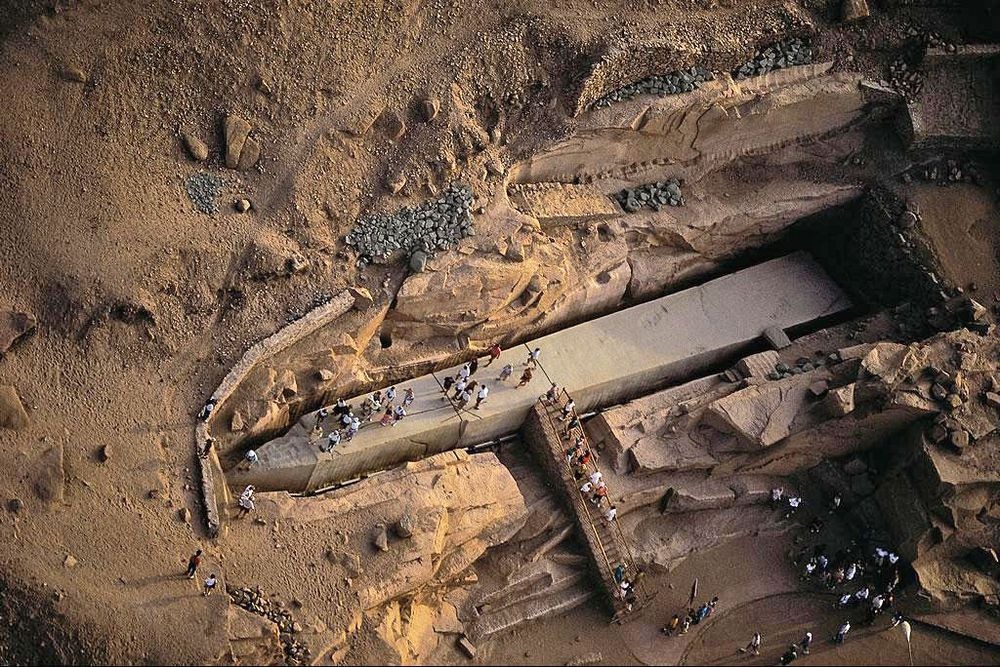
It is believed that the obelisk was constructed and abandoned during the reign of Queen Hatshepsut in the 15th century BC. The obelisk was commissioned perhaps to complement the Lateran Obelisk which originally stood at Karnak Temple in Egypt but was later taken to Rome by the Romans. If completed, it would have stood approximately 137 feet, and would have been the heaviest obelisk ever erected in Ancient Egypt.
The unfinished obelisk offers unusual insights into ancient Egyptian stone-working techniques, as the scratches made by the workers’ tools can still be seen clearly on its rock surface. Some ocher-colored lines were also found on the surface, which were probably drawn to mark the places where the workers were supposed to carve out the granite. Archeologists believe that the Ancient Egyptians used small balls of Dolerite, which is a type of rock harder than granite, to cut through the rock. Once the sides were cut down into the rock, the obelisk had to be separated from the bedrock. For this, they dug small cavities in the body of the rock along the line of desired detachment and those cavities were filled with wood spikes. The wood was then thoroughly wetted with water until it expanded causing the rock to crack along the drawn lines and finally got detached from its base.
The entire quarry is now an open museum and arranged to preserve these structures as archaeological treasures of the country.
Source….Kaushik in http://www.amusingplanet.com
Natarajan
Source: http://media.radiosai.org/
Do not be carried away by others’ opinions – either good or bad. Develop your own line of thinking, based on your conscience. Develop self confidence. Where there is self-confidence, there will be self-satisfaction. Where there is self-satisfaction, there will be self-sacrifice. And through self-sacrifice comes self-realisation. Self-confidence is the foundation for the building; it remains below the surface of the earth. Self-satisfaction represents the walls, self-sacrifice is the roof, and the life in this house is self-realisation. Without the foundation of self-confidence, self-realisation cannot be achieved. Therefore, build up your self-confidence slowly. In this process, start early, drive slowly and reach your goal of self-realisation safely. First and foremost, develop love. It is easier to cultivate love than all other qualities. There is nothing in this world which cannot be achieved with love.
Pl click the link below and read the story as appeared in http://www.earthsky.org
Natarajan
See it! Moon passes Venus and Mars

