Did you jump for joy when you heard coconut oil was no longer on the “bad foods” list? If you’re one of the many doing cartwheels down supermarket aisles and piling your cart high with every coconut item on the shelf, you may want to read on to find out if your jubilation is truly justified.
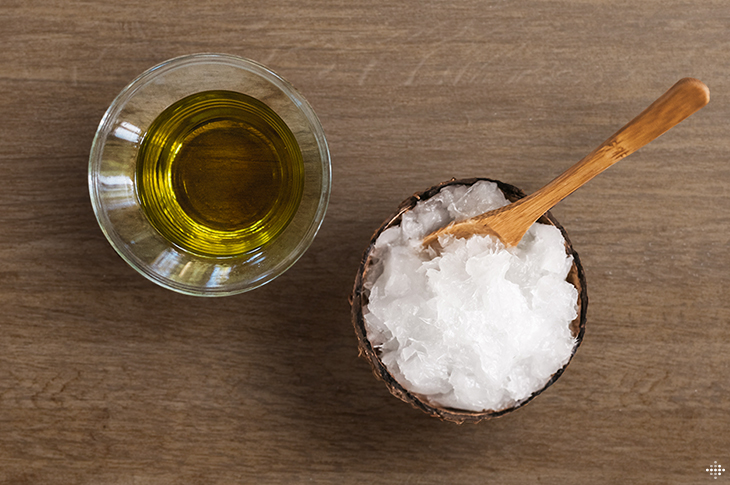
When comparing coconut oil to other fats, it does have some redeeming qualities. However, it’s not exactly the healthiest oil out there. It just doesn’t measure up when you pit virgin coconut oil(VCO), which is mechanically extracted from the coconut meat or milk, against extra virgin olive oil (EVOO), the juice squeezed or cold pressed directly from the olive fruit. (Neither oil extraction process involves the use of potentially harmful chemicals.) Take a look at how they fare against each other in five categories: fats, vitamins, antioxidants, health benefits, and cooking.
Extra Virgin Olive Oil |
Virgin Coconut Oil |
| Nutrition Facts: Serving Size: 1 tablespoonAmount Per ServingCalories 120Total Fat 14 g
Cholesterol 0%* Vitamin E about 2mg Vitamin K about 8µg Polyphenol Antioxidants at least 36 *percent of total fat value |
Nutrition Facts: Serving Size: 1 tablespoonAmount Per ServingCalories 120Total Fat 14 g
Cholesterol 0%* Vitamin E about 0.01mg Vitamin K 0.1µg Polyphenol Antioxidants about 6 *percent of total fat value
|
Winner in the Fats Category: EVOO
The great news is both oils are very low in the worst type of fat—trans fat. But that’s where the similarity ends. EVOO is predominantly heart-healthy monounsaturated fat, while VCO is almost 90% saturated fat (that’s almost double the amount found in butter!). Some research shows coconut oil, which contains lauric acid, a medium chain triglyceride (or MCT) that is easier to burn as energy and less likely to be stored as fat, has the potential to increase good HDL cholesterol levels. Unfortunately, less than half of the saturated fat is lauric acid—the other half is still harmful saturated fat. And even through saturated fats aren’t all bad for us, they haven’t been proven healthy either. It’s still a good idea to limit total saturated fat, including from tropical oils like coconut, as the evidence backing the health benefits of diets low in saturated fat is just too strong to ignore.
Winner in the Vitamins Category: EVOO
The only notable micronutrients the oils contain are vitamin E, an antioxidant shown in studies to have properties that may protect against heart disease and certain cancers, and vitamin K, which is essential for blood clotting and healthy bones. And in this case, the olive is mightier than the coconut, as EVOO contains 160 times more vitamin E and 120 times more vitamin K than VCO.
Winner in the Antioxidants Category: EVOO
The main antioxidants you’ll find in both oils are polyphenols. EVOO contains significantly higher levels (40 times more!) with at least 36 different polyphenols—that’s a lot of highly bioavailable, disease-fighting antioxidants. VCO only contains about six different polyphenols.
Winner in the Health Benefits Category: EVOO
There is an enormous body of evidence supporting the health benefits of EVOO. The high levels of monounsaturated fats and antioxidants in EVOO, have been shown to improve heart health, aid weight control, decrease the body’s inflammatory response, and reduce the risk of certain cancers.
Until more research is conducted, the same cannot be said about VCO. Although it has been linked to many conditions, including weight loss, cholesterol, diabetes, chronic fatigue, Crohn’s disease, irritable bowel syndrome, and thyroid issues, there is insufficient scientific evidence to rate the effectiveness of coconut oil.
Winner in the Cooking Category: EVOO
Unrefined oils like EVOO and VCO have lower smoke points (the temperature at which oils begin to smoke and become less healthy) than refined versions. According to the International Olive Council, EVOO has a smoke point roughly around 410°F, making it great for sautéing, frying, and baking (below 410°F). VCO has a lower smoke point (up to 350°F) and is best used when sautéing over medium heat, or as a replacement for butter or shortening for medium-heat baking.
Overall Champion: Extra Virgin Olive Oil!
EVOO is the stand out winner when it comes to levels of heart-healthy, monounsaturated fats, vitamins, antioxidants, health benefits, and cooking. Virgin coconut oil can be used occasionally when a recipe calls for a solid fat, such as butter or shortening, or when cooking Asian cuisine—but adding oodles of the stuff to your morning smoothie isn’t going to do you any good. For undisputed health-boosting benefits, make extra virgin olive oil your go-to.
source….Tracy Morris in http://www.blog.fitbit.com
Natarajan
Tracy Morris holds a master’s degree in nutrition and dietetics. She has owned a nutrition consultancy and worked in private practice in Sydney, Australia and Cape Town, South Africa. Over the past 15 years, Tracy has lived in five different countries and has inspired people around the globe to be healthy. Currently, she is happily settled in Northern California where she writes, practices Pilates, runs after her three kids, and sips pinot noir with her husband.
 Take off with Natarajan