Looking Up and Up Eiffel Tower !!!

Built in 1889 as the entrance arch to the World’s Fair, the 320 meter (1,050 ft) tall Eiffel Tower, located on the Champ de Mars in Paris, is undoubtedly one of the most iconic structures in the world. For 41 years it held the title as the world’s tallest man-made structure until the completion of the Chrysler Building in New York City in 1930.

The Eiffel Tower’s iconic design is recognized around the globe, however the view looking up the tower from below is not as familiar. The perspective offers a different view for photographers, and the gallery below shows how a creative eye can bring a new dimension to such a well known structure.

The Eiffel Tower Seen from Below

Eiffel Tower

Eiffel Tower

Eiffel Tower from below!

Looking up the Eiffel Tower

Eiffel Tower From Below, Paris, France

source:::::twistedSifter.com

natarajan

பேசும் { புகை } படங்கள் !!!

சத்சங்கி…
பஞ்சாப் மாநிலம் லூதியானாவில் 1944ம் ஆண்டில் பிறந்தவர், சிறுவயது முதலே புகைப்படத்தின் மீது ஆர்வம் கொண்டவர். 1961ம் ஆண்டு ஆக்பா அறிமுகம் செய்த பாக்ஸ் டைப் கேமிராவை பதினெட்டு ரூபாய் எழுபத்தைந்து பைசாவிற்கு வாங்கி தனது புகைப்பட வாழ்வைத்துவக்கியவர்.
என்ஜினியரிங் முடித்துவிட்டு வியாபாரத்தில் ஈடுபட்டு அதன் மூலம் பரபரப்பான வாழ்க்கை வாழ்ந்து முடித்தவர், தற்போது சென்னையில் தன் மனைவியுடன் அழகான ஒரு பிளாட்டில் புகைப்படமே வாழ்க்கை என வாழ்ந்து கொண்டு இருப்பவர்.
கடந்த 89ம் ஆண்டில் இருந்து சீரியஸ் புகைப்படக் கலைஞரானவர். வைல்டு லைப், லேண்ட்ஸ்கேப், மைக்ரோ, போர்ட்ரெய்ட் என்று புகைப்பட பிரிவின் அனைத்து பிரிவிலும் தனது முத்திரையை பதித்தவர்,
படம் எடுப்பதற்காக ஹாங்காங், மலேசியா, இந்தோனேசியா, கம்போடியா, ஆஸ்திரேலியா, அலஸ்கா, தான்சானியா, கென்யா, ஜாம்பியா, ஜிம்பாப்வே மற்றும் போஸ்வானா ஆகிய நாடுகளுக்கு போய்வந்தவர்.
புகைப்படம் தொடர்பான சர்வதேச போட்டிகளில் கலந்து கொள்பவர், இவரது படங்கள் பல முறை சர்வதேச பரிசுகள் பெற்றுள்ளது. அமெரிக்காவில் உள்ள போட்டோகிராபி அமைப்பு உலகம் முழுவதிலும் உள்ள சிறந்த புகைப்படக் கலைஞர்களின் படங்களை தொகுத்து புத்தகமாக வெளியிட்டுள்ளது. அந்த புத்தகத்தில் இவரது படமும் இடம் பெற்றுள்ளது என்பதே இவரது பெருமைக்கு சான்றாகும்.
நிக்கான் கேமிரா காதலரான இவர் ஒரே நேரத்தில் மூன்று கேமிராக்களையும், மூன்றுவித லென்சுகளையும் எடுத்துக்கொண்டு செல்வார்.
இவ்வளவு படங்கள் எடுத்தாலும் எந்த படங்களையும் காசாக்க நினைக்காதவர். தனது ஆத்ம திருப்திக்காக மட்டுமே எடுக்கக்கூடிய படங்களை பொதுமக்கள் பார்க்கவேண்டும், அவர்களும் புகைப்படம் எடுப்பதில் ஆர்வமாக முன்வரவேண்டும் என்று நினைப்பவர்.

Some of his Pictures are here…..


இவருடன் தொடர்பு கொண்டு பேசுவதற்கான எண்: 9884039713
– எல்.முருகராஜ்   in Dinamalar Tamil Daily 

natarajan

” Sorry… You are in No Parking Zone ” !!!

It turns out one Colorado cop has quite the sense of humour.

The Blackhawk was part of the Army National Guard units called in to help rescue stranded victims of the Colorado flood.

He had to park in the street, and he got ticketed for “facing the wrong way” and “parking in a no parking zone.”

We found the image on a Reddit post titled: “Blackhawk pilot must land on a street in Colorado to help in a rescue from the floods; gets this amusing ticket from local police in return.”

The Redditor also posted this image of the helicopter parked in the street and this image, as verification.

But don’t worry, another commenter claiming police experience pointed out that there “no court date” and no “section codes for violations” — so it had to be a practical joke.

Ticket Colorado


Ticket Redditq


source ::::business insider.com

natarajan

Best Views From The Cockpit !!!

The best views from the cockpit

Patrick Smith, a pilot and author of Cockpit Confidential, reveals the most memorable sights from the sky. 

On a typical 747 with four hundred passengers, a mere quarter of them will be lucky enough, if that’s the correct word, to be stationed at a window. In a ten-abreast block, only two of those seats come with a view. If flying has lost the ability to touch our hearts and minds, perhaps that’s part of the reason: there’s nothing to see anymore.

There’s something instinctively comforting about sitting at the window – a desire for orientation. Which way am I going? Has the sun risen or set yet? For lovers of air travel, of course, it’s more than that. To this day, the window is always my preference, even on the longest and most crowded flight. What I observe through the glass is no less a sensory moment, potentially, than what I’ll experience sightseeing later on. Traveling to Istanbul, for instance, I remember the sight of the ship-clogged Bosporus from 10,000 feet as vividly as I remember standing before the Süleymaniye Mosque or the Hagia Sofia.

For pilots, obviously, there isn’t much choice. We spend hours in what is essentially a small room walled with glass. Cockpit windows are surprisingly large, and although there’s often little to see except fuzzy gray cirrus or pitch – blackness, the panorama they provide is occasionally spectacular.


The best views from the cockpit

New York City

The arrival patterns into LaGuardia will sometimes take you along the Hudson River at low altitude, skirting the western edge of Manhattan and offering a breathtaking vista of the New York skyline – that “quartz porcupine,” as Vonnegut termed it.


The best views from the cockpit

Shooting stars (especially during the annual, late-summer Perseids meteor shower)

Most impressive are the ones that linger on the horizon for several seconds, changing color as they burrow into the atmosphere. I’ve seen shooting stars so bright they were visible even in daylight.


The best views from the cockpit

The Northern Lights

At its most vivid, the aurora borealis has to be seen to be believed. And you needn’t traipse to the Yukon or Siberia; the most dazzling display I’ve ever witnessed was on a flight between Detroit and New York. The heavens had become an immense, quivering, horizon–wide curtain of fluorescence, like God’s laundry flapping in the night sky.


The best views from the cockpit

Flying into Africa

I love the way the Cap Vert peninsula and the city of Dakar appear on the radar screen, perfectly contoured like some great rocky fishhook – the westernmost tip of the continent, and the sense of arrival and discovery it evokes. There it is, Africa! And further inland, the topography of Mali and Niger. From 30,000 feet, the scrubby Sahel looks exactly like 40-grade sandpaper, sprayed lightly green and spattered with villages – each a tiny star with red clay roads radiating outward.


The best views from the cockpit

The eerie, flickering orange glow of the Venezuelan oil fields — an apocalyptic vista that makes you feel like a B-17 pilot in 1945.


The best views from the cockpit

Similar, but more depressing, are the thousands of slash-and-burn fires you’ll see burning throughout the Amazon. Some of the fire fronts are miles long – walls of red flame chewing through the forests.


The best views from the cockpit


Compensating for the above are the vast, for-now untouched forests of Northeastern South America. Over Guyana in particular the view is like nothing else in the world – an expanse of primeval green as far as the eye can see. No towns, no roads, no clear-cutting or fires. For now.


Climbing out over the “tablecloth” – the cloud deck that routinely drapes itself over Table Mountain in Cape Town, South Africa.


The best views from the cockpit

The frozen, midwinter oblivion of Northeastern Canada. I love passing over the jaggedy, end-of-the-world remoteness of Newfoundland, Labrador, and Northern Quebec in midwinter – a gale-thrashed nether-region of boulders, forests, and frozen black rivers.


The best views from the cockpit

The majestic, primordial nothingness of Greenland. The great circle routes between the United States and Europe will sometimes take you over Greenland. It might be just a brush of the southern tip, but other times it’s forty-five minutes across the meatier vistas of the interior. If you’ve got a window seat, do not miss the opportunity to steal a peek, even if it means splashing your fast-asleep seatmate with sunshine.


The best views from the cockpit


Other views aren’t spectacle so much as just peculiar…

One afternoon we were coasting in from Europe, about 200 miles east of Halifax, Nova Scotia. “Gander Center,” I called in. “Got time for a question?”

“Yeah, go ahead.”

“Do you have any idea what the name of that strange little island is that we just passed over?”

“Sure do,” said the man in Gander. “That’s Sable Island.”

Sable Island is one of the oddest places I’ve ever seen from aloft. The oceans are full of remote islands, but Sable’s precarious isolation makes it especially peculiar. It’s a tiny, ribbony crescent of sand, almost Bahamian in shape and texture, all alone against the relentless North Atlantic. It’s like a fragment of a submerged archipelago—-a miniature island that has lost its friends.

“Island,” maybe, is being generous. Sable is really nothing more than a sand bar, a sinewy splinter of dunes and grass – 26 miles long and only a mile wide – lashed and scraped by surf and wind. How staggeringly vulnerable it appears from 38,000 feet.

I’d flown over Sable many times and had been meaning to ask about it. Only later did I learn that the place has been “the subject of extensive scientific research,” according to one website, “and of numerous documentary films, books, and magazine articles.” Most famously, it’s the home of 250 or so wild horses. Horses have been on Sable since the late eighteenth century, surviving on grass and fresh water ponds. Transient visitors include grey seals and up to 300 species of birds. Human access is tightly restricted. The only permanent dwelling is a scientific research station staffed by a handful of people.


The best views from the cockpit

But all right, okay, enough with the terrestrial stuff. I know that some of you are wondering about UFOs. This is something I’m asked about all the time. For the record, I have never seen one, and I have never met another pilot who claims to have seen one. Honestly, the topic is one that almost never comes up, even during those long, dark flights across the ocean. Musings about the vastness of the universe are one thing, but I cannot recall ever having had a conversation with a colleague about UFOs specifically. Neither have I seen the topic discussed in any industry journal or trade publication.

I once received an email asking me about a supposed “tacit agreement” between pilots that says we will not openly discuss UFO sightings out of fear of embarrassment and, as the emailer put it, “possible career suicide.” I had to laugh at the notion of there being a tacit agreement among pilots over anything, let alone flying saucers. And although plenty of things in aviation are tantamount to career suicide, withholding information about UFOs isn’t one of them.


The best views from the cockpit

In 2011, a poll by the website PrivateFly.com revealed travellers’ favourite airports to land at. Barra Island in the Outer Hebrides – with its unique beach runway – came out on top.


The best views from the cockpit

London City Airport (pictured), Jackson Hole, Aruba, Male, St Barts, Queenstown, Gibraltar, Narvik and St Maarten completed the top 10.


The best views from the cockpit

Paro Airport, in the Himalayan country of Bhutan, is regularly named among the scariest airports to land at. It is located in a deep valley, and landing involves negotiating a series of mountains, rapid descents and then a steep bank to the left. Only a handful of pilots are certified to land there.


The best views from the cockpit

Other scary touch-downs include Matekane in Lesotho, Saba in the Caribbean, Tenzing-Hillary airport in Lukla, Nepal, Funchal in Madeira, and Courchevel.


source::::Patrick Smith in The Telegraph …UK

natarajan


தேங்காய் பிள்ளையார் !!!!

பிள்ளையாருக்கு தேங்காய்களைக் காட்டுவாங்க..!

தேங்காய்களையே பிள்ளையாராக் காட்டினா…?

(சென்னை, கொளத்தூரில் தேங்காய்களால் செய்யப்பட்ட விநாயகர்)

source:::::Dinamani Tamil Daily

natarajan

Highest Altitude Civilian Airport In the World !!!

World's highest-altitude airport in China.

AT 4411m above sea level, a new airport in a mountainous Tibetan village sits about halfway to the cruising altitude of most commercial planes.

The Daocheng Yading Airport was opened in China on Monday, becoming the highest-altitude civilian airport in the world.

The airport is in Garzi, a restive and remote Tibetan region of south-western Sichuan province.
The first planes touch down at the world's highest altitude airport. Picture: AP
The first planes touch down at the world’s highest altitude airport.

It will cut journey times from the provincial capital of Chengdu from a two-day drive to a little more than an hour in the air.

The 1.58 billion yuan ($258 million) airport, designed to handle 280,000 passengers a year, will help open up the nearby Yading Nature Reserve to tourism, the official Xinhua news agency said, referring to an area renowned for its untouched natural beauty.

source::::news.com.au

natarajan

Read more: http://www.news.com.au/travel/news/daocheng-yading-airport-claims-world-record-for-highest-altitude/story-e6frfq80-1226720989926#ixzz2fCoRmxiX


Photos of Beautiful collection of Insects !!!

The USGS Native Bee Inventory and Monitoring Program is program run by biologists with the U.S. Geological Survey in Maryland. Part of their work is to develop identification tools and keys for native bee species by creating accurate and detailed pictures of native bees and the plants and insects they interact with. The biologists set up a mini studio surrounded by a styrofoam cooler with a black background to make their macro shots, stacking anywhere from 30 to 300 photos to get an image in focus. They have shared their collection of more than 1,200 photos online, from whuich I’ve selected the following  photos


Eugloss dilemma, a male orchid bee from the Biscayne National Monument in Florida


Leiobunum flavum, a species of arachnids known as harvestmen, from Beltsville, Maryland — from the collection of Dejen Mengis.(CC BY USGS/Sam Droege# 

Exomalopsis analis, a bee from the Dominican Republic. (CC BY USGS/Sam Droege) #


An Oak Timberworm, Arrhenodes minutus, found at a moth light owned by photographer Sam Droege.


Apple Bark Borer moth, Synanthedon pyri, found in Beltsville, Maryland.


Xylocopa cubaecola, a female Cuban Carpenter Bee, found on the base of Guantanamo Bay, Cuba.


Harlequin bug eggs, Murgantia histrionica, a common pest of brassicas, these were raised by the Weber USDA lab at Beltsville, Maryland.


Unknown Jumping spider, Beltsville, Maryland, possibly an immature Thiodina sylvana.


Augochloropsis metallica, a bee collected in Laurel, Maryland.


Unknown Wasp, Yellowstone National Park.

Buffalo Treehopper, unknown species in the genus Ceresa, Collected in Beltsville, Maryland.


Chlorion aerarium, the Steel Blue Cricket Hunter, a wasp found in Cumberland, Maryland.


Leucauge venusta, Orchard Orb Weaver, Upper Marlboro, Maryland.


Gratiana pallidula beetle, Patuxent Wildlife Research Center, Anne Arundel County, Maryland


Rove beetle, Staphylinidae, species unknown, found at moth light in Upper Marlboro, Maryland.


Trichiotinus assimilis, a common Flower Chafer scarab beetle.


Tabanidae, unknown Deer Fly form near Bowie, Maryland.


Unknown spider found March 21, 2013 in a steam tunnel underneath the Beltsville Agriculture Research Center, possibly Pholcus phalangioides. (CC BY USGS/Sam Droege# 


Tabanus atratus, Black Horse Fly, found in Upper Marlboro, Maryland.


source :::::The Atlantic  …. mail credit :::: senthil natarajan

natarajan

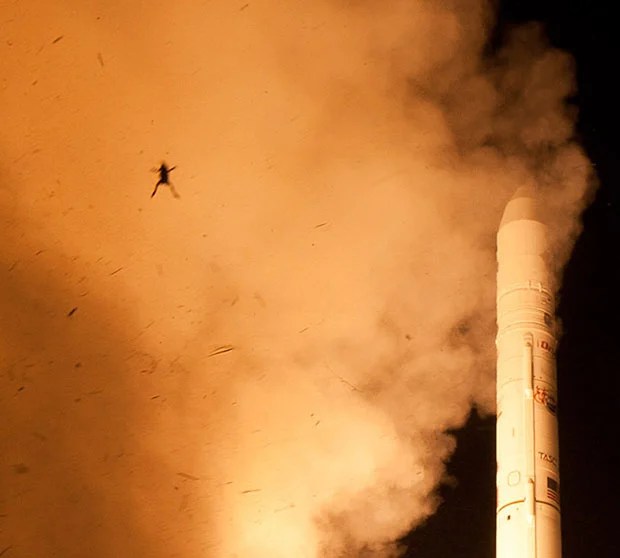
Frog Photobombs NASA Launch Photo !!!!

frogphotobomb

Check out this photograph NASA captured recently during the launch of its LADEE spacecraft. Notice anything unusual? If you’re thinking that the strange dark spot seen in the middle of the smoke plume looks familiar, you’re right — that’s a frog.

Here’s the original, uncropped version of the photo:

fullpicture


It was captured on September 7, 2013 during the launch of the Lunar Atmosphere and Dust Environment Explorer (LADEE) spacecraft. The craft will enter orbit around the Moon’s equator in order to study the exosphere and dust particles in the area.

The photograph itself was captured using a sound trigger that was set to detect when the launch sequence started. The NASA photo team has confirmed that the frog in the frame is in fact real, and states that it was captured in just one of the photos produced by the remote cameras active at the scene of the launch.

Here’s a closer crop showing our little amphibious friend:

frogcloseup

It’s a one-of-a-kind photograph. “The condition of the frog, however, is uncertain,” NASA says.


Image credit: Photograph by NASA/Wallops Flight Facility/Chris Perry   inPETA PIXEL

source:::::senthil natarajan …

Playing Tennis on the Wings Of a Flying Plane !!!

Dare Devil – Ivan Unger and Gladys Roy playing tennis on the wings of a flying airplane in 1927. — with Martim Alves de LimaNuri LomelinKhawar Mehmood,Juanjo Moreno Vélez and Bilal Ahmed…


source::::: input from a friend of mine…

natarajan

A Rabbit in The Cage Of Tiger !!!!

You might think that tiger cubs would be hard-wired to go after their prey aggressively from an early age.

But when these wild-beasts-in-training were presented with a juicy rabbit, their predatory instincts seemed to fail them.

The white rabbit simply jumped around their enclosure, eluding their grasping paws as it outpaced them.
Nervous: These tiger cubs seem not to know what to do when confronted with a rabbit


Escape: The rabbit's leaping abilities apparently enabled it to avoid a grisly fate


The charming scenes took place at Qingdao Forestry Zoo in Shandong province in northern China.

Zookeepers there put the rabbit in with the tiger and leopard cubs when they reached the age of two months.

They hoped to test how well developed the big cats’ wild instincts were by seeing if they would be able to hunt down the rabbit.

However, the intended prey was apparently able to escape the fierce animals’ attention.

Athletic: The rabbit's canny escape attempt seemed to outpace this leopard on the prowl

Success? One leopard cub got his teeth on the rabbit - but only managed to chomp on its ear


Stand-off: The tiger apparently tried intimidating the rabbit by giving it the hairdryer treatment

The tiny tigers even seemed to shy away from the rabbit, though it was only a quarter of its size.

Photographs of the chase show that the worst any of the predators was able to do was to grab hold of one of the rabbit’s ears.

The scene was presided over by a mother tiger, separated from the youngsters in another cage.


Playful: The big cats toyed with the rabbit but were not pictured going in for the kill


Disapproving: The mother tiger would have had no problems catching and eating the white rabbit

source:::::mailonline.com Uk

natarajan