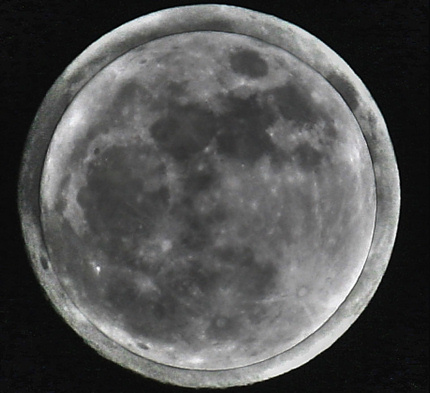
Image of the Day…Super Moon with Rainbow !!!

Waxing toward a supermoon, with rainbow

Kimmie Randall caught this photo of Thursday night’s gibbous moon, waxing toward the supermoon … with a portion of a rainbow. Beautiful!

Waxing gibbous moon on August 7, 2014, with a portion of a rainbow, by Kimmie Randall

All eyes are on the moon this weekend, with a supermoon coming up on Sunday. It’s not just any supermoon, but the closest supermoon of this year. The moon on both Saturday and Sunday nights will appear very round and full – and very beautiful. As seen from across the Earth, the moon will be rising around the time of sunset and will be in the sky all night.

Full moon falls on August 10, 2014 at 18:09 UTC (1:09 p.m. CDT in the U.S.).

The moon will be closest to Earth (356,856 km) at approximately that same time (18:00 UTC).

Read more: Most “super” supermoon of 2014 on August 10

Video: Why does the moon look so big on the horizon? It’s not because of the supermoon

Discern a supermoon’s large size with the eye? An observer says yes

Source::::Earthskynews

Natarajan

Image of the Day…California Fire Clouds…

California fire clouds

Fires raging over California last week created these towering pyrocumulus clouds – aka “fire clouds.” A close look from jets flying nearby.

Photo credit: NASA

Photo credit: NASA

These two photographs, taken from an Oregon Air National Guard F-15C on July 31, give a close look at a developing pyrocumulus cloud above the Oregon Gulch fire, a part of the Beaver Complex fire on the Oregon/California border.

Pyrocumulus clouds—sometimes called “fire clouds”—are tall, cauliflower-shaped, and appear as opaque white patches hovering over darker smoke in satellite imagery. Pyrocumulus clouds are similar to cumulus clouds, but the heat that forces the air to rise (which leads to cooling and condensation of water vapor) comes from fire instead of sun-warmed ground. Under certain circumstances, pyrocumulus clouds can produce full-fledged thunderstorms, making them pyrocumulonimbus clouds.

Here’s a satellite view of the fast-moving fires. More than 100,000 acres (400 square kilometers) were charred in a few days as fires raged through forests and grasslands in northern California. NASA’s Terra satellite captured this image on August 2, 2014. Red outlines show where MODIS detected high surface temperatures associated with active burning.

Image credit: NASA

Read more from NASA Earth Observatory

Source::::Earthskynews

Natarajan

Busiest Flight Routes in the World …

A LOT of people take to the skies every day.

A LOT of people take to the skies every day. Source: ThinkStock

Fun facts about flying coming at ya.

Did you know that every day 8.3 million people are cruising the skies on some 93,500 flights? That’s about the population of NYC. Every. SINGLE. Day.

So where are most people travelling?

Our guesses were between Rio and Sao Paulo, between somewhere and Dubai and someplace in Asia. We asked the folks at FlightStats to compile data on the busiest FLIGHT routes around the world over the course of a year, and we had the gurus at FlightAware compile the busiest flight routes over the course of a single day (July 30, in this case).

From January 1, 2013 to December 31, 2013, these were the busiest flight routes around the world:

Flight routes.

FLIGHT routes. Source: Supplied

While these routes were the busiest for the entire calendar year, different routes were more popular for a SINGLE day in 2014. The busiest route for July 30, 2014 was from Seoul’s Gimpo International to Jeju International with 94 flights. The busiest route in America on July 30 was Los Angeles International to San Francisco International with 55 flights.

For the curious, the busiest route between two American cities in all of 2012 was Chicago to New York.

As the saying goes: The more you know.

Source::::news.com.au

Natarajan

Image of the Day…Curiosity rover tracks on Mars, August 4, 2014 !!!

Mars rover Curiosity's tracks in Mars'

Today is the second anniversary of the Mars rover Curiosity’s landing inside the Martian Gale Crater on August 5, 2012, PDT (Aug. 6, 2012, EDT).

This image from the Navigation Camera on NASA’s Curiosity Mars rover shows wheel tracks printed by the rover as it drove on the sandy floor of a lowland called “Hidden Valley.” Curiosity has been crossing this valley en route to its destination, the base of Mount Sharp, the central mountain in the Gale Crater.

The image was taken during the 709th Martian sol – Curiosity’s 709th day on Mars – aka Earth date August 4, 2014.

It was one day before the second anniversary, in Earth years, of Curiosity’s landing on Mars.

See a great video of Curiosity’s descent to Mars’ surface: 7 minutes of terror

News release from NASA celebrating Curiosity rover’s second anniversary on Mars.

Source::::Earth sky news

Natarjan

Image of the Day… “Most ‘ Super’ Super Moon of 2014 on 10 August…


Most "super" supermoon of 2014 on August 10 Read more

Above image contrasting largest and smallest full moons: Stefanao Sciarpetti

Full moon falls on August 10, 2014 at 18:09 UTC (1:09 p.m. CDT in the U.S.). This full moon is not only the closest and largest full moon of the year. It also presents the moon’s closest encounter with Earth for all of 2014. The moon will not be so close again until the full moon of September 28, 2015. In other words, it’s not just a supermoon. It’s the closest supermoon of 2014.

At United States’ time zones, the moon will turn full on August 10 at 2:09 p.m. EDT, 1:09 p.m. CDT, 12:09 p.m. MDT and 11:09 a.m. PDT.

We astronomers call this sort of close full moon a perigee full moon. The word perigeedescribes the moon’s closest point to Earth for a given month. Three years ago, when the closest and largest full moon fell on March 19, 2011, many used the term supermoon, which we’d never heard before. In the following years, we heard this term again to describe the year’s closest full moon on May 6, 2012, and again on June 23, 2013. Now the term supermoon is being used a lot. Last month’s full moon – on June 13, 2014 – was also a supermoon. But the August full moon is even more super! In other words, the time of full moon falls even closer to the time of perigee, the moon’s closest point to Earth. The crest of the moon’s full phase in August 10, and perigee, fall within the same hour.

What does supermoon mean exactly? And how special is the August 10, 2014 supermoon? Follow the links below to find out.

What is a supermoon?

How super is this supermoon?

How often is moon both full and closest to Earth?

Will the tides be higher than usual?

Your best photos: May 2013 supermoon

Does a supermoon have a super effect on us?


Source::: Earth sky news

Natarajan


Image of the Day… Close View of Mercury !!!

Super-close views of Mercury

The MESSENGER spacecraft is now dropping closer to Mercury, and long anticipated, super-close views of the planet are beginning to come in.

Image via NASA / JHU / APL MESSENGER spacecraft

The image above is one of the highest resolution images ever returned of Mercury. MESSENGER acquired it on June 11, 2014. Last Friday – July 25, 2014 – MESSENGER’s periherm(closest point to Mercury) dropped below 100 kilometers / 62 miles. MESSSENGER is the first manmade object ever to come this close to Mercury.

On June 17 – around the time the image above was taken – the periherm had dropped to 113.80 kilometers / 70.80 miles. The image has absolutely incredible 2.90-meter resolution, showing a cluster of tiny secondary craters within the northern intercrater lava plains in a 3.00 kilometer / 1.86 mile wide area within Mercury’s North Polar Borealis Quadrangle.

The craters seen here are a few hundred meters at most in width, many much smaller. These are secondary craters from an impact out of this frame, where impact ejecta fell back on ballistic trajectories forming smaller craters. Many can be hundreds of kilometers away from the primary impact if the impact was large enough.

There are a handful of much smaller craters in the area too.

All of these craters in this image are of the simple bowl shaped type.

The image is a little ‘noisy’ due to the very short exposure required to prevent blurring of the image as MESSENGER was lower and faster than usual above the surface of Mercury.

On August 19, 2014, periherm will drop below 50 kilometers / 31 miles. On September 12, 2014, periherm will have lowered to 25 kilometers / 15.52 miles.

The number of such high resolution and even higher resolution images will increase as periherm continues to lower.

The fuel on board MESSENGER is expected to be depleted on January 21, 2015. MESSENGER is expected to impact Mercury during the last weekend of March, 2015.

Source:::: earth sky news site

Natarajan

Image of the Day…New Moon…

New moon: night side of moon facing Earth

What is the ghostly image at the top of this post? It’s a new moon. Its lighted half is facing entirely away from Earth.

The image above is imaginary. It’s as if you flew in a spaceship to a place where you could see the night side of the moon. Why do we say imaginary? Because, when the moon is new, its night face is facing us on Earth … and we can’t see the moon at this time.

We can’t see the new moon from Earth, except during the stirring moments of a solar eclipse. Then the moon passes in front of the sun, and the night portion of the moon becomes visible to us, surrounded by the sun’s fiery corona.

Once each month, the moon comes all the way around in its orbit so that it is more or lessbetween us and the sun. If the moon always passed directly between the sun and Earth at new moon, a solar eclipse would take place every month. But that doesn’t happen every month. Instead, in most months, the moon passes above or below the sun as seen from our earthly vantage point.

On the day of new moon, the moon rises when the sun rises. It sets when the sun sets. It crosses the sky with the sun during the day. That’s why we can’t see the new moon in the sky. It is too close to the sun’s glare to be visible. Plus its lighted hemisphere is facing away from us.

Then a day or two later, the moon reappears, in the west after sunset. Then it’s a slim waxing crescent visible only briefly after sunset – what some call ayoung moon.

Each new lunar cycle is measured beginning at each new moon. Astronomers call one lunar cycle a lunation.

As the moon orbits Earth, it changes phase in an orderly way. Follow these links to understand the various phases of the moon.

Source::: Earth sky news site

Natarajan

Can Malaysia Airlines’ Brand Survive ?

Can Malaysia Airlines’ brand survive?

Can Malaysia Airlines salvage its brand after MH370 and MH17

 tragedies?

Malaysian Airlines planes parked at the tarmac of Kuala Lumpur International Airport Pic:

Malaysian Airlines planes parked at the tarmac of Kuala Lumpur International Airport Pic: Roslan Rahman / AFP Source:AFP

MALAYSIA Airlines is in uncharted territory after the disappearance of Flight MH370 in March with 239 people aboard was followed by the downing of MH17 carrying 298 people over Ukraine.

Before the disasters the carrier had among the worst financial performance of any airline. An even bigger question mark now hangs over the future of Malaysia Airlines, with its brand tied to two almost unfathomable tragedies.

Some analysts say the state-owned airline won’t survive a year without a substantial cash injection from the Malaysian government.

A bailout would address the airline’s immediate financial problems but without far-reaching changes it could remain a burden on taxpayers and shrivel into regional obscurity.

Several experts give their views on the airline’s crisis.


A piece of the crashed Malaysia Airlines Flight 17 lies in the grass near the village of

A piece of the crashed Malaysia Airlines Flight 17 lies in the grass near the village of Hrabove, eastern Ukraine, Sunday, July 20, 2014. Pic: AP Evgeniy Maloletka. Source: AP


HOW BAD IS THE SITUATION FOR MALAYSIA AIRLINES?

Other airlines have come back from disasters but none have experienced two tragedies of such magnitude within the space of four months.

“There’s no historical precedent,” said Mohshin Aziz, aviation analyst at Maybank. “It’s completely not their fault, but right now if you ask any customers would they fly with Malaysia Airlines, they’d just have that negative sentiment of ‘I’d rather choose something else’.”

The airline was already losing about $1.6 million a day and has been in the red for the past three years. The disappearance of MH370 with many Chinese passengers on board also caused a backlash in the crucial Chinese market. Experts don’t see any short cuts to recovery.

“It cannot be a quick fix,” said Aziz. “So the second question is do they have the financial resources to survive a year, two years? And the answer is, unfortunately, no.”


Debris and objects scattered on the ground where MH17 fell from the sky.

Debris and objects scattered on the ground where MH17 fell from the sky. Source: Supplied


IS MALAYSIA AIRLINES TO BLAME?

The airline was blasted for its erratic response to the disappearance of Flight 370 en route to Beijing from Kuala Lumpur. Because the location of the plane was unknown, Malaysia Airlines had little meaningful information for the families of passengers. Communication of what information it did have was often mishandled, compounding the anguish of relatives.

The plane, believed to have crashed far off course in the southern reaches of the Indian Ocean, still hasn’t been found.

The fate this week of Flight 17, heading to Kuala Lumpur from Amsterdam, is far more clear-cut. It was shot out of the sky over an area of Ukraine controlled by pro-Russian separatist rebels.

“They are a victim this time, so it is very different from a situation where they have no answers,” said Caroline Sapriel, managing director of CS&A, a company that specialises in reputation management in crisis situations. “The whole world is going to be sympathetic to them.”

But another narrative questions why airlines continued to fly over the conflict zone. Some airlines were avoiding it, which involves taking a longer, fuel-guzzling route, but most were not. Malaysia Airlines may face more scrutiny about its risk-management decisions once the initial shock of the tragedy dissipates.

“It is unthinkable from a risk management point of view that the plane was flying where it was,” said Kuniyoshi Shirai, crisis management expert at A.C.E. Consulting.

“Their brand is going to suffer serious damage,” he said. “There is even a possibility the airline will go out of business.”


The search for MH370 continues. Pic: AFP/Greg Wood

The search for MH370 continues. Pic: AFP/Greg Wood Source: AFP


HOW SHOULD MALAYSIA AIRLINES HANDLE THE LATEST TRAGEDY?

Clear, consistent and compassionate communications are essential, experts say.

“I think their immediate response has been consistent and caring. They are communicating on Twitter and Facebook, they are definitely going out on the commercial media,” said Sapriel of CS&A. That’s important, she said, because “if they weren’t getting the immediate response right, then it just would be the nail in the coffin for them.”

Others say that being open and transparent, continuing to assist the families of passengers and crew members while also running a punctual and reliable business will help the airline build on the sympathy about its plight.

Malaysia Airlines “appears to have learnt lessons from its halting slowness to react to the MH370 tragedy and is already applying those lessons,” said aviation consultant Robert Mann.


A photograph of a young boy lies among tributes at the entrance to Schiphol Airport, whic

A photograph of a young boy lies among tributes at the entrance to Schiphol Airport, which has grown into a sea of flowers in memory of the victims of Malaysia Airlines flight MH17. Pic: Christopher Furlong/Getty Images Source: Getty Images


WHAT CAN THE AIRLINE DO TO REBUILD ITS BRAND?

The airline needs far-reaching changes.

“I think the Malaysian government is going to look at it eventually and say ‘Do we keep this same name or do we rebrand them?’ Maybe they will feel that they need a new name,” said Sapriel, the reputation management expert.

Because of its financial struggles, some analysts had advocated the sale of the state-owned airline to bring in fresh capital, ideas and expertise. Like all international airlines, Malaysia Airlines needs to renew its fleet with modern jets to be competitive, which requires substantial investment. Its capacity to make those investments is further compromised if travellers avoid the airline because of the disasters. But even a partial sale of the airline is unpopular with the airline’s union, the government and sections of the Malaysian public.

There are other ways it could make a break with the past, such as installing a new executive leadership.

“Malaysia needs to bring in a new CEO and head of flight operations to restore employee and consumer trust in the airline,” said travel consultant Henry Harteveldt of Atmosphere Research.

Beyond that, the carrier needs to demonstrate an absolute commitment to safety to overcome negative perceptions and rebuild confidence.

“You need an expert on risk management at the top, who has the power equal to a chief executive,” said Shirai, the crisis management executive.

“You have to change people’s consciousness. And while you’re doing all that, you have to keep the whole process transparent. Otherwise, you cannot regain the trust of either consumers or investors.”


Source::::news.com.au

Natarajan

Ukranian Airspace after MH 17 Incident…

Embedded image permalink

@Newsweek

 source::::BENJAMIN ZHANG  in Business Insider India and Newsweek

On a normal travel day, the airspace over Ukraine is some of the most congested in the world. It serves as a major cross roads for flights connecting major hubs in Europe with megacities in Asia.

However, after Malaysia Airlines Flight MH17 was reportedly shot down earlier today, most of the world’s major airlines have ordered their planes to avoid the area completely.

The above map, which was tweeted by Newsweek, shows Ukranian airspace a few hours after MH17 lost contact with radar.

Two of Europe’s largest airlines, Lufthansa and British Airways, have both told Business Insider that they have ordered their planes away from the disputed region.

To avoid the Russian-Ukraine conflict altogether, Lufthansa has specifically ordered their planes to take a southerly route over Romania.