Antarctica is losing 159 billion tons of land ice every year …


This is Antarctic land ice, not sea ice, which in recent years has expanded. The land ice loss is now thought to drive 0.43 millimeters of global sea level rise per year.

Antarctica

Antarctica is losing land ice much faster than previously measured. Overall, Antarctica is losing 159 billion (“yes, billion, with a b”) tons of ice every year. That’s enough land ice from Antarctica to push global sea levels up by 0.43 millimeters (0.017 inch) per year. We are talking about land ice here, not sea ice, which has been spreading out around Antarctica in recent winters. Previous measurements (made from 2005 to 2010) were lower, closer to 100 billion tons per year. The new information comes from CryoSat, a European Space Agency Earth-observing satellite. Cryosat has been using a radar instrument specifically designed to measure the shape of the ice sheet. The new information is published online in the journal Geophysical Research Letters. It comes out only about a week after scientists at the University of California and NASA announced that the loss of six major Antarctic glacier to the sea appears inevitable and in the same week that the Union of Concerned Scientists released a report showing 30 U.S. landmarks at risk from climate change.

Phil Plait has a good article about ice loss from Antarctica in his blog on Slate


source:::: Earth sky news site

natarajan

Image of the Day….


What does looking at the night sky feel like to you? Art by T. Richardsen in northern Norway offers this conceptual image.

Photo via Art by R. Richardsen.  If you want to know more about the image and the process, visit his blog.

Art by T. Richardsen captured this photo in Sørkjosen, Troms, northern Norway. He wrote:

I had a thought: What does looking up at the night sky feel like?

Out of that I tried my best to illustrate that in this conceptual image.

source::::Earthskynews site

natarajan

Image Of The Day…


lake baikal 140512

ISS Crew Earth Observations Facility and the Earth Science and Remote Sensing Unit, Johnson Space Center. The image was taken by the Expedition 39 crew.

Sun glints off Russia’s Lake Baikal in an astronaut photograph taken on April 22, 2014.

Russia’s Lake Baikal is the deepest lake in the world, but its beauty is skin-deep in a new astronaut photograph.


The lake image, taken by a crew member aboard the International Space Station, shows the southern half of the lake, which is mostly covered by ice. A melted portion catches the sun, creating a silvery, mirrorlike surface. This phenomenon is called sunglint, according toNASA’s Earth Observatory.

Sunglint is a literal trick of the light — sun reflects directly off the surface of the water toward the observer. It can happen in rivers, lakes and on the open ocean, and the color of the sunglint depends on the roughness of the water surface, among other factors, according to Earth Observatory. [101 Stunning Images of Earth from Space]

One of a kind

Lake Baikal is a UNESCO World Heritage site. Its depths stretch down some 5,577 feet (1,700 meters) — twice as deep as the tallest building in the world, Dubai’s Burj Khalifa, is high. The lake is also the world’s oldest, dating back about 25 million years, according to UNESCO.

Lake Baikal is also the single largest reservoir on Earth. It contains 20 percent of the fresh, unfrozen water on the planet, and has a rare and diverse ecosystem to match. According to UNESCO, the lake is home to 1,340 animal species and 570 plants. Of these, 745 animals and 150 plants are found nowhere else on Earth.

Perhaps the cutest of these is the Baikal seal (Pusa sibirica), also known as the nerpa. This seal is the only pinniped that lives only in freshwater, according to the Seal Conservation Society. Adults are silver-grey, and pups are a fuzzy, fluffy white. Weighing in around 155 pounds (70 kilograms) max, Baikal seals are some of the smallest pinnipeds on the planet.

Less adorable, but no less amazing, is the golomyanka, a bizarre translucent fish that is more than one-third oil by weight. The fish have no scales and, because of their unique bodies, can move from Lake Baikal’s depths to its shallows without suffering damage from changes in water pressure. The fish are the main prey of the Baikal seal.

Threats and challenges

Despite its storied status, Lake Baikal is not immune to the threat of human activity. Baikal seals are hunted, which may be contributing to declining numbers of the species. Pollution also threatens the lake, particularly agricultural runoff and discharge from nearby industrial plants, according to the Seal Conservation Society.

The lake is also a repository of gas hydrates, which are essentially dissolved gases locked inside solid crystals of water. Lake Baikal hosts huge amounts of methane trapped in these structures in its depths, making it a popular place for research into how to extract these gas hydrates as an alternative source of energy.

There are currently no plans to extract these gas hydrates from Lake Baikal, but similar structures are also found in the oceans and in permafrost. This fact has led to additional concerns about climate change, as melting ice could release large amounts of methane, a potent greenhouse gas.


source:::::::BUSINESS INSIDER

NATARAJAN

Exclusive Views Of Earth From A Mini Satellite ….

Launched on May 7, 2013, the European Space Agency’s minisatellite Proba-V monitors Earth’s plants, covering the entire planet every two days.
At the end of the month, after a year in orbit, this little bundle of sensors will be taking over the job of a series of satellites that have been tracking the health of the planet’s vegetation for 16 years.

The ESA’s Spot-4 satellite stopped working in 2013, and Spot-5 is on its last legs.

Not only is Proba-V the size of a washing machine, it looks a little like one too. The minisatellite has a huge, 1,400-mile-wide field of view — enough to cover most continents in a single shot. In order to get the best information about Earth’s flora, the satellite’s Vegetation instrument detects light in the blue, red, near-infrared and mid-infrared wavebands. The instrument has a 1,150-foot resolution.

Accounting for cloud cover, the satellite collects enough data for a nearly cloud-free global map every 10 days.

In addition to keeping track of vegetation growth, the little satellite’s data makes beautiful images. Here are some of its best views of Earth from its first year in orbit.


India_3x4

India from Sri Lanka to the Himalayas:


Nile_Delta_Egypt_fullwidth

The Nile Delta in Egypt:


Proba V_images_Europe_1x1


A nearly cloud-free view of Europe made of a mosaic of images:


source:::: Business Insider

natarajan


Picture Of Earth as seen From Moon …

The Earth rises spectacularly as a tiny blue marble above the moon in a new NASA photo that hints at the fragility of humanity and the vastness of space.

NASA’s Lunar Reconnaissance Orbiter captured the image on Feb. 1 with its wide-angle camera, depicting a colorized view of the Earth rising over the 112-mile-wide (180 kilometers) Rozhdestvenskiy crater. The event was one of 12 such “earthrises” that occur every day from the perspective of the moon.

The LRO spacecraft’s wide-angle camera takes images in a different way than most digital cameras. A typical cellphone camera has more than 5 million pixels, whereas a single frame of the LRO camera has fewer than 10,000 pixels. [Amazing Photos of Earth from Space]

But the LRO camera builds up a much larger image by taking multiple exposures as the spacecraft orbits, a technique known as “push-frame” imaging. Over the course of a month, the orbiter camera collects enough images to cover the whole moon.

The LRO usually spends its time staring at the lunar surface looking for signs of water or ice in permanently shadowed craters. But occasionally the spacecraft points into space to image the moon’s exosphere, the thin atmosphere-like layer surrounding it, or to calibrate the craft’s instruments. Sometimes, the spacecraft captures images of Earth (like this one) or other planets making their progress across the heavens.

In the image, Earth is a color composite of several frames, optimized for the colors blue, green and red. These colors match what the human eye detects, so they are true to what an average person might see.

Follow Tanya Lewis on Twitter and Google+.Follow us @Spacedotcom, Facebook and Google+. Original article on Space.com.


earthmoon_square1
This image, captured Feb. 1, 2014, shows a colorized view of Earth from the moon-based perspective of NASA’s Lunar Reconnaissance Orbiter.


source :::::Business Insider .com    …https://www.facebook.com/BusinessInsiderScience…

natarajan

Incredible Images…. !!!

Incredible Photos Taken by the Hubble Telescope!

The Hubble telescope is located outside our atmosphere, and is orbiting the Earth at more than 500 km above sea level, while orbiting the Earth every hour and a half, at a speed of 28,000 km an hour. Its name was given to it in honor of famed astronomer Edwin Hubble, and it was placed in orbit back in 1990, 22 years ago. It weighs about 11 tons (but in space, it weighs nothing at all).


Some Images Taken by The Hubble ….


hubble photos


hubble photos


hubble photos


But the most interesting thing about the Hubble telescope is its ability to obtain images of the vast universe we are in, and it is responsible for a lot of our knowledge of what the universe and our galaxy really look like…  

source::::ba-ba mail site

natarajan

8 Million Flower Petals Rain Down on a Village !!!


A glorious eruption of vibrantly-colored flower petals – 8 million of them – has flooded through a small village in Costa Rica. The surreal and beautiful sight is part of SONY’s advertisement campaign for their new 4K Ultra HD line of TV sets.

Perhaps the most surprising thing about this advertisement stunt is that these billowing waves of petals are real. It took the creative team behind the endeavor and the inhabitants of the village more than two weeks to collect the 8 million flower petals used, which ended up weighing about 3.5 tons.

A British special effects team brought various wind machines to blow the petals around and create the amazing sights in the video. Some visual effects were added, but director Jaron Albertin assures us that as much of the video as possible is real. Sony’s behind-the-scenes video also indicates that all of the petals were either real or from some biodegradable material. The video was commissioned by the McCann advertising agency, and photographer Nick Meek shot photos of the whole affair.

The reason the video uses 8 million flower petals is because that’s the number of pixels on the 4K TV’s screen. The video will be used to demonstrate this new ultra-high-definition screen’s sharp display and color capabilities.

Source: sony.co.uk |    and You Tube

natarajan

Image of The Day …..


Guitar forest

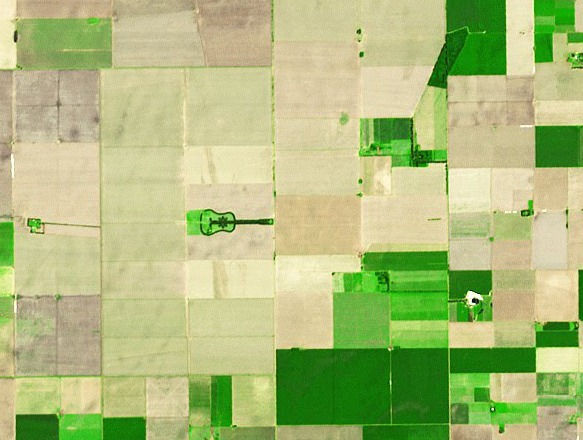
This guitar-shaped forest is a piece of land art in Argentina. Here’s how it looks from space.

Image credit: NASA

Pedro Martin Ureta created a piece of land art so that it could be viewed from an airplane. It turns out that it is visible from space, too.

In the fertile lowland plains of Argentina (the Pampas), a guitar-shaped forest grows amidst the farmland. The project was started in 1979 by Ureta on his farm near the town of Laboulaye, and it has become a wonder for pilots and passengers flying over the region. Together with his children, Ureta created the forest in a tribute to his wife, Graciela, who died during childbirth in 1977. News reports claim that Ureta has never seen his creation from the air, except for photos from friends.

According to news reports, the forest is composed of more than 7,000 cypress and eucalyptus trees. It stretches nearly a kilometer (two-thirds of a mile) across the landscape.

The image above was acquired on November 2, 2007, by the Advanced Spaceborne Thermal Emission and Reflection Radiometer (ASTER) on the Terra satellite. The false-color image was created with red, green, and near-infrared light.

Via NASA

source::::Earth sky news site

natarajan

Partial Solar Eclipse in Australia ….on 29 April…


Beautiful partial solar eclipse in Australia today (April 29, 2014).

Damian McCudden Landscape Photography captured this photo of the setting sun in eclipse on April 29, 2014, as seen from Australia.  Thank you, Damian!  Visit Damian McCudden Landscape Photographer on Facebook.

Damian McCudden Landscape Photographer captured this photo of today’s partial solar eclipse as seen from Australia. He wrote:

Partial Solar Eclipse at sunset today. I made my way to the farm, went to the old barn but too many trees around so raced back to the windmill and shot it from there. Sucks that there are power lines in the way, but I reckon they add to the shot, and that nice tree next to the windmill adds to the shot, too.

Thanks for looking and hope you like it.

source::::Earth Sky News site

natarajan