Checkpoint Charlie….

For nearly thirty years until the end of the Cold War, Berlin lay divided both physically and ideologically by the infamous Berlin Wall that snaked through the now united German capital. The wall was erected mainly to prevent East Germans from defecting to the West. Citizens from East Germany were strictly forbidden to travel to the other side. West Germans and citizens of other countries, however, could visit East Germany after applying for a visa.

The 155-km long wall had nine border crossings that allowed visitors from the West, Allied personnel, foreigners etc. into the Soviet controlled East Berlin. The most famous of this crossings was the checkpoint at the corner of Friedrichstraße and Zimmerstraße, named Checkpoint Charlie.

The name Charlie comes from the letter C in the NATO phonetic alphabet—Alpha, Bravo, Charlie and so on. Similarly, the border crossing at Helmstedt-Marienborn was nicknamed Checkpoint Alpha, and the one at Dreilinden-Drewitz was called Checkpoint Bravo. Checkpoint Charlie was the third opened by the Allies around Berlin.

Checkpoint Charlie became the most famous crossing point between East and West Germany, and it was the only gateway through which Allied diplomats, military personnel and foreign tourists could pass into Berlin’s Soviet sector. Despite its importance, the Allies did not try to erect any permanent buildings here. A small wooden shed with a couple of sandbags was all that stood. Although this was replaced by a larger metal building in the 1980s, the Allies kept their operations deliberately simple as a way of symbolizing their view that the Berlin Wall was not a legitimate border. Things were different on the East German side of the checkpoint, with guard towers, cement barriers and a shed where departing vehicles and their occupants were meticulously searched for potential fugitives.

Checkpoint Charlie was the most visible checkpoint on the Berlin Wall. A small café opened right on the checkpoint became very popular among Allied officials, armed forces and foreigners alike because it provided an excellent viewing point to look into East Berlin while having something to eat and drink.

Checkpoint Charlie also attracted many desperate East Germans looking to flee to the West. In its early years, the checkpoint was blocked only by a gate and one escapee smashed a car through the flimsy barrier. Another escapee simply sped underneath the checkpoint’s vehicle barrier after removing his convertible’s windshield to lower the car’s height. In another famous but unsuccessful attempt, a teenager named Peter Fechter was shot to death by East German guards when he tried to escape to the other side. As he bled to death, his body tangled on the barbed wire, the American soldiers could only watch. Checkpoint Charlie was also the site of the famous tank confrontation in October 1961 when American and Soviet tanks took up position on either side of the gate.

After the Berlin Wall came down and the East and West were united, the guardhouse was removed and is now on display in the open-air museum of the Allied Museum in Berlin-Zehlendorf. A replica of the guardhouse complete with actors dressed in military uniform and posing as Allied guards now stand where the original checkpoint once stood. Today, it is one of Berlin’s primary tourist attractions.
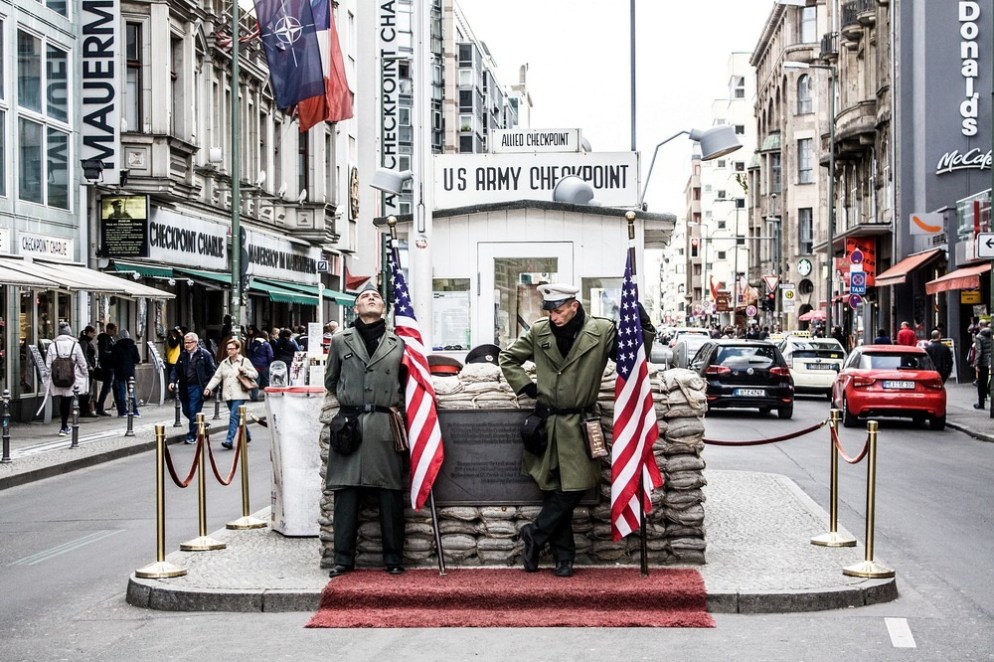
Two actors dressed as Cold War circa American guards stand at a replica of Checkpoint Charlie in Berlin. Photo credit: Shadowgate/Flickr

Source : Kaushik in www. amusingplanet.com

Natarajan


Few Surprising Facts about the Fall of Berlin Wall …

Nov. 9 marks the 25th anniversary of the fall of the Berlin Wall, the iconic barrier that completely enclosed East Berlin between 1961 and 1989 and symbolized the height of Cold War tensions.

West Berliners crowd in front of the Berlin Wall early

West Berliners crowd in front of the Berlin Wall Nov. 11, 1989, as they watch East German border guards demolish a section to open a crossing point. (Photo: Gerard Malie, AFP/Getty Images) 


Around the world, the international German community and others are marking the milestone with celebrations and shared memories. In Germany, artists have recreated the Wall with illuminated white balloons along the path that the structure once traced. The 8,000 balloons stretch more than nine miles across the city, according to the German embassy in London.

With the anniversary putting the Cold War fresh in most people’s minds, here are nine facts about the Berlin Wall that may be new to you:

• A mistake helped lead to the fall of the Wall. The flood of East Germans and West Germans to the Wall, which led to its ultimate collapse, came after East German Politburo member Guenther Schabowski on Nov. 9, 1989, mistakenly announced that East Germans would be allowed to cross into West Germany effective immediately, according to National Public Radio.

• What the world saw as the Berlin Wall was actually two concrete barriers with a 160-yard “death strip” in between that included watchtowers, trenches, runs for guard dogs, flood lights and trip-wire machine guns, according to History.com.

• Parts of the Wall are on display or in private safekeeping all over the world. One section of the Wall is in a men’s room of the Main Street Casino in Las Vegas, History.com reports. Urinals are mounted on the graffiti-covered segment, which is protected by glass. Another section is in the gardens of the Vatican. If you don’t feel like traveling to Italy or Vegas to see a part of the Wall, you can have your own little slice for as little as $10 on eBay. And you can consider that a steal; an 8,000-pound slab went for $23,500 at an Atlanta auction

• A mass exodus of East Germans into West Germany began almost 15 years before the Berlin Wall was erected in 1961. In fact, so many left that by the time the Wall went up, East Germany lost one-sixth of its population, according to the Berlin Wall Memorial website.

• The Wall and several U.S. presidents shared a relationship. President Kennedy visited in the summer of 1963, not long before his assassination that November. He said in a rousing speech that Berlin could help the world understand the divisions between the Communist and non-Communist world.

In 1987, Reagan challenged Russian leader Mikhail Gorbachev to “Tear down this wall” during a June 1987 speech near the Wall.

When Clinton visited in 1994, he told the crowd of Berliners, “You have proved that no Wall can forever contain the mighty power of freedom.”

During President Obama’s June 2013 visit, he noted neither he nor German Chancellor Angela Merkel looked like their predecessors.

“The fact that we can stand here today, along the fault line where a city was divided, speaks to an eternal truth: No wall can stand against the yearning of justice, the yearnings for freedom, the yearnings for peace that burns in the human heart,” he said.

• The formal reunification of East and West Germany did not happen until Oct. 3, 1990, almost a year after the fall of the Wall, according to History.com.

• A July 1988 concert by Bruce Springsteen in East Berlin may have led to the growing sense of dissent in the walled city that contributed to the fall of the Wall, according to the CBC. “The Boss” told the crowd in German, “I’ve come to play rock ‘n’ roll for you in the hope that one day all the barriers will be torn down.”

Another in the U.S. music industry, conductor Leonard Bernstein, performed a series of concerts in venues on both sides of the barrier just weeks after the November 1989 fall of the Wall. Bernstein’s international orchestra included musicians from the four countries that had occupied Berlin after World War II: the United States, the former Soviet Union, France and England. Bernstein led Beethoven’s Ninth Symphony and altered its final movement, “Ode to Joy,” to become “Ode to Freedom.”

• Some parts of the barrier became world famous. Checkpoint Charlie, formally known as Checkpoint C, was the nickname that Western Allies gave the best-known border crossing point between East and West Berlin.

Also, the Brandenburg Gate is an 18th-century arch that is built on the site of a former gate that marked the start of a road that led from Berlin to the town of Brandenburg. Because of its location, it was associated with the Berlin Wall for a time.

• The physical demolition of the Berlin Wall was not complete until 1992, according to the BBC.

SOURCE::::www.usatoday.com

Natarajan