Image of the Day…Full Moon Day Today !!!

Full moonrise by Mohamed Laaifat Photographies in Normandy, France.Full moonrise, above, by Mohamed Laaifat Photographies in Normandy, France.

Tonight, the moon is full. This full moon falls on January 5, 2015 at 4:53 Universal Time. Although the moon turns full at the same instant worldwide, the clock time – and possibly the date – differs by time zone. For the mainland United States, the moon reaches the crest of its full phase on this Sunday evening on January 4 at 11:53 p.m. EST, 10:53 p.m. CST, 9:53 p.m. MST or 8:53 p.m. PST.

The January 2015 full moon is the first full moon after the December 21 solstice. In North America, we often this full moon the Wolf Moon, Old Moon or Moon After Yule.

Astronomically speaking, the moon is full at the moment that it’s most opposite the sun in its orbit (180o from the sun in celestial or ecliptic longitude). For general reference, however, we can say the moon is full all night tonight, lighting up the nighttime from dusk until dawn.
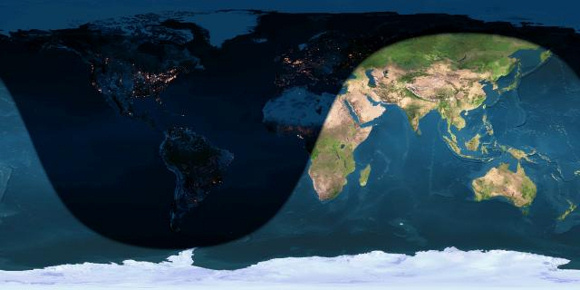
Day and night sides of Earth at the instant of the January 2015 full moon (2015 January 5, at 4:53 UTC) Image credit: Earthview

Elsewhere around the world, the moon reaches the crest of its full phase at different times on the clock. Looking at the worldwide map above, you can see that the full moon comes at midnight in South America and northeastern North America, at sunrise in Africa and the Middle East and at noon in eastern Asia. All these places will see a full-looking moon lighting up the sky tonight from dusk until dawn.

But to see the moon at the instant of full moon, the moon has to be above your horizon on the nighttime side of the world.

In both the Northern and Southern Hemispheres, the January sun – unlike the January full moon – rises south of due east and sets south of due west. In the Northern Hemisphere, these far-southern risings and settings of the sun give us the short days of winter. South of the equator, the same far-southern sunrises and sunsets bring long summer days. Meanwhile, the full moon lies opposite the sun, mirroring the sun’s place in front of the backdrop stars for six months hence.

And that’s why tonight’s moon – like the sun in summer – will follow a high path across the sky as seen from the northern part of the globe – and a low path as seen from the southern.

This January full moon rises north of due east around sunset, climbs highest in the sky around midnight and sets north of due west around sunrise.

Bottom line: Watch the full moon shine from sundown to sunup on the night of January 4, 2015.

SOURCE::: http://www.earthsky.org

Natarajan

Image of the Day… Full Moon On 6 November….

Full moon on November 6 stays out all night!!!

Tonight … November 6, 2014 … the full moon will stay up all night and sleep in all day tomorrow, like a college student on vacation. From sundown on this night to sunup on November 7, the moon will follow the path of the early May sun across the sky tonight. Watch it rise in the east around sunset on November 6 and set in the west around sunrise the next morning. At midnight, when the sun lurks beneath our feet, the moon will assume the position of the noonday sun in early May. For us in the Northern Hemisphere, this November full moon is sometimes called the Frosty Moon or Beaver Moon.

Full moon about to set in the west as sun rises in the east, via G. Gillet/ESO

In the Southern Hemisphere, where it’s now spring, the November full moon could be called the Flower Moon. Click here to learn more about full moon names.

All full moons rise around sunset and set around sunrise. Tonight’s November full moon – like the full moon at any season – shines from dusk until dawn, and climbs to its highest point in the sky around midnight.

EarthSky lunar calendars make great gifts for astronomy-minded friends and family.

Image top of post via Peter Van Burun Bunswork of Columbia Falls Montana

This awesome image is from November 27, 2012.  It comes from our friend Sorge Solverg in northern Norway and shows Jupiter left of the moon, with both surrounded by a lunar halo.  Read more about lunar halos here.  Thank you Borge!  Click here to expand this image.

Because the full moon occurs when the moon is most directly opposite the sun for the month, the full moon follows nearly the same arc across the sky that the sun follows six months henceforth. In both the Northern and Southern Hemispheres, the November full moon will rise in the east-northeast and set in the west-northwest – just as the sun does in May. In the Northern Hemisphere, tonight’s full moon will soar up high – like the springtime sun. But south of the equator, the moon will follow the low trajectory of the late autumn sun.

So on this November 6, 2014 night, the full moon shines from dusk until dawn … unless you live north of the Arctic Circle. That far north, the moon simulates the midnight sun, staying out for 24 hours around the clock.

Bottom line: Full moon is November 6, 2014. Although moon can be seen from anywhere worldwide on this night – except southern Antarctica – its path in the sky varies, depending on where you live. Enjoy the all-night appearance of the full moon tonight, as it mimics the path of the early May sun across your sky!

SOURCE::::www.earthsky.org

Natarajan