Joke of the Day !!!

A pilot landed a plane with a rather bumpy landing. As part of his job he was required to stand by the terminal door and say goodbye to the passengers as they exited the airplane. He was afraid that someone might say something about his rather less than perfect landing, but everyone left without saying a word except for one passenger, an elderly lady, she slowly approached the pilot after most passengers had exited the plane and asked, “Did we land? Or were we shot down?”


Source::::joke a day .com

Natarajan

Image of the Day !!!


Jet zips past moon

“Aimed at the moon and started to focus when I saw the jet enter the frame … “

By GregDiesel Landscape Photography.  Visit his online gallery on Facebook.

Check out this cool image of an airplane passing in front of the moon. GregDiesel Landscape Photography captured it on May 31, 2014. He wrote:

Unless you live by an airport and try all day/night it’s a really tough shot to get! Story behind it was that I was just taking my ‘daily moon’ shot and my shutter froze. I took the lens off cleaned the sensors and snapped it back on. Aimed at the moon and started to focus when I saw the jet enter the frame and then, I mean, I needed split-second reaction to focus and get about 5 shots as it flew through in about 2 seconds start to finish. Got lucky with the timing.

Lucky for us! .

Click here to see Greg’s daily moon shots.

Source:::::Earth sky News site

Natarajan

In Search of MH 370… Mapping of Underwater Terrain …


A new illustration of the seafloor, created by two of the world’s leading ocean floor mapping experts, details underwater terrain where the missing Malaysia Airlines flight might be located.


Image credit: AGU


Seafloor topography in the Malaysia Airlines flight MH370 search area. Dashed lines approximate the search zone for sonar pings emitted by the flight data recorder and cockpit voice recorder popularly called black boxes. The first sonar contact (black circle) was reportedly made by a Chinese vessel on the east flank of Batavia Plateau (B), where the shallowest point in the area (S) is at an estimated depth of 1637 meters. The next reported sonar contact (red circle) was made by an Australian vessel on the north flank of Zenith Plateau (Z). The inset in the top left shows the area’s location to the west of Australia. Image credit: Walter H.F. Smith and Karen M. Marks


Seafloor experts have created a new topography map that could shed additional light on what type of underwater vehicles might be used to find the missing airplane and where any debris from the crash might lie.

The seafloor topography map illustrates jagged plateaus, ridges and other underwater features of a large area underneath the Indian Ocean where search efforts have focused since contact with Malaysia Airlines flight MH370 was lost on March 8. The image was published today in Eos, the weekly newspaper of the Earth and space sciences, published by the American Geophysical Union.

The new illustration of a 2,000 kilometer by 1,400 kilometer (1,243 miles by 870 miles) area where the plane might be shows locations on the seafloor corresponding to where acoustic signals from the airplane’s black boxes were reportedly detected at the surface by two vessels in the area. It also shows the two plateaus near where these “pings” were heard.

It points out the deepest point in the area: 7,883 meters (about five miles) underneath the sea in the Wallaby-Zenith Fracture Zone – about as deep as 20 Empire State buildings stacked top to bottom. Undersea mountains and plateaus rise nearly 5,000 meters (about three miles) above the deep seafloor, according to the map.

The illustration, designated as Figure 1 of the Eos article, was created by Walter H.F. Smith and Karen M. Marks, both of the National Oceanic and Atmospheric Administration’s Laboratory for Satellite Altimetry in College Park, Maryland, and the former and current chairs, respectively, of the Technical Sub-Committee on Ocean Mapping of the General Bathymetric Chart of the Oceans, or GEBCO. GEBCO is an international organization that aims to provide the most authoritative publicly available maps of the depths and shapes of the terrain underneath the world’s oceans.

Satellite altimetry has made it possible to depict the topography of vast regions of the seafloor that would otherwise have remained unmapped, Smith said. To illustrate the topography of the search area, Smith and Marks used publicly available data from GEBCO and other bathymetric models and data banks, along with information culled from news reports.

Smith said the terrain and depths shown in the map could help searchers choose the appropriate underwater robotic vehicles they might use to look for the missing plane. Knowing the roughness and shape of the ocean floor could also help inform models predicting where floating debris from the airplane might turn up.

Smith cautions that the new illustration is not a roadmap to find the missing airplane. Nor does the map define the official search area for the aircraft, he added.

“It is not ‘x marks the spot’,” Smith said of their map. “We are painting with a very, very broad brush.”

Search efforts for the missing airplane have focused on an area of the southern Indian Ocean west of Australia where officials suspect that the plane crashed after it veered off course. After an initial air and underwater search failed to find any trace of the airplane, authorities announced this month that they will expand the search area and also map the seabed in the area.

Smith pointed out that the search for the missing plane is made more difficult because so little is understood about the seafloor in this part of the Indian Ocean. In the southeast Indian Ocean, only 5 percent of the ocean bottom has been measured by ships with echo soundings. Knowledge of the rest of the area comes from satellite altimetry, which provides relatively low-resolution mapping compared to ship-borne methods.

“It is a very complex part of the world that is very poorly known,” Smith said.

A lack of good data about Earth’s seafloors not only hinders search efforts, it also makes it harder for scientists to accurately model the world’s environment and climate, Smith noted. Today, our knowledge of our planet’s undersea topography is “vastly poorer than our knowledge of the topographies of Earth’s Moon, Mars and Venus,” Smith and Marks write in Eos. This is because these other planetary bodies have no oceans, making their surfaces relatively easy to sense from space.

Smith said he hoped that “the data collected during the search for MH370 will be contributed to public data banks and will be a start of greater efforts to map Earth’s ocean floor.”

Via AGU

source:::: Earth SKY News site

Natarajan

A Man Hijacks a Plane…Collects His Ransom Money and Jumps out Of Plane …!!!


This Day In History: November 24, 1971

An unidentified man referred to as D.B. Cooper hijacked a Boeing 727 airplane between Portland, Oregon and Seattle, Washington.   Cooper bought a one-way ticket on a Northwest Orient Airlines, Flight 305 to Seattle, Washington leaving Portland, Oregon at 2:50 p.m.  He brought with him aboard the plane a black suit-case supposedly containing a bomb.

During the 30 minute flight, Cooper handed a ransom note to the nearby flight attendant telling her he had a bomb and was going to use it if necessary.   He demanded $200,000 in unmarked $20 dollar bills, along with two front parachutes and two back parachutes.  His demands were delivered to the pilot William Scott, who then delivered them to the air traffic control center at the Seattle-Tacoma Airport. Cooper’s flight landed at the SEA-TAC Airport at 5:45 p.m.   After his money and parachutes were delivered, the passengers were released along with two of the flight attendants.  The hijacker then delivered his flight plan to the cockpit crew.   The plane was to take a course heading southeast to Mexico City and was to maintain an altitude of 10,000 feet.  The crew was ordered by Cooper to remain in the cockpit for the duration of the flight.

At 7:40 p.m., the aircraft took off heading south.  At approximately 8:00 p.m., the instruments on the plane indicated that the door had been opened and the stairs lowered.  Outside at 10,000 feet the temperature was around 10 degrees below zero, the weather was stormy, and the wind speed would have been around 200 mph. Around 10:15 p.m., the aircraft landed in Reno with FBI Agents, state troopers, sheriff’s deputies, and the Reno police surrounded the aircraft.   After a quick search, it was confirmed that Cooper was no longer on the airplane and his approximant departure happened between 8:00 p.m. and 8:13 p.m. Even with a thorough search and an exhaustive FBI investigation, the hijacker has never been located nor positively identified.  Originally, they had tried to tail the plane, but chose military F-106 fighter jets to do it with, which could not fly as slow as the airline plane was required to fly by Cooper.

It is believed that he probably didn’t survive the jump.  First, the F.B.I. had trouble locating parachutes for Cooper in the time they had allotted.  Because of this, out of the four chutes they gave him, they accidentally gave him one non-functional practice parachute and one parachute that was quite old.  They had not intended to give him bad parachutes at the time, because they thought there was a chance he’d be taking some of the crew with him.  He didn’t, but did pick the old primary parachute and the secondary non-functional, practice chute.  Further, Cooper had no jacket or rain protective gear and jumped on a cold stormy, pitch-black night into hilly terrain filled with trees.  Finally, no spent money has ever been recovered with the serial numbers matching those given to Cooper.  There has been $5,800 recovered though, which was found near the Columbia River about 40 miles from the predicted landing site, still bundled.   However, this isn’t seen as conclusive evidence that he didn’t survive because it could have just as easily been blown out of the bag during the jump or accidentally left there, if Cooper took a boat downstream.  In addition to that, there were ten bills missing from the bundles, which would likely have had to be manually taken out of the tightly bound bundles.  Further, the parachutes were very brightly covered and should have been easy to spot had he not survived.  So the mystery continues on whether he survived and who exactly he was in the first place.  Even recent DNA samples from evidence left in the plane have failed to turn up any leads.

source::::Today i foundout.com

natarajan

Why Don’t Commercial Airplanes Have Parachutes for Passengers? ….


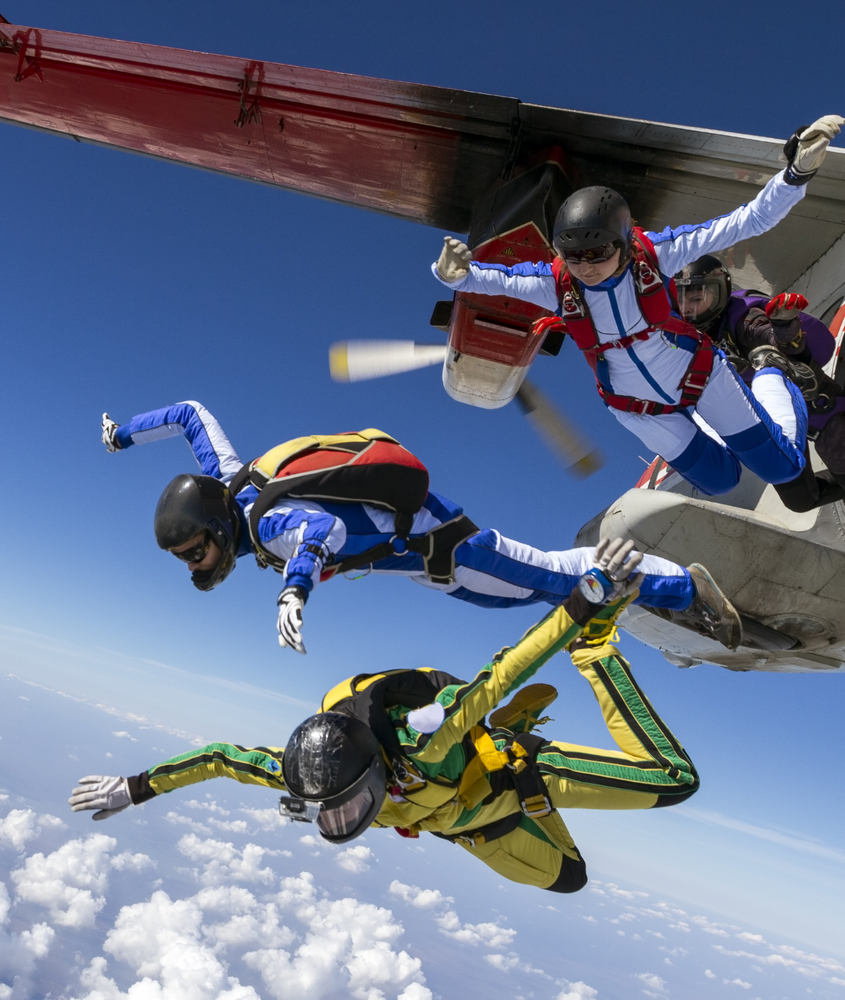
parachuteSeatbelts and airbags in cars save passengers lives. Parachutes save people who, for a variety of reasons, exit a plane in mid-flight. So why aren’t parachutes provided to passengers on commercial airline flights, in case of emergencies?

Because they almost certainly would not save anyone’s life.

Parachuting Basics

When your average daredevil skydives for fun, the plane is typically travelling at between 80 and 110 mph when the skydiver jumps.Tandem and accelerated free fall (AFF) jumps occur between 10,000 and 13,000 feet, while static jumps can be as low as 3,500 feet.

Student divers choosing the easiest, tandem jump, where the newbie is physically and securely attached to an experienced instructor, are still required to undergo “a half hour of basic ground instruction.”

Braver neophytes who wish to fly untethered will have to endure:

Four to five hours of intense ground instruction, including learning body flight maneuvers and hand signals that instructors use to coach the student as they fly alongside.

For an AFF jump, although not harnessed together, freshman flyers are accompanied by two instructors who “hold onto the student’s harness until” it’s deployed.

Those who choose a static line jump also have to take four + hours of training prior to the jump, although the parachute is deployed as the rookie flyer leaves the aircraft.

When skydivers leave a plane, they do it alone or in small groups. When successive groups will be jumping, they try to keep separated by anywhere between 500 and 1500 feet; this is often accomplished by waiting until the preceding group is “back under the tail to 45 degrees behind the airplane” or several seconds in between groups.

Experienced skydivers can make even riskier jumps, although when descents begin at higher than 15,000 feet, “the risk of hypoxia and being significantly affected by altitude” increases dramatically and divers are less able “to make effective safe decisions at critical times.” Therefore, divers who jump from 15,000 feet or higher carry supplemental oxygen.

Further, each parachute weighs around 40 pounds and the equipment is expensive. To be fully outfitted with “rig, main, reserve, ADD, altimeter, jumpsuit, helmet [and] goggles” can run between $5,900 and $9,000.

Commercial Airplane Basics

Perhaps the most popular commercial jetliner is the Boeing 737 family. Its 737-800 can carry nearly 200 people (including the crew).

Although speeds can vary slightly, the 737-800 travels at approximately 600 mph when at its cruising altitude of 35,000 feet. Cruising altitudes are assigned by air traffic controllers and are usually up to 39,000 feet, except for longer flights that may fly higher.

Individual Parachutes Won’t Improve Passenger Safety

Doing the math . . .

Passenger Training

Since four hours of training just to board a plane is unrealistic, passengers would have to read and execute detailed skydiving instructions including how to properly strap the chute on in order to benefit from the parachute. Not everyone is good at following detailed, technical instructions even when time and stress aren’t a factor.  In a situation where the plane is going down and one has only a moment to get the parachute properly strapped on (likely while keeping an oxygen mask firmly attached and perhaps also needing to keep the seat belt on to keep from being thrown about in the cabin), it’s unlikely most would be able to even get this far.

Every Man for Himself

Unless passengers wanted to fly suited up and tethered for a static jump, parachuting from a commercial airplane will be an AFF jump; however, unlike the conditions that students get – training and trained instructors to assist, commercial passengers will just have to learn as they go.

In addition, they will have to keep calm and proceed in an orderly fashion, which will require most to patiently wait their turn to exit. This is not likely to happen.

Parachuting Equipment is Bulky

Adding just parachutes (not counting helmets, altimeters, etc.) for each passenger would add another 8,000 pounds or so to the flight’s weight. In addition, that equipment would take up space, that is already at a premium.

Parachuting Only Makes Sense if Something Happens in Mid-Flight

The only feasible time for people to jump from the plane is while it’s cruising. However, most fatal airline accidents occur on airplanes during takeoff and landing.

Consider that between 2003 and 2012, only 9% of all fatal accidents on commercial flights, seven total, occurred while the plane was cruising; moreover, at least one of those accidents happened as a result of wind shear or thunderstorm. This is a situation where parachuting is extremely dangerous even if you’re an expert.

So even if parachuting were feasible from a jetliner, the conditions in which parachutes could theoretically save lives are almost never apparent in fatal commercial accidents. But even if they were, it still wouldn’t be a good idea.

Jetliners Cruise Very High and Very Fast

At 35,000 feet (three times higher than a typical jump) every passenger would need high altitude equipment (HALO) that includes an oxygen tank, mask and regulator, flight suit, ballistic helmet and altimeter just to manage the thin air. Or they could just pass out from hypoxia and wake up later, hopefully when the parachute automatically deployed at under 15,000-20,000 feet.

Of course, none of this would matter since the plane is moving so fast (600 mph), and it is so large, that many passengers would almost certainly smash into it and suffer debilitating if not fatal injuries.

Whole Plane Parachutes May Save Lives

There is hope, however. Over the past few years, many small planes have been equipped with whole-plane parachutes that slow the craft’s descent. As of late 2013, the largest planes equipped with these safety devices carry five people, but plans are in the works for putting them on larger crafts. As one manufacturer said, “There is no doubt that big commercial airlines of the future will be equipped with some kind of parachute recovery system.”

source:::: Today i foundout.com

natarajan

” Emergency Landing of a Plane After a Part of its Wing Fell Off …” !!!


If you have a fear of flying and want to be able to fly again in the future, you might want to stop reading here. For everyone’s worst nightmare became a reality for passengers on board a flight from London, UK to Florence, Italy last week. Their aircraft was forced to make an emergency landing after a part of the left wing fell off.

Shortly after taking off from London City airport a loud bang was heard by those aboard, the 60 passengers were shocked to discover that a 6ft (1.8m) piece of the wing was dangling in the air.

airplane_problems

Here’s a video of the incident filmed by one of the passengers:

Daily Telegraph journalist Cole Moreton was one of the 60 passengers on board and explained what went through everyone’s minds during that moment of fear.

The bang made people jump and was alarming. Then we sat there thinking ‘this isn’t right, surely? Does the pilot know?’ But we didn’t appear to be crashing. So there was a tense few minutes while we circled and waited for an announcement. It was a relief to get back on the ground.

The Avro RJ85 aircraft was diverted back to London City airport and landed with the badly burned section of the wing only just attached. Passengers were put on another flight two hours after landing back in London. A CityJet spokesperson later said the piece was merely a cover for the plane’s inner-mechanics.

The cover of the operating mechanism on the wing became partially detached. The crew followed their standard procedures.

Source: Metro, Photo Courtesy: Twitter  and You Tube

Story in  … viral nova Trending site

natarajan

Image Of The Day…


lake baikal 140512

ISS Crew Earth Observations Facility and the Earth Science and Remote Sensing Unit, Johnson Space Center. The image was taken by the Expedition 39 crew.

Sun glints off Russia’s Lake Baikal in an astronaut photograph taken on April 22, 2014.

Russia’s Lake Baikal is the deepest lake in the world, but its beauty is skin-deep in a new astronaut photograph.


The lake image, taken by a crew member aboard the International Space Station, shows the southern half of the lake, which is mostly covered by ice. A melted portion catches the sun, creating a silvery, mirrorlike surface. This phenomenon is called sunglint, according toNASA’s Earth Observatory.

Sunglint is a literal trick of the light — sun reflects directly off the surface of the water toward the observer. It can happen in rivers, lakes and on the open ocean, and the color of the sunglint depends on the roughness of the water surface, among other factors, according to Earth Observatory. [101 Stunning Images of Earth from Space]

One of a kind

Lake Baikal is a UNESCO World Heritage site. Its depths stretch down some 5,577 feet (1,700 meters) — twice as deep as the tallest building in the world, Dubai’s Burj Khalifa, is high. The lake is also the world’s oldest, dating back about 25 million years, according to UNESCO.

Lake Baikal is also the single largest reservoir on Earth. It contains 20 percent of the fresh, unfrozen water on the planet, and has a rare and diverse ecosystem to match. According to UNESCO, the lake is home to 1,340 animal species and 570 plants. Of these, 745 animals and 150 plants are found nowhere else on Earth.

Perhaps the cutest of these is the Baikal seal (Pusa sibirica), also known as the nerpa. This seal is the only pinniped that lives only in freshwater, according to the Seal Conservation Society. Adults are silver-grey, and pups are a fuzzy, fluffy white. Weighing in around 155 pounds (70 kilograms) max, Baikal seals are some of the smallest pinnipeds on the planet.

Less adorable, but no less amazing, is the golomyanka, a bizarre translucent fish that is more than one-third oil by weight. The fish have no scales and, because of their unique bodies, can move from Lake Baikal’s depths to its shallows without suffering damage from changes in water pressure. The fish are the main prey of the Baikal seal.

Threats and challenges

Despite its storied status, Lake Baikal is not immune to the threat of human activity. Baikal seals are hunted, which may be contributing to declining numbers of the species. Pollution also threatens the lake, particularly agricultural runoff and discharge from nearby industrial plants, according to the Seal Conservation Society.

The lake is also a repository of gas hydrates, which are essentially dissolved gases locked inside solid crystals of water. Lake Baikal hosts huge amounts of methane trapped in these structures in its depths, making it a popular place for research into how to extract these gas hydrates as an alternative source of energy.

There are currently no plans to extract these gas hydrates from Lake Baikal, but similar structures are also found in the oceans and in permafrost. This fact has led to additional concerns about climate change, as melting ice could release large amounts of methane, a potent greenhouse gas.


source:::::::BUSINESS INSIDER

NATARAJAN

Imaginative Photos Of Toy Plane Soaring in the Sky !!!


Macau-based web designer and developer Varun Thota (@vnthota) has an Instagram feed full of photos depicting dynamic metropolitan life, but his series My Toy Plane (#mytoyplane) takes his creative vision to new heights. The imaginative photos show a hand guiding a toy airplane overhead in various locations. If it weren’t for the hand, the images would be quite convincing as shots of a real plane soaring in the sky, flying over tall buildings, or preparing to land on a runway.

What makes Thota’s photos even more fun to look at are the glimpses of urban life in Macau, Hong Kong, and other bustling cities in Asia. His toy plane weaves in between tall skyscrapers, over lively streets, and above vibrant downtown bays, taking the viewer on a mini-voyage of their own. Looking at the creative shots, you can almost imagine yourself sitting in the plane itself, gazing down at the beautiful sights below.

Drawing inspiration from the hashtag #putaplaneonit, Thota decided to start this series after his father found a toy plane inside a chocolate Kinder egg. Through the photos, he not only gets to explore his interest in aviation, but also to build relationships with the people around him. He says, “The thing I enjoy most about the series is how fun it is to include other people in it. It’s always fun to show people the plane, tell them the story and then ask them for a helping hand in taking the shot.”


Varun Thota Website

source:::::::::::::::http://www.mymodernmet.com/profiles/blogs/varun-thota-my-toy-plane natarajan

Take 2 For Terminal 2 of Heathrow ….Ready For Take off On June 4 …

  • The new Terminal 2 is to be rebranded to become ‘The Queen’s Terminal’ when it opens on June 4
  • Spacious new air transit facility will be able to handle 20million passengers a year, flying to 51 destinations

By DAMIEN GAYLE   in mailonline.com UK

NATARAJAN


Heathrow Airport’s new Terminal 2 is set to open in months, giving the capital a spacious new air transit point able to handle 20million passengers a year.

Replacing the old, overcrowded Terminal 2 which had stood since the Fifties, the new facility was today hailed as a cornerstone of Heathrow’s revitalisation ahead of its opening on June 4.

Shafts of natural light and high quality acoustics should make the building a calm space for travellers accustomed to high anxiety at dark, noisy airports, said lead architect Luis Vidal.

Spacious: British artist Richard Wilson's sculpture Slipstream dominates this view of the new Terminal 2 at Heathrow Airport on April 23, 2014 in London, England. The rebuilding of the transit point has taken five years at a cost of £2.5billion, but it is finally slated to open on June 4

Spacious: British artist Richard Wilson’s sculpture Slipstream dominates this view of the new Terminal 2 at Heathrow Airport on April 23, 2014 in London, England. The rebuilding of the transit point has taken five years at a cost of £2.5billion, but it is finally slated to open on June 4

Gateway to the world: The departure area of the new 'Queen's Terminal', which is expected to manage up to 20million passengers every year

Gateway to the world: The departure area of the new ‘Queen’s Terminal’, which is expected to manage up to 20million passengers every year

Breath of fresh air: Visitors walk past a doorway at the new building, which replaces the old, overcrowded Terminal 2 which had stood since the Fifties

Breath of fresh air: Visitors walk past a doorway at the new building, which replaces the old, overcrowded Terminal 2 which had stood since the Fifties

‘If you make it intuitive, pleasant, joyful, you can take away a completely different memory of the terminal,’ Mr Vidal told The Associated Press.

‘You can never completely erase your memory of the former Terminal 2, because it was a dreadful experience. This will be completely the opposite. This will be a destination. People will want to come here.’

In an effort to dispense with those past bad associations, the new Terminal 2 will be rebranded as ‘The Queen’s Terminal’. Queen Elizabeth will open the building herself – just as she did the original Terminal 2 in 1955.

The completion of the £2.5billion project, in conjunction with the relatively new Terminal 5 that opened in 2008, gives Heathrow two modern terminals. It is part of an £11billion refurbishment designed to keep London’s biggest airport competitive with other major European hubs including Amsterdam, Frankfurt and Paris.

 
The Slipstream sculpture is the centrepiece of the development, hanging 18m above the ground with a design intended to evoke the path of a plane in flight

The Slipstream sculpture is the centrepiece of the development, hanging 18m above the ground with a design intended to evoke the path of a plane in flight

Luxurious: With London increasingly becoming a destination of choice for the world's super-rich, Terminal 2 will have no shortage of pricey shops

Luxurious: With London increasingly becoming a destination of choice for the world’s super-rich, Terminal 2 will have no shortage of pricey shops

World of possibility: A construction worker puts the finishing touches to a sign at Terminal 2, which is to be rebranded 'The Queen's Terminal' when it opens this summer

World of possibility: A construction worker puts the finishing touches to a sign at Terminal 2, which is to be rebranded ‘The Queen’s Terminal’ when it opens this summer

The Queen’s Terminal will host 26 airlines, including United, Air Canada, Singapore Airlines and others that are part of the global Star Alliance, and offer flights to 51 destinations.

Of course, with London increasingly becoming a destination of choice for the world’s super-rich, Terminal 2 will have no shortage of pricey shops.

Officials say Terminal 2 will be the first in the world to offer a ‘complimentary personal shopping lounge where trained stylists will present a curated range of products for each client.’

The interior of the new terminal is dominated by a huge aluminium sculpture hanging 18m above the ground that is inspired by the flight path of a stunt place.

British artist Richard Wilson’s ‘Slipstream’ weighs 77 tonnes and is 78m in length, its vast bulk looming above the terminal’s main lobby and escalators, evoking the journeys that those who see it are set to embark on.

Slipstream weighs 77 tonnes and is 78m in length, its vast bulk looming above the terminal's main lobby and escalators

Slipstream weighs 77 tonnes and is 78m in length, its vast bulk looming above the terminal’s main lobby and escalators

Airport officials chastened by the chaos that plagued the opening of Terminal 5 in 2008 are planning a 'soft' opening of the new terminal

Airport officials chastened by the chaos that plagued the opening of Terminal 5 in 2008 are planning a ‘soft’ opening of the new terminal

Only one flight is planned the first day so, even if things go awry, the number of people affected will be small

Only one flight is planned the first day so, even if things go awry, the number of people affected will be small

The new terminal will gradually be brought to full capacity over six months

The new terminal will gradually be brought to full capacity over six months

Chastened by the problems that plagued the opening of Terminal 5, which included chaos when the luggage handling system broke down, airport officials are planning a ‘soft’ opening of the new terminal.

Only one flight is planned the first day so, even if things go awry, the number of people affected will be small.

The new terminal will gradually be brought to full capacity over six months.

Queues at the old Terminal 2: The old, overcrowded terminal building had stood since the Fifties

Queues at the old Terminal 2: The old, overcrowded terminal building had stood since the Fifties

Old fashioned: The building suffered from poor design and a lack of natural light, problems exacerbated by its handling far more passengers than it was ever intended to

Old fashioned: The building suffered from poor design and a lack of natural light, problems exacerbated by its handling far more passengers than it was ever intended to

Passengers try to sleep on uncomfortable seats at Terminal 2 after the UK's then newly privatised air traffic control system crashed

Passengers try to sleep on uncomfortable seats at Terminal 2 after the UK’s then newly privatised air traffic control system crashed

Heathrow officials say they are still pushing to build a controversial third runway, which is opposed by London Mayor Boris Johnson and influential environmental groups.

John Holland-Kaye, Heathrow’s development director, said the completion of the new terminal shows Heathrow has complied with the last Labour government’s directive that Heathrow should improve without growing.

‘Our challenge now is to make the case to expand,’ he said, admitting that getting permission would be ‘politically complex.’

Mr Holland-Kaye said private money is available to pay for a third runway, which would greatly add to Heathrow’s capacity.

He also claimed the new Terminal 2 would reduce the ‘stacking’ problem over Heathrow that often causes delays as planes await permission to land.