Ise Jingu: The Japanese Shrine That’s Torn Down And Rebuilt Every 20 Years…

The Ise Grand Shrine, also known as Ise Jingu, located in the city of Ise, in Japan, is one of Shinto’s holiest and most important sites. The shrine complex contains over a hundred shrines distributed over an immense area, but its two most important shrines are Naiku—the inner shrine, and Geku—the outer shrine. The inner shrine is believed to date from the 3rd century and is held in higher reverence than the outer shrine, due to it being the purported home of the Sacred Mirror of the Emperor.

What’s interesting about these shrine buildings is that the Naiku and Geku shrines, as well as the Uji Bridge, are rebuilt every twenty years—a tradition that has been going on for the past 1,300 years. The tradition is part of the Shinto belief of the death and renewal of nature and the impermanence of all things. It is also a way of passing down the skills and technique of building shrines from one generation to the next.


The general public is not allowed to access the shrines beyond sight of the thatched roofs of the central structures, hidden behind four tall wooden fences. Photo credit: N yotarou/Wikimedia

The rebuilding of the main shrine takes place on a site adjacent to the old, and each rebuilding alternates between the two sites. The old shrines are first dismantled and new ones built on the adjacent plot of land to exacting specifications so that the buildings remain forever new, yet original. The last rebuilding, which took place in 2013, was the 62nd iteration to date. The next rebuilding is scheduled for 2033.

In the lead-up to the rebuilding of the shrines, a number of festivals are held to mark special events. In the Okihiki Festival that is held in the spring over two consecutive years people from surrounding towns drag huge wooden logs through the streets of the city. The logs are prepared from Japanese cypress trees cut from a sacred forest surrounding the two shrines. These are eventually used in construction of the new shrine. As many as 10,000 cypress trees are cut down for the new building. Some of these trees cut are over 200 years old.

The cost of rebuilding is also enormous. Each rebuilding costs half a billion US dollars. The fund comes from tax payers and from private donations, including from business leaders and members of the royal family. The entire rebuilding ritual spans at least eight years.

The tradition of rebuilding the shrines every twenty years has its root in antiquity when old grain houses were demolished and reconstructed every 20 to 30 years. These grain houses had raised floors on wooden stilts and a thatched roof. The raised floor kept insects and water away while the thatched roof weighted down by rainwater pressed heavily down on the walls effectively sealing the inside and keeping moisture away. Eventually the roof and the pillars would start to show signs of decay, at which they would be torn down and a new granary constructed. This periodic reconstruction of these structures probably became customary, leading eventually to the rebuilding ceremonies of the Shrines in Ise.

Source….Kaushik in http://www.amusingplanet.com

Natarajan
A stray dog became the world’s first cosmonaut 60 years ago today…

Laika was a dog with humble beginnings who would become a global star. The first living being to leave the Earth’s orbit, taking off 60 years ago today in the Russian satellite Sputnik on Nov. 3, 1957, the stray mutt landed a place in history.

Discovered by a talent spotter from the Russian space program on the streets, the dog met all the criteria—docile, resourceful, peed without lifting a leg, and photogenic. One of six picked to train for space travel, Laika was ultimately chosen to go for her quizzical expression, her trainer, 90-year-old biologist Adilya Kotovskaya, told the Associated Press.

Indeed, in images Laika always looked gently confused, as if she already sensed her destiny and couldn’t understand why she’d die for her charms.

Kotovska grew close to the dog and recalls that the night before Laika took off was emotional. “I asked her to forgive us and I even cried as I stroked her for the last time,” she says.

Laika couldn’t have survived the trip, even if things hadn’t gone wrong. The charming dog had a one-way ticket to space, though this wasn’t made clear to the world at large.

According to Le Figaro (in French), international concern for Laika sparked conversations in which Russian officials reassured critics that the dog would be safely returned to Earth in eight days. The Russians were testing whether a living being could survive weightlessness, and Laika had been trained to be comfortable in ever-smaller boxes, surviving on space rations of jellied foods, ahead of her journey.

The dog was expected to orbit the Earth, surviving for eight to 10 days;, but she was never expected to return alive, according to the biologist who trained Laika. That just wasn’t possible at the time.

Laika didn’t last even a day. She lived only a few short hours after takeoff. The satellite wasn’t sufficiently insulated from the sun’s rays and the dog quickly began overheating. She died of radiation after only nine orbits around the Earth, much earlier than even her trainer had expected.

The death was kept a secret and fake news of Laika’s safety was provided regularly in official Russian broadcasts while Sputnik orbited. The dog was doing just fine, they reported. Le Figaro’s records show that there was skepticism of these accounts but no way to disprove the news out of Moscow.

Officially, Laika was poisoned through her food after about a week to prevent a painful death when reentering the Earth’s atmosphere. The satellite that carried her burned on April 14, 1958.

Kotovska, who now heads a laboratory at Moscow’s Institute of Biomedical Problems, and still works on preparing beings for space travel, knew the true story, of course. Still, she’s proud of Laika and her job training the cosmonaut dog, saying, “Those nine orbits of Earth made Laika the world’s first cosmonaut—sacrificed for the sake of the success of future  missions.”

Source….https://qz.com/

Natarajan

Message for the Day…”Being afraid of someone or something is an animal tendency and bullying others is a demonic tendency. You should have neither! Your human body is gifted to you for a grand purpose – to realise the Lord within”

Source: http://media.radiosai.org/

God has endowed you with a body and so every limb and sense-organ is worthy of reverent attention. Each must be used for His glory. The ear must exult when it gets a chance to hear the wonderful tales of God. The tongue must exult when it can praise Him. Else, your tongue is as effective as that of frogs on the marshy bank which croak day and night! An animal (pasu) fears; a beast (mriga) terrifies! Being afraid of someone or something is an animal tendency and bullying others is a demonic tendency. You should have neither! Your human body is gifted to you for a grand purpose – to realise the Lord within. If you own a fully loaded car in good running condition, would you keep it in the garage? Would you not drive it to where you need to go? So too, learn to use the faculties of body, senses, intellect, and mind, and achieve your goal!


Message for the Day…”The body is the temple of the Lord; keep it in good and strong condition.Let the tongue, accustomed to the bitterness of the margosa fruit of worldly triumphs and disasters, taste the sweet honey of remembering the Lord’s name.”

Source: http://media.radiosai.org/

Do not yield to the snares of friends or society or miscalled social conventions and become prey to smoking and other such bad habits. They destroy health, happiness, energy and even charm. Smoke disfigures your face and denigrates your lungs. It debilitates you and makes you diseased. The body is the temple of the Lord; keep it in good and strong condition. This skeletal cage or body is the Hasthinapuram, where we have the blind king, Dhritarashtra, the symbol of ignorance, as well as Yudhistira, the symbol of wisdom. Let the forces of Yudhistira win with the help of Sri Krishna. Let the tongue, accustomed to the bitterness of the margosa fruit of worldly triumphs and disasters, taste the sweet honey of remembering the Lord’s name. Experiment with this and you will be surprised at the result. You can feel the vast improvement in peace and stability in you and around you. Learn this easy lesson, get immersed in joy, and let others also share that joy with you.

Message for the Day…”Have Lord’s Name ever in your thoughts and you can brave any calamity!The seedling of devotion must be carefully watered, weeded, manured, and dusted with pesticides, to yield a harvest of love, peace and joy.”

Source:  http://media.radiosai.org

You are judged by your spiritual discipline not by the number of temples you go to or the quantity and the cost of the offerings you have made there. Do not calculate the length of time you have spent in the company of the Lord’s Name and exult! Calculate rather the length of time you wasted, away from that contact and repent. Have Lord’s Name ever in your thoughts and you can brave any calamity! Remember how Mother Sita braved the taunts, insults and tortures of the aggressors in Lanka; what gave her the mental stamina? It was the Lord’s name (Rama nama) and nothing else. Desire and anger (Kama and krodha) cannot co-exist with true devotion to God. Your devotion to God must be sincere and steady. Bhakti is not a matter of beads and beards nor does worship consist of flowers and camphor! The seedling of devotion must be carefully watered, weeded, manured, and dusted with pesticides, to yield a harvest of love, peace and joy.

Jokes for the Day…

Many people say that men and women are opposites. Others hold the notion that they complement each other, while others believe them to be both. Despite it all, we cannot help but be a little comical about the differences between the two sexes, so if you agree with us on this, the following short jokes will surely have you bursting into laughter!

Marriage is like a public toilet. Those waiting outside are desperate to get in…
While those inside are desperate to come out.

Wife: “Why are you home so early?”
Husband: “My boss said go to hell!”

Doctor: “How’s your headache?”
Patient: “She’s out of town.”

Compromising does not mean you are wrong and your wife is right.
It only means that the safety of your head is much more important than your ego!

It is said that when a woman closes her eyes, she sees the person she loves the most.
But when a man does that – the slide show begins….

Whisky is a brilliant invention.
One double and you start feeling single again.
Wives are magicians…

They can change anything into an argument.

There are 3 kinds of men in this world: Some remain single and make wonders happen, some have girlfriends and see wonders happen…the rest get married and wonder what happened!

Q- Why can’t women drive well?
A- Because there are too many mirrors in a car that distract them.

Q- Why can’t women stand a day in a Jungle?
A- There are no shopping centers.
 

Q: How can you save a dying woman?
A: Tell her about a 90% sale going on somewhere.
Q: If a Woman is quiet, which day is it?
A: Who cares, just enjoy that day!
Women live a better, longer and more peaceful Life, compared to men. Do you want to know why?
A very smart man replied: Women don’t have a wife!

Source…www.ba-bamail.com

Natarajan

Chandrakant Bhide: Here is Why RK Laxman Was a Fan of this Diligent Typist…

A typist is required to be fast and accurate, and while he proved to be precisely that, Bhide was much more too. Throw in artistic to those set of skills, and you have Chandrakant Bhide.

“Sachin Tendulkar’s curls gave me the most trouble!”

Chandrakant Bhide is a typist by profession. In 1967 he joined the Union Bank of India and worked there for 3 decades.

A rather implausible scenario for Tendulkar’s curls to give him grief, right?

A typist is required to be fast and accurate, and Bhinde proved he was precisely that but more too.

Throw in artistic to those set of skills, and you have Chandrakant Bhide.


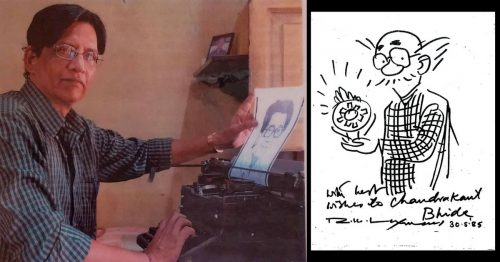
Chandrakant Bhide and a typed out sketch of RK Laxman’s the Common Man

“Art helped me meet important people. How else does a modest typist like me get to meet and be appreciated by people like R. K. Laxman and Mario Miranda,” questions Mr Chandrakant Bhide?

Mr Bhide is anything but ‘just a typist’. His art is indicative of his sheer talent and why the likes of the above-mentioned greats were his fans.

Growing up, he always wanted to join an art school – specifically the Sir J.J. School of Art in Mumbai.

But financial constraints forced him to take a more secure job.

“One day I was asked to type out a list of phone numbers, instead of typing a regular list, I made one in the shape of a telephone instrument,” he remembers. That was the beginning of many more artistic endeavours to come.


“I typed out Lord Ganesha using the ‘x’ key and it was published in the Maharashtra Times newspaper in 1975. I slowly started improvising and started using other keys like ‘_’, ‘=’, ‘@’, ‘-’, ‘,’ in my sketches,” recalls Bhide.

His father’s words inspired him to be better and do better. Each sketch takes him about 5-6 hours to complete.


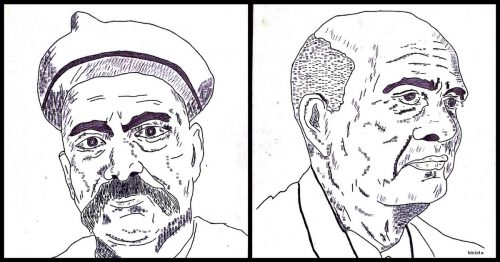
Bhide’s sketches of Bal Gangadhar Tilak and Sardar Patel done on the typewriter

“I hold the paper with my left hand and use the fingers on my right hand to type out the symbols. The different shades in a sketch are added by using a light or a hard touch on the keys. My hands start aching after 10-15 minutes, and so I need constant breaks,” he adds.

One day, Mr Bhide sketched RK Laxman’s, Common Man. It was a time when Xerox machines had just made their appearance. His friend helped him get copies and requested to keep the original.


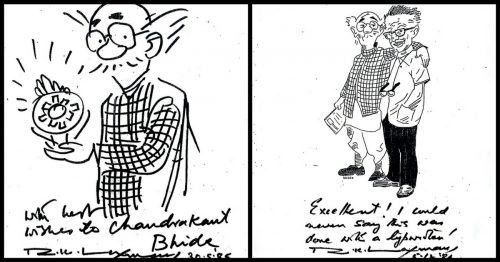
A huge fan of RK Laxman’s work, Bhide has made several sketches of Laxman’s iconic “Common Man”, winning him the famous illustrator’s admiration

“I wanted to show the sketch to R.K. Laxman sir. I went to his office without an appointment and showed it to the cartoonist. Laxman sir was so thrilled with it that he said the result could not have been better with a pen and brush. We spent 1.30 hours talking, and I even mentioned my lost dream of studying in Sir J.J. School of Art, and he said, you can be an artist anyway!” he recalls.

Bhide continued to keep in touch with the famed cartoonist and takes great pride in having several original ‘Common Man’ sketches.

Over the years, Mr Bhide has created almost 150 sketches including several of people he admires including Amitabh Bachchan, Dilip Kumar, Sunil Gavaskar, Dr Ambedkar, Lata Mangeshkar and more.

But it was Sachin Tendulkar’s curls that frustrated the master typer! “I finally used the ‘@’ symbol to get it right,” he recalls.

One of his fondest memories was meeting up with renowned cartoonist and illustrator Mario De Miranda via a common friend, the famous Behram Contractor also known as the Busy Bee. “I was nervous when I rang the bell to Mario’s home, but he soon put me to ease. Once he saw some of my sketches based on his famous characters (Ms Fonseca, Godbole and Boss), he autographed one of my sketches with the words – ‘I wish I could draw like you type.’ That was my biggest compliment,” says Mr Bhide.

Mario De Miranda encouraged and inaugurated Mr Bhide’s first exhibition. He went on to hold several more, including ones in festivals like IIT Mumbai’s Mood Indigo and IIT-Kanpur’s Antaragini.

Mr Chandrakant Bhide retired from the Union Bank of India in 1996. He approached the administration department with a request to buy his beloved companion, his typewriter but was denied it as it was against policy. But on the day of his farewell, the chairman of the Bank allowed him to buy it for just Rs. 1.

Today, the typewriter still holds a place of pride in his household. “It has been with me for fifty years now, I understand it, it understands me,” he chuckles.

Source….Uma Iyer in http://www.the betterindia.com

Natarajan


Message for the Day…”Remember the Lord with thankfulness at least thrice or even twice a day; that will give you great peace. Do not give up your worldly duties, but do them with the name of God on your lips.”

Source:  http://media.radiosai.org/

Worry and grief of one sort or another will always be there, in the past, present, and future, while walking, dreaming, and sleeping. But place faith in the Lord and do your tasks as dedication to Him and they will definitely vanish! Remember the Lord with thankfulness at least thrice or even twice a day; that will give you great peace. Do not give up your worldly duties, but do them with the name of God on your lips. Do not involve yourselves in the affairs of others to the extent that you get so entangled that you cannot extricate yourselves. Spend your time in the contemplation of the beauties of nature, which are spread out before you in earth and sky – lovely green expanses, soothing and joyful cool breezes, the panorama of coloured clouds and the music of the birds. Sing the glories of God as you walk along. Do not talk hatefully, do not get angry, do not disturb the sky with your shouts and curses, and do not pollute the air with vengeful boasts.