Lucky Escape …Teen Stowaway in Wheel !!!

Lucky escape ... the teen was found in the wheel well of a Hawaiian Airlines Boeing 767.

Lucky escape … the teen was found in the wheel well of a Hawaiian Airlines Boeing 767. Source: Supplied

A BOY stowed in the wheel well of a Boeing 767 on a flight from California to Hawaii has miraculously survived unharmed despite freezing temperatures and a lack of oxygen.

FBI officials said staff at Maui’s Kahului Airport noticed the boy on the tarmac after the Hawaiian Airlines plane landed and notified security.

TRAGIC: Stowaway found dead in Moscow

RUNAWAY: Teen faked documents to board flight

FATAL: Workers find stowaway in plane wheel

“Our primary concern now is for the well-being of the boy, who is exceptionally lucky to have survived,” Hawaiian Airlines said.

Breach ... security footage from San Jose airport showed the boy jumping a fence to get t

Breach … security footage from San Jose airport showed the boy jumping a fence to get to the plane. Source: No Source

FBI spokesman Tom Simon in Honolulu said security footage from the San Jose airport showed the boy from Santa Clara, California, hopped a fence to get to Hawaiian Airlines Flight 45 on Sunday morning.

Simon said the boy, who had run away from his family, would would not be charged and was referred to child protective services.

source::::news.com.au

natarajan


What Happens When You Try To Open the Door Of an Aircraft @ 30000 Feet !!!


What happens when you flip out on a Boeing 737 and try to open the door at 30,000 feet? 

After dousing himself in bathroom water on his Southwest flight from Chicago to Sacramento, 23-year-old Joshua Carl Lee Suggs tried to find that out. When asked to take his seat, Suggs pushed past flight attendants and attempted to open the exit hatch because he “wanted to look out the window.” A couple of good Samaritans wrestled the suicidal half-wit into submission. 

Suggs is now safe in a Nebraska jail cell after the pilot emergency landed in Omaha to boot the addled hooligan. Since Suggs never got his question answered, we continued his search for enlightenment. So we asked the experts. 

Pilot and Vietnam War veteran Pete Jordan knows exactly what happens when a pressurized cabin decompresses 30,000 feet in the air at 300 to 600 mph: “There’s no oxygen, and it gets damn cold in a hurry.” An open door would release the cabin’s ball of pressure, causing an immediate “suction explosion.” 

Jordan’s plane was shot during ‘Nam. Although terrifying, small bullet holes at low speeds and altitude gave this veteran a very different chaos than what Suggs might have caused. 

In 1988, Aloha Airlines Flight 243 lost a section of its fuselage roof at 24,000 feet due to metal fatigue. It was an 18-year-old Boeing 737. Explosive decompression removed and killed one un-harnessed flight attendant and injured 65 strapped-in passengers. There have been no other instances of similar roof removal since that tragedy. 

Chief flight instructor at the US Aviation Academy David Cruz says there’s a good reason that you never hear about the hatch opening. 

“Commercial planes have been designed to prevent in-flight exits ever since [D.B. Cooper] robbed that flight in [1971],” says Cruz. 

D.B. Cooper’s famous sting operation was in a Boeing 727, which “had a stairwell that automatically lowered in the back.” Cooper grabbed around $200,000 in cash and jumped (likely to his death) out of the rear of the plane. Modern commercial aircrafts do not allow passengers to voluntarily exit in flight no matter how badly they want to die. 

Miles Kotay of Boeing’s Aviation Safety Communications confirms it. “It’s completely impossible to open the door of any modern Boeing in flight,” he says. “The doors are locked, which doesn’t even matter, because physics prevents it anyway.” 

Boeing’s inwardly opening doors have around 1,000 lbs of suction holding them shut. 

Sorry, Suggs. Looks like you’ll just have to “look out of the window” by… looking out the window. 

Originally published at Esquire.   

source:::::www.popular mechanics.com

natarajan

The Stuff We Learn After A Plane Goes Missing ….


While we search for flight MH370, what else have we learnt? Photo: Vasudevan Mukunth

While we search for flight MH370, what else have we learnt?

During the search for Malaysian Airlines flight 370, many interesting facts have cropped up – about how planes navigate, how phones ring, even disturbing things like pilot suicide. What other secrets does the world of aviation hold?

It’s likely any of you knew many of or all the following, but these are things I became aware of from reading news items and analyses of the missing Malaysian Airlines flight 370, currently one of hijacked, crashed into a large water-body or next-plausible-occurrence. While some of them may not directly apply to the search for any survivors or the carrier, all of them shine important and interesting light on how things work.

Ringing phones aren’t actually ringing. Yet. – After the relative of a passenger on board flight 370 called up the person’s phone, it started to ring. This was flashed on TV channels as proof of the plane still being intact, whether or not it was in the air. A couple hours later, some telecom experts wrote in that the first few rings you hear aren’t rings that the call’s receiver is hearing, too. Instead, those are the rings the network relays to you so you don’t cut the call while it looks for the receiver’s device.

Air-traffic controllers don’t always know where the plane is* – Because planes are flying at 35,000 feet, controllers don’t anticipate much to happen to them, and they’re almost always right. This is why, while cruising at that altitude, pilots don’t constantly buzz home to controllers about where their flight is, its altitude, its speed, etc. To be on the safe side, they buzz home over specific intervals, a process that’s automated on some modern models. Between these intervals, of course, the flight might just as well be blinking in and out of extra dimensions but no one is going to have an eye on it.

Radar that controllers have access to don’t work so well beyond a range of 150-350 km** – If civilian aircraft are farther than this, they no longer show up as pings on the scanning screen. In fact, in another system, called automatic dependent surveillance-broadcast (ADS-B), a plane determines its location based on GPS and transmits it down to a controller.  Here again, there’s a distance limit of up to 300 or so km. Beyond this, they communicate over high-frequency radio. Of course, this depends on the quality of equipment, but it’s useful to know such limitations exist.

If a plane’s communication systems have been disabled, there’s no Plan B – There’s radar, then radio, then GPS, then a fourth system where the aircraft’s computers communicate via satellite with the airline’s offices. The effectiveness of radar and radio is contingent on weather conditions. Beyond a particular altitude and, again, depending on the weather, GPS is capable of blinking out. The fourth system can be be manually disabled. If a renegade technician on the flight knows these things and how to work them, he/she can take the flight off the grid.

For pilots, it’s aviate, navigate, and then communicate – If the flight is in some kind of danger, the pilot’s primary responsibility is to do those things necessary to tackle the threat, and try and get the carrier away from the danger area. Only then is he/she obligated to get in touch with the controllers.

The ocean is a LARGE place – Sure, we studied in school that the oceans cover 71% of Earth’s surface and contain 1.3 billion cubic km of water, but those were just numbers – big numbers, but numbers nonetheless. I think our sense of bigness isn’t reliant any bit on numbers but only on physical experiences. I’m 6’4″ tall, but you’ll have to come stand next to me to understand how tall I really am. That said, I now quote former US Navy sailor Jim Wright (from his Facebook post):

… even when you know exactly, and I mean EXACTLY, where to look, it’s still extremely difficult to find scattered bits of airplane or, to be blunt, scattered bits of people in the water. As a navy sailor, I’ve spent days searching for lost aircraft and airmen, and even if you think you know where the bird went down, the winds and the currents can spread the debris across hundreds or even thousands of miles of ocean in fairly short order. No machine, no computer, can search this volume, you have to put human eyeballs on every inch of the search area. You have to inspect every item you come across – and the oceans of the world are FULL of flotsam, jetsam, debris, junk, trash, crap, bits, and pieces. Often neither the sea nor the weather cooperates, it is INCREDIBLY difficult to spot [an] item the size of a human being in the water, among the swells and the spray, even if you know exactly where to look – and the sea conditions in this part of the world are some of the worst, especially this time of year.

Mr. Wright goes on to write that should flight 370 have crashed into the Bay of Bengal, the South China Sea or wherever, its leaked fuel wouldn’t exactly be visible as an oil slick because of two reasons: first, high-grade aircraft fuel evaporates really fast (if it hasn’t already been vaporized on its way down from the sky); second, given the size of the fuel-tank, such a slick might cover a few square kilometers: on an ocean, that’s a blip. The current extended search area spans 30,000 sq. km.

One of the simplest ways armored units know what they’re seeing in the sky is not a missile but a civilian aircraft is by their trajectory – This is the shape of their path. Most missiles are ballistic, which means their trajectories are like upturned Us. Aircraft, on the other hand, fly in a straight line. I suppose this really is common sense.

The global positioning system doesn’t continuously relay the aircraft’s location to controllers – See * and **.

Smaller nations advance pilots with fewer flying hours than is the norm in bigger nations – According to a piece on CNN, one of flight 370’s two pilots had clocked only 2,763 flying hours as a pilot, and was “transitioning from flight simulator training to the Boeing 777-200ER”. The other pilot had a little over 18,000 hours under his belt. As CNN goes on to explain, smaller nations tend to advance pilots they think are very talented, farther than they could go in the same time in other countries, through intensive training programs. I couldn’t find anything substantive on the nature of these supposedly advanced programs, so I can’t comment further.

Pilot suicide – Nobody wants a person at the controls who’s expressed suicidal tendencies, and it’s the airline’s responsibility to treat or accordingly deal with such people. However, the moment you’ve said that, you realize how difficult such situations could be to predict, not to mention how much more difficult to prevent. A report by the US Federal Aviation Administration titled ‘Aircraft-Assisted Pilot Suicides in the United States‘, from February 2014, describes eight case-studies of flights whose pilots have killed themselves by crashing the aircraft. Each study describes the pilot’s behavior during the flight’s duration and is careful to note no other electric/mechanical failures were present. In the case of flight 370, of course, pilot suicide is just a theory.

The Boeing 777 is one safe carrier – Since its first flight in 1994, the Boeing 777-200ER (for ‘Extended Range’) had an estimated full loss equivalent (FLE) of 0.01 as of December 31, 2012, over 6.9 million flights. According to AirSafe.com, the FLE…

… is the sum of the proportions of passengers killed for each fatal event. For example, 50 out of 100 passengers killed on a flight is an FLE of 0.50, 1 of 100 would be a FLE of 0.01. The fatal event rate for a set of fatal events is found by dividing the total FLE by the number of flights in millions.

The same site also lists the 777-200ER as having the second lowest crash rate – 0.001 per million flights – of all time, among all models with 2 million flights or more, as of September, 2013. Only the Airbus A340 is better with a crash rate of 0, although it has clocked 4 million fewer flights (just saying).

Southeast Asia is a busy area for aviation – Between April-2012 and October-2013, the number of seats per week per Southeast Asian country grew by an average of 19.4%. In the same 18 months, the entire region’s population grew by 6% (both numbers courtesy the Center for Asia-Pacific Aviation). Then, of course, there’s Singapore’s Changi Airport. It’s one of Asia’s busiest, if not the world’s, handling 6,100 flights a week. And it was in this jam-packed area that people were trying to look for one flight.

source::::Vasudevan Mukunth  in The Hindu …

BLOGS » THE COPERNICAN

natarajan

Best Airports in the World… For A Stopover …


Take advantage of day spas at the airport. Picture: Holidayextras.

Take advantage of day spas at the airport. Picture: Holidayextras. Source: Flickr

DAY spas, showers, free food, comfy chairs, fine dining, free internet — all facilities you’d expect to find at the airport if you’re flying at the pointy end of the plane.

These days the perks are not just for first and business class passengers. Expediabrings you the airports that have a lot more to offer than Duty Free shops and VIP Club lounges.

Samui Airport, Thailand

If you’re flying into Thailand, Koh Samui’s quaint Samui Airport sets the scene for a fly and flop holiday.

Open air, thatched roof bures stand in for gates and the terminal has sprawling manicured lawns and carved wooden chairs.

It’s more fun on the way out — deck chairs and snacks at the departure gate are free for everyone.


Samui’s open air terminal. Picture: KLGreenNYC.

Samui’s open air terminal. Picture: KLGreenNYC. Source: Flickr


Incheon International Airport, Seoul

At Incheon International Airport in Seoul, the Airstar Terrace bar looking out over the runways is a popular spot to spend some time before boarding.

There’s the Cultural Museum of Korea if you ran out of time to find out about the history of the country, watch Korean movies in space age pods in the Advanced Technology area or head to the International Business Area for a game of golf, yes golf.


A movie theatre at Incheon airport. Picture: woofiegrrl.

A movie theatre at Incheon airport. Picture: woofiegrrl. Source: Flickr


Schiphol International Airport, Amsterdam

Schiphol International Airport in Amsterdam is another hub known for looking after its guests in transit. The 24-hr library sees more than 300,000 visitors a year.

The books are focused on Dutch art and culture but there’s also a book swap section where you’ll see plenty of Dan Brown novels.

There’s also a piano next door so you can tinkle the ivories for a while. Take the kids to the Kids Forest playground, hang out on the comfy couches in the Living Room and squeeze in a quick foot massage.

A small version of the Rijksmuseum is just a taster if you missed out on the amazing State Museum in Amsterdam. Don’t forget to stop by the giant tea cups cafe.


The 24-hour library in Schiphol Airport. Picture: generalising.

The 24-hour library in Schiphol Airport. Picture: generalising. Source: Flickr


Changi International Airport, Singapore

Singapore’s Changi International Airport is probably one of the most well known airports for entertainment value.

A movie theatre, koi pond, outdoor pool, gardens, waterfall, spa, live butterflies … the list goes on.

If you’ve got more than five hours to spare and have had your fun at the airport, hop on one of the free two hour tours of the city. Departing four times a day, the bus tours head to Marina Bay Sands, Merlion Park, the Colonial District, Chinatown, even Little India.


The Butterfly Garden at Changi International Airport. Picture: Michael — Spencer

The Butterfly Garden at Changi International Airport. Picture: Michael — Spencer Source: Flickr


Other honourable mentions go to Dallas/Fort Worth International Airport, where the pulled pork burgers are cheap and tasty, Dubai for the comfortable plastic lounge chairs by the departure gates and Cancun where you can drink Coronas and margaritas while lining up to check in.


source::::news.com.au

natarajan

Fate of MH 370… Finally….


Malaysian authories are assuming beyond a reasonable doubt that the missing Malaysia Airlines Flight 370 has been lost in the Southern Indian Ocean, according to South China Morning Post reporter Danny Lee.


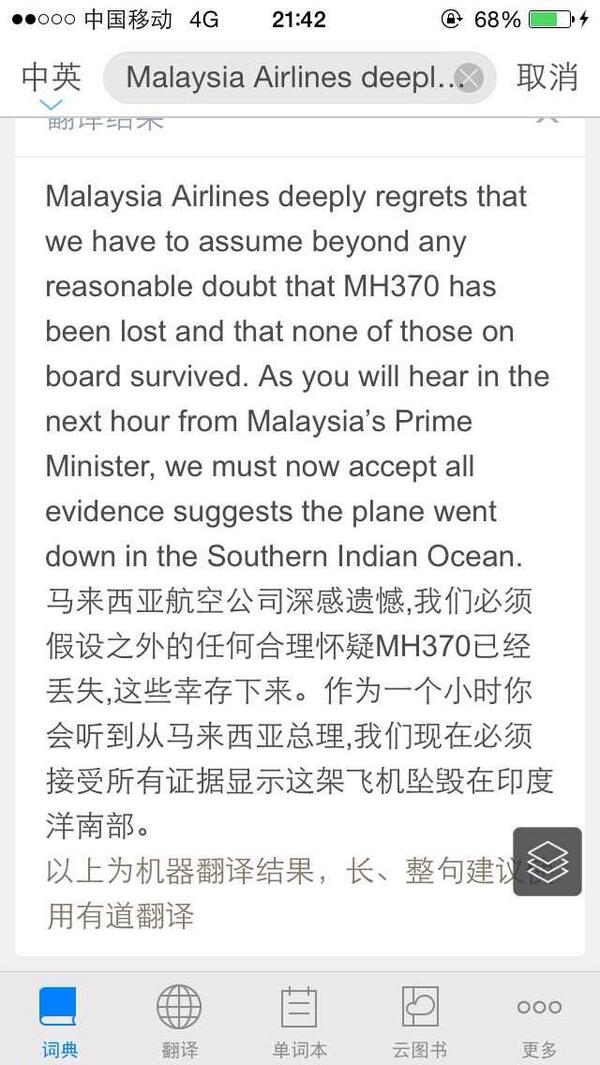
NBC News reports that Malaysia Airlines sent a text message to the relatives of the 239 passengers who were on board the plane saying “we have to assume beyond any reasonable doubt that MH370 has been lost and that none of those on board have survived. … We must now accept all evidence that  suggest the plane went down in the Southern Indian Ocean.”

Malaysia Prime Minister Najib Razak will announce the new developments at a press conference on Monday.

The U.S. Navy is now flying a black box detector to the area in hopes of recovering the cockpit voice recorder and flight data recorder. A U.S. Navy plane flying over the possible debris field detected two or three faint radar hits, according to NBC News reporter Bill Neely.

Families of the MH370 passengers are taking charter flights to Australia tonight, according to Sky News.

Both Chinese and Australian aircraft have spotted possible debris in the Indian Ocean. The Boeing 777 plane went missing on March 8 during a flight from Kuala Lumpur to Beijing. There were 239 people on board.

Military radar shows that the plane reportedly changed altitutde and dropped to about 12,000 feet after making a sharp turn off its planned flight path, CNN reports.

This could point to the pilots trying to save the plane after something catastrophic happened – dropping to a low altitude is a procedure pilots use when the plane loses pressure. Getting down to a low altitude can save passengers on board because there’s enough air in the atmosphere to keep everyone alive.


Here’s The Text Message Malaysia Airlines Sent To The

Families Of The Lost Passengers…

View image on Twitter


source::::Business Insider India

natarajan


All the Airplanes that Have Mysteriously Vanished since 1948 …

All the airplanes that have mysteriously vanished since 1948

As this Bloomberg map shows, Malaysian flight 370 is not the first flight to mysteriously disappear. 83 flights have vanished since 1948—80 of them never to be found again (the dots in yellow). This map only includes flights capable of carrying more than 14 passengers.

Some more curious stats:

  • Five planes were missing in the famous Bermuda Triangle.
  • The DC-3 is the airplane with the higher count of disappearances: 19.
  • The average number of people missing: 13.
  • The average number of vanished flight per year: 1.2.

Check out the full Bloomberg infographic here.

 source::: http: // sploid.gizmodo.com

natarajan

Is This the Most Plausible Theory on the Missing MH 370 Flight ?

A CANADIAN pilot with 20 years experience has a simple theory regarding the disappearance of flight MH370.

Chris Goodfellow, a veteran flyer, isn’t buying any of the complicated ideas that have been floated by aviation experts since the plane vanished 11 days ago.

In a lengthy Google+ post, Goodfellow argues that the missing Malaysia Airlines flight probably fell victim to a fire, not a hijacking.


A woman offers prayers in solidarity with the passengers of the missing plane.

A woman offers prayers in solidarity with the passengers of the missing plane. Source: AFP


He says the plane’s sudden left turn is the key piece of evidence.

“We old pilots were drilled to know what is the closest airport of safe harbour while in cruise,” he writes. “If something happens, you don’t want to be thinking about what you are going to do — you already know what you are going to do. When I saw that left turn with a direct heading, I instinctively knew he was heading for an airport.”

Goodfellow believe Captain Zaharie Ahmad Shahs was taking a direct route to Pulau Langkawi, a 3,962-metre airstrip with an approach over water and no real obstacles. If the plane had turned back towards Kuala Lumpur, it would have needed to cross a series of high ridges.


Goodfellow thinks the pilot was heading for this airstrip.

Goodfellow thinks the pilot was heading for this airstrip. Source: NewsComAu


According to Goodfellow, an electrical fire could explain MH370’s failure to communicate.

“For me, the loss of transponders and communications makes perfect sense in a fire. And there most likely was an electrical fire,” he says.

“In the case of a fire, the first response is to pull the main busses and restore circuits one by one until you have isolated the bad one. If they pulled the busses, the plane would go silent.

“It probably was a serious event and the flight crew was occupied with controlling the plane and trying to fight the fire. Aviate, navigate, and lastly, communicate is the mantra in such situations.”


Children read messages aimed at the missing passengers.

Children read messages aimed at the missing passengers. Source: AP


Goodfellow also floats the possibility of a fire being caused by an overheating tyre on the plane’s landing gear.

“Once going, a tyre fire would produce horrific, incapacitating smoke,” he writes.

“What I think happened is the flight crew was overcome by smoke and the plane continued on the heading, probably on George (autopilot), until it ran out of fuel or the fire destroyed the control surfaces and it crashed.

“You will find it along that route — looking elsewhere is pointless.”


The Royal Malaysian Navy ship KD Selangor is aiding in the search effort.

The Royal Malaysian Navy ship KD Selangor is aiding in the search effort. Source: AFP


The former pilot has not been convinced by other theories that suggest the plane was hijacked.

“There are many ways a pilot can communicate distress,” Goodfellow says. “A hijack code or even transponder code off by one digit would alert ATC that something was wrong. Every good pilot knows keying an SOS over the mike always is an option … So I conclude that at the point of voice transmission all was perceived as well on the flight deck by the pilots.”

Goodfellow suggests the pilots were unaware that the ACARS system was not transmitting, and says an electrical fire is more likely to have caused that problem than a deliberate shutdown.


A man recites the Koran after a special prayer session held for the missing Malaysian air

A man recites the Koran after a special prayer session held for the missing Malaysian airliner. Source: Getty Images


He says the analysis offered by news outlets has been “almost disturbing”, and the plane’s pilots deserve better.

“There is no point speculating further until more evidence surfaces, but in the meantime it serves no purpose to malign pilots who well may have been in a struggle to save this aircraft from a fire or other serious mechanical issue,” he says.

“Captain Zaharie Ahmad Shah was a hero struggling with an impossible situation trying to get that plane to Langkawi. There is no doubt in my mind.”


A young Malaysian boy prays, at an event for the missing flight.

A young Malaysian boy prays, at an event for the missing flight. Source: AP


Goodfellow may have no doubts about his theory, but other aviation experts do. Greg Feith, a former crash investigator with America’s National Transportation Safety Board, has told NBC News that a fire would have given the pilots time to communicate.

“I’ve seen those remarks. I’ve seen the articles. If there was an electrical fire on board, there still has to be a source,” Mr Feith said. “And you can’t take out the entire electrical system all in one fell swoop without really catastrophically compromising the structure of the aeroplane.

“Typically, with an electrical fire, you’ll have smoke before you have fire. You can do some troubleshooting. And if the systems are still up and running, you can get off a mayday call.”

source::::news.com.au

natarajan

Abandoned Airports … A Quick Look …


Abandoned airports are fascinating.

Abandoned airports are fascinating. Source: ThinkStock

WELCOME to no-man’s land.

They are the airports to nowhere; commercial flights ceased long ago and they have been left to fall into ruin, yet we remain intrigued at just what went so “plane” wrong.

Here are the amazing stories behind 15 of the biggest, weirdest and most expensive abandoned airports in the world.

That includes “alien landing strips”, ruined runways and financial disasters.

1. Castellón — Costa Azahar Airport, Spain

What’s Spanish for “white elephant”? Officially declared open in March 2011, no commercial flight has actually departed or landed at Castellón-Costa Azahar Airport. Built at a cost of 150 million euros ($230 million), the enduring feature of this freshly-deceased airport near Valencia is a statue in honour of Carlos Fabra, the local politician who was the driving force behind its construction.


Castellon — Costa Azahar. picture: Sanbec, Wikicommons

Castellon — Costa Azahar. picture: Sanbec, Wikicommons Source: Supplied


2. Don Quijote Airport, Spain

If you thought $230 million was a gigantic waste of money, how about $1.2 billion?Don Quijote Airport (or Ciudad Real Central, to give it its official name) was conceived in the 1990s as an alternative to Madrid-Barajas Airport. Fifty minutes from Madrid on a high-speed rail connection with Seville, it was Spain’s first private international airport, and Spain’s last — it went bust and closed in April 2012.


Don Quijote Airport. Picture: Africa Twin, Wikicommons

Don Quijote Airport. Picture: Africa Twin, Wikicommons Source: Supplied


3. Berlin Templehof, Germany

Built in 1923, Berlin-Tempelhof closed to passengers in October 2008. Until the construction of the Pentagon, it was the largest building in the world. It played a key role in the Berlin Airlift but over the years it became obsolete. Today ‘Tempelhof Field’ is the largest public park in the city and the airport buildings host events such as raves and fashion shows.


Berlin Templehof. Picture: Quapan

Berlin Templehof. Picture: Quapan Source: Flickr


4. Croydon Airport, England

Said to be one of the three iconic pre-WWII airports in Europe, along with Le Bourget in Paris and Templehof in Berlin (see above), Croydon was redolent of the romance of early aviation. Several famous figures, from Amy Johnson and Charles Lindbergh to Winston Churchill, graced its runway, which crossed a road on which traffic had to be stopped by a man waving a red flag. It’s also famous for being the first airport with air traffic control. Today, the old terminal Airport House still stands.


Croydon Airport. Picture: HHA124L

Croydon Airport. Picture: HHA124L Source: Flickr


5. Nicosia International Airport, Cyprus

Nicosia International Airport was the most important airport in Cyprus but commercial activity stopped after the Turkish invasion of 1974. Today it is a no-man’s land, a United Nations buffer zone from which both Greeks and Turks are barred.


Nicosia International Airport. Picture: Dicklebers, Wikicommons

Nicosia International Airport. Picture: Dicklebers, Wikicommons Source: Supplied


6. RAF Binbrook, England

The UK has a number of old disused airfields just waiting to be turned into the next ‘regional hub’ or Mayor of London-named mega project mooted as an alternative to Heathrow’s 11th runway. RAF Binbrook, near Brookenby in Lincolnshire was used by bombers during World War II and continued to be used by the Air Force until the 1980s. Its biggest claim to fame is as the set for 1990 flick Memphis Belle.


RAF Binbrook. Picture: MilbourneOne, Wikicommons

RAF Binbrook. Picture: MilbourneOne, Wikicommons Source: Supplied


7. Gaza International Airport, Gaza strip

Also known as Yasser Arafat International Airport, this airport served the Gaza strip. Opened in 1998, 700,000 passengers passed though it a year, but not for long. In December 2001 Israeli forces shelled its radar station and control tower, putting it out of action. A few weeks later, they bulldozed the runway.


Gaza International Airport. Picture: GishaOrg

Gaza International Airport. Picture: GishaOrg Source: Flickr


8. Stapleton International Airport, US

Stapleton International Airport served Denver, Colorado between 1929 and 1995, when it was replaced by Denver International. In July 1997, a storm caused severe damage to its structure, so it had to get knocked down completely. All that remains today is one old control tower.


Stapleton International Airport. picture: Bradleygee

Stapleton International Airport. picture: Bradleygee Source: Flickr


9. Marine Corps Air Station El Toro, US

“Welcome to Earth!” This was Will Smith’s greeting to an alien in Independence Day. Scenes from the classic 1996 sci-fi blockbuster were filmed at the Air Station Marine Corps El Toro airfield in the California desert, which looks exactly like the kind of place that an extraterrestrial attack force would use as a rendezvous point on our planet. It closed in 1999 (not because of an alien attack).


Marine Corps Air Station El Toro. Picture: Dsearls

Marine Corps Air Station El Toro. Picture: Dsearls Source: Flickr


10. Galeville, Shawangunk, US

The small military airfield in upstate New York was built during World War Two for use as a military academy. It had two paved runways and for some years operated as a civilian airport. It’s now part of the Shawangunk Grasslands National Wildlife Refuge.


Galeville, Shawangunk. Picture: Danielcase, Wikicommons

Galeville, Shawangunk. Picture: Danielcase, Wikicommons Source: Supplied


11. Johnston Atoll Airport, US

Imagine trying to land a plane here! Johnston Atoll Airport is, as the name suggests, a small atoll in the Pacific Ocean, several hundred miles south of Hawaii. It was a US military base for much of the 20th century but closed in 2005. Built on a small island, it housed 400 men and had an underground hospital. Attacked by Japanese submarines in During World War II, it’s now abandoned and lies in ruins.


Johnston Atoll Airport. Picture: USFWSPacific

Johnston Atoll Airport. Picture: USFWSPacific Source: Flickr


12. Montreal-Mirabel International Airport, Canada

Opened in 1975, Montreal International Airport in Quebec is now just used by cargo planes. But his beginnings were more ambitious. It was conceived as the largest airport in the world at the time, 10 times as big as Charles de Gaulle Airport in Paris. Expected to receive 50 million passengers a year, this never happened. Despite government intervention, passenger flights ceased in 2004. The Tom Hanks movieTerminal was filmed here, while the track serves as a racing circuit.


Montreal-Mirabel International Airport. Picture: Yvan — Leduc, Wikicommons

Montreal-Mirabel International Airport. Picture: Yvan — Leduc, Wikicommons Source: Supplied


13. Floyd Bennett Field, New York, US

Formerly one of New York’s major airports, Floyd Bennett Field is synonymous with the exploits of Amelia Earhart and Howard Hughes. Its glory days over, it was replaced by Newark Airport in New Jersey. Although these days is a public park, it retains some of the historic buildings that were part of the airport.


Floyd Bennett Field. picture: Uberzombie

Floyd Bennett Field. picture: Uberzombie Source: Flickr


14. Robert Mueller Municipal Airport, US

Robert Mueller Municipal Airport served the city of Austin in Texas from 1928 to 1999 when it was officially closed and replaced by the Austin Bergstrom International Airport. Now built over, the only thing that reminds us that one day there was an airport here is the old control tower.


Robert Mueller Municipal Airport. Picture: Seanmasn

Robert Mueller Municipal Airport. Picture: Seanmasn Source: Flickr


15. Kai Tak International Airport, Hong Kong

Kai Tak International was Hong Kong’s main airport from 1925 to 1998, when it closed and all traffic moved to the new Hong Kong International Airport, 48 kilometresto the west. Surrounded by mountains and buildings, it was one of the world’s most notorious for takeoffs and landings, especially on the famous track 13, since the aircraft had to make a turn of 90 or even 180 degrees.

Read more travel news from leading travel search website Skyscanner.


Kai Tak International Airport. Picture: Alandot

Kai Tak International Airport. Picture: Alandot Source: Flickr

source:::::news.com.au

natarajan

” How Safe Flying Has Become … “

When Malaysian Airlines flight MH370 disappeared without a trace over Southeast Asia sometime Saturday, a persistent question quickly emerged: How could an airliner just vanish? But as the days continue to pass without any sign of the plane, we have been reminded that flight is a complex process that we now frequently take for granted. That’s right, maybe this whole flying through the air in a metal tube with wings thing isn’t as easy or simple as we make it look, and sometimes, albeitextremely rarely, it does go wrong.

From the beginnings of the remarkable achievement of human flight and the mysterious disappearance of American aviator Amelia Earhart, a number of seemingly unbelievable incidents have helped shape how we fly. Some of the following air incidents ultimately made airplane travel safer, but usually only after emphasizing the fact that the skies — and what we do in them — can sometimes be shockingly unpredictable. Perhaps it’s amazing that things almost always go right.
1. A commercial airliner went down over the Atlantic and wasn’t found for five days.

88368623

Crew members of a Brazilian frigate recover debris from Air France flight 447. 

A little after 10 p.m. on May 31, 2009, Air France Flight 447 took off from Rio de Janeiro, Brazil to make its way across the Atlantic to Paris’ Charles de Gaulle International Airportf. The Airbus A330-203 was carrying 216 passengers, as well as 12 crew members. The aircraft was last contacted at 2:10 a.m. on June 1. Five days later, wreckage of the plane finally began showing up in the Atlantic. All aboard were presumed dead and the cause of the crash remained largely undetermined until the plane’s flight data recorder and the cockpit voice recorder were recovered nearly two years later, about two miles under the ocean.

Analysis of the black boxes determined that Air France Flight 447’s autopilot failed and the pilots mistakenly raised the nose of the plane causing it to stall. The pilots were reportedly unaware of the stall and continued pulling up, which resulted in the plane eventually plummeting intact from 38,000 feet, falling at roughly 10,000 feet per minute. Experts concluded that the plane broke apart not in the air but upon impact with the Atlantic Ocean.

2. An American Airlines plane was stolen off a runway in Luanda, Angola and has never been seen again.

northwest airlines flight 255

The stolen American Airlines plane, 14 years prior. 

It was 2003, and Ben Charles Padilla — airline mechanic, flight engineer and private pilot — was in charge of maintenance of a used Boeing 727 American Airlines plane(owned by a Miami airline leasing company), that had been sitting on the runway in Luanda, Angola at Quatro de Fevereiro Airport for a little over a year. On May 25, 2003, the plane inexplicably made its way down the runway, without authorization and with its transponder turned off. The FBI and CIA believe Padilla was at the controls, but reports vary as to how many people were with him upon takeoff. U.S officials suspect the plane was used for illegal activity, such as running drugs, guns or perhaps even crashed for insurance money, but no one is certain. As of today, the plane and Padilla remain missing.
3. An Australian pilot reported a UFO hovering above him mid flight. He and his plane are still missing.

154952947

Single engine Cessna craft similar to that flown by Valentich. 

In October 1978, Frederick Valentich was flying over Melbourne’s Bass Strait when he reported that an aircraft that he could not identify was hovering a thousand feet above him. The flight tower told Valentich they detected no other aircraft in the area. At about 7:12 p.m., Valentich told the tower the object was “hovering and it’s not an aircraft.” This was followed by 17 seconds of unidentified “metal scraping sounds” and then silence. Valentich and his Cessna 182L were never seen again.

Without the wreckage, we’ll never really know what happened, but subsequent reports suggest it is likely that Valentich became disoriented, possibly misjudged his altitude and crashed. Given that the disappearance took place over 30 years ago, and no wreckage has ever been found on land, it leads many to believe that Valentich must have gone down over water, which could conceivably hide a crashed plane indefinitely.
4. The roof of a commercial airliner blew off mid-flight, leaving passengers and crew exposed to the elements. The plane still managed to land safely.

aloha airlines 243

Passengers recover as the exposed cabin of Flight 243 looms in the background. 

On April 28, 1988, Aloha Airlines Flight 243 was carrying passengers from Hilo to Honolulu, Hawaii on a Boeing 737-297 when an explosive decompression caused the roof just outside the cockpit to rupture, leaving a gaping hole through which debris from the aircraft and unsecured items from the cabin were rapidly sucked out. One flight attendant, Clarabelle Lansing, was also ejected from the plane, and her body was never found. She was the lone fatality in the catastrophic incident, which according to the NTSB, was caused by a structural failure in the fuselage due to age and stress on the 19-year-old aircraft. Others had different hypotheses, but following the NTSB’s report, safety inspection and construction standards were changed for this line of commercial airliner.
5. A pilot successfully crash-landed a 737 in the middle of the jungle after flying in the wrong direction upon takeoff.

varig flight

A Varig 737 similar to the one piloted into the Amazon. 

Varig Flight 254 was supposed to be taking a plane full of passengers on the final leg of a flight from São Paulo to Belém, in Brazil, on Sept. 3, 1989. After completing a number of successful stopovers, the crew prepared for the home stretch, a short journey from Marabá to Belém. When the pilot went to input the heading for the final flight, he misread the coordinates, leading him to direct the plane to fly in the opposite direction, into an uninhabited section of the Amazon. The true extent of the mistake went unnoticed until it was too late, as the pilots attempted to find nearby airfields to land in when they couldn’t find the Belém runway. The plane eventually ran out of fuel and the crew was forced to take the aircraft down over an isolated stretch of rainforest.

The impact and ensuing disintegration of the plane led to eight fatalities. Survivors of the crash then hiked out of the jungle to retrieve help for their companions. A total of 13 were killed as a result of the incident.
6. A commercial jetliner went down in the ocean just short of its island destination. Out of 153 people on board, only one survived.

yemenia flight 626

French and Yemeni divers search the Indian Ocean for the wreckage of Yemenia Flight 626. 

Yemenia Flight 626, an Airbus A310-324, crashed into the Indian Ocean off the coast of the small island of Comoros on June 30, 2009. Thirteen hours after the crash, rescuers spotted 14-year-old Bahia Bakari clinging to debris in the ocean. Without a life vest and apparently unable to swim, Bakari was the only survivor of the flight, which also claimed the life of her mother. An investigation of the crash ultimately determined that the plane had gone down due to crew error.
7. The U.S. Navy shot down a commercial jet thinking it was an F-14.

uss vincennes

The U.S.S. Vincennes. 

With the Iran-Iraq war still going strong in 1988, there was still a great deal of uneasiness in the Persian Gulf. Iran Air Flight 655 left from Tehran on its way to Dubai on July 3. Patrolling the Gulf that day was the USS Vincennes, a U.S. Navy guided missile cruiser. The U.S. claims that it attempted to make contact with the aircraft, which did not identify itself, and thus was forced to shoot down the plane using two surface to air missiles, killing all 290 on board.

The U.S. military has stated that it believed the Airbus A300 was actually an F-14 fighter jet, a much smaller and much faster aircraft. The lack of concrete reasoning for firing upon the aircraft, along with its historical opposition to Iran, did not paint the U.S. in a forgiving light. And though it has never admitted fault, the U.S. government paid the families of the deceased $61.8 million in restitution.
8. A plane veered off the runway shortly after takeoff, severing its wing and exploding onto a nearby highway.

northwest airlines flight 255

A flatbed truck hauls the remains of Northwest Airlines flight 255’s two engines. 

Northwest Airlines Flight 255 took off just outside of Detroit on August 16, 1987. The McDonnell Douglas MD-82 departed the runway shakily and veered off in one direction, severing the fuel-filled wing of the plane on a light pole. That ignited the plane as it crashed and broke apart on nearby Interstate 94. A total of 148 passengers and six crew members were killed in the accident. Two people on the ground were also killed. The lone survivor of the flight was a 4-year-old girl named Cecelia Cichan. She lost her mother, father and 6-year-old brother in the incident. It remains thedeadliest sole-survivor crash in the history of aviation.

9. A corporate jet had part of its wing and tail clipped by a commercial airliner — at 37,000 feet.

shocking flights

The Legacy 600 jet with part of its wing and tail clipped. 

New York Times travel writer Joe Sharkey was flying above the Amazon rainforest on September 29, 2006 in what he called an “uneventful and comfortable flight.”Suddenly, the $25 million Embraer Legacy 600 corporate jet he was flying in was hit. By what, no one knew. The passengers could only see that part of a wing was gone. And all this at nearly 40,000 feet in the air, above the Amazon. The pilots, unsuccessful in contacting anybody on the ground, desperately looked for a place to land. Finally, they located a hidden military base and miraculously brought the aircraft down safely.

Sharkey and the other passengers all celebrated and joked about their brush with death, wondering what might have hit them. Then news came. A Brazilian flight went missing right in the area where they had reported the collision. It was carrying 155 passengers. The two aircraft had somehow been traveling at the same altitude in opposite directions, in the same space, each at about 500 miles per hour.

The other craft turned out to be Gol Transportes Aéreos Flight 1907, a Boeing 737 traveling from Manaus, Brazil to Rio De Janeiro. According to crash reports, the Legacy 600’s left winglet (part of the wing that juts vertically off the wing’s tip) had collided with and sliced off nearly half of the Boeing 737’s left wing. This caused Flight 1907 to nose dive from 37,000 feet into an uncontrollable spin, which broke the aircraft apart in midair, sending all passengers and crew members to their death in the jungle below.

___________________________________________________________
All of these incidents were as tragic are they were unusual, which is perhaps why they are so fascinating. Flying in an airplane is seemingly inevitable. The airline industry has made it possible for us to jet coast to coast, continent to continent and everywhere in between, pretty much at the drop of a hat. And while the two million-plus passengers who board more than 30,000 flights every day in the U.S. (and no doubt others around the world) love to complain when things go wrong and flights are delayed or interrupted by crying babies, being involved in something like one of the incidents above seems almost unthinkable.

And that’s not by accident: The airline industry has continued to improve safety standards for both planes and broader flight protocols, ensuring that we almost always get from point A to point B without any real trouble, much less danger. You have a one-in-11 million chance of being killed in an airplane crash, meaning you’re much more likely to be eaten by a shark, or as some airline executives claim, more likely to die in the airport — and certainly while driving there — than on the plane itself.

MORE:

Air FranceAirplane CrashesAloha Airlines Flight 243Northwest Airlines Flight 255Jack Gilbert GrahamJoe Sharkey Legacy 600Frederick ValentichVarig Flight 254Yemenia Flight 626Iran Air Flight 655USS VincennesAirplane IncidentsWorldPost News

source:::: The World Post

natarajan

Here’s An Aerial View Of Oil Slicks Believed To Be From Missing Malaysia Plane …

A Vietnamese Air Force aircraft took this aerial photograph of an oil slick believed to be from the Malaysia Airlines 777 that vanished from radar yesterday.

Here's An Aerial View Of Oil Slicks Believed To Be From Missing Malaysia Plane

The plane disappeared over the South China Sea with 239 people on board.

The Vietnamese government says it hasspotted two oil slicks off the southern coast of the country that are “consistent with the kinds that would be produced by the two fuel tanks of a crashed jetliner,” according to an AP report.

Several countries, including the U.S., have joined the search for the missing plane.


source:::business insider india.com

natarajan