Image of the Day…. Space Station Flies over Super Typhoon Maysak !!!

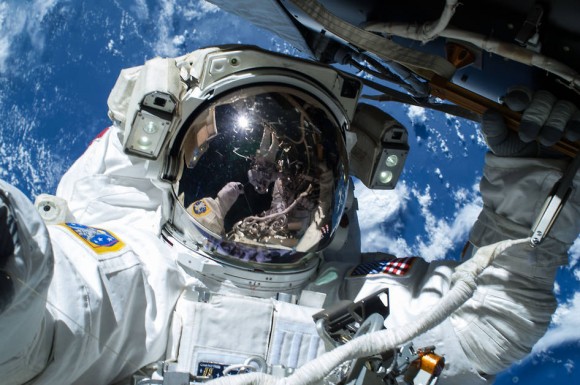
Typhoon Maysak strengthened into a super typhoon on March 31, reaching Category 5 hurricane status on the Saffir-Simpson Wind Scale. ESA Astronaut Samantha Cristoforetti captured this image while flying over the weather system on board the International Space Station.

The Tropical Rainfall Measuring Mission (TRMM) and Global Precipitation Measurement (GPM) satellites, both co-managed by NASA and the Japan Aerospace Exploration Agency, captured rainfall and cloud data that revealed heavy rainfall and high thunderstorms in the strengthening storm.

The TRMM satellite has been collecting valuable scientific data since November 1997. Early on March 30, the satellite collected rainfall data as it flew directly above Maysak at 04:14 UTC (12:14 a.m. EDT) when maximum sustained winds were near 85 knots (98 mph). Rainfall data was collected by TRMM’s Microwave Imager (TMI) and Precipitation Radar (PR) instruments and showed heaviest rainfall southwest of the center, and in fragmented bands of thunderstorms northeast of the center. In both of those places rainfall was in excess of 50 mm/2 inches per hour.

More information.

Image Credit: ESA/NASA/Samantha Cristoforetti 

Source:::::: http://www.nasa.gov

Natarajan

Image of the Day…Spacecraft Launch on March 27 2015…

One-year crew lift-off success

NASA astronaut Scott Kelly and Russian Federal Space Agency (Roscosmos) cosmonaut Mikhail Kornienko will spend a year aboard the International Space Station.

Soyuz TMA-16M spacecraft launch on March 27, 2015

Media photograph the Soyuz TMA-16M spacecraft as it launches to the International Space Station with Expedition 43 NASA astronaut Scott Kelly, Russian cosmonauts Mikhail Kornienko and Gennady Padalka of the Russian Federal Space Agency (Roscosmos) onboard.

Liftoff was at 3:42 p.m. EDT Friday, March 27, 2015 (March 28 Kazakh time) from the Baikonur Cosmodrome in Kazakhstan.

As the one-year crew, Kelly and Kornienko will return to Earth on Soyuz TMA-18M in March 2016.

The goal of the mission is to help scientists better understand how the human body reacts and adapts to the harsh environment of space.

Source:::: http://www.earthskynews.org

Natarajan


Image of the Day…Soyuz Spacecraft Ready to be Launched on March 28…

The Soyuz TMA-16M spacecraft is seen after having rolled out by train to the launch pad at the Baikonur Cosmodrome, Kazakhstan, Wednesday, March 25, 2015. NASA astronaut Scott Kelly and Russian cosmonauts Mikhail Kornienko and Gennady Padalka of the Russian Federal Space Agency (Roscosmos) are scheduled to launch to the International Space Station in the Soyuz at 3:42 p.m. EDT, Friday, March 27 (March 28, Kazakh time). As the one-year crew, Kelly and Kornienko will return to Earth on the Soyuz TMA-18M in March 2016.

Most expeditions to the space station last four to six months. By doubling the length of this mission, researchers hope to better understand how the human body reacts and adapts to long-duration spaceflight. This knowledge is critical as NASA looks toward human journeys deeper into the solar system, including to and from Mars, which could last 500 days or longer.

More: A Year in Space

Image Credit: NASA/Bill Ingalls 

source:::: http://www.nasa.gov

Image of the Day… ” Return of Expedition 42 to Earth ” …

The Soyuz TMA-14M spacecraft is seen as it lands with International Space Station Expedition 42 commander Barry Wilmore of NASA, Alexander Samokutyaev of the Russian Federal Space Agency (Roscosmos) and Elena Serova of Roscosmos near the town of Zhezkazgan, Kazakhstan. The landing took place on the evening of Wednesday, March 11 in the U.S, and early in the morning on Thursday, March 12, in Kazakhstan.

The three crew members returned to Earth after a 167-day mission on the orbital outpost that included hundreds of scientific experiments and several spacewalks to prepare the orbiting laboratory for future arrivals by U.S. commercial crew spacecraft.

SOURCE:::: http://www.nasa.gov

Natarajan


Image For The Day…. Dwarf Planet Ceres as Seen From Dawn Spacecraft Of NASA…

NASA’s Dawn spacecraft has become the first mission to achieve orbit around a dwarf planet. The spacecraft was approximately 38,000 miles (61,000) kilometers from Ceres when it was captured by the dwarf planet’s gravity at about 4:39 a.m. PST (7:39 a.m. EST) Friday, March 6.

This image of Ceres was taken by the Dawn spacecraft on March 1, just a few days before the mission achieved orbit around the previously unexplored world. The image shows Ceres as a crescent, mostly in shadow because the spacecraft’s trajectory put it on a side of Ceres that faces away from the sun until mid-April. When Dawn emerges from Ceres’ dark side, it will deliver ever-sharper images as it spirals to lower orbits around the planet.

The image was obtained at a distance of about 30,000 miles (about 48,000 kilometers) at a sun-Ceres-spacecraft angle, or phase angle, of 123 degrees. Image scale on Ceres is 1.9 miles (2.9 kilometers) per pixel. Ceres has an average diameter of about 590 miles (950 kilometers).

Dawn’s mission is managed by NASA’s Jet Propulsion Laboratory, Pasadena, California, for NASA’s Science Mission Directorate in Washington. Dawn is a project of the directorate’s Discovery Program, managed by NASA’s Marshall Space Flight Center in Huntsville, Alabama. The University of California, Los Angeles, is responsible for overall Dawn mission science. Orbital ATK Inc., in Dulles, Virginia, designed and built the spacecraft. The German Aerospace Center, the Max Planck Institute for Solar System Research, the Italian Space Agency and the Italian National Astrophysical Institute are international partners on the mission team. For a complete list of acknowledgments, http://dawn.jpl.nasa.gov/mission.

Image Credit: NASA/JPL-Caltech/UCLA/MPS/DLR/IDA 

SOURCE:::: http://www.nasa.gov

Natarajan

” MARS once had More Water Than Earth”s Arctic Ocean….”

NASA Research Suggests Mars Once Had More Water than Earth’s Arctic Ocean

Mars once held more water than Earth's Arctic Ocean

NASA scientists have determined that a primitive ocean on Mars held more water than Earth’s Arctic Ocean and that the Red Planet has lost 87 percent of that water to space.
Image Credit:
NASA/GSFC

A primitive ocean on Mars held more water than Earth’s Arctic Ocean, according to NASA scientists who, using ground-based observatories, measured water signatures in the Red Planet’s atmosphere.

Scientists have been searching for answers to why this vast water supply left the surface. Details of the observations and computations appear in Thursday’s edition of Science magazine.

“Our study provides a solid estimate of how much water Mars once had, by determining how much water was lost to space,” said Geronimo Villanueva, a scientist at NASA’s Goddard Space Flight Center in Greenbelt, Maryland, and lead author of the new paper. “With this work, we can better understand the history of water on Mars.”

Perhaps about 4.3 billion years ago, Mars would have had enough water to cover its entire surface in a liquid layer about 450 feet (137 meters) deep. More likely, the water would have formed an ocean occupying almost half of Mars’ northern hemisphere, in some regions reaching depths greater than a mile (1.6 kilometers).

The new estimate is based on detailed observations made at the European Southern Observatory’s Very Large Telescope in Chile, and the W.M. Keck Observatory and NASA Infrared Telescope Facility in Hawaii. With these powerful instruments, the researchers distinguished the chemical signatures of two slightly different forms of water in Mars’ atmosphere. One is the familiar H2O. The other is HDO, a naturally occurring variation in which one hydrogen is replaced by a heavier form, called deuterium.

By comparing the ratio of HDO to H2O in water on Mars today and comparing it with the ratio in water trapped in a Mars meteorite dating from about 4.5 billion years ago, scientists can measure the subsequent atmospheric changes and determine how much water has escaped into space.

The team mapped H2O and HDO levels several times over nearly six years, which is equal to approximately three Martian years. The resulting data produced global snapshots of each compound, as well as their ratio. These first-of-their-kind maps reveal regional variations called microclimates and seasonal changes, even though modern Mars is essentially a desert.

The research team was especially interested in regions near Mars’ north and south poles, because the polar ice caps hold the planet’s largest known water reservoir. The water stored there is thought to capture the evolution of Mars’ water during the wet Noachian period, which ended about 3.7 billion years ago, to the present.

From the measurements of atmospheric water in the near-polar region, the researchers determined the enrichment, or relative amounts of the two types of water, in the planet’s permanent ice caps. The enrichment of the ice caps told them how much water Mars must have lost – a volume 6.5 times larger than the volume in the polar caps now. That means the volume of Mars’ early ocean must have been at least 20 million cubic kilometers (5 million cubic miles).

Based on the surface of Mars today, a likely location for this water would be in the Northern Plains, considered a good candidate because of the low-lying ground. An ancient ocean there would have covered 19 percent of the planet’s surface. By comparison, the Atlantic Ocean occupies 17 percent of Earth’s surface.

“With Mars losing that much water, the planet was very likely wet for a longer period of time than was previously thought, suggesting it might have been habitable for longer,” said Michael Mumma, a senior scientist at Goddard and the second author on the paper.

NASA is studying Mars with a host of spacecraft and rovers under the agency’s Mars Exploration Program, including the Opportunity and Curiosity rovers, Odyssey and Mars Reconnaissance Orbiter spacecraft, and the MAVEN orbiter, which arrived at the Red Planet in September 2014 to study the planet’s upper atmosphere.

In 2016, a Mars lander mission called InSight will launch to take a first look into the deep interior of Mars. The agency also is participating in ESA’s (European Space Agency) 2016 and 2018 ExoMars missions, including providing telecommunication radios to ESA’s 2016 orbiter and a critical element of the astrobiology instrument on the 2018 ExoMars rover. NASA’s next rover, heading to Mars in 2020, will carry instruments to conduct unprecedented science and exploration technology investigations on the Red Planet.

NASA’s Mars Exploration Program seeks to characterize and understand Mars as a dynamic system, including its present and past environment, climate cycles, geology and biological potential. In parallel, NASA is developing the human spaceflight capabilities needed for future round-trip missions to Mars in the 2030s.

To view a video of this finding, visit:

http://youtu.be/WH8kHncLZwM 

SOURCE:::::;www.nasa.gov

Natarajan

Image of the Day…. ” Astronaut Salutes Leonard Nimoy From Orbit…”

International Space Station astronaut Terry Virts (@AstroTerry) tweeted this image of a Vulcan hand salute from orbit as a tribute to actor Leonard Nimoy, who died on Friday, Feb. 27, 2015. Nimoy played science officer Mr. Spock in the Star Trek series that served as an inspiration to generations of scientists, engineers and sci-fi fans around the world.

Cape Cod and Boston, Massachusetts, Nimoy’s home town, are visible through the station window.

SOURCE:::::: http://www.nasa.gov

Natarajan

Image of the Day…. ISS astronauts’ Space Walk Today… Feb 25…

Today’s spacewalk – the 2nd of 3 planned – began at 7:10 a.m. EST (1210 UTC) and will last 6.5 hours. This post has links to today’s live coverage, plus spectacular images from Saturday’s spacewalk.

NASA astronaut Barry Wilmore works outside the International Space Station on the first of three spacewalks preparing the station for future arrivals by U.S. commercial crew spacecraft, Saturday, February 21, 2015. Fellow spacewalker Terry Virts, seen reflected in the visor, shared this photograph on social media.  View larger. \  Image credit; NASA

NASA astronaut Barry Wilmore works outside the International Space Station on the first of three spacewalks preparing the station for future arrivals by U.S. commercial crew spacecraft, Saturday, February 21, 2015. Fellow spacewalker Terry Virts, seen reflected in the visor, shared this photograph on social media.
View larger. | Image credit: NASA

Today – February 25, 2015 – beginning at 7:10 a.m. EST (1210 UTC), International Space Station (ISS) astronauts are performing the second of three spacewalks to prepare the orbiting laboratory for future arrivals by U.S. commercial crew spacecraft. NASA TV coverage has begun and will go until 2 p.m. EST (1900 UTC) Wednesday. Watch here

NASA astronauts Barry Wilmore and Terry Virts completed the first spacewalk on February 21 and the third is scheduled for Sunday, March 1.

The spacewalks are designed to lay cables along the forward end of the U.S. segment to bring power and communication to two International Docking Adapters slated to arrive later this year. The new docking ports will welcome U.S. commercial spacecraft launching from Florida beginning in 2017, permitting the standard station crew size to grow from six to seven and potentially double the amount of crew time devoted to research.

NASA astronaut Terry Virts Flight Engineer of Expedition 42 on the International Space Station is seen working to complete a cable routing task while the sun begins to peak over the Earth’s horizon on February 21 2015. Image credit: NASA

Ground controllers have maneuvered the space station’s large robotic arm Canadarm2 in place for work planned for Wednesday’s spacewalk. Spacewalkers Barry Wilmore and Terry Virts will start their spacewalk at 7:10 a.m. EST to lay more cables and lubricate one of Canadarm2’s two latching end effectors, which serve as tip or base for the robotic arm. They will also prepare the Tranquility module for the relocation of the Permanent Multipurpose Module and the new Bigelow Expanded Activity Module later this year.

All three spacewalks are in support of the long-planned ISS reconfiguration from its current configuration, which was designed to support visiting Space Shuttles, to its new configuration optimived for future visiting commercial crew and cargo vehicles.

While cargo vehicles attach to the ISS using the process of berthing, whereby they are captured with the station’s robotic arm and positioned below a berthing port prior to being bolted into place, commercial crew vehicles will not use this method.

This is because the process of un-berthing takes a long time to complete, since cables and ducting between the visiting spacecraft and the ISS must first be manually disconnected, control boxes installed, hatches closed, and then the visiting spacecraft must be maneuvered away from the station with the robotic arm.

This means that berthing ports cannot support a rapid evacuation of crew from the ISS should it ever be necessary, which will be one of the primary roles of the commercial crew vehicles as they serve as “lifeboats” during their crew’s stay at the ISS.

Instead, crewed vehicles will attach to the ISS via a process of docking, whereby the visiting spacecraft flies itself all the way into its docking port and attaches via a capture ring striking a corresponding attachment mechanism.

The leading end effector of the Canadarm2 (bottom foreground) will be lubricated Wednesday when astronauts Barry Wilmore conduct their second spacewalk.  Imge credit: NASA TV

Bottom line: NASA astronauts Barry Wilmore and Terry Virts aboard the International Space Station completed the first of three spacewalk on February 21, 2105. The second is scheduled for Wednesday, February 25 and the third for Sunday, March 1. The astronauts are securing cables to prepare the orbiting laboratory for future arrivals by U.S. commercial crew.

SOURCE::::: http://www.earthskynews.org

Natarajan