Image of the Day… FirstEver Image of 5th order Rainbow …

The fabled quinary or 5th order rainbow is made by sunlight reflected five times inside raindrops. Now, for the first time, we have an image of one.

caption

The familiar primary and secondary rainbows have been known since there were eyes. The long sought 3rd and 4th order rainbows were finally imaged in 2011. Now we have the 5th order!

Harald Edens’ discovery image was taken on August 8, 2012 from the Langmuir Laboratory for Atmospheric Research near the 10,800-foot summit of South Baldy Peak, New Mexico, USA. This is the first-ever image on which the 5th order rainbow is positively identified. This version is considerably enhanced. The raw camera image is here (link to image).

The 5th order lies between the primary and secondary rainbows in the dark sky of Alexanders dark band, where there is no primary or secondary rainbow light.

caption

The fabled quinary or 5th order rainbow is made by sunlight reflected five times inside raindrops. We see only its broad greens tending to blue towards the primary bow. Its yellows and reds are hidden behind the secondary bow.

Harald has now photographed the 5th order several times. He ascribes his success to the very bright rainbows formed locally from small thunderstorms and to the exceptionally clear high altitude low density air. Astute observation over many years by an atmospheric optics expert also helps somewhat! His scientific account will be published in the Journal of Applied Optics.

More about it on Optics Picture of the Day, from the website Atmospheric Optics

SOURCE:::: EARTH SKY NEWS

Natarajan

India”s NIRBHAY Subsonic Cruise Missile… Few Facts on its Launch …

Nirbhay, India’s first home-grown subsonic cruise missile, was on Friday successfully test-launched from the Interim Test Range in Chandipur, near Balasore in Orissa.

This is Nirbhay’s second launch, the first being terminated mid-way on 12 March 2013 owing to a technical snag. Nirbhay, with an expected strike range of 800-1000 km, is the first missile being made completely in Bangalore.

Here are some facts of the missile:

1) Nirbhay is a subsonic cruise missile – it starts off as a rocket and then turns into an aircraft.

2) Nirbhay is expected to have an expected strike range of 800-1000 km.

3) The missile was nurtured at the Defence Research and Development Organisation’s premier laboratory Aeronautical Development Establishment in Bangalore’s C V Raman Nagar.

4) The cost of one missile is Rs 10 crore.

5) It has good loitering capability, good control and guidance, high degree of accuracy in terms of impact and very good stealth features.

6) The Nirbhay missile is similar to the US Tomahawks, which can fly like an aircraft and capable of travelling up to 1,000 km.

7) It can fly at tree-top level making it difficult to detect on radar and as it approaches the target, the missile can determine the point of impact while hovering over the target.

8) It gives India the capacity to launch different kinds of payloads at different ranges from various platforms at a very low cost. It can be launched from a mobile launcher.

SOURCE::: REDIFF.COM  
Natarajan

” Suggest a Suitable Name to Space Robot and Win a Prize from NASA …” !!!

Name a Flying Space Robot, and Win a Prize From NASA

NASA needs your help to name a new space robot, and you could win some cash doing it.

NASA officials are asking space fans around the world to help name, and design a mission patch for, a new free-flying robot expected to launch to theInternational Space Station in 2017. The first-place winner of the challenge will receive $1,000. Officials with the space agency put out the call to any interested space fans at New York Comic Con on Saturday.

“We have this new free-flying robot that we’re building,” Jason Crusan, director of NASA’s Advanced Exploration Systems division, told a full house at Comic Con. “We don’t know what to call it. ‘Free-flying robot’ sounds kind of boring and not all that exciting, so we’re asking you to actually name the robot for us.”

Image: Free-flying robotNASA / TOPCODER
A sketch shows how a free-flying robot on the International Space Station could be moved by remote control to get a better video angle.

Second, third and fourth place also come with cash prizes. Second place will win $500, with third and fourth prize taking home $250 each. NASA has teamed up with Topcoder to organize the contest.

If an artist’s depiction of the new space automaton is any indication, the new robot may look like something out of “Star Wars.” In the artist’s concept, the robot could appear as a small, ball-shaped droid that will use fans to move itself around the interior of the International Space Station. It is expected to be able to fly itself, or be operated by remote control.

The new free-flying bot would join a group of other free-fliers already on the station. NASA’s SPHERES robots (the name is short for Synchronized Position Hold, Engage, Reorient, Experimental Satellites) are already used on the orbiting outpost.

To participate in the NASA challenge to name the new robot, space fans need to register with Topcoder. Participants will reach a checkpoint where they will receive feedback on their initial designs on Oct. 22, and the challenge ends on Oct. 27. Officials will announce the winners of the competition on Nov. 2.

To participate in the challenge and learn more about it, go tohttp://www.topcoder.com/challenge-details/30046039/?type=design&noncache=true.

— Miriam Kramer, Space.com

This is a condensed version of a report from Space.com. Read the full report.Follow Miriam Kramer on Twitter and Google+. Follow Space.com on Twitter,Facebook and Google+.

First published October 15th 2014, 5:55 am  in http://www.nbcnews.com

NatarajanBO

Image of the Day… Earth and Moon as Seen From Mercury !!!

MESSENGER spacecraft sees lunar eclipse from Mercury

The MESSENGER spacecraft, now orbiting Mercury, caught the images to make this movie of last Wednesday’s lunar eclipse. See Earth and moon from Mercury!

Earth and Moon from Mercury orbit, with Moon entering eclipse.  Imaged on Wednesday, October 8, 2014 by MESSENGER, a spacecraft in orbit around Mercury.

The MESSENGER spacecraft – which has been orbiting the sun’s innermost planet Mercury since 2011 – made this movie of the the Hunter’s Moon passing into the Earth’s shadow on October 8, 2014. The movie consists of 31 MDIS NAC (Mercury Dual Imaging System Narrow Angle Camera) frames taken two minutes apart from 09:18 UTC to 10:18 UTC on October 8. MESSENGER made the movie from a distance of 107 million kilometers / 66 million miles.

Notice the orientation of bright side of Earth. Earth’s shadow always extends in the direction opposite this bright side – or day side – approximately 1,400,000 kilometers / 1,000,000 miles into space. On October 8, the moon passed into the shadow, causing the eclipse.

The images have been enlarged 2 times and the moon brightened 25 times. The Earth was five pixels wide and the Moon one pixel wide.

The Earth – moon pair appeared in front of the constellation Aries, near the border of the constellation Pisces, as seen from Mercury.

The Earth was very bright magnitude minus 4.38 and the Moon was magnitude minus 0.03.

Read more from Emily Lakdawalla at the Planetary Society

Bottom line: The MESSENGER spacecraft, now orbiting Mercury, caught the images to make this movie of last Wednesday’s lunar eclipse. See Earth and moon from Mercury!

SOURCE:::: earthskynews

Natarajan

This Teen Wants to be the First Person Landing on MARS !!!

Alyssa Carson, from Louisiana, wants to be the first person on Mars

Determined ... Alyssa Carson wants to be the first person on Mars. Picture: Twitter.

Determined … Alyssa Carson wants to be the first person on Mars. Picture: Twitter. Source: Supplied

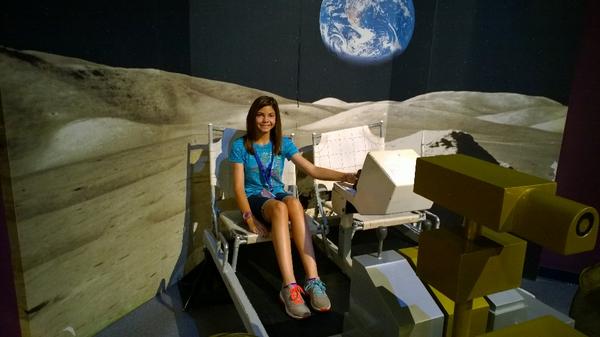
THIS 13-year-old girl has been training to be an astronaut for nine years and is determined to become the first person to land on Mars.

Alyssa Carson is the first person to have attended all three of NASA’s world space camps.

The Louisiana teenager speaks Spanish, French and Chinese, and is prolific on social media.

She told the BBC that she wants to inspire other children to achieve their dreams.

“I have thought about possibly being other things but being an astronaut was always first on my list,” she said. “I don’t want one obstacle in the way to stop me from going to Mars … Failure is not an option”.


And NASA is not discounting her ambitions. Her call sign at the US space agency is “Blueberry”.

“She is of the perfect age to one day become an astronaut and eventually travel to Mars,” NASA’s Paul Foremantold the BBC. “She is doing the right thing, she is doing the right training, taking all the right steps to actually become an astronaut.”

View image on Twitter

Bret Carson, Alyssa’s dad, said he has spoken to his daughter about the possibility that she may never return from Mars but he says she isn’t worried about that.

“We have the next 20 years planned out, we know what she’s doing, she’s looking at going on a mission to mars in 2033,” he said. “In 20 years I may not ever see her again, there are options out there where they go to mars and not come back, and we’ve had those discussions, and if that’s the only option she still wants to go.”

Source:::: news.com.au

Natarajan

Image of the Day…Full Moon Rising over Lotus Temple in NewDelhi …


Full moon rising over Lotus Temple in Delhi, India

We saw many photos of the October 8 moon during the total lunar eclipse. Here’s one from India, where the eclipse was less easily visible.

Photo by Abhinav Singhai.  Visit him on Flickr.

Our friend Abhinav Singhai captured this moonrise (Hunters Moon) time lapse over the Lotus Temple in Delhi, India. It was October 8, 2014, the night of the total lunar eclipse. Abhinav wrote:

Penumbral lunar eclipse was visible from Delhi at the time of moonrise, and visible in the first picture as well (slight shadow).

SOURCE:::: EARTHSKYNEWS

Natarajan

NASA Invites Public to send their Names into Space !!!

Over 2.8 lakh people from around the world, including 21,729 Indians, have so far submitted their names to be inscribed on a NASA microchip that will eventually fly to Mars.

NASA is giving people a chance to shoot their names up into space on the first Orion mission, scheduled to for launch on December 4, and then eventually to the Red Planet.

http://mars.nasa.gov/layout/embed/image/485snm/

Currently, 2,80,429 people have submitted their names to fly into space.

The highest number of names submitted to NASA so far from a single country – a total of 1,13,121 – comes from the USA while the third-largest submission of names is from India, with 21,729 space enthusiasts from the nation giving their names.

Other countries with high participation include UK (22,491 names), Philippines (9,869 names) and Canada (7,760 names). Currently, only 1,828 names have been submitted from China and 1,620 from Pakistan.

The collected names will be included on a microchip the size of a dime. The first trip will be on board NASA’s initial test flight for the new Orion spacecraft. It is set for a 4.5-hour mission in orbit around Earth.

“After returning to Earth, the names will fly on future NASA exploration flights and missions to Mars. With each flight, selected individuals will accrue more miles as members of a global space-faring society,” NASA said.

To sign up, users have to go to NASA’s name-collecting site, fill out some basic information, and submit. The site then generates a digital “boarding pass.”

The deadline for getting your name on Orion’s inaugural flight is October 31.

SOURCE::::: THE HINDU.COM

Natarajan

Keywords: NASAOrion

Image of the Day… Crater in Planet Mercury …

One of the sharpest images ever obtained of Mercury

This unnamed crater is only 1.5 kilometers / 0.93 miles wide. It’s made more visible by the deep shadows cast on a Mercury afternoon.

Very closeup look at planet Mercury.  Image obtained on August 3, 2014, via NASA / JHU / APL MESSENGER spacecraft.

Here is one of sharpest images ever obtained of the sun’s innermost planet, Mercury. It’s a small crater within a 3.75-kilometer / 2.33-mile-wide area within the Hokusai Quadrangle in Mercury’s Northern Hemisphere.

What you see here is seen an unnamed crater only 1.5 kilometers / 0.93 miles wide in the hermean [Mercury] afternoon. The surrounding terrain and the crater profiles appear quite smooth, owing to many millions of years of thermal changes between the hermean day and night as well as micrometeoroids, ‘gardening’ the regolith.

The smallest craters and degraded ghost craters seen in this image are only 20 meters / 65 feet wide.

The bright streak within the crater is a cosmic ray strike on the MDIS NAC CCD.

On September 12, 2014. the MESSENGER spacecraft periherm – its closest point to Mercury – was successfully raised from: 24.3 kilometers / 15.1 miles to 94 kilometers / 58.4 miles, extending the mission further.

Periherm will be raised again on October 24, 2014 and once more on January 21, 2015, when the fuel on board MESSENGER is expected to be depleted.

MESSENGER is expected to impact Mercury on the weekend of March 28-29, 2015.

Source::::   in earth sky news

Natarajan

World”s Shortest A 380 Route….Between Dubai and Kuwait !!!

Photo: © Tommy Beattie | Dreamstime.com

Emirates now offers the world’s shortest Airbus A380 service. The Gulf carrier upgraded the Boeing 777-200LR aircraft that previously operated flights EK857 and EK858 between Dubai International Airport and Kuwait International Airport to superjumbo aircraft. Lasting one hour and 45 minutes in duration, the flight is the shortest A380 service globally. Emirates offers the route five times daily with both Boeing and Airbus aircraft. The carrier’s double-decker aircraft features 17 private suites in first class and 76 flat-bed seats in business class. Kuwait became the second destination in the Middle East to be served by Emirates’ A380, joining Riyadh International Airport in Saudi Arabia.

You may also like:

Emirates Business Class

Emirates Launches Private Jet Service


SOURCE::: news.com.au

Natarajan