Image of the Day…Songbird Migrating 1500 Miles …Non Stop !!!

Photo credit: Greg Lasley

A little songbird known as the blackpoll warbler departs each fall from New England and eastern Canada to migrate nonstop in a direct line over the Atlantic Ocean toward South America. To track the birds’ migration route, scientists used miniaturized light-sensing geolocators attached to the birds like tiny backpacks.


According to the study, which appears in the March issue of Biology Letters, the birds complete a nonstop flight ranging from about 1,410 to 1,721 miles (2,270 to 2,770 km) in just two to three days, making landfall somewhere in Puerto Rico, Cuba and the islands known as the Greater Antilles, from there going on to northern Venezuela and Columbia. First author Bill DeLuca is an environmental conservation research fellow at the University of Massachusetts Amherst. He said:

We’re really excited to report that this is one of the longest nonstop overwater flights ever recorded for a songbird, and finally confirms what has long been believed to be one of the most extraordinary migratory feats on the planet.

While other birds, such as albatrosses, sandpipers and gulls are known for trans-oceanic flights, most migratory songbirds that winter in South America take a less risky, continental route south through Mexico and Central America, the authors note. A water landing would be fatal to a warbler.

Blackpoll warbler fitted with a miniaturized light-sensing geolocator on its back that enabled researchers to track their exact migration routes from eastern Canada and New England south toward wintering grounds. Photo credit: Vermont Center for Ecostudies

Blackpoll warbler fitted with a miniaturized light-sensing geolocator on its back that enabled researchers to track their exact migration routes from eastern Canada and New England south toward wintering grounds. Photo credit: Vermont Center for Ecostudies

In the recent past, DeLuca explains, geolocators have been too large and heavy for use in studying songbird migration. The tiny blackpoll warbler, at around half an ounce (12 grams), was too small to carry even the smallest of traditional tracking instruments. Scientists had only ground observations and radar as tools.

But with recent advances have made geolocators lighter and smaller. For this work, the researchers harnessed miniaturized geolocators about the size of a dime and weighing only 0.5g to the birds’ lower backs like a tiny backpack. By retrieving these when the warblers returned to Canada and Vermont the following spring, then analyzing the data, DeLuca and colleagues could trace their migration routes.

So-called light-level geolocators use solar geolocation, a method used for centuries by mariners and explorers. It is based on the fact that day length varies with latitude while time of solar noon varies with longitude. So all the instrument needs to do is record the date and length of daylight, from which daily locations can then be inferred once the geolocator is recaptured.

Deuca said:

When we accessed the locators, we saw the blackpolls’ journey was indeed directly over the Atlantic. The distances travelled ranged from 2,270 to 2,770 kilometers.

Ryan Norris of the University of Guelph was the Canadian team leader. He said that to prepare for the flight, the birds build up their fat stores.

They eat as much as possible, in some cases doubling their body mass in fat so they can fly without needing food or water. For blackpolls, they don’t have the option of failing or coming up a bit short. It’s a fly-or-die journey that requires so much energy.

These birds come back every spring very close to the same place they used in the previous breeding season, so with any luck you can catch them again. Of course there is high mortality among migrating songbirds on such a long journey, we believe only about half return.

DeLuca added:

It was pretty thrilling to get the return birds back, because their migratory feat in itself is on the brink of impossibility. We worried that stacking one more tiny card against their success might result in them being unable to complete the migration. Many migratory songbirds, blackpolls included, are experiencing alarming population declines for a variety of reasons, if we can learn more about where these birds spend their time, particularly during the nonbreeding season, we can begin to examine and address what might be causing the declines.

As for why the blackpoll undertakes such a perilous journey while other species follow a longer but safer coastal route, the authors say that because migration is the most perilous part of a songbird’s year, it may make sense to get it over with as quickly as possible. However, this and other questions remain to be studied.

Bottom line: According to a study in the March issue of Biology Letters, the blackpoll warbler completes a nonstop migration over the Atlantic ocean, ranging from about 1,410 to 1,721 miles (2,270 to 2,770 km), in just two to three days.

Source:::: http://www.earthskynews.org

Natarajan

 

Image of the Day…” Sunset Over The Atlantic…”

Dramatic sunset over the Atlantic, seen near Rio

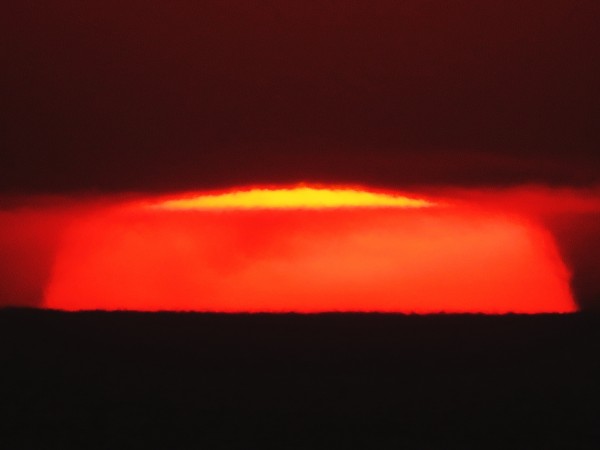
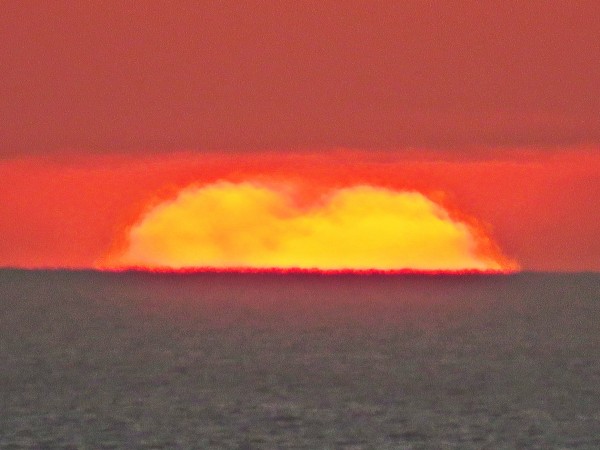
Cool air on the sea surface strongly refracted the setting sun, seen Saturday night from a small town near Rio de Janeiro, Brazil. Cool series of images!

January 17 sunset by Helio de Carvalho Vital.  Shot 1 of 6.

Helio de Carvalho Vital wrote:

That the strong refraction next to the horizon flattens the image of the setting sun is no surprise to anyone. But what if the sun suddenly becomes shaped like a mushroom? Saturday evening [January 17, 2015], I took some photos of the sun setting over the Atlantic Ocean from Saquarema, a small city 100 km east of downtown Rio de Janeiro.

The local air temperature was 34°C but the seawater was only 21°C. Thus a layer of cooler air formed on the surface of the sea.

As sunlight crossed that layer to reach my camera, it underwent a complex series of refractions and reflections that severely distorted the image of the sun, making it acquire very unusual shapes.

A Canon Powershot SX60 HS was used for all the shots, taken at 21:39-41 UTC.

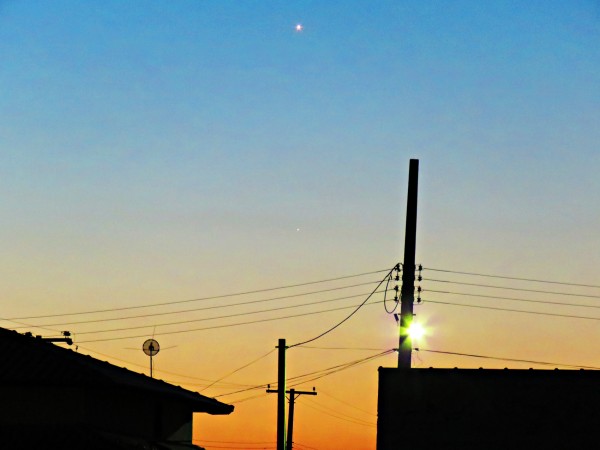
After sunset that same evening, Venus and Mercury appeared!

January 17 sunset by Helio de Carvalho Vital.  Shot 2 of 6.

January 17 sunset by Helio de Carvalho Vital.  Shot 3 of 6.

January 17, 2015 sunset by Helio de Carvalho Vital.  Shot 4 of 6.

January 17, 2015 sunset by Helio de Carvalho Vital.  Shot 5 of 6.

After sunset on January 17, as the sky began to darken, Venus and Mercury popped into view in the western sky.  Photo by Helio de Carvalho Vital.

Bottom line: Series of images of Saturday night’s amazing sunset, seen over the Atlantic from a small town near Rio de Janeiro, Brazil.

SOURCE::: http://www.earthskynews.org

Natarajan

Jan 21 2015

Image of the Day…”Colorful and Plankton-full Patagonian Waters” !!!

Late spring and summer weather brings blooms of color to the Atlantic Ocean off of South America, at least from a satellite view. The Patagonian Shelf Break is a biologically rich patch of ocean where airborne dust from the land, iron-rich currents from the south, and upwelling currents from the depths provide a bounty of nutrients for the grass of the sea—phytoplankton. In turn, those floating sunlight harvesters become food for some of the richest fisheries in the world.

The Visible Infrared Imaging Radiometer Suite (VIIRS) on Suomi NPP captured this view of phytoplankton-rich waters off of Argentina on Dec. 2, 2014. Scientists in NASA’s Ocean Color Group used three wavelengths (671, 551, and 443 nanometers) of visible and near-infrared light to highlight different plankton communities in the water. Bands of color not only reveal the location of plankton, but also the dynamic eddies and currents that carry them.

> More Information

Image Credit: Norman Kuring, NASA’s Ocean Color Group, using VIIRS data from the Suomi National Polar-orbiting Partnership

SOURCE:::www.nasa.gov

Natarajan 

” Is This the Most Dangerous Road Bridge in the World …” ?

http://www.dailymail.co.uk/embed/video/1126769.html

Kindly click the link above for video clip ….

This dramatic video above  with over eight million views on YouTube reveals the treacherous conditions that motorists regularly face on Norway’s picturesque Atlantic Ocean Road.

In good weather, the five-mile stretch offers breath-taking scenery along the Scandinavian country’s western coast.

But when the weather takes an ugly turn, cars are lashed by powerful wind gusts and pounded by large waves that send frigid water crashing over barricades or the rocky shore.

Nice curves: Norway’s picturesque Atlantic Ocean Road includes the iconic Storseisundet Bridge

Nice curves: Norway’s picturesque Atlantic Ocean Road includes the iconic Storseisundet Bridge.

With a curve that protrudes over the Norwegian Sea, the 850-ft bridge plays a visual trick on approaching motorists

For approaching motorists it appears that the ‘bridge to nowhere’ drops off into the sea, but it’s just an optical illusion

For approaching motorists it appears that the ‘bridge to nowhere’ drops off into the sea, but it’s just an optical illusion

Open road: In bad weather, cars are pounded by large waves and whipped by powerful wind gusts

Open road: In bad weather, cars are pounded by large waves and whipped by powerful wind gusts

With stormy skies above and turbulent waters below, the nearly four-minute video shows the daunting journey from a driver’s point of view.

One of the most popular spots on the route is its iconic Storseisundet Bridge, known locally as ‘the drunk bridge’ due to its unusual appearance.

It has been featured in advertisements and lures thousands of tourists each year to a route that has been hailed as one of the world’s best for a holiday road trip.

In good weather, the five-mile stretch offers breath-taking scenery along the Scandinavian country’s western coast

In good weather, the five-mile stretch offers breath-taking scenery along the Scandinavian country’s western coast

Atlantic Ocean Road has been hailed as one of the world's best for a holiday road trip Atlantic Ocean Road has been hailed as one of the world’s best for a holiday road trip

Atlantic Ocean Road passes through an archipelago and links mainland Norway with the island of Averoy Atlantic Ocean Road passes through an archipelago and links mainland Norway with the island of Averoy

With a curve that protrudes over the Norwegian Sea, the 850-ft bridge plays a visual trick on approaching motorists.

It appears that the ‘bridge to nowhere’ drops off into the sea, but it’s just an optical illusion given the angle of the span.

Offering a series of exhilarating twists and turns, Atlantic Ocean Road is unsheltered from the North Atlantic Ocean, putting it at the mercy of the elements.

Road trip: Storseisundet Bridge is one of the features that lures thousands of tourists to the oceanfront route every year Road trip: Storseisundet Bridge is one of the features that lures thousands of tourists to the oceanfront route every year

Atlantic Ocean Road is unsheltered from the North Atlantic Ocean, putting it at the mercy of the elements Atlantic Ocean Road is unsheltered from the North Atlantic Ocean, putting it at the mercy of the elements

Now 25 years old, Atlantic Ocean Road passes through an archipelago as it links mainland Norway with the island of Averoy, and is one of the country’s official national tourist routes.

Over the six years that it took to construct, workers struggled with the region’s wild weather and were interrupted by 12 hurricanes, according to the country’s tourist bureau.

There are several tourist stops along the way, including the Kvernes Stave Church, the Bremsnes Cave and popular fishing spots, although the road and its rocky shore have a dangerous reputation.

In 2013, an Israeli tourist was swept away after he fell into the sea while admiring the view from the roadside.

Source:::::www.dailymail.co.uk

Natarajan