A Man Hijacks a Plane…Collects His Ransom Money and Jumps out Of Plane …!!!


This Day In History: November 24, 1971

An unidentified man referred to as D.B. Cooper hijacked a Boeing 727 airplane between Portland, Oregon and Seattle, Washington.   Cooper bought a one-way ticket on a Northwest Orient Airlines, Flight 305 to Seattle, Washington leaving Portland, Oregon at 2:50 p.m.  He brought with him aboard the plane a black suit-case supposedly containing a bomb.

During the 30 minute flight, Cooper handed a ransom note to the nearby flight attendant telling her he had a bomb and was going to use it if necessary.   He demanded $200,000 in unmarked $20 dollar bills, along with two front parachutes and two back parachutes.  His demands were delivered to the pilot William Scott, who then delivered them to the air traffic control center at the Seattle-Tacoma Airport. Cooper’s flight landed at the SEA-TAC Airport at 5:45 p.m.   After his money and parachutes were delivered, the passengers were released along with two of the flight attendants.  The hijacker then delivered his flight plan to the cockpit crew.   The plane was to take a course heading southeast to Mexico City and was to maintain an altitude of 10,000 feet.  The crew was ordered by Cooper to remain in the cockpit for the duration of the flight.

At 7:40 p.m., the aircraft took off heading south.  At approximately 8:00 p.m., the instruments on the plane indicated that the door had been opened and the stairs lowered.  Outside at 10,000 feet the temperature was around 10 degrees below zero, the weather was stormy, and the wind speed would have been around 200 mph. Around 10:15 p.m., the aircraft landed in Reno with FBI Agents, state troopers, sheriff’s deputies, and the Reno police surrounded the aircraft.   After a quick search, it was confirmed that Cooper was no longer on the airplane and his approximant departure happened between 8:00 p.m. and 8:13 p.m. Even with a thorough search and an exhaustive FBI investigation, the hijacker has never been located nor positively identified.  Originally, they had tried to tail the plane, but chose military F-106 fighter jets to do it with, which could not fly as slow as the airline plane was required to fly by Cooper.

It is believed that he probably didn’t survive the jump.  First, the F.B.I. had trouble locating parachutes for Cooper in the time they had allotted.  Because of this, out of the four chutes they gave him, they accidentally gave him one non-functional practice parachute and one parachute that was quite old.  They had not intended to give him bad parachutes at the time, because they thought there was a chance he’d be taking some of the crew with him.  He didn’t, but did pick the old primary parachute and the secondary non-functional, practice chute.  Further, Cooper had no jacket or rain protective gear and jumped on a cold stormy, pitch-black night into hilly terrain filled with trees.  Finally, no spent money has ever been recovered with the serial numbers matching those given to Cooper.  There has been $5,800 recovered though, which was found near the Columbia River about 40 miles from the predicted landing site, still bundled.   However, this isn’t seen as conclusive evidence that he didn’t survive because it could have just as easily been blown out of the bag during the jump or accidentally left there, if Cooper took a boat downstream.  In addition to that, there were ten bills missing from the bundles, which would likely have had to be manually taken out of the tightly bound bundles.  Further, the parachutes were very brightly covered and should have been easy to spot had he not survived.  So the mystery continues on whether he survived and who exactly he was in the first place.  Even recent DNA samples from evidence left in the plane have failed to turn up any leads.

source::::Today i foundout.com

natarajan
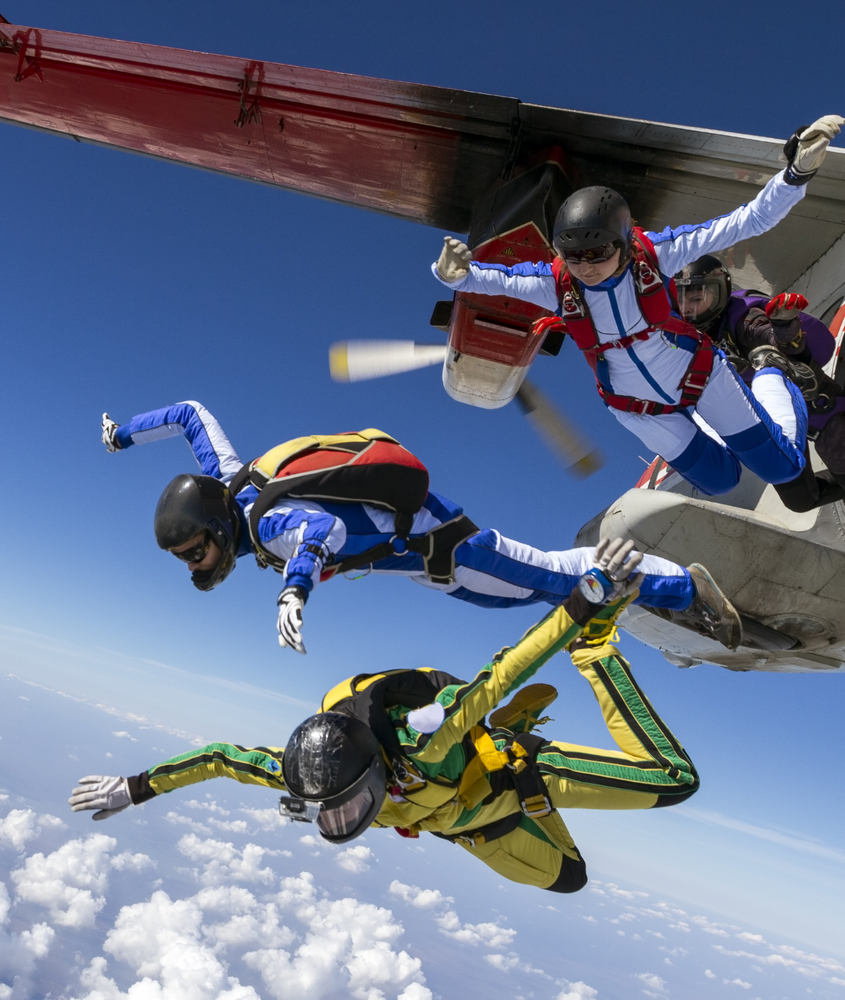
Why Don’t Commercial Airplanes Have Parachutes for Passengers? ….


parachuteSeatbelts and airbags in cars save passengers lives. Parachutes save people who, for a variety of reasons, exit a plane in mid-flight. So why aren’t parachutes provided to passengers on commercial airline flights, in case of emergencies?

Because they almost certainly would not save anyone’s life.

Parachuting Basics

When your average daredevil skydives for fun, the plane is typically travelling at between 80 and 110 mph when the skydiver jumps.Tandem and accelerated free fall (AFF) jumps occur between 10,000 and 13,000 feet, while static jumps can be as low as 3,500 feet.

Student divers choosing the easiest, tandem jump, where the newbie is physically and securely attached to an experienced instructor, are still required to undergo “a half hour of basic ground instruction.”

Braver neophytes who wish to fly untethered will have to endure:

Four to five hours of intense ground instruction, including learning body flight maneuvers and hand signals that instructors use to coach the student as they fly alongside.

For an AFF jump, although not harnessed together, freshman flyers are accompanied by two instructors who “hold onto the student’s harness until” it’s deployed.

Those who choose a static line jump also have to take four + hours of training prior to the jump, although the parachute is deployed as the rookie flyer leaves the aircraft.

When skydivers leave a plane, they do it alone or in small groups. When successive groups will be jumping, they try to keep separated by anywhere between 500 and 1500 feet; this is often accomplished by waiting until the preceding group is “back under the tail to 45 degrees behind the airplane” or several seconds in between groups.

Experienced skydivers can make even riskier jumps, although when descents begin at higher than 15,000 feet, “the risk of hypoxia and being significantly affected by altitude” increases dramatically and divers are less able “to make effective safe decisions at critical times.” Therefore, divers who jump from 15,000 feet or higher carry supplemental oxygen.

Further, each parachute weighs around 40 pounds and the equipment is expensive. To be fully outfitted with “rig, main, reserve, ADD, altimeter, jumpsuit, helmet [and] goggles” can run between $5,900 and $9,000.

Commercial Airplane Basics

Perhaps the most popular commercial jetliner is the Boeing 737 family. Its 737-800 can carry nearly 200 people (including the crew).

Although speeds can vary slightly, the 737-800 travels at approximately 600 mph when at its cruising altitude of 35,000 feet. Cruising altitudes are assigned by air traffic controllers and are usually up to 39,000 feet, except for longer flights that may fly higher.

Individual Parachutes Won’t Improve Passenger Safety

Doing the math . . .

Passenger Training

Since four hours of training just to board a plane is unrealistic, passengers would have to read and execute detailed skydiving instructions including how to properly strap the chute on in order to benefit from the parachute. Not everyone is good at following detailed, technical instructions even when time and stress aren’t a factor.  In a situation where the plane is going down and one has only a moment to get the parachute properly strapped on (likely while keeping an oxygen mask firmly attached and perhaps also needing to keep the seat belt on to keep from being thrown about in the cabin), it’s unlikely most would be able to even get this far.

Every Man for Himself

Unless passengers wanted to fly suited up and tethered for a static jump, parachuting from a commercial airplane will be an AFF jump; however, unlike the conditions that students get – training and trained instructors to assist, commercial passengers will just have to learn as they go.

In addition, they will have to keep calm and proceed in an orderly fashion, which will require most to patiently wait their turn to exit. This is not likely to happen.

Parachuting Equipment is Bulky

Adding just parachutes (not counting helmets, altimeters, etc.) for each passenger would add another 8,000 pounds or so to the flight’s weight. In addition, that equipment would take up space, that is already at a premium.

Parachuting Only Makes Sense if Something Happens in Mid-Flight

The only feasible time for people to jump from the plane is while it’s cruising. However, most fatal airline accidents occur on airplanes during takeoff and landing.

Consider that between 2003 and 2012, only 9% of all fatal accidents on commercial flights, seven total, occurred while the plane was cruising; moreover, at least one of those accidents happened as a result of wind shear or thunderstorm. This is a situation where parachuting is extremely dangerous even if you’re an expert.

So even if parachuting were feasible from a jetliner, the conditions in which parachutes could theoretically save lives are almost never apparent in fatal commercial accidents. But even if they were, it still wouldn’t be a good idea.

Jetliners Cruise Very High and Very Fast

At 35,000 feet (three times higher than a typical jump) every passenger would need high altitude equipment (HALO) that includes an oxygen tank, mask and regulator, flight suit, ballistic helmet and altimeter just to manage the thin air. Or they could just pass out from hypoxia and wake up later, hopefully when the parachute automatically deployed at under 15,000-20,000 feet.

Of course, none of this would matter since the plane is moving so fast (600 mph), and it is so large, that many passengers would almost certainly smash into it and suffer debilitating if not fatal injuries.

Whole Plane Parachutes May Save Lives

There is hope, however. Over the past few years, many small planes have been equipped with whole-plane parachutes that slow the craft’s descent. As of late 2013, the largest planes equipped with these safety devices carry five people, but plans are in the works for putting them on larger crafts. As one manufacturer said, “There is no doubt that big commercial airlines of the future will be equipped with some kind of parachute recovery system.”

source:::: Today i foundout.com

natarajan

Cool Global Selfie From NASA…Do You See Yourself !!!


NASA’s 3.2 gigapixel mosaic of … us

Last Earth Day, NASA asked us take pictures of ourselves and post to social media using the hashtag #GlobalSelfie. And here’s the result.

This is NASA's massive, 3.2 gigapixel mosaic of ... us.  And we look good.  Image via NASA.

Will Ferrell?  Or his doppleganger.  Grabbed from NASA's global selfie.

To see the individual selfies, click into the big, zoomable version of the global selfie here.

This past Earth Day (April 22, 2014), NASA invited you – and everyone else on the planet – to take part in a worldwide celebration. They asked us to take pictures of ourselves wherever we were on Earth, then post to social media using the hashtag #GlobalSelfie. And here’s the result. It’s a 3.2 gigapixel global selfiecomposed of 36,422 individual images. NASA said:

People on every continent – 113 countries and regions in all – posted selfies. From Antarctica to Yemen, Greenland to Guatemala, Micronesia to the Maldives, Pakistan, Poland, Peru – and on. The image was assembled after weeks of curating more than 50,000 #globalselfie submissions – not all were accessible or usable – from Twitter, Instagram, Facebook, Google+ and Flickr.

Click here to read more about this image.

Bottom line: Cool global selfie from NASA, taken for and around last Earth Day 2014. Do you see yourself?


source:::: earth sky news site

natarajan

Drone Delivers Pizza @ Mumbai !!!


  Mumbai, notorious for its traffic snarls, has achieved a first in the country after a city-based pizza outlet used an unmanned drone to execute a delivery by taking the aerial route recently.

“All of us had read about (global e-commerce giant) Amazon’s plans of using drones. We successfully carried out a test-delivery by sending a pizza to a customer located 1.5 km away from our outlet on May 11,” Francesco’s Pizzeria chief executive Mikhel Rajani said.

He stressed that this was only a test-flight but its results confirm that it can be used routinely in a few years.

A four-rotor drone took off with the order from its outlet in central Mumbai’s Lower Parel area and delivered it to a high-rise building in adjacent Worli area, Rajani said, claiming that it is for the first time that the ubiquitous drone has been used for such a purpose in the country.

The eatery, which has been in operations for two years, has made a video of the delivery, he said, adding an auto engineer friend helped with making the flight possible.

Rajani, who comes from a family that is into textiles, said the drone saves time and costs for a company like his, which would otherwise depend on a two-wheeler borne agent to deliver the pizzas.

“What we have done now will be common place in the next four-five years,” he said, adding every such customised drone costs around USD 2,000.

At present, there are certain restrictions on the regulatory front like the drone not allowed to fly above 400 feet altitude and barred from flying over security establishments, he said, adding the American Federal Aviation Authority’s regulations on usage of drones, expected next year, will help.

Apart from that there are technical difficulties like a limited operating radius of 8 km after which the batteries go dry, he said, adding proper infrastructure like having charging stations can help.

Even though the four-rotor version drone had a limited carrying capacity, he said the payload capacity can be increased to up to 8 kg in case of a an eight-rotor drone.   

source:::: NDTV.COM  & YOU TUBE

Natarajan


” Emergency Landing of a Plane After a Part of its Wing Fell Off …” !!!


If you have a fear of flying and want to be able to fly again in the future, you might want to stop reading here. For everyone’s worst nightmare became a reality for passengers on board a flight from London, UK to Florence, Italy last week. Their aircraft was forced to make an emergency landing after a part of the left wing fell off.

Shortly after taking off from London City airport a loud bang was heard by those aboard, the 60 passengers were shocked to discover that a 6ft (1.8m) piece of the wing was dangling in the air.

airplane_problems

Here’s a video of the incident filmed by one of the passengers:

Daily Telegraph journalist Cole Moreton was one of the 60 passengers on board and explained what went through everyone’s minds during that moment of fear.

The bang made people jump and was alarming. Then we sat there thinking ‘this isn’t right, surely? Does the pilot know?’ But we didn’t appear to be crashing. So there was a tense few minutes while we circled and waited for an announcement. It was a relief to get back on the ground.

The Avro RJ85 aircraft was diverted back to London City airport and landed with the badly burned section of the wing only just attached. Passengers were put on another flight two hours after landing back in London. A CityJet spokesperson later said the piece was merely a cover for the plane’s inner-mechanics.

The cover of the operating mechanism on the wing became partially detached. The crew followed their standard procedures.

Source: Metro, Photo Courtesy: Twitter  and You Tube

Story in  … viral nova Trending site

natarajan

Image Of The Day…


lake baikal 140512

ISS Crew Earth Observations Facility and the Earth Science and Remote Sensing Unit, Johnson Space Center. The image was taken by the Expedition 39 crew.

Sun glints off Russia’s Lake Baikal in an astronaut photograph taken on April 22, 2014.

Russia’s Lake Baikal is the deepest lake in the world, but its beauty is skin-deep in a new astronaut photograph.


The lake image, taken by a crew member aboard the International Space Station, shows the southern half of the lake, which is mostly covered by ice. A melted portion catches the sun, creating a silvery, mirrorlike surface. This phenomenon is called sunglint, according toNASA’s Earth Observatory.

Sunglint is a literal trick of the light — sun reflects directly off the surface of the water toward the observer. It can happen in rivers, lakes and on the open ocean, and the color of the sunglint depends on the roughness of the water surface, among other factors, according to Earth Observatory. [101 Stunning Images of Earth from Space]

One of a kind

Lake Baikal is a UNESCO World Heritage site. Its depths stretch down some 5,577 feet (1,700 meters) — twice as deep as the tallest building in the world, Dubai’s Burj Khalifa, is high. The lake is also the world’s oldest, dating back about 25 million years, according to UNESCO.

Lake Baikal is also the single largest reservoir on Earth. It contains 20 percent of the fresh, unfrozen water on the planet, and has a rare and diverse ecosystem to match. According to UNESCO, the lake is home to 1,340 animal species and 570 plants. Of these, 745 animals and 150 plants are found nowhere else on Earth.

Perhaps the cutest of these is the Baikal seal (Pusa sibirica), also known as the nerpa. This seal is the only pinniped that lives only in freshwater, according to the Seal Conservation Society. Adults are silver-grey, and pups are a fuzzy, fluffy white. Weighing in around 155 pounds (70 kilograms) max, Baikal seals are some of the smallest pinnipeds on the planet.

Less adorable, but no less amazing, is the golomyanka, a bizarre translucent fish that is more than one-third oil by weight. The fish have no scales and, because of their unique bodies, can move from Lake Baikal’s depths to its shallows without suffering damage from changes in water pressure. The fish are the main prey of the Baikal seal.

Threats and challenges

Despite its storied status, Lake Baikal is not immune to the threat of human activity. Baikal seals are hunted, which may be contributing to declining numbers of the species. Pollution also threatens the lake, particularly agricultural runoff and discharge from nearby industrial plants, according to the Seal Conservation Society.

The lake is also a repository of gas hydrates, which are essentially dissolved gases locked inside solid crystals of water. Lake Baikal hosts huge amounts of methane trapped in these structures in its depths, making it a popular place for research into how to extract these gas hydrates as an alternative source of energy.

There are currently no plans to extract these gas hydrates from Lake Baikal, but similar structures are also found in the oceans and in permafrost. This fact has led to additional concerns about climate change, as melting ice could release large amounts of methane, a potent greenhouse gas.


source:::::::BUSINESS INSIDER

NATARAJAN

This Beautiful Film Of A Guy Surprising His Mother Will Warm Your Heart …


“The only love that I really believe in is a mother’s love for her children.” ~Karl Lagerfeld

This beautiful video of a man’s journey back home is shot entirely on Google Glass. The film is unique because it gives us a first person perspective of the whole journey, as if we are going home to our own mother.

The ending, where the son reveals the news of his wife’s pregnancy by showing the ultrasound, is so beautiful that it might just wet your eyes.

Thank you, Mom.  

source:::::You Tube and Story Pick

natarajan


” Perfect Landing of Plane with Parachute …” !!!


A light plane that ran into trouble over Australia’s Blue Mountains has made a near-perfect landing – on the end of a parachute.

The pilot of the Cirrus aircraft deployed the parachute that is fitted to that make of plane and drifted down into the front garden of a house.

If the aircraft had not been carrying a parachute, police and flying experts agreed that the result could have been tragic.

Carried to safety: All four people on board landed safely in the front yard of a house in Larson, New South Wales

Carried to safety: All four people on board landed safely in the front yard of a house in Larson, New South Wales

The pilot and his two passengers received only minor injuries after the unusual landing – witnessed by open-mouthed residents of the small town of Lawson.

Resident Robert Ross, who stared in astonishment at the sight of an aircraft coming towards him on the end of a parachute, said he had at first heard the engine splutter.

‘He got it going again and then it went dead,’ he told the Herald Sun newspaper.

No injuries: Amazingly everyone survived the terrifying incident with just one of the passengers requiring hospital attention for neck pain

No injuries: Amazingly everyone survived the terrifying incident with just one of the passengers requiring hospital attention for neck pain

‘It then started to go into a spiral. I thought the pilot was going to eject, but it all happened too quick.

‘I started yelling out to my wife “There’s a plane going to crash into the house”.’

The aircraft’s sudden descent was halted at around 4,000ft, however, when a huge parachute, with orange stripes, suddenly appeared above it and it drifted down about 400 yards from Mr Ross’s home.

Onlookers: Resident Robert Ross watched the entire drama unfold as he chopped wood in his back garden and said if it wasn't for the parachute the plane would have crashed into his house

Onlookers: Resident Robert Ross watched the entire drama unfold as he chopped wood in his back garden and said if it wasn’t for the parachute the plane would have crashed into his house

Cirrus light planes have a handle in the cockpit which, when pulled, removes a cover plate and deploys a parachute.

Mr Allan Bligh, president of the Sydney Flying Club, told the paper that there were about 200 registered Cirrus planes in Australia, but a number of manufacturers decline to use the same parachute system believing a forced controlled landing should be carried out.

‘You are taught from your early days of flying that it is a far better system than the deployment of a parachute.’

Carried to safety: Since January this year Cirrus claims 85 lives have been saved by pilots activating the system

Carried to safety: Since January this year Cirrus claims 85 lives have been saved by pilots activating the system

But Cirrus claims that 85 lives have been saved when pilots or passengers have activated the parachute system.

It is understood the Cirrus SR22, which came down in the Blue Mountains, was a demonstration model, which prompted Sydney radio host Stewart Bocking to comment today: ‘They were caught in a bit of a dilemma.

‘If the plane was being demonstrated, you wouldn’t want it known that it developed engine trouble – but you would also want it to be known that you can land safely on the end of a parachute.’

A staff member at Regal Air, which sells and carries out maintenance work on the aircraft from its headquarters at Sydney’s Bankstown Airport, said that if the passengers ‘had been in any other aircraft they wouldn’t be going home tonight to their families.’

source::::: mailonline.comUK
 NATARAJAN

Picture Of Earth as seen From Moon …

The Earth rises spectacularly as a tiny blue marble above the moon in a new NASA photo that hints at the fragility of humanity and the vastness of space.

NASA’s Lunar Reconnaissance Orbiter captured the image on Feb. 1 with its wide-angle camera, depicting a colorized view of the Earth rising over the 112-mile-wide (180 kilometers) Rozhdestvenskiy crater. The event was one of 12 such “earthrises” that occur every day from the perspective of the moon.

The LRO spacecraft’s wide-angle camera takes images in a different way than most digital cameras. A typical cellphone camera has more than 5 million pixels, whereas a single frame of the LRO camera has fewer than 10,000 pixels. [Amazing Photos of Earth from Space]

But the LRO camera builds up a much larger image by taking multiple exposures as the spacecraft orbits, a technique known as “push-frame” imaging. Over the course of a month, the orbiter camera collects enough images to cover the whole moon.

The LRO usually spends its time staring at the lunar surface looking for signs of water or ice in permanently shadowed craters. But occasionally the spacecraft points into space to image the moon’s exosphere, the thin atmosphere-like layer surrounding it, or to calibrate the craft’s instruments. Sometimes, the spacecraft captures images of Earth (like this one) or other planets making their progress across the heavens.

In the image, Earth is a color composite of several frames, optimized for the colors blue, green and red. These colors match what the human eye detects, so they are true to what an average person might see.

Follow Tanya Lewis on Twitter and Google+.Follow us @Spacedotcom, Facebook and Google+. Original article on Space.com.


earthmoon_square1
This image, captured Feb. 1, 2014, shows a colorized view of Earth from the moon-based perspective of NASA’s Lunar Reconnaissance Orbiter.


source :::::Business Insider .com    …https://www.facebook.com/BusinessInsiderScience…

natarajan