Fascinating Fifty Facts about Statue of Liberty !!!!


 Statue of Liberty: 50 fascinating facts

1. The statue’s full name is Liberty Enlightening the World.

2. It was a gift from France, given to America in 1886.

3. The head of the statue was displayed at the World’s Fair in Paris in 1878.

4. The robed female figure represents Libertas, the Roman goddess of freedom.

5. She holds a torch and tablet upon which is inscribed the date of American Declaration of Independence (July 4, 1776).

6. From the ground to the top of the torch the statue measures 93 metres, and weighs 204 metric tonnes.

7. Lady Liberty wears a size 879 shoe.

8. She has a 35-foot waistline

9. Visitors have to climb 354 stairs to reach the statue’s crown.

10. There are 25 windows in the crown.

11. Approximately 4m people visit the statue each year. In comparison, over 6m people visit The Eiffel Tower, and 3.5m visit The London Eye.

12. The seven spikes on the crown represent the seven oceans and the seven continents of the world, indicating the universal concept of liberty.

13. The statue has an iron infrastructure and copper exterior which has turned green due to oxidation. Although it’s a sign of damage, the patina (green coating) also acts as a form of protection from further deterioration.

14. Edouard de Laboulaye provided the idea for the statue, while Frederic-Auguste Bartholdi designed it.

15. Laboulaye proposed that a great monument should be given as a gift from France to the United States as a celebration of both the union’s victory in the American Revolution, and the abolition of slavery.

16. Laboulaye also hoped the gift of the statue would inspire French people to fight for their own democracy in the face of a repressive monarchy under Napolean III.

17. Gustave Eiffel, the man who designed the Eiffel Tower was also behind the design for Liberty’s ‘spine’; four iron columns supporting a metal framework that holds the copper skin which is a mere 3/32ths of an inch thick.

18. 300 different types of hammers were used to create the copper structure.

19. The statue’s face was said to be modelled on the sculptor’s mother, Charlotte.

20. The statue’s original torch was replaced in 1984 by a new copper torch covered in 24k gold leaf.

21. Although you cannot see Lady Liberty’s feet clearly she is in fact standing among a broken shackle and chains, with her right foot raised, depicting her moving forward away from oppression and slavery.

22. Despite the positive meaning of the statue – American independence and the abolition of slavery – it African Americans saw the statue as an ironic image of America; professing to be a country of freedom and justice for everyone regardless of race, despite racism and discrimination continuing to exist.

23. The Statue of Liberty became the symbol of immigration during the second half of the 19th century, as over 9m immigrants came to the United States, with the statue often being the first thing they saw when arriving by boat.

24. The statue’s most famous cinematic appearance was in the 1968 film “Planet of the Apes” where it is seen half buried in sand.

25. It is also destroyed in the films “Independence Day” and “The Day After Tomorrow”.

26. The cost of the statue was funded by contributions from both the French and the Americans. In 1885, a New York newspaper entitled “World” announced that $102,000 had been raised from donors, and that 80 per cent of this total had been received in sums of less than one dollar.

27. Groups in Boston and Philadelphia offered to pay the full cost of the construction of the statue, in return for its relocation.

28. When the statue was first erected in 1886 it was the tallest iron structure ever built.

29. In 1984, the statue was listed as a UNESCO World Heritage Site.

30. In high winds of 50mph Lady Liberty can sway by up to 3 inches, while her torch can move 5 inches.

31. Lady Liberty is thought to have been hit by around 600 bolts of lightning every year since she was built. A photographer captured this for the first time in 2010.

32. Two people have committed suicide by jumping off the statue, one in 1929 and the other in 1932, while many others have jumped and survived.

33. American poet Emma Lazarus wrote about the Statue of Liberty in a sonnet called “The New Colossus” (1883). In 1903 the poem was engraved on a bronze plaque and placed inside the lower level of the pedestal on the statue.

34. The island in which it stands was previously called Bedloe Island, but its name was changed in 1956 to Liberty Island.

35. There are various replicas of the statue, including a smaller version in Paris, and one on the Las Vegas Strip in Nevada.

36. In 1944 the lights in the crown flashed “dot-dot-dot-dash” which in the Morse code means V, for Victory in Europe.

37. Andy Warhol painted “Statue of Liberty” as part of his Pop Art series in the 1960s. It is estimated to be worth in excess of $35m.

38. The statue functioned as a lighthouse for 16 years (1886-1902), lighting a distance of up to 24 miles away.

39. The statue will be celebrating its 127th birthday in October 2013.

40. Miss America, the comic book character, was granted her powers by the statue.

41. After the terrorist attacks of September 11, the statue was closed for security reasons, with the pedestal reopening in 2004, and the statue in 2009, but only a limited number of visitors are able to go up to the crown.

42. The statue was again closed in 2012 due to the effects of Hurricane Sandy, with the island off limits to the public. The statue is reopening to visitors on Independence Day, July 4, 2013.

43. The statue sustained minor damage in 1916 when German saboteurs set off an explosion during World War One. The torch-bearing arm suffered the most damage, with repair works costing $100,000. The stairs in the torch were then closed to the public for safety reasons, and have remained closed ever since.

44. No-one has been able to visit the torch since.

45. Private boats are not allowed to dock at Liberty and Ellis islands. Therefore the only way on is via the ferry system.

46. The statue’s 300 copper pieces were transported to America in 214 crates on the French ship Isere, which almost sank in stormy seas.

47. Liberty Island is federal property within the territory of the State of New York, even though it is closer to New Jersey.

48. In 1982, it was discovered that the head had been installed two feet off centre.

49. Two images of the statue appear on a $10 bill.

50. The cost of building the statue and pedestal amounted to over $500,000, over $10m in today’s money.


source::::The Telegraph UK

natarajan

“What 3 Words ” or W3W Can Pinpoint any Spot In Earth With a 3 Letter code !!!!

Pinpoint any spot on Earth with three words

FORGET about postcodes and street numbers. A new mapping system called ‘what3words’ can find any searchable spot on the globe with a three-word code.

The London-based start-up has divided Earth into 57 trillion squares, each of them three square metres large. Every individual square has been assigned a unique three-word code.

With a simple, map-based search, you can pinpoint any location and find its code in a matter of seconds. It sure beats writing down a full address.

For instance, say you were meeting friends at the Queen Victoria Building in Sydney. Traditionally, you would tell people the address: 455 George St, Sydney NSW 2000. A what3words search would yield a simple result: input.fines.bonus. It’s much easier to remember.

“With GPS and smartphones, we have at our fingertips the ability to pinpoint precise locations,” said what3words CEO Chris Sheldrick.

“However, until what3words we haven’t had a simple, memorable universal system to easily describe locations with any degree of precision.”

The system is certainly more precise than conventional mapping. The three word codes apply to spaces just three square metres large, allowing you to direct people to something as specific as a particular tent in your campsite.

If you feel like shelling out a dollar or so, you can even reduce your address to a single word.

We played around with what3words and came up with a few examples:

The Eiffel Tower: ship.vocal.launched

 The Eiffel Tower in Paris, France.

The Eiffel Tower in Paris, France.

An escalator in Tokyo: tooth.develops.landings

Escalators probably look like this in Tokyo.

Escalators probably look like this in Tokyo.

The White House: engine.doors.cubs

The White House looking extra white.

The White House looking extra white.

Big Ben: lease.ensure.paused

BONG BONG BONG

BONG BONG BONG

A tree in New Zealand: trains.rally.feared

There?s a tree behind this sheep. Maybe.

There’s a tree behind this sheep. Maybe.

Christ the Redeemer: familiar.system.mule

?Hey guys, I can totally see write.complex.running from here!?

“Hey guys, I can totally see write.complex.running from here!”

Tahrir Square: publish.digesting.woven

Another quiet day in Egypt. Photo: AFP

Another quiet day in Egypt. Photo: AFP

A mailbox in Los Angeles: jump.union.blade

A well maintained American mailbox.

A well maintained American mailbox

source::::::news.com.au      pl see the site what 3 words .com  for further inf and details…

natarajan

World”s Biggest Commercial Complex @ China ….19 Million Sq Ft!!!

The world’s largest building has opened in China capable of fitting 20 Sydney Opera Houses – or three Pentagons – inside.

The New Century Global Center in Chengdu, Sichuan province, is a staggering 19million sq.ft. and contains shopping centres, a Mediterranean village, a water park, an ice-skating rink, and multiple hotels.

However, visitors to the glass panelled building need not worry about the weather as the giant complex will have its own artificial sun.
Giant among men: New Century Global Centre in Chengdu, southwest China's Sichuan province is the world's largest freestanding building

Living it large: Workers clean the glass roof of the New Century Global Centre which opened to the public this weekend after three years of construction

Pride of Chengdu: The gigantic complex is so large it fits 20 Sydney Opera Houses or nearly three Pentagons and boasts several hotels and shopping centres

Pride of Chengdu: The gigantic complex is so large it fits 20 Sydney Opera Houses or nearly three Pentagons and boasts several hotels and shopping centres

The building is 500 metres long, 400 metres wide and 100 metres high, reports said.


According to Chinese officials, the New Century Global Center is the largest freestanding building in the world, and took three years to complete.


‘This is an ocean city built by man,’ Chinese guide Liu Xun told AFP.

He added that the artificial sun built inside the building will provide light and heat 24 hours a day for shoppers exploring the around 400,000 sq. metres of boutiques and stores.

The building sits directly opposite the Chengdu Contemporary Arts Centre, designed by British-Iraqi architect Zaha Hadid, at the heart of a booming area of Chengdu.

All you need: Visitors to New Century Global Centre can browse 400,000 sq. metres of shops inside the complex
High ceilings: The gigantic dome-like glass roof is 100metres (328ft) high and has an 'artificial sun'

Family fun: As well as the shops, hotels and the artificial sun, the building also has an indoor water park

source :::::mailonline.com

natarajan


Impressive Image of ISS Passing in Front Of Moon !!!!!

While testing his new telescope a Romanian astrophotographer managed to capture clear images of the International Space Station passing in front of the moon, in broad daylight.

And the snap makes Nasa’s space station look remarkably like the iconic USS Enterprise from TV show Star Trek.

Maximilian Teodorescu was testing the range of his new 150mm f/12 Maksutov telescope near the town of Dumitrana in Romania earlier this month when he took the shot.
This shot of the International Space Station as it crosses in front of the moon was taken by Romanian astrophotographer Maximilian Teodorescu.

This shot of the International Space Station as it crosses in front of the moon was taken by Romanian astrophotographer Maximilian Teodorescu. It bears a striking resemblance to the USS Enterprise ship from TV show Star Trek


The USS Enterprise was one of the ships that featured in the Star Trek franchise.

The Starship Enterprise was one of the ships that featured in the Star Trek franchise. In the show, this NX-01 model was the first NX-class starship and was launched by the United Earth Starfleet in 2151

Teodorescu took the images on 15 June at around 6.17pm in Romania.


He posted the photos to his blog. Translated from Romanian, it reads: ‘A new ‘First-light’ or rather ‘First-photo’.


‘This time it’s a new instrument, a 150mm F/12 Maksutov.’


‘And what better topic for a first test if not the moon?’


He then adds he was surprised to see the International Space Station in transit so clearly.


He explains that the equipment used to capture the picture was Skywatcher 150mm Mak (F = 1800mm), Canon 550D, ISO 800, 1/1250s.


The angle of the International Space Station (ISS) in Teodorescu’s images bear a striking resemblance to the USS Enterprise starship from the TV show Star Trek.


The ISS first launched into space in 1998 and since the arrival of Expedition 1 in November 2000 the station has been continuously occupied.


 Teodorescu used an 1800mm f/12 Maksutov telescope to take this image of Nasa's space station.
Teodorescu used an 150mm f/12 Maksutov telescope to take this image of Nasa’s space station. He wanted to test the telescope’s range so took these images in broad daylight near the town of Dumitrana in Romania

It is currently the longest continuous human presence in space and in 2010, the station broke the previous record of almost 10 years -or 3,634 days – held by Nasa’s Mir station.

It has been visited by astronauts and cosmonauts from 15 different nations.

One of its most famous inhabitants was Commander Chris Hadfield from Canada who regularly tweeted images and videos from the station.

source:::::mailonline.com


13 Year Old From Bihar Cracks IIT Entrance Exam !!!!

Satyam Kumar, a Bihar farmer’s son who is just 13-years old, has cleared the fiercely competitive Indian Institute of Technology-Joint Entrance Examination (IIT-JEE) for which 150,000 candidates had appeared this year.

Satyam, who passed his class 12 exam last year, secured an impressive all-India rank of 679.

“We are proud of him. He has done something special at this age,” Satyam’s father Sidhnath Singh, a farmer, told IANS.

IIT-JEE (Advanced) results for admission into IITs were declared Friday.

According to IIT-JEE website, Sahal Kaushik from Delhi was the youngest person to have cracked the exam in 2010 at the age of 14. But now this record is held by Satyam.

“Now Satyam is the youngest to crack the IIT-JEE,” an IIT official said.

Satyam, who hails from Bakhorapur village in Bhojpur district, had last year qualified for admission into IIT at the age of 12-and-a-half years after he got a special permission from the Central Board of Secondary Education (CBSE). He had then secured an all-India rank of 8,137.

Not satisfied with his low rank, he appeared for the IIT-JEE preliminary examination this year again and qualified.

“Satyam has improved his rank by his hard work and determination,” his father said.

He appeared for the entrance examination in Kota, Rajasthan, where he had been studying. He was one of the 150,000 candidates who appeared for the examination this year.

Earlier, Satyam Kumar had said he wanted to establish a software company on the lines of social networking website Facebook.


source:::::siliconindia news net

natarajan

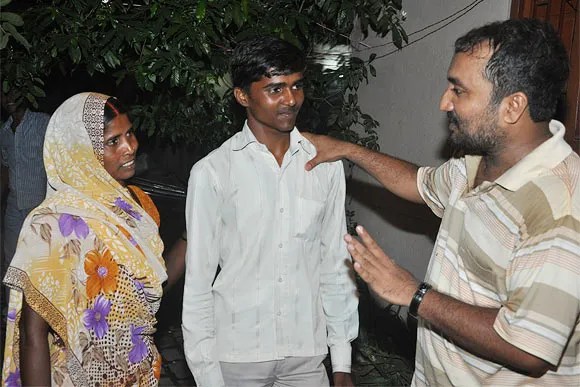
” I Had No Money for School Fees …But My Son Is Going To IIT”….Thanks to AnandKumar”s Super 30 Project !!!!

Students from underprivileged families crack the IIT-JEE Advanced thanks to Anand Kumar’s Super 30 educational programme.

Pranav Kumar, Bhanu Pratap, Ankit Kumar, Shivangi Gupta, Abhishek Kumar, Santosh Kumar and Hanjala Shafi cleared the fiercely competitive Indian Institute of Technology Joint Entrance Examination (IIT-JEE) this year. These students and 23 others from Anand Kumar’s Super 30 share one thing in common: all of them come from poverty-stricken families.

While the intelligent and hard-working youngsters studied for the JEE, their parents were fighting for survival and earning their livelihood by working as labourers, landless farmers, electricians, salesmen, smalltime shopkeepers and magazine vendors. These poor folks never dreamt that their children will become part of prestigious IIT campuses, but thanks to Super 30, a free coaching centre for underprivileged students in Bihar, it was made possible.

Super 30 is an innovative school run by Anand Kumar in Patna since 2002. Each year, Kumar selects 30 meritorious students — mostly from poor families — and grooms them for the IITs. The students stay with him; they are provided free food and lodging. And Kumar bears the expenses on his own, with no financial help from anyone.

And the main feature of Super 30 was reflected yet again in this year’s results, announced last Friday — of Kumar’s 30 wards, 28 cracked the examination and will make it into an IIT.

The mood at Kumar’s residence in a congested lane in Patna’s Jakhanpur locality, from where he runs Super 30, was overpowering as successful students basked in their newfound glory.

Joy knew no bounds for Bhanu Pratap from Uttar Pradesh. His father Rampyare Pratap is a labourer and the sole breadwinner in the family; they have often had to go without food. Along with Bhanu’s mother Geeta Devi, he was at Kumar’s house celebrating their son’s achievement. “You have shown us a day we never even dreamt of. We shall always be obliged to you,” said Geeta Devi, as her husband nodded.

“I think Anand Sir not only prepared us (for IITs), but also gave us the confidence to excel, even in the face of difficult odds,” added Bhanu.

And there are many like Bhanu who were part of the Super 30 this year.

source::::rediff.com

natarajan

Dazzling….Never Before Seen Images From the Archives of National Geographic !!!

Dreamscape: A replica of the Mayflower sails into New York Harbor with a welcoming fleet, November 1957

Dreamscape: A replica of the Mayflower sails into New York Harbor with a welcoming fleet, November 1957

National Geographic has earned a reputation as the epicenter of some of the world’s finest photojournalism, but few people known that the renowned magazine also has built up a vast collection of unpublished breathtaking images over the years.


To mark the magazine’s 125th birthday this year, its editors launched a Tumblr account to highlight some of the hidden gems that for one reason or another have been lingering in its photographic vaults.


The project aptly named ‘FOUND’ is NatGeo’s photostream, culled from its sprawling treasury of unpublished vintage prints.

Otherworldly beauty: Buckets of iron ore are transported to a major steelworks in Hunedoara, Romania, November 1975

Otherworldly beauty: Buckets of iron ore are transported to a major steelworks in Hunedoara, Romania, November 1975


Horsing around: This 1957 print of teenagers running and playing on large white sand dunes in New Mexico ended up in National Geographic's vast collection of unpublished photos

Horsing around: This 1957 print of teenagers running and playing on large white sand dunes in New Mexico ended up in National Geographic’s vast collection of unpublished photos

Among the previously unreleased photos are some true masterpieces, like the otherworldly sight of the Mayflower replica sailing into 1950s New York under the shadow of a zeppelin overhead, or the simple beauty of buckets of iron being transported to a steelworks in Romania in 1975 set against the dreamlike background of golden clouds fit for a Canaletto painting.


Other prints in the photographic backlog include a whimsical shot of women in 1960s London using compact mirrors to catch a glimpse of Queen Elizabeth II, and a print showing a group of teens horsing around on a sand dune in New Mexico back in the 50s.


The curator of the Tumblr account, young NatGeo designer Web Barr, explained that he chose this medium to release the once-forgotten images into the world in the hopes that a broad audience of people will be able to enjoy, appreciate and share them with others.


Barr compared the FOUND Tumblr to NatGeo’s Instagram account, which photographers working for the magazine use to upload pictures from the field.


To put the project together, Barr and a team of NatGeo staffers sifted through the magazine’s 11.5 million collection of prints, searching for unique, visually striking and slightly offbeat images that are in keeping with the magazine’s overall aesthetic.

Royal treatment: Women use compact mirrors in packed crowd to catch sight of Queen Elizabeth II in London, June 1966

Royal treatment: Women use compact mirrors in packed crowd to catch sight of Queen Elizabeth II in London, June 1966


 Rustic: A man feeds donkey sulla flowers and foliage from its own load near Gangi, Sicily, Italy, January 1955
 Rustic: A man feeds donkey sulla flowers and foliage from its own load near Gangi, Sicily, Italy, January 1955


After spending decades collecting dust in the storage, many of the forgotten prints lack even the most basic information, so the team behind FOUND are hoping to harness the power of the masses to fill those gaps.

Tumblr users are encouraged to provide information on any of the images, and the staffers behind the photostream say they have already received a lot of feedback. In the future, they plan to feature the stories behind individual prints.
source:::::mailonline.com

Natarajan

Read more: http://www.dailymail.co.uk/news/article-2346288/Beauty-rediscovered-The-dazzling-seen-images-discovered-depths-National-Geographic-archives-released-celebrate-magazines-125th-anniversary.html#ixzz2WwJHK2kc


The Height Of Annoyance !!!!

Homeowners living in the world’s tallest residential skyscraper are having to climb up more than 1,300ft of steps – the equivalent of walking one-third of the way up Ben Nevis – after all the lifts broke down.
Princess Tower in Dubai, which stands at 1,355ft tall with 97 above-ground residential floors, has been named the tallest residential building in the world Guinness World Records.
But residents living in the luxurious tower block – many of whom are British – have been told they have ‘no choice’ but to walk up to their flats, some on the 97th floor, after all eight lifts in the building broke down last week.


Tall order: Residents of Dubai's Princess Towers, the tallest building pictured with a domed roof, have been told they will have to use the stairs to reach their flats after all eight lifts in the building broke down

Tall order: Residents of Dubai’s Princess Towers, the tallest building pictured with a domed roof, have been told they will have to use the stairs to reach their flats after all eight lifts in the building broke down


The building, which has six levels in the basement and 101 above ground level, opened in September last year, with two-bed flats on the rental market for £140-a-day and penthouse flats selling for more than £2million.

It is 339ft taller than The Shard, although still dwarfed by the world’s tallest building, the 2,722ft tall Burj Khalifa in Dubai which is not classed as a residential building.

One resident, who lives on the 78th floor, said: ‘I came home after a hard day of work and was told I’d have to walk to my apartment on the 78th floor.

‘I truly couldn’t believe it – there was no way I was walking all that distance so I just booked myself into a hotel.’


source:::::mailonline.com

Natarajan


End of an Era!!! Like Telegram , Host of Other Things Are History Now !!!!

When the very last telegram is transmitted on July 14, India will witness the end of an analogue era.

As the watershed of 1991’s liberalisation disappears into history, the numbers of those who remember a time when we wrote letters, developed film roll and recorded a cassette will also start to fade into the background.

Future generations – with their ubiquitous touch screens – might not even know what it is like to communicate through a device that has actual wires.

But as we put the beloved telegraph to bed forever, it is time to pay tribute to the remnants of a past age.

Convergence has become an oddly corporate buzzword in recent times, alongside fellow jargon staples such as synergy and ideation, but it is impossible to ignore its all too real effect on the middle-class household.

Step into an ordinary living room today, and you’re likely to find one or two shiny screens that do it all: send messages, post emails, make phone calls, save your contacts, act as an encyclopedia, take photos, play music, record videos, control video games and even map out your neighbourhood.

Barely a decade ago, we had a whole host of beloved devices to help us do the same thing – albeit with much more patience added in

Coming generations will never know the anticipation of waiting to get your Kodak film rolls back from the developers before you see whether the pictures were taken well, they’ll never know the pleasure of receiving a painstakingly written love letter through post or the joy of hearing the song you have been waiting for on the radio.

Even the wait for that scratchy sound on a dial-up modem to end before connecting to the Internet could be excruciating. Instant is in, everything else is ancient. Even our roads look different.

The Ambassadors and Fiats have been replaced by a veritable army of little cars that simply look like variations on a single box-on-wheels theme.

Ask a kid today what a Yezdi or a Rajdoot is, and she would have no idea that they come from the same family that is now populated by the banal-looking Pulsars and Karizmas.

The rapid switch to an entirely digital universe also has a serious impact on how we come to value things.

No matter how ‘real’ the online world is to us, tangibility has its own appeal. The physical act of using an ink pen to write out a letter alters the person writing in a way that tapping out an SMS can never do.

Swiping through a Facebook photo set will never replace the joy of looking at albums printed out and carefully stored years ago – not the least because the spread of digital cameras and cameraphones allows practically all of our lives to be documented, making individual moments much less valuable.

If everything can be recorded, nothing is particularly precious.

The digital world does attempt to be a facsimile of this past age. Your iPhone still pretends that a switch has to be pulled every time you unlock it and the phenomenal popularity of Instagram – which simply attempts to recreate the look of a vintage photograph – bears testimony to this nostalgia.

But even these remnants will slowly give way to generations that have little recollection of what came before them leaving no need for designers to appeal to a sentiment from a different world.

The advent of technology is not a thing to be mourned, and yet it is important to pay our respects to the passing of an older way of life. We come not to praise the telegraph, but to bury it.

Older styles of writing were minor art forms. It is why, to this day, official letters are still typed out by professional typewriters – they couldn’t be entrusted to the layman.

The same held true for writing with ink pens, where the act of cursive writing – and better yet calligraphy – did get elevated to an accepted form of art.

Today’s keyboard word processors and ball pens have been much more democratic, allowing one and all to conveniently put their words onto paper (digital or otherwise) but have little of the charm of the old devices.

The film roll, made ubiquitous by Kodak over the 20th century, is a delicate object. Treat it badly, and all your photos will be lost. Hurry it, and your pictures will be damaged.

 Give it enough time and you have a batch of pictures to cherish. The digital photo, on the other hand, is a prolifically dispensable object: you can take hundreds of pictures in a matter of minutes, and discard all of them in seconds.
There may not have been many designs to pick from back in the days of Ambassadors and Yezdis, but they were all fine looking vehicles.

Following liberalisation, the market was completely revolutionised, and while the tremendous spread of automobile technology has been excellent for households and corporate India (if not particularly beneficial to the environment), the cookie-cutter nature of most box-on-wheels models make our roads look a lot less interesting.

Music is more precious when you cannot listen to it. Or rather, its value is much higher when you only hear it very rarely.

From a time when you had to wait for certain songs to be aired on the radio to the need for you to buy or record cassettes and CDs, kids today simply have to click a button – usually without paying – for them to listen to any song they want

The land-line is an endangered species. Few can even remember how we used to find a way to meet up before the cellphone became common, or the anger at someone else in the house – usually a parent – picking up the line while you are talking to that special someone.

Land-line phones were once a luxury but now everyone has a touch-screen cellphone.
The entry of VHS tapes and later VCRs into households were occasions to be celebrated. Until then, movies were confined to the cinema or the tyranny of the single national broadcaster.

When VHS first showed up, everything changed. Suddenly the entire catalogue of movies from the past were now welcome into your homes and the Handycam meant you could even make home movies.

The cold exterior of the CD and DVD doesn’t carry quite the same cachet, and even they have begun to be replaced by the USB drive !!!
source:::: Rohan Venkataramakrishnan  in mailonline india


Natarajan

World”s Fastest Super Computer @ China !!!


China’s Tianhe-2 is now the world’s fastest super computer, with speeds reaching up to 30.65 petaflops; 74 percent faster than the current record holder Cray XK7 system-based Titan at the Oak Ridge National Laboratory in the US, according to a report by Ars Technica.

 
What makes it more amazing is that, the supercomputer wasn’t even running to its full capacity during the test. A five-hour Linpack test using 14,336 out of 16,000 compute nodes, or 90 percent of the machine, clocked in at 30.65 petaflops. The benchmarks are used to rank the Top 500 supercomputers in the world. The previous title holder, Titan, hit 17.59 petaflops. Tianhe-2 achieved 1.935 gigaflops per watt, which is slightly less efficient than Titan’s 2.143 gigaflops per watt.

 
Tianhe-2’s numbers were revealed this week in a paper by University of Tennessee professor Jack Dongarra, who created the Linpack benchmarks and helps compile the bi-annual Top 500 list.


Tianhe-2 is being assembled and tested at China’s National University for Defense Technology (NUDT), and is scheduled to arrive in the National Supercomputer Center in Guangzhou before the end of this year. Once operational, Tianhe-2 “will provide an open platform for research and education and provide high performance computing service for southern China,” Dongarra wrote.

 
It is not yet known whether he had sent the computers data for the list.

 
Tianhe-2 is built with Intel Ivy Bridge and Xeon Phi processors. “There are 32,000 Intel Ivy Bridge Xeon sockets and 48,000 Xeon Phi boards for a total of 3,120,000 cores,” Dongarra wrote. It has storage of 12.4PB and memory totaling 1.4PB. NUDT built its own proprietary interconnect which Dongarra describes as “an optoelectronics hybrid transport technology” that “uses a fat tree topology with 13 switches each of 576 ports at the top level.” Tianhe-2 runs in Kylin Linux.


source:::::siliconindianet

Natarajan