The Best Pictures of the Super Moon….

Hello pretty … the full moon rises between clouds in Berlin. Picture: AP Photo/Gero Breloer

LAST night’s spectacular full moon was a treat for many Australian skywatchers, but in other parts of the world it was merely the overture to a total lunar eclipse.

When a full or new moon makes its closest approach to Earth, that’s a supermoon. A combination of a supermoon and a total lunar eclipse has not been seen since 1982 and will not happen again until 2033.

The supermoon rises behind Glastonbury Tor in Somerset, England. Picture: Matt Cardy/Getty Images

The supermoon rises behind Glastonbury Tor in Somerset, England. Picture: Matt Cardy/Getty ImagesSource:Getty Images

A flock of birds fly by as a perigee moon, also known as a super moon, rises in Mir, Belarus. Picture: AP / Sergei Grits

A flock of birds fly by as a perigee moon, also known as a super moon, rises in Mir, Belarus. Picture: AP / Sergei GritsSource:AP

A perigee moon rises in the sky above the La Concha Beach, in San Sebastian, northern Spain. Picture: AP Photo/Alvaro Barrientos

A perigee moon rises in the sky above the La Concha Beach, in San Sebastian, northern Spain. Picture: AP Photo/Alvaro BarrientosSource:AP

Although still about 220,000 miles (354,055 km) away, it was still the closest full moon of the year, about 30,000 miles (48,280km) closer than the average distance. (The moon’s orbit is far from a perfect circle.)

Skywatchers in North and South America, Europe, Africa and western Asia are expected to be able to see the lunar eclipse, when the moon, Earth and sun will be lined up, with Earth’s shadow totally obscuring the moon

The moon is seen against the peak of the tomb of Jama Masjid in New Delhi. Picture: AFP / Chandan Khanna

The moon is seen against the peak of the tomb of Jama Masjid in New Delhi. Picture: AFP / Chandan KhannaSource:AFP

The full moon is seen on the city skyline as Indian devotees carry statues of elephant-headed Hindu god Lord Ganesha for immersion in the Arabian Sea in Mumbai. Picture: AFP / Punit Paranjpe

The full moon is seen on the city skyline as Indian devotees carry statues of elephant-headed Hindu god Lord Ganesha for immersion in the Arabian Sea in Mumbai. Picture: AFP / Punit ParanjpeSource:AFP

The full moon rises behind Lisbon’s St. George castle. Picture: AP / Armando Franca

The full moon rises behind Lisbon’s St. George castle. Picture: AP / Armando FrancaSource:AP

The event is due to happen at 10.11pm on America’s east coast (12pm AEST) and the ellipse should be visible for more than an hour, weather permitting.

There won’t be another total lunar eclipse until 2018.

This eclipse marks the end of a tetrad, or series of four total lunar eclipses set six months apart. This series began in April 2014.

The 21st century will see eight of these tetrads, an uncommonly good run. From 1600 to 1900, there were none.

NASA planetary scientist Noah Petro is hoping the celestial event will ignite more interest in the moon. He is deputy project scientist for the Lunar Reconnaissance Orbiter, or LRO, which has been studying the moon from lunar orbit since 2009.

Rising big and full in Lausanne, Switzerland. Picture: AFP / Fabrice Coffrini

Rising big and full in Lausanne, Switzerland. Picture: AFP / Fabrice CoffriniSource:AFP

An Indian man leans on a wall on top of a building in New Delhi as the moon does time as a backdrop. Picture: AFP / Roberto Schmidt

An Indian man leans on a wall on top of a building in New Delhi as the moon does time as a backdrop. Picture: AFP / Roberto SchmidtSource:AFP

A full moon shines behind a tower of the Jama Masjid mosque in New Delhi. Picture: AFP / Roberto Schmidt

A full moon shines behind a tower of the Jama Masjid mosque in New Delhi. Picture: AFP / Roberto SchmidtSource:AFP

“The moon’s a dynamic place,” Petro said Wednesday. “We’re seeing changes on the surface of the moon from LRO. We’re seeing that it’s not this static dead body in the sky … it’s this great astronomical object that we have in our backyard, essentially. So people should get out and start looking at it.”

Many stargazers, professional and amateur alike, dislike the term “supermoon,” noting the visible difference between a moon and supermoon is slight to all but the most faithful observers.

“It’s not like the difference between an ordinary man and Superman,” said Alan MacRobert, a senior editor at Sky & Telescope magazine. “It really ought to be called a tiny, slightly little bit bigger moon, rather than the supermoon.”

People watch a full moon rising in Berlin. Picture: AP Photo/Gero Breloer

People watch a full moon rising in Berlin. Picture: AP Photo/Gero BreloerSource:AP

Source….www.news.com.au

Natarajan

Image of the Day…” Simutaneous view of Eclipsed Moon and Sun in the Sky…”

Who will see a selenelion – the eclipsed moon and sun in the sky simultaneously – for the April 4, 2015 total eclipse of the moon? Charts and info here.

Tonight's sunset and moonrise - September 19, 2013 - as seen by EarthSky Facebook friend Andy Somers in Noumea, New Caledonia.  One of the characteristics of the Harvest Moon is that it rises around the time of sunset for several evenings in a row.  Thank you, Andy.

This photo does not show an eclipsed moon, but it does show a simultaneous sunset and (nearly) full moonrise as captured byEarthSky Facebook friend Andy Somers in Noumea, New Caledonia in September 2013. On Saturday, April 4, 2015 – from just the right spot on Earth – you might see something like this … but the moon will be in eclipse!

In case you haven’t heard, there’s a total lunar eclipse coming up this Saturday, April 4, 2015. North Americans will see the eclipse Saturday morning. Australians and Asians will see it Saturday evening.Read more about the April 4 eclipse here.

If you’re in just the right spot on Earth, you might observe the eclipsed moon setting while the sun rises – or the eclipsed moon rising while the sun sets. This is called a selenelion. Celestial geometry says this should not happen. After all, in order for an eclipse to take place, the sun and moon must be exactly 180 degrees apart in the sky, in a perfect alignment known as a syzygy. Such perfection – needed for an eclipse to take place – would seem to make it impossible to view the sun and eclipsed moon above your horizon simultaneously.

But – thanks to atmospheric refraction, the same effect that causes a spoon in a glass of water to appear broken in two – you might actually see images of the sun and totally eclipsed moon, both above your horizon at once, lifted up by the effect of refraction.

You need to be positioned in just the right spot on Earth’s surface to see a selenelion.

Source::::: http://www.earthskynews.org

Natarajan

Image of the Day… Earth and Moon as Seen From Mercury !!!

MESSENGER spacecraft sees lunar eclipse from Mercury

The MESSENGER spacecraft, now orbiting Mercury, caught the images to make this movie of last Wednesday’s lunar eclipse. See Earth and moon from Mercury!

Earth and Moon from Mercury orbit, with Moon entering eclipse.  Imaged on Wednesday, October 8, 2014 by MESSENGER, a spacecraft in orbit around Mercury.

The MESSENGER spacecraft – which has been orbiting the sun’s innermost planet Mercury since 2011 – made this movie of the the Hunter’s Moon passing into the Earth’s shadow on October 8, 2014. The movie consists of 31 MDIS NAC (Mercury Dual Imaging System Narrow Angle Camera) frames taken two minutes apart from 09:18 UTC to 10:18 UTC on October 8. MESSENGER made the movie from a distance of 107 million kilometers / 66 million miles.

Notice the orientation of bright side of Earth. Earth’s shadow always extends in the direction opposite this bright side – or day side – approximately 1,400,000 kilometers / 1,000,000 miles into space. On October 8, the moon passed into the shadow, causing the eclipse.

The images have been enlarged 2 times and the moon brightened 25 times. The Earth was five pixels wide and the Moon one pixel wide.

The Earth – moon pair appeared in front of the constellation Aries, near the border of the constellation Pisces, as seen from Mercury.

The Earth was very bright magnitude minus 4.38 and the Moon was magnitude minus 0.03.

Read more from Emily Lakdawalla at the Planetary Society

Bottom line: The MESSENGER spacecraft, now orbiting Mercury, caught the images to make this movie of last Wednesday’s lunar eclipse. See Earth and moon from Mercury!

SOURCE:::: earthskynews

Natarajan

Image of the Day…Full Moon Rising over Lotus Temple in NewDelhi …


Full moon rising over Lotus Temple in Delhi, India

We saw many photos of the October 8 moon during the total lunar eclipse. Here’s one from India, where the eclipse was less easily visible.

Photo by Abhinav Singhai.  Visit him on Flickr.

Our friend Abhinav Singhai captured this moonrise (Hunters Moon) time lapse over the Lotus Temple in Delhi, India. It was October 8, 2014, the night of the total lunar eclipse. Abhinav wrote:

Penumbral lunar eclipse was visible from Delhi at the time of moonrise, and visible in the first picture as well (slight shadow).

SOURCE:::: EARTHSKYNEWS

Natarajan

Image For the Day… Total Lunar Eclipse ….

Total eclipse of Blood Moon on night of October 7-8

View larger. | Last year's Hunter's Moon by EarthSky Facebook friend John Michael Mizzi on the island of Gozo

TONIGHT FOR OCTOBER 7, 2014

There is a total eclipse of the full moon on October 8, 2014. This is the Northern Hemisphere’s Hunter’s Moon – the name for the full moon after the Harvest Moon. It’s also aBlood Moon, and this eclipse is the second in a series of four so-called Blood Moon eclipses. For North America and the Hawaiian Islands, the total lunar eclipse happens in the wee hoursbefore sunrise on October 8. For New Zealand, Australia and eastern Asia, the total eclipse is seen after sunset on October 8. A partial lunar eclipse can be seen before sunrise, October 8, from much of South America, or after sunset, October 8, from western Asia. Follow the links below to learn more about the 2014 Hunter’s Moon and the October 8 total lunar eclipse.

When is the October 2014 moon exactly full?

Who will see the October 7-8 total lunar eclipse?

Who will see the partial lunar eclipse on October 8?

Eclipse times in Universal Time.

Eclipse times for North American time zones.

Lunar eclipse computer courtesy of the US Naval Observatory

Eclipse calculator courtesy of TimeandDate

A double Blood Moon eclipse on October 8?

How is the Hunter’s Moon different from other full moons?

North Americans see partial solar eclipse on October 23

Hurry! Purchase eclipse-viewing glasses for the October 23 partial solar eclipse here.

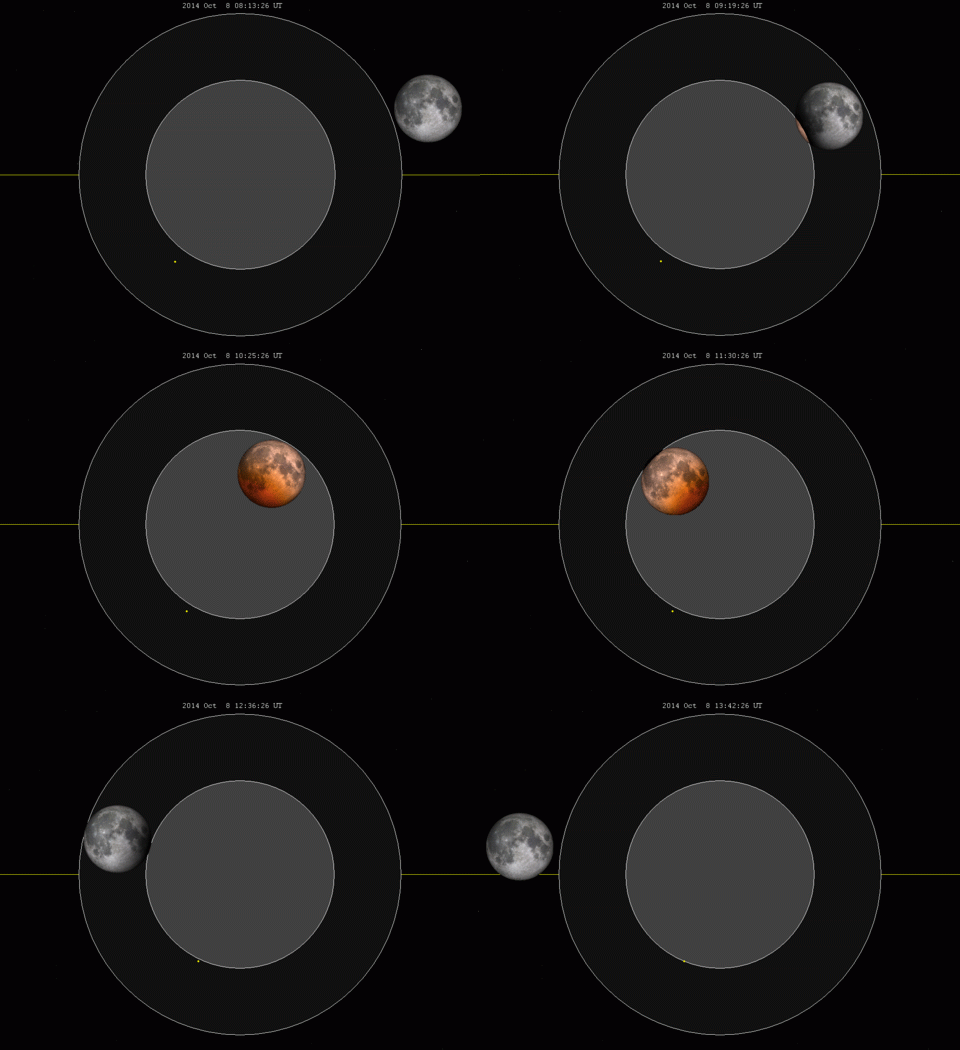
Animation of the October 8, 2014, total lunar eclipse, whereby the moon passes through the Earth's shadow from west to east. The horizontal yellow line depicts the ecliptic. The nearby dim

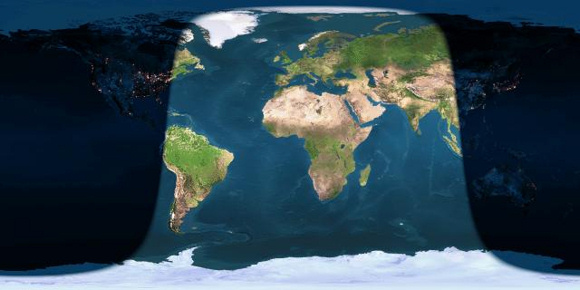
Day and night sides of Earth at instant of the October 2014 full moon

Day and night sides of Earth at instant of the October 2014 full moon (2014 October 8 at 10:51 Universal Time)

When is the October 2014 moon exactly full? Generally speaking, we in the Americas will say the moon stays full all through the night tonight, October 7-8.

But to astronomers, the moon turns full at a well-defined instant: when it’s most opposite the sun for the month.

That instant happens on October 8, 2014 at 10:51 UTC. At our U.S. time zones, that places the precise time of full moon on October 8 at 6:51 a.m. EDT, 5:51 a.m CDT, 4:51 a.m. MDT or 3:51 a.m. PDT. At that time, because there’s an eclipse happening, the moon will be totally submerged in the Earth’s dark umbral shadow.

Meanwhile, because of the difference in time zones, this same full moon happens at local midnight (October 7-8) for far-western Alaska and the Aleutian Islands. It’s sunrise (October 8) for northeastern North America and far-western South America, and it’s sunset (October 8) in Asia.

Watch the full-looking moon on the night of October 7-8 rise in the east as the sun goes down. Like any full moon, the Hunter’s Moon will shine all night long. It’ll soar highest in the sky around midnight and will set in the west around sunrise.

Who will see the October 7-8 total lunar eclipse? The October 2014 full moon passes directly through Earth’s dark (umbral) shadow. The total part of the October 8 eclipse lasts nearly 1 hour. A partial umbral eclipse precedes totality by about one hour and 10 minutes, and follows totality by about the same period of time, so the moon takes about 3 and 1/3 hours to completely sweep through the Earth’s dark shadow.

North and South America, the Pacific Ocean, New Zealand, Australia and eastern Asia are in a good position worldwide to watch the total eclipse of the moon on October 8. If you live in the Americas or Hawaii, the total eclipse happens before sunrise October 8. In the world’s eastern hemisphere, the total eclipse happens after sunset October 8.

A very light penumbral eclipse comes before and after the dark (umbral) stage of the lunar eclipse. But this sort of eclipse is so faint that many people won’t even notice it. The penumbral eclipse would be more fun to watch from the moon, where it would be seen as a partial eclipse of the sun.

Who will see the partial lunar eclipse on October 8? A partial lunar eclipse may be visible in the haze of morning dawn from the extreme eastern portion of North America (Newfoundland), before sunrise on October 8. A partial lunar eclipse can also be observed from western Asia (eastern India, Nepal, western China) after sunset on October 8.

source:::::earth sky news

Natarajan