Message For The Day….Love Is God..Truth Is God…Love is Truth ..Truth is Love !!!

If you want to attain God, cultivate love. If you promote love and look upon all with love, hatred will never be your lot. That is the one important lesson I teach always. I do not ask that you should become a scholar or a recluse or an ascetic skilled in recitation of holy Names and Meditation (Japa and Dhyana). God only examines, “Is your heart full of love?” Firmly believe that Love is God, Truth is God. Love is Truth, Truth is Love. For it is only when you love that you have no fear. Fear is the mother of falsehood. If you have no fear, you will adhere to truth. The mirror of love reflects the Divine Self within you and reveals to you that the Divine Self within you is Universal and is immanent in every being.
– Divine Discourse, Jul 25, 1958


Sathya Sai Baba

Watch Warren Buffett “s Interview in 1962 !!!!

Warren Buffett will tell you that his investment career began in the 1940s when he bought shares in a company as an 11-year.
However, there isn’t much footage of the Oracle of Omaha available before the 1980s.
Reformed Broker Josh Brown points us to this rare 1962 interview with Buffett on ValueWalk.com.
In this brief clip, Buffett discusses the predictive power of the stock market.
“The stock market has been a good forecaster from time to time in the past,” he said. It also has been a rather poor forecaster occasionally.”
He addressed an ongoing sell-off in the stock market.
“For example, the last four or five years, the stock market has been booming along presumably forecasting better business which has really not materialized,” he said. “So maybe the stock market is correcting a previously incorrect forecast this time.”
Watch the whole clip here:


source::::businessinsider.com

Natarajan

Best Quotes Of Warren Buffett On Investment Strategy !!!!

Warren Buffett has just joined Twitter. 

Hopefully this means we’ll hear from the Oracle of Omaha on a more regular and informal basis.

Buffett has established himself as the most successful investor in history.

And he has never kept his investing methods secret.

In fact, when he shares his tips, he often does so in an approachable and entertaining manner.

So, as we get ready for this week’s annual meeting of Berkshire Hathaway shareholders, we reflect on some of Buffett’s best investing quips.

We compiled a few of Buffett’s best quotes from his TV appearances, newspaper op-eds, magazine interviews, and of course his annual letters, which are always-must reads.

Investing novices and experts alike can learn from the advice that the he has articulated through the years.

If we’ve missed any of your favorites, let us know in the comments.


Buying a stock is about more than just the price.

“It’s far better to buy a wonderful company at a fair price than a fair company at a wonderful price.”

Source: Letter to shareholders, 1989

You don’t have to be a genius to invest well.

“You don’t need to be a rocket scientist. Investing is not a game where the guy with the 160 IQ beats the guy with 130 IQ.”

Source: Warren Buffet Speaks, via msnbc.msn

But, master the basics.

“To invest successfully, you need not understand beta, efficient markets, modern portfolio theory, option pricing or emerging markets. You may, in fact, be better off knowing nothing of these. That, of course, is not the prevailing view at most business schools, whose finance curriculum tends to be dominated by such subjects. In our view, though, investment students need only two well-taught courses – How to Value a Business, and How to Think About Market Prices.”

Source: Chairman’s Letter, 1996

Don’t buy a stock just because everyone hates it.

“None of this means, however, that a business or stock is an intelligent purchase simply because it is unpopular; a contrarian approach is just as foolish as a follow-the-crowd strategy. What’s required is thinking rather than polling. Unfortunately, Bertrand Russell’s observation about life in general applies with unusual force in the financial world: “Most men would rather die than think. Many do.”

Source: Chairman’s Letter, 1990

Bad things aren’t obvious when times are good.

“After all, you only find out who is swimming naked when the tide goes out.”

Source: Letter to shareholders, 2001

Always be liquid.

“I have pledged – to you, the rating agencies and myself – to always run Berkshire with more than ample cash. We never want to count on the kindness of strangers in order to meet tomorrow’s obligations. When forced to choose, I will not trade even a night’s sleep for the chance of extra profits.”

 Source: Letter to shareholders, 2008

The best time to buy a company is when it’s in trouble.

“The best thing that happens to us is when a great company gets into temporary trouble…We want to buy them when they’re on the operating table.”

Source: Businessweek, 1999

Stocks have always come out of crises.

Stocks have always come out of crises.

A soup kitchen in 1936

Wikimedia Commons

“Over the long term, the stock market news will be good. In the 20th century, the United States endured two world wars and other traumatic and expensive military conflicts; the Depression; a dozen or so recessions and financial panics; oil shocks; a flu epidemic; and the resignation of a disgraced president. Yet the Dow rose from 66 to 11,497.”

Source: The New York Times, October 16, 2008

Don’t be fooled by that Cinderella feeling you get from great returns

“The line separating investment and speculation, which is never bright and clear, becomes blurred still further when most market participants have recently enjoyed triumphs. Nothing sedates rationality like large doses of effortless money. After a heady experience of that kind, normally sensible people drift into behavior akin to that of Cinderella at the ball. They know that overstaying the festivities ¾ that is, continuing to speculate in companies that have gigantic valuations relative to the cash they are likely to generate in the future ¾ will eventually bring on pumpkins and mice. But they nevertheless hate to miss a single minute of what is one helluva party. Therefore, the giddy participants all plan to leave just seconds before midnight. There’s a problem, though: They are dancing in a room in which the clocks have no hands.”

Source: Letter to shareholders, 2000

Think long-term.

“Your goal as an investor should simply be to purchase, at a rational price, a part interest in an easily-understandable business whose earnings are virtually certain to be materially higher five, ten and twenty years from now. Over time, you will find only a few companies that meet these standards – so when you see one that qualifies, you should buy a meaningful amount of stock. You must also resist the temptation to stray from your guidelines: If you aren’t willing to own a stock for ten years, don’t even think about owning it for ten minutes. Put together a portfolio of companies whose aggregate earnings march upward over the years, and so also will the portfolio’s market value.”

Source: Chairman’s Letter, 1996

Forever is a good holding period.

“When we own portions of outstanding businesses with outstanding managements, our favorite holding period is forever.”

Source: Letter to shareholders, 1988

Buy businesses that can be run by idiots.

Buy businesses that can be run by idiots.

“I try to buy stock in businesses that are so wonderful that an idiot can run them. Because sooner or later, one will.“

Source: Business Insider

Be greedy when others are fearful.

“Investors should remember that excitement and expenses are their enemies. And if they insist on trying to time their participation in equities, they should try to be fearful when others are greedy and greedy only when others are fearful.”

Source: Letter to shareholders, 2004

You don’t have to move at every opportunity.

“The stock market is a no-called-strike game. You don’t have to swing at everything–you can wait for your pitch. The problem when you’re a money manager is that your fans keep yelling, ‘Swing, you bum!'”

Source: The Tao of Warren Buffett via Engineeringnews.com

Ignore politics and macroeconomics when picking stocks.

“We will continue to ignore political and economic forecasts, which are an expensive distraction for many investors and businessmen. Thirty years ago, no one could have foreseen the huge expansion of the Vietnam War, wage and price controls, two oil shocks, the resignation of a president, the dissolution of the Soviet Union, a one-day drop in the Dow of 508 points, or treasury bill yields fluctuating between 2.8% and 17.4%.

“But, surprise – none of these blockbuster events made the slightest dent in Ben Graham’s investment principles. Nor did they render unsound the negotiated purchases of fine businesses at sensible prices. Imagine the cost to us, then, if we had let a fear of unknowns cause us to defer or alter the deployment of capital. Indeed, we have usually made our best purchases when apprehensions about some macro event were at a peak. Fear is the foe of the faddist, but the friend of the fundamentalist.

Source: Chairman’s Letter, 1994

The more you trade, the more you underperform.

The more you trade, the more you underperform.

Public domain

“Long ago, Sir Isaac Newton gave us three laws of motion, which were the work of genius. But Sir Isaac’s talents didn’t extend to investing: He lost a bundle in the South Sea Bubble, explaining later, “I can calculate the movement of the stars, but not the madness of men.” If he had not been traumatized by this loss, Sir Isaac might well have gone on to discover the Fourth Law of Motion: For investors as a whole, returns decrease as motion increases.”

Source: Letters to shareholders, 2005

Price and value are not the same

“Long ago, Ben Graham taught me that ‘Price is what you pay; value is what you get.’ Whether we’re talking about socks or stocks, I like buying quality merchandise when it is marked down.”

Source: Letter to shareholders, 2008

There are no bonus points for complicated investments.

“Our investments continue to be few in number and simple in concept: The truly big investment idea can usually be explained in a short paragraph. We like a business with enduring competitive advantages that is run by able and owner-oriented people. When these attributes exist, and when we can make purchases at sensible prices, it is hard to go wrong (a challenge we periodically manage to overcome).

“Investors should remember that their scorecard is not computed using Olympic-diving methods: Degree-of-difficulty doesn’t count. If you are right about a business whole value is largely dependent on a single key factor that is both easy to understand and enduring, the payoff is the same as if you had correctly analyzed an investment alternative characterized by many constantly shifting and complex variables.”

Source: Chairman’s Letter, 1994

A good businessperson makes a good investor.

“I am a better investor because I am a businessman, and a better businessman because I am no investor.”

Source: Forbes.com – Thoughts On The Business Life

Higher taxes aren’t a dealbreaker.

“SUPPOSE that an investor you admire and trust comes to you with an investment idea. “This is a good one,” he says enthusiastically. “I’m in it, and I think you should be, too.”

Would your reply possibly be this? “Well, it all depends on what my tax rate will be on the gain you’re saying we’re going to make. If the taxes are too high, I would rather leave the money in my savings account, earning a quarter of 1 percent.” Only in Grover Norquist’s imagination does such a response exist.”

Source: New York Times

Companies that don’t change can be great investments.

“Our approach is very much profiting from lack of change rather than from change. With Wrigley chewing gum, it’s the lack of change that appeals to me. I don’t think it is going to be hurt by the Internet. That’s the kind of business I like.”

Source: Businessweek, 1999

This is the most important thing.

This is the most important thing.

Wikipeda

“Rule No. 1: never lose money; rule No. 2: don’t forget rule No. 1”

Source: The Tao of Warren Buffett

Time will tell.

“Time is the friend of the wonderful business, the enemy of the mediocre.”

Source: Letters to shareholders 1989

BONUS: On Wall Street advice

“Wall Street is the only place that people ride to in a Rolls-Royce to get advice from those who take the subway.”

Source: The Tao of Warren Buffett….businessinsider.com

Natarajan

Read more: http://www.businessinsider.com/warren-buffetts-best-investing-quotes-2013-5?op=1#ixzz2Uh9wS79f

Top 15 Countries With Highest Quality Of Life… Australia is Ranked No 1 !!!!

For a good chance at a happy life, head to Australia, which one again topped the Organization for Economic Cooperation and Development‘s Better Life Index, which looks at the quality of life in member countries.

The (OECD) — an international economic organization — analyzed 34 countries in 11 categories, including income, housing, jobs, community, education, environment, civic engagement, health, life satisfaction, safety, and work-life balance. (You can read the full methodology here.)

We looked at the countries with the highest overall scores, and highlighted a few of the criteria on the following slides.


#15 Ireland

Average household disposable income: $24,104

The Irish have a strong sense of community — 96% of people believe they know someone they could rely on in a time of need (higher than the OECD average of 90%).

They also rate highly in work-life balance, where the average employee works 1,543 hours a year, less than the OECD average of 1,776.

Researchers compared data from 34 countries that are members of the Organization for Economic Cooperation and Development. They based the rankings on 11 factors including income, safety, life satisfaction, and health, and then rated each country on a 10-point scale. Income is net-adjusted and in USD.

#14 Luxembourg

Average household disposable income: $23,047

Luxembourg rates well in both health and environment, with an average life expectancy of 81 years and a low level of atmospheric PM10 — tiny air pollutant particles small enough to enter and cause damage to the lungs.

Citizens also have a high participation rate in the political process, with 91% of the population turning out for recent elections.

Researchers compared data from 34 countries that are members of the Organization for Economic Cooperation and Development. They based the rankings on 11 factors including income, safety, life satisfaction, and health, and then rated each country on a 10-point scale. Income is net-adjusted and in USD.

#13 Austria

Average household disposable income: $28,852

Austria has a high rate for education. 82% of Austrian adults ages 25-64 have earned the equivalent of a high school degree.

Austrians also have a strong sense of community, with 94% of the population reporting they know someone they could rely on in a time of need.

Researchers compared data from 34 countries that are members of the Organization for Economic Cooperation and Development. They based the rankings on 11 factors including income, safety, life satisfaction, and health, and then rated each country on a 10-point scale. Income is net-adjusted and in USD.

#12 Finland

Average household disposable income: $25,739

Finland performed extremely well on the OECD’s Programme for International Student Assessment — the average student scored 543 in reading literacy, math, and science, whereas the average OECD score was 497.

They also have a high level of life satisfaction with 82% of the population saying they have more positive experiences than negative ones in an average day.

Researchers compared data from 34 countries that are members of the Organization for Economic Cooperation and Development. They based the rankings on 11 factors including income, safety, life satisfaction, and health, and then rated each country on a 10-point scale. Income is net-adjusted and in USD.

#11 New Zealand

Average household disposable income: $21,892

New Zealand has one of the best rates of renewable energy of any OECD country with 36.47%.

Students also scored 524 in reading literacy, math, and science on the OECD Programme for International Student Assessment — higher than the average of 497.

And New Zealand girls outperformed boys by 15 points, higher than the average OECD gap of 9 points.

Researchers compared data from 34 countries that are members of the Organization for Economic Cooperation and Development. They based the rankings on 11 factors including income, safety, life satisfaction, and health, and then rated each country on a 10-point scale. Income is net-adjusted and in USD.

#10 United Kingdom

#10 United Kingdom

AP/RICHARD LEWIS

Average household disposable income: $23,047

85% of the English population say they have more positive experiences in an average day than negative ones.

They also have a high life expectancy of 81 years, and 97% of the people say they are satisfied with the quality of their water.

Researchers compared data from 34 countries that are members of the Organization for Economic Cooperation and Development. They based the rankings on 11 factors including income, safety, life satisfaction, and health, and then rated each country on a 10-point scale. Income is net-adjusted and in USD.

#9 Iceland

Average household disposable income: $23,047

Iceland has high levels of civic participation — 98% of people believe they know someone they could rely on in a time of need.

97% of the Iceland population are also extremely satisfied with their water quality, and Iceland has less air pollutant particles per cubic meter than the OECD average.

Researchers compared data from 34 countries that are members of the Organization for Economic Cooperation and Development. They based the rankings on 11 factors including income, safety, life satisfaction, and health, and then rated each country on a 10-point scale. Income is net-adjusted and in USD.

#8 Netherlands

#8 Netherlands

Average household disposable income: $25,493

People in the Netherlands only work 1,379 hours a year, significantly less than the OECD average of 1,776 hours.

They also test extremely high on the OECD’s Programme for International Student Assessment with an average of 519 (the OECD average is 497).

Researchers compared data from 34 countries that are members of the Organization for Economic Cooperation and Development. They based the rankings on 11 factors including income, safety, life satisfaction, and health, and then rated each country on a 10-point scale. Income is net-adjusted and in USD.

#7 Denmark

#7 Denmark

Chris Jackson/Getty Images

Average household disposable income: $24,682

Denmark has one of the highest life satisfaction rankings, with 89% of the population reporting they have more positive experiences in an average day than negative ones.

The Danish also know how to balance their work life with their personal life — only 2% of employees say they work very long hours, much lower than the OECD average of 9%.

Researchers compared data from 34 countries that are members of the Organization for Economic Cooperation and Development. They based the rankings on 11 factors including income, safety, life satisfaction, and health, and then rated each country on a 10-point scale. Income is net-adjusted and in USD.

#6 United States

#6 United States

Assouline

Average household disposable income: $38,001

The U.S. has the highest average household disposable income on the list at $38,000 a year — much higher than the OECD average of $23,000.

It also ranks as one of the best countries for housing conditions, with good basic facilities and general feelings of safety and personal space.

Researchers compared data from 34 countries that are members of the Organization for Economic Cooperation and Development. They based the rankings on 11 factors including income, safety, life satisfaction, and health, and then rated each country on a 10-point scale. Income is net-adjusted and in USD.

#5 Switzerland

Average household disposable income: $30,060

86% of adults in Switzerland have earned the equivalent of a high school degree, and students scored 517 on the OECD Programme for International Student Assessment — higher than the average of 497.

The Swiss also have a high life expectancy at 83 years of age, and 95% of the population say they are satisfied with the quality of their water.

Researchers compared data from 34 countries that are members of the Organization for Economic Cooperation and Development. They based the rankings on 11 factors including income, safety, life satisfaction, and health, and then rated each country on a 10-point scale. Income is net-adjusted and in USD.

#4 Norway

Average household disposable income: $31,459

There is a strong sense of community and high levels of safety in Norway, where 93% of people believe that they know someone they could rely on in a time of need.

Norwegians also tend to have a good work-life balance, with only 3% of employees working very long hours, compared to the OECD average of 9%.

Researchers compared data from 34 countries that are members of the Organization for Economic Cooperation and Development. They based the rankings on 11 factors including income, safety, life satisfaction, and health, and then rated each country on a 10-point scale. Income is net-adjusted and in USD.

#3 Canada

Average household disposable income: $28,194

Canadians work only 1,702 hours a year — less than the OECD average — with 72% of the population working at a paid job.

There is little difference in voting levels across society too, suggesting there is broad inclusion in Canada’s democratic institutions: Voter turnout for the top 20% of the population is 63% and for the bottom 20% it is 60%, a much smaller difference than the OECD average gap of 12 percentage points.

Researchers compared data from 34 countries that are members of the Organization for Economic Cooperation and Development. They based the rankings on 11 factors including income, safety, life satisfaction, and health, and then rated each country on a 10-point scale. Income is net-adjusted and in USD.

#2 Sweden

Average household disposable income: $26,242

Having a good education is extremely important in Sweden, where 87% of adults aged 25-64 have earned the equivalent of a high school degree.

They also ranked highly in all environmental categories. Their level of air pollutant particles is 10 micrograms per cubic meter — considerably lower than the OECD average of 21 micrograms per cubic meter — and 95% of the population is satisfied with their water quality.

Researchers compared data from 34 countries that are members of the Organization for Economic Cooperation and Development. They based the rankings on 11 factors including income, safety, life satisfaction, and health, and then rated each country on a 10-point scale. Income is net-adjusted and in USD.

#1 Australia

Average household disposable income: $28,884

For the second year in a row, Australia is the number one happiest country in the world. And it’s not hard to see why —they rank extremely well in health, civic engagement, and housing.

The life expectancy at birth in Australia is 82 years, two years higher than the OECD average.

Australia also has exceptional voter turnout at 93% during recent elections, which is far above the OECD average of 72%.

Researchers compared data from 34 countries that are members of the Organization for Economic Cooperation and Development. They based the rankings on 11 factors including income, safety, life satisfaction, and health, and then rated each country on a 10-point scale. Income is net-adjusted and in USD.

Read more: http://www.businessinsider.com/top-countries-on-oecd-better-life-index-2013-5?op=1#ixzz2Uh2HIE5s

source::::businessinsider.com

Natarajan

Duck Crossing The Road along with Her Ducklings!!!!

Quick-step: Drivers were forced to hit the brakes as this family of ducks marched down the middle of busy route in Cheshire

Quick-step: Drivers were forced to hit the brakes as this family of ducks marched down the middle of busy route in Cheshire…


Out for a stroll: The mallard and her brood were en route to a reservoir in Cheshire for a morning swim, onlookers said

Out for a stroll: The mallard and her brood were en route to a reservoir in Cheshire for a morning swim, onlookers said

source::::mailonline.com

Natarajan

This mother duck brought traffic to a halt as she set out for a morning swim with her adorable brood in tow.


Drivers in Macclesfield could only watch and wait as the mallard waddled along Clarke Lane with her flock of 13 fluffy ducklings en route to the nearby Ridgate Reservoir.


Onlookers said the family of ducks had tried to reach the water over a wall, but took a detour along the road when it proved too high for the tiny ducklings to cross.


Message For The Day…Differnce Between Quality of Life and Standard of Life …

You do not wail that the pot you are holding is a mud pot, if you know that what is contained in it is nectar, is it not? Having a mud pot with nectar is far better than having a gold pot with poison! There is no value to the land of riches or a mansion if the quality of life is deplorable. Even if the standard of life is poor, it does not matter if the way of life is pure, full of love, humility, fear of sin and reverence towards elders. It is easy to restore this way of life provided the Vedas are studied and fostered and its teachings practised in earnestness. The Mother of Vedas (Vedamatha) will foster in you love and kindness. The teachings for right conduct laid down in the Vedas are the best armour to guard you against sorrow and difficulties.
– Divine Discourse, Aug 15, 1964.

Sathya Sai Baba

Do You Know ?….Farmers From Bihar Have a Solution to World Food Shortage !!!

India’s rice revolution

In a village in India’s poorest state, Bihar, farmers are growing world record amounts of rice – with no GM, and no herbicide. Is this one solution to world food shortages?

Sumant KumarView larger picture

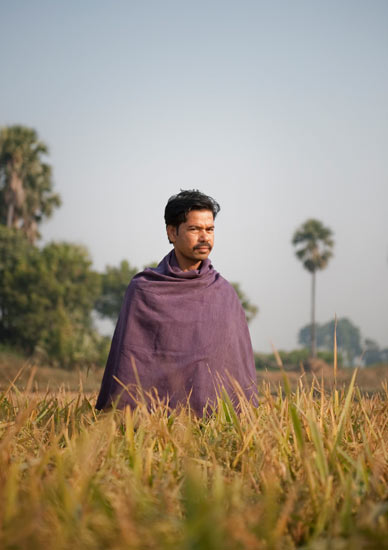
Sumant Kumar photographed in Darveshpura, Bihar, India. Photograph: Chiara Goia for Observer Food Monthly

Sumant Kumar was overjoyed when he harvested his rice last year. There had been good rains in his village of Darveshpura in north-eastIndia and he knew he could improve on the four or five tonnes per hectare that he usually managed. But every stalk he cut on his paddy field near the bank of the Sakri river seemed to weigh heavier than usual, every grain of rice was bigger and when his crop was weighed on the old village scales, even Kumar was shocked.

This was not six or even 10 or 20 tonnes. Kumar, a shy young farmer in Nalanda district of India’s poorest state Bihar, had – using only farmyard manure and without any herbicides – grown an astonishing 22.4 tonnes of rice on one hectare of land. This was a world record and with rice the staple food of more than half the world’s population of seven billion, big news.

Link to video: Rice farming in India: ‘Now I produce enough food for my family’It beat not just the 19.4 tonnes achieved by the “father of rice”, the Chinese agricultural scientist Yuan Longping, but the World Bank-funded scientists at the International Rice Research Institute in the Philippines, and anything achieved by the biggest European and American seed and GM companies. And it was not just Sumant Kumar. Krishna, Nitish, Sanjay and Bijay, his friends and rivals in Darveshpura, all recorded over 17 tonnes, and many others in the villages around claimed to have more than doubled their usual yields.

The villagers, at the mercy of erratic weather and used to going without food in bad years, celebrated. But the Bihar state agricultural universities didn’t believe them at first, while India’s leading rice scientists muttered about freak results. The Nalanda farmers were accused of cheating. Only when the state’s head of agriculture, a rice farmer himself, came to the village with his own men and personally verified Sumant’s crop, was the record confirmed.

A tool used to harvest riceA tool used to harvest rice. Photograph: Chiara GoiaThe rhythm of Nalanda village life was shattered. Here bullocks still pull ploughs as they have always done, their dung is still dried on the walls of houses and used to cook food. Electricity has still not reached most people. Sumant became a local hero, mentioned in the Indian parliament and asked to attend conferences. The state’s chief minister came to Darveshpura to congratulate him, and the village was rewarded with electric power, a bank and a new concrete bridge.

That might have been the end of the story had Sumant’s friend Nitish not smashed the world record for growing potatoes six months later. Shortly after Ravindra Kumar, a small farmer from a nearby Bihari village, broke the Indian record for growing wheat. Darveshpura became known as India’s “miracle village”, Nalanda became famous and teams of scientists, development groups, farmers, civil servants and politicians all descended to discover its secret.

When I meet the young farmers, all in their early 30s, they still seem slightly dazed by their fame. They’ve become unlikely heroes in a state where nearly half the families live below the Indian poverty line and 93% of the 100 million population depend on growing rice and potatoes. Nitish Kumar speaks quietly of his success and says he is determined to improve on the record. “In previous years, farming has not been very profitable,” he says. “Now I realise that it can be. My whole life has changed. I can send my children to school and spend more on health. My income has increased a lot.”

What happened in Darveshpura has divided scientists and is exciting governments and development experts. Tests on the soil show it is particularly rich in silicon but the reason for the “super yields” is entirely down to a method of growing crops called System of Rice (or root) Intensification (SRI). It has dramatically increased yields with wheat, potatoes, sugar cane, yams, tomatoes, garlic, aubergine and many other crops and is being hailed as one of the most significant developments of the past 50 years for the world’s 500 million small-scale farmers and the two billion people who depend on them.

People work on a rice field in BiharPeople work on a rice field in Bihar. Photograph: Chiara GoiaInstead of planting three-week-old rice seedlings in clumps of three or four in waterlogged fields, as rice farmers around the world traditionally do, the Darveshpura farmers carefully nurture only half as many seeds, and then transplant the young plants into fields, one by one, when much younger. Additionally, they space them at 25cm intervals in a grid pattern, keep the soil much drier and carefully weed around the plants to allow air to their roots. The premise that “less is more” was taught by Rajiv Kumar, a young Bihar state government extension worker who had been trained in turn by Anil Verma of a small Indian NGO called Pran (Preservation and
Proliferation of Rural Resources and Nature), which has introduced the SRI method to hundreds of villages in the past three years.

While the “green revolution” that averted Indian famine in the 1970s relied on improved crop varieties, expensive pesticides and chemical fertilisers, SRI appears to offer a long-term, sustainable future for no extra cost. With more than one in seven of the global population going hungry and demand for rice expected to outstrip supply within 20 years, it appears to offer real hope. Even a 30% increase in the yields of the world’s small farmers would go a long way to alleviating poverty.

“Farmers use less seeds, less water and less chemicals but they get more without having to invest more. This is revolutionary,” said Dr Surendra Chaurassa from Bihar’s agriculture ministry. “I did not believe it to start with, but now I think it can potentially change the way everyone farms. I would want every state to promote it. If we get 30-40% increase in yields, that is more than enough to recommend it.”

The results in Bihar have exceeded Chaurassa’s hopes. Sudama Mahto, an agriculture officer in Nalanda, says a small investment in training a few hundred people to teach SRI methods has resulted in a 45% increase in the region’s yields. Veerapandi Arumugam, the former agriculture minister of Tamil Nadu state, hailed the system as “revolutionising” farming.

SRI’s origins go back to the 1980s in Madagascar where Henri de Laulanie, a French Jesuit priest and agronomist, observed how villagers grew rice in the uplands. He developed the method but it was an American, professor Norman Uphoff, director of the International Institute for Food, Agriculture and Development at Cornell University, who was largely responsible for spreading the word about De Laulanie’s work.

Given $15m by an anonymous billionaire to research sustainable development, Uphoff went to Madagascar in 1983 and saw the success of SRI for himself: farmers whose previous yields averaged two tonnes per hectare were harvesting eight tonnes. In 1997 he started to actively promote SRI in Asia, where more than 600 million people are malnourished.

“It is a set of ideas, the absolute opposite to the first green revolution [of the 60s] which said that you had to change the genes and the soil nutrients to improve yields. That came at a tremendous ecological cost,” says Uphoff. “Agriculture in the 21st century must be practised differently. Land and water resources are becoming scarcer, of poorer quality, or less reliable. Climatic conditions are in many places more adverse. SRI offers millions of disadvantaged households far better opportunities. Nobody is benefiting from this except the farmers; there are no patents, royalties or licensing fees.”

Rice seedsRice seeds. Photograph: Chiara GoiaFor 40 years now, says Uphoff, science has been obsessed with improving seeds and using artificial fertilisers: “It’s been genes, genes, genes. There has never been talk of managing crops. Corporations say ‘we will breed you a better plant’ and breeders work hard to get 5-10% increase in yields. We have tried to make agriculture an industrial enterprise and have forgotten its biological roots.”

Not everyone agrees. Some scientists complain there is not enough peer-reviewed evidence around SRI and that it is impossible to get such returns. “SRI is a set of management practices and nothing else, many of which have been known for a long time and are best recommended practice,” says Achim Dobermann, deputy director for research at the International Rice Research Institute. “Scientifically speaking I don’t believe there is any miracle. When people independently have evaluated SRI principles then the result has usually been quite different from what has been reported on farm evaluations conducted by NGOs and others who are promoting it. Most scientists have had difficulty replicating the observations.”

Dominic Glover, a British researcher working with Wageningen University in the Netherlands, has spent years analysing the introduction of GM crops in developing countries. He is now following how SRI is being adopted in India and believes there has been a “turf war”.

“There are experts in their fields defending their knowledge,” he says. “But in many areas, growers have tried SRI methods and abandoned them. People are unwilling to investigate this. SRI is good for small farmers who rely on their own families for labour, but not necessarily for larger operations. Rather than any magical theory, it is good husbandry, skill and attention which results in the super yields. Clearly in certain circumstances, it is an efficient resource for farmers. But it is labour intensive and nobody has come up with the technology to transplant single seedlings yet.”

But some larger farmers in Bihar say it is not labour intensive and can actually reduce time spent in fields. “When a farmer does SRI the first time, yes it is more labour intensive,” says Santosh Kumar, who grows 15 hectares of rice and vegetables in Nalanda. “Then it gets easier and new innovations are taking place now.”

In its early days, SRI was dismissed or vilified by donors and scientists but in the past few years it has gained credibility. Uphoff estimates there are now 4-5 million farmers using SRI worldwide, with governments in China, India, Indonesia, Cambodia, Sri Lanka and Vietnam promoting it.

Sumant, Nitish and as many as 100,000 other SRI farmers in Bihar are now preparing their next rice crop. It’s back-breaking work transplanting the young rice shoots from the nursery beds to the paddy fields but buoyed by recognition and results, their confidence and optimism in the future is sky high.

Last month Nobel prize-winning economist Joseph Stiglitz visited Nalanda district and recognised the potential of this kind of organic farming, telling the villagers they were “better than scientists”. “It was amazing to see their success in organic farming,” said Stiglitz, who called for more research. “Agriculture scientists from across the world should visit and learn and be inspired by them.”

A man winnows rice in Satgharwa villageA man winnows rice in Satgharwa village. Photograph: Chiara GoiaBihar, from being India’s poorest state, is now at the centre of what is being called a “new green grassroots revolution” with farming villages, research groups and NGOs all beginning to experiment with different crops using SRI. The state will invest $50m in SRI next year but western governments and foundations are holding back, preferring to invest in hi-tech research. The agronomist Anil Verma does not understand why: “The farmers know SRI works, but help is needed to train them. We know it works differently in different soils but the principles are solid,” he says. “The biggest problem we have is that people want to do it but we do not have enough trainers.

“If any scientist or a company came up with a technology that almost guaranteed a 50% increase in yields at no extra cost they would get a Nobel prize. But when young Biharian farmers do that they get nothing. I only want to see the poor farmers have enough to eat.”


source:::: John Vidal in The Observer  UK

Natarajan

Message For The Day….Continue to Love , You Will be Loved In Return…

The others are part of yourself. You need not worry about them. Worry about yourself that is enough. When you become all right, they too will be all right, for you will no longer be aware of them as separate from you. Criticising others, finding fault with them, etc. – all this comes out of egoism. Search for your own faults instead. The faults you see in others are but reflection of your own personality traits. Pay no heed to little worries; attach your mind to the Lord. Then, you will be led onto the company of good people and your talents will be transmuted. Consider everyone as the children of the Lord, as your own brothers and sisters, develop the quality of love and seek always the welfare of humanity. Be like the bee, drinking the nectar of every flower, not like the mosquito drinking blood and distributing disease in return. If you continue to love, you will be loved in return.
– Divine Discourse, Jul 25, 1958.

Sathya Sai Baba

Failure is the First Step To Success !!!!

MOST SUCCESSFUL PEOPLE WHO FAILED AT FIRST

The quote, You  are only as good as your last success should actually be rephrased to,  you are only as bad as your last failure.

You can’t possibly be a failure every single time.
You’ll find success if you work hard, plan well, and don’t give up
Like the 10 most successful failures of all time.

10. Michael Jordan

Michael Jordan failed getting into his varsity basketball team during sophomore year because he was clumsy and was only 5 feet 11 inches tall
High school and college sports performances are what NBA recruiters look into when scouting for talent, but Jordan had failed right from the start.
So, he locked himself up in his room to cry.

But he tried out again the next year and got into the junior varsity team.
He practiced the game every day and grew taller by a few more inches until he honed his skills to an unbelievable level. Years later, he became the NBAs most famous MVP and the greatest basketball player of all time.

9. Lucille Ball

Lucille was booted out of New Yorks John Murray Anderson School for the Dramatic Arts for being too scared to perform. After that, she kept going back and forth New York as a fashion model and actress, getting fired from at least two stage productions
She went to Hollywood, got a contract with Metro-Goldwyn-Mayer, but her best efforts got her only in B-movies.

Eventually, she found her way into radio then television, a new entertainment medium back in the 1940s and 1950s
She and her husband Desi Arnaz launched the I Love Lucyshow on CBS, which went on to become one of the longest-running TV shows in history, and making her a famous comedienne.

8. Steven Spielberg

As a dyslexic young man, Spielbergs application to the University of Southern Californias School of Theater, Film, and Television was rejected thrice
He went to California State University in Long Beach instead, but ended up dropping out of it anyway.

His directorial debut was Sugarland Expresspraised by critics, but a box office failure.
Nevertheless, Spielberg forged ahead and was given the chance to film big-budgeted hits such as Jaws,ïClose Encounters of the Third Kind,ïET,ïRaiders of the Lost Ark,ïand Jurassic Park.ï
But the Academy of Motion Picture Arts Sciences snubbed him for years, and avoided giving him the Best Director award until 1993, when he made Schindlers List.ï
From then on, he was recognized as an A-list Hollywood director and a major artistic force in film history.

7. Walt Disney

Walt Disney was once a young artist whose editor fired him because he reportedly lacked imagination or good ideas. Disney wanted to start a company creating animated short films
But his first few tries failed; at one point he even lost some of his employees and the rights to his own animated character (Oswald the Rabbit) to Universal Pictures
But eventually, he built a gigantic entertainment empire that churned out classic characters (Donald Duck and Mickey Mouse) and ground-breaking animated films like Snow White, and Sleeping Beauty.

6.Oprah Winfrey

TVs queen of talk grew up with poverty and child abuse.
She tried her hand at being a television reporter
But she was fired from her TV job because she wasn’t considered fit for TV.
Emotional problems stemming from childhood had made her eat obsessively, creating her weight problem.
She also tried smoking crack cocaine, and had a number of disastrous romantic relationships.

But she reinvented herself as a talk show host, producing and starring in her own Oprah Winfrey Show
She changed the way talk shows were conducted by focusing on geopolitics, health, spirituality, and charity
Her show went on to become the most viewed talk show on the planet, turning Oprah into a billionaire.

5. Winston Churchill

Churchill was a rebellious boy who never did well in school, even failing sixth grade. He had a lisp and a stutter.
He tried his hand at building a military and political career, but he failed at nearly every election he ran in.
In later years, he was politically isolated from even the British Conservative party he worked with, his political reputation so in tatters that he exiled himself temporarily from Parliament and the House of Commons.

But Churchill was among the first to see the dangers of Nazi Germany, and managed to become Britains Prime Minister at age 62 during World War II.

His steadfastness helped inspire British resistance against Hitler, all the way to the defeat of the Nazis, securing him the title of Greatest Briton of All Time.

4. Albert Einstein

People thought Einstein was a slow young man.

He hated the regimented ways of school.

At the age of 16, he failed the entrance exams at the Swiss Federal Polytechnic in Zurich, and had to a smaller school instead.

Though he managed to get a teaching diploma from the Swiss Polytechnic later on, it took him two long years to find any job at all.
And when he did, it was for the Swiss Patent Office as an assistant examiner for patents.
But he tried writing his own scientific papers and thesis from 1901 to 1905 (including one on the theory of special relativity), which were so groundbreaking that by 1909 he became recognized as a leading scientist and one of the most brilliant minds in human history.

3. J. K. Rowling

At one point, the famous author of the Harry Potter books was a broke, unemployed, and depressed divorced mother feeding her children through welfare.

She was cradling a baby even as she wrote her manuscript for Harry Potter and the Sorcerers Stone in a caf, trying to write, eat, and get her child to sleep.
Her book proposal was rejected by no less than twelve publishing houses.

But after the Bloomsbury publishing house agreed to publish the book, it won so much acclaim and sold so many copies that Rowling could afford to write the rest of the Harry Potter seriesbecoming even richer than Britains Queen.

2. Steve Jobs

Jobs redefined the way the world used personal computers, through the company he founded, Apple, Inc.
He created Mac computers and the GUI (Graphical User Interface).
But he rubbed a lot of people the wrong way with his driven personality.
By age of 30, the board of directors of the very company he built fired him, leaving him humiliated and depressed.

But he started another company (NeXT Computer), which developed the next-generation personal computer technology, and bought Lucasfilms computer graphics division and renamed it Pixar.

When a failing Apple, Inc. asked Jobs to return to their helm, he again took over and eventually made Apple, Inc. one of the most innovative and profitable companies on the planet.

1. Abraham Lincoln

The 16th President of the United States who was responsible for ending slavery in his country was the self-educated son of a country frontier family.

He tried starting his own businesses and a political career, but because of the lack of education, powerful connections, or money, he failed at two businesses and in eight elections.

When he got married to Mary Todd, they had four sons, but three of them died early on from illnesstriggering clinical depression in Lincoln.

But by 1860, Lincoln got nominated to be the Democratic candidate to the presidency.
He won the elections, and as President of the United States oversaw the Civil War to its very end, with the emancipation of African-American slaves.

source::::unknown…input from a friend of mine…

Natarajan