Image of the day…. Image sent by MANGALYAAN on 7 Oct 2014 !!!

India’s maiden spacecraft to Mars—Mangalyaan—has send another image of the Red Planet, captured by the camera on board.

“Another full disc image of Mars, taken by the Mars Color Camera, from an altitude of 66,543 km. Dark region towards south of the cloud formation is Elysium – the second largest volcanic province on Mars,” the facebook page of Isro Mars Orbiter said on Tuesday.

The spacecraft had beamed its first photos of Mars’ crater-marked surface a day after India successfully put the probe into the red planet’s orbit.

Just after that Isro had uploaded the regional dust storm activities over northern hemisphere of Mars – captured by Mars Color Camera.The image was taken from an altitude of 74500 km from the surface of Mars.

India joined an exclusive global club of deep space explorers on September 24 when the indigenously-made spacecraft successfully slipped into the orbit around Mars after a 10-month journey on a relatively shoe-string budget.

Source:::: http://www.hindustantimes.com

Natarajan

Image of the Day…Total Lunar Eclipse…

Are you ready for tonight’s total lunar eclipse?

Total lunar eclipse of April 14-15, 2014 by EarthSky friend and NASA eclipse expert Fred Espenak.

Photo credit: Fred Espenak

A beautiful shot of April’s total lunar eclipse. Are you ready for the total lunar eclipse of October 7-8? Here’s everything you need to know.

Send us your photos or post them to our Facebook page!

Visit Fred Espenak at his new astronomy website.

SOURCE::::: EARTH SKY NEWS

Natarajan

” New York Times Apologises for the Offensive Cartoon on MANGALYAAN …”

Days after The New York Times published an offensive cartoon mocking India’s successful Mars mission, the leading US daily today apologised following readers’ complaints.

The cartoon showed a farmer with a cow knocking at the door of a room marked ‘Elite Space Club’ where two men sit reading a newspaper on India’s feat. On September 24, India made history by successfully placing its spacecraft in orbit around Mars, becoming the first country in the world to succeed in such an inter-planetary mission in the maiden attempt itself.

At just USD 74 million, the mission less than the estimated 100 million USD budget of the sci-fi blockbuster “Gravity”. Only the US, Russia and Europe have previously sent missions to Mars.

Andrew Rosenthal, editorial page editor of the New York Times, wrote in a Facebook post that a “large number of readers” had complained about the cartoon. “The intent of the cartoonist, Heng Kim Song, was to highlight how space exploration is no longer the exclusive domain of rich, Western countries,” Rosenthal said.

“Mr Heng, who is based in Singapore, uses images and text – often in a provocative way – to make observations about international affairs. We apologise to readers who were offended by the choice of images in this cartoon.” Rosenthal said Heng “was in no way trying to impugn India, its government or its citizens”.

“We appreciate that readers have shared their feedback, which we welcome,” he said.

After India’s successful arrival at the Red Planet with the low-cost Mars Orbiter Mission(MOM), US space agency NASA has lauded it. “It was an impressive engineering feat, and we welcome India to the family of nations studying another facet of the Red Planet. We look forward to MOM adding to the knowledge the international community is gathering with the other spacecraft at Mars,” NASA Administrator Charles Bolden said.

Source:::: http://www.dndindia.com

Natarajan


Kindly CLICK the following link wherein I have published a Blog on the subject on Sep 30 …

Natarajan

” No Need for India to Knock at the Doors of Elite Space Club …” !!!


Image For the Day… Total Lunar Eclipse ….

Total eclipse of Blood Moon on night of October 7-8

View larger. | Last year's Hunter's Moon by EarthSky Facebook friend John Michael Mizzi on the island of Gozo

TONIGHT FOR OCTOBER 7, 2014

There is a total eclipse of the full moon on October 8, 2014. This is the Northern Hemisphere’s Hunter’s Moon – the name for the full moon after the Harvest Moon. It’s also aBlood Moon, and this eclipse is the second in a series of four so-called Blood Moon eclipses. For North America and the Hawaiian Islands, the total lunar eclipse happens in the wee hoursbefore sunrise on October 8. For New Zealand, Australia and eastern Asia, the total eclipse is seen after sunset on October 8. A partial lunar eclipse can be seen before sunrise, October 8, from much of South America, or after sunset, October 8, from western Asia. Follow the links below to learn more about the 2014 Hunter’s Moon and the October 8 total lunar eclipse.

When is the October 2014 moon exactly full?

Who will see the October 7-8 total lunar eclipse?

Who will see the partial lunar eclipse on October 8?

Eclipse times in Universal Time.

Eclipse times for North American time zones.

Lunar eclipse computer courtesy of the US Naval Observatory

Eclipse calculator courtesy of TimeandDate

A double Blood Moon eclipse on October 8?

How is the Hunter’s Moon different from other full moons?

North Americans see partial solar eclipse on October 23

Hurry! Purchase eclipse-viewing glasses for the October 23 partial solar eclipse here.

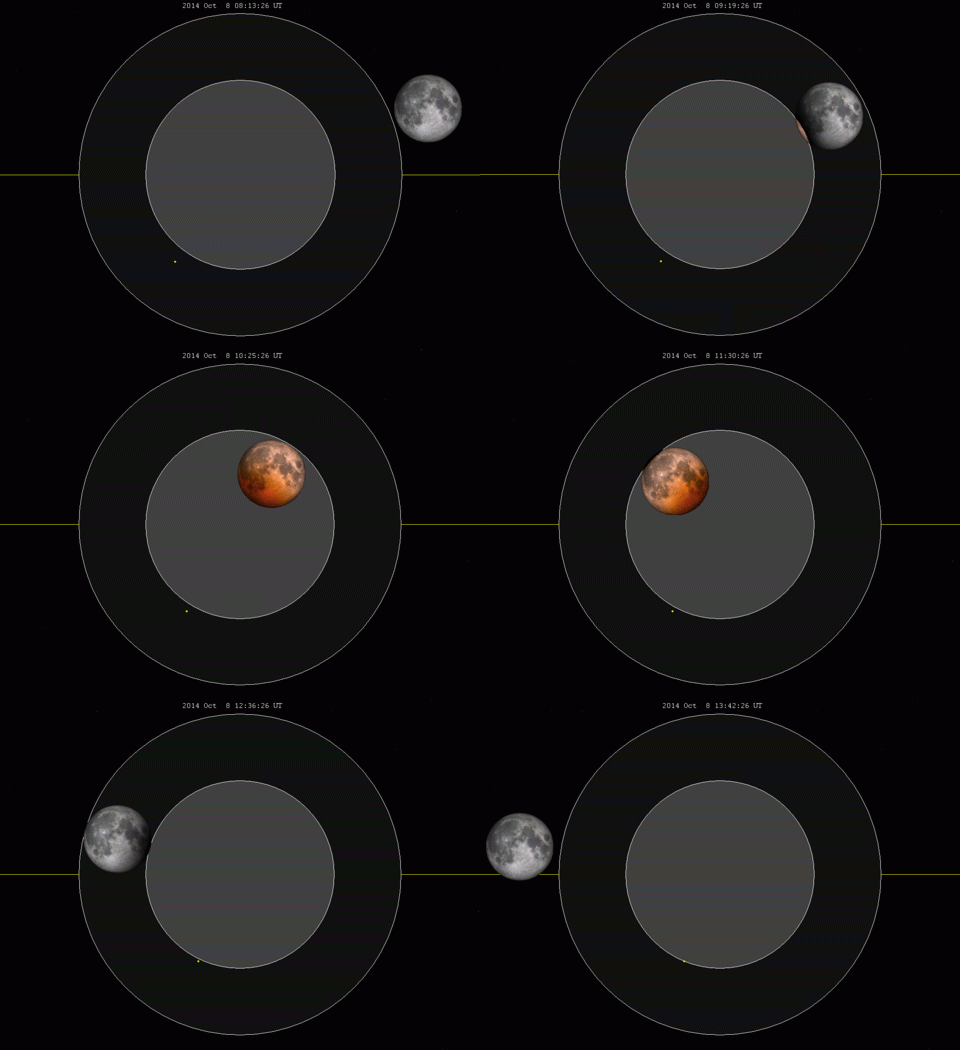
Animation of the October 8, 2014, total lunar eclipse, whereby the moon passes through the Earth's shadow from west to east. The horizontal yellow line depicts the ecliptic. The nearby dim

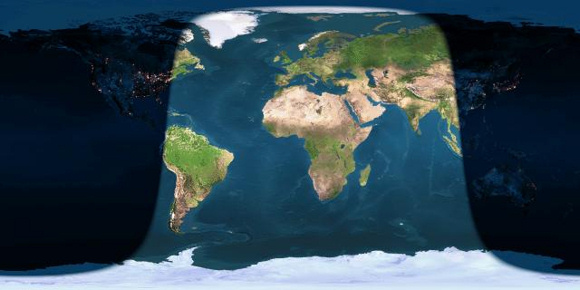
Day and night sides of Earth at instant of the October 2014 full moon

Day and night sides of Earth at instant of the October 2014 full moon (2014 October 8 at 10:51 Universal Time)

When is the October 2014 moon exactly full? Generally speaking, we in the Americas will say the moon stays full all through the night tonight, October 7-8.

But to astronomers, the moon turns full at a well-defined instant: when it’s most opposite the sun for the month.

That instant happens on October 8, 2014 at 10:51 UTC. At our U.S. time zones, that places the precise time of full moon on October 8 at 6:51 a.m. EDT, 5:51 a.m CDT, 4:51 a.m. MDT or 3:51 a.m. PDT. At that time, because there’s an eclipse happening, the moon will be totally submerged in the Earth’s dark umbral shadow.

Meanwhile, because of the difference in time zones, this same full moon happens at local midnight (October 7-8) for far-western Alaska and the Aleutian Islands. It’s sunrise (October 8) for northeastern North America and far-western South America, and it’s sunset (October 8) in Asia.

Watch the full-looking moon on the night of October 7-8 rise in the east as the sun goes down. Like any full moon, the Hunter’s Moon will shine all night long. It’ll soar highest in the sky around midnight and will set in the west around sunrise.

Who will see the October 7-8 total lunar eclipse? The October 2014 full moon passes directly through Earth’s dark (umbral) shadow. The total part of the October 8 eclipse lasts nearly 1 hour. A partial umbral eclipse precedes totality by about one hour and 10 minutes, and follows totality by about the same period of time, so the moon takes about 3 and 1/3 hours to completely sweep through the Earth’s dark shadow.

North and South America, the Pacific Ocean, New Zealand, Australia and eastern Asia are in a good position worldwide to watch the total eclipse of the moon on October 8. If you live in the Americas or Hawaii, the total eclipse happens before sunrise October 8. In the world’s eastern hemisphere, the total eclipse happens after sunset October 8.

A very light penumbral eclipse comes before and after the dark (umbral) stage of the lunar eclipse. But this sort of eclipse is so faint that many people won’t even notice it. The penumbral eclipse would be more fun to watch from the moon, where it would be seen as a partial eclipse of the sun.

Who will see the partial lunar eclipse on October 8? A partial lunar eclipse may be visible in the haze of morning dawn from the extreme eastern portion of North America (Newfoundland), before sunrise on October 8. A partial lunar eclipse can also be observed from western Asia (eastern India, Nepal, western China) after sunset on October 8.

source:::::earth sky news

Natarajan


Image of the Day…Comet 67p as Captured by Rosetta Spacecraft !!!

Rosetta’s comet is spouting jets

Wow! The Rosetta spacecraft is now seeing jets from Comet 67P/Churyumov-Gerasimenko, as the comet draws in closer to the sun.

View larger. |

As Comet 67P/Churyumov-Gerasimenko gets closer to the sun, it’s becoming more active. The European Space Agency’s Rosetta spacecraft – which has been flying in tandem with the comet since August 6 – captured the images to make the above montage on September 26, 2014, when Rosetta was 16 miles (26 kilometers) from the comet. The montage shows jets of dust and gas escaping from the neck of 67P/C-G.
.
Rosetta spent 10 years on a deep-space chase of this comet, which will reach its perihelion, closest point to the sun, in July 2015.

This November, the Rosetta spacecraft will send a probe down to land on the surface of this active comet!

Posted by   in earth sky news

Natarajan

Image of the Day… This Date in Science…Launch Of SPUTNIK…

This date in science: Launch of Sputnik

Sputnik’s unassuming beep was a symbol not only of Russia’s remarkable accomplishment, but also of what many believed was Soviet superiority in space.

October 4, 1957. On this date, the Soviet Union launched Sputnik I, the first artificial satellite to orbit the Earth. According to many space historians, the Space Age began on this date.

It was a polished metal sphere, made of aluminum alloy. It was 58 centimeters (23 inches) in diameter – about the size of a beach ball – and weighed just 184 pounds. Its four external radio antennae were meant to broadcast radio pulses. And broadcast they did. For 21 days in 1957, people around the globe heard Sputnik’s unassuming beep beep on the radio.

Photo credit: NASA

The pressurized sphere had five primary science objectives: test a process for placing an artificial “moon” into Earth orbit; provide information on the density of Earth’s atmosphere, calculated from Sputnik’s lifetime in orbit; test radio and optical methods of orbital tracking; determine the effects of radio wave propagation though Earth’s atmosphere; and check principles of pressurization that could be used on Earth-orbiting satellites. Clearly, the next step was to place living things in space.

Sputnik’s beeping was a symbol not only of Soviet Russia’s remarkable accomplishment, but also of what many immediately assumed was Russia’s superiority in space. The American public feared that the Soviets’ ability to launch satellites also translated into the capability to launch ballistic missiles that could carry nuclear weapons from Europe to the U.S.

This historic image shows a technician putting the finishing touches on Sputnik 1, humanity's first artificial satellite. The pressurized sphere made of aluminum alloy had five primary scientific objectives: Test the method of placing an artificial satellite into Earth orbit; provide information on the density of the atmosphere by calculating its lifetime in orbit; test radio and optical methods of orbital tracking; determine the effects of radio wave propagation though the atmosphere; and, check principles of pressurization used on the satellites.  Image Credit: NASA/Asif A. Siddiqi

Then the Soviets struck again. On November 3, 1957, they launched Sputnik II, this time carrying a much heavier payload, including a dog named Laika.

Sputnik I and Sputnik II sent shockwaves around the world. American political leadership scrambled to catch up. Ultimately, that extra push resulted in the United States sending the first astronauts to walk on the moon, on July 20, 1969.

Bottom line: On October 4, 1957, the Soviet Union launched the Sputnik 1 satellite into Earth orbit, and the Space Age began.

SOURCE::::: earth sky news

Natarajan


Sky…. Why it is Blue ?

Why Is The Sky Blue?

2_151694830

Barring cloudy days (along with both sunsets and sunrises), the sky will usually appear to be blue. This happens because of the way certain things can manipulate light. Just as prisms can bend light to create a rainbow and a mirror can reflect light back to where it came from, some objects can scatter light. The white light from the Sun hits oxygen and nitrogen molecules that make up most of the Earth’s atmosphere and is scattered to produce all the colors. However, since the color blue has a shorter wavelength than the rest,it is scattered more.

This effect also explains the other colors that can appear in the sky. Closer to the horizon, the sky will look much paler. Here, the light has traveled through more air and has been scattered more intensively, mixing in with the other colors and losing its blue tinge. With the Sun lower in the sky, as with sunsets, the light has to travel through even more light. This scatters the blue light further, allowing the red and yellow light to travel through.

SOURCE:::: listverse.com

Natarajan

Image of the Day…” Sunset …”

Sunset in Glacier National Park

Beautiful sunset in northern Montana’s Glacier National Park by Sashikanth Chintia Photography.

Photo credit: Sashikanth Chintia Photography

Sashikanth Chintia contributed this photo of a sunset at Glacier National Park, in the U.S. state of Montana on the Canadian border. He wrote:

We wanted to go to Grinnell Lake and shoot a time-lapse. Weather was not co-operative. After hiking 2 1/2 miles, we got rained out and we had to return back. When we hiked back we were offered with a beautiful sunset.

By the way, Glacier National Park encompasses over 1 million acres (4,000 square kilometers) and includes parts of two mountain ranges. The park contains a dozen large lakes, 700 smaller ones and 200 waterfalls. And glaciers? In 1850, the area now comprising the national park had 150 glaciers. There are 25 active glaciers remaining in the park today.


Source:::::: earth sky news

Natarajan

” No Need for India to Knock at the Doors of Elite Space Club …” !!!

The ‘New York Times’ Publishes Racist Comic About India’s Space

Mission

Last week, India became the first Asian nation to reach Mars, and the first in the world to do so on its first attempt.

The spacecraft called Mars Orbiter Mission (MOM) in English and “Mangalyaan” or “mars craft” in Hindi was launched in November and reached the orbit on Wednesday, to much jubilation from the public.

India’s first interplanetary mission is all the more creditable because, at $72 million, Mangalyaan cost just a fraction of NASA’s $670 million Maven, and $2 billion Curiosity Rover. It also cost less than to produce the film Gravity, and at Rs.7 or 11 cents, per kilometer, cost less than the per-kilometer cost of commuting by autorickshaw in most Indian cities.

So yesterday’s New York Times’ comic by Heng, titled “India’s budget mission to Mars” seems in poor taste.

2014-09-29-racistcomic.jpg

The comic depicts a poor Indian farmer in traditional garb, accompanied by a bored-looking cow, eagerly knocking on the door of “Elite Space Club”. The two people in the elite space club drinking wine and reading about India’s mission in the papers look perturbed and hesitant to open the door. It is also worth noting that the members of the elite space club are male, white, elderly and look wealthy. Whether meant to be funny or ironic, the racial, national and classist stereotyping is apparent.

In reaching Mars, the Indian Space Research Organization (ISRO) joins the ranks of Soviet space program, NASA and European Space Agency. It not only did so on a budget, but also battling “brain drain“. It’s a commonly lamented problem that many of the country’s brightest scientists and engineers end up working internationally, and tend to shy away from research in India, especially an area like space research, because it’s not as lucrative.

The comic strip comes at the time of Indian Prime Minister, Narendra Modi’s maiden visit to the United States. Addressing a 20,000 strong crowd at Manhattan’s iconic Madison Square Garden yesterday, he emphasized India’s new role on the world stage and its growing economic clout. “When people ask if we still play with snakes in our country, I tell them that now we play with the mouse,” Mr Modi said, drawing attention to the changing stereotype of India from a nation of snake charmers to one of technical prowess.

In case the Times is wondering what interplanetary-mission-heading Indian scientists look like then here you go, this is what they look like:

2014-09-29-isroscientists.jpg

And this:

2014-09-29-isro2.jpg

And this:

2014-09-29-isro3.jpg

The male engineers are wearing Western gear, while some of the female engineers are rocking traditional silk saris, the kind usually worn on special occasions, and jasmine flowers in their hair. On regular days, they work in full suits. There are no farm animals in sight at the ISRO office. And they certainly don’t look desperate for membership into some secret elite club. In fact, their jubilance says it all.

See, there are lots of socially and economically elite people in the world — being elite is like winning the lottery. But only a handful of human beings in history can claim to have sent a spaceship to another planet. That is brilliance and merit. That is actualizing human potential and literally moving humanity forward — like inventing the wheel, or, you know, sending a spaceship to Mars. One doesn’t have to be a rocket scientist to understand that.

SOURCE::::   IN  http://www.huffingtonpost.com/  

NATARAJAN

Image of the Day…. Images of MARS sent by India”s MOM …

Mars and its atmosphere, seen by MOM spacecraft

Two early images from India’s MOM spacecraft. One shows an edge of Mars, with the planet’s tenuous atmosphere above. The other shows the whole planet. Beautiful!

India's Mars Orbiter Mission (MOM) captured this image of the

The world applauded India last week as its maiden interplanetary spacecraft – the Mars Orbiter Mission, or MOM – achieved orbit around the Red Planet. Here are some of the first images transmitted from MOM. At top, a gorgeous shot of the limb, or edge, of Mars with the tenuous Martian atmosphere silhouetted against the blackness of space. The Indian Space Research Organization (ISRO), India’s space agency, released this image on September 25, 2014, about a day after MOM arrived.

ISRO announced that MOM successfully entered into an orbit around planet Mars on September 24, 2014 at 7:30 a.m. India Standard Time (02:00 UTC; 20:00 EDT in the U.S. on September 23). MOM carries five instrument suite whose mission is to study the surface and atmosphere of Mars with a particular emphasis on measuring the methane in the Martian atmosphere: a key indicator of microbial life.

Image via Mars Orbiter Mission

Above is another beauty from MOM, acquired on September 28, 2014.

The Schiaparelli Basin (460 kilometers / 286 miles wide) is visible just below right, of dead center. To the left is the Meridiani Terra with Meridiani Planum where NASA’s Opportunity rover is still operating almost flawlessly after 10 years on Mars.

Oxia Palus is clearly visible as is Chryse Planitia where the Viking 1 lander touched down in July 1976 and also the Ares Vallis, where the Mars Pathfinder successfully landed in July 1997.

Syrtis Major is visible towards the right limb.

Bottom line: Here are some early images from India’s MOM spacecraft. One shows the limb of Mars, with its tenuous atmosphere above. The other shows the whole planet, with a dust storm visible in the planet’s northern hemisphere. Beautiful!

SOURCE:::: earth sky news

Natarajan