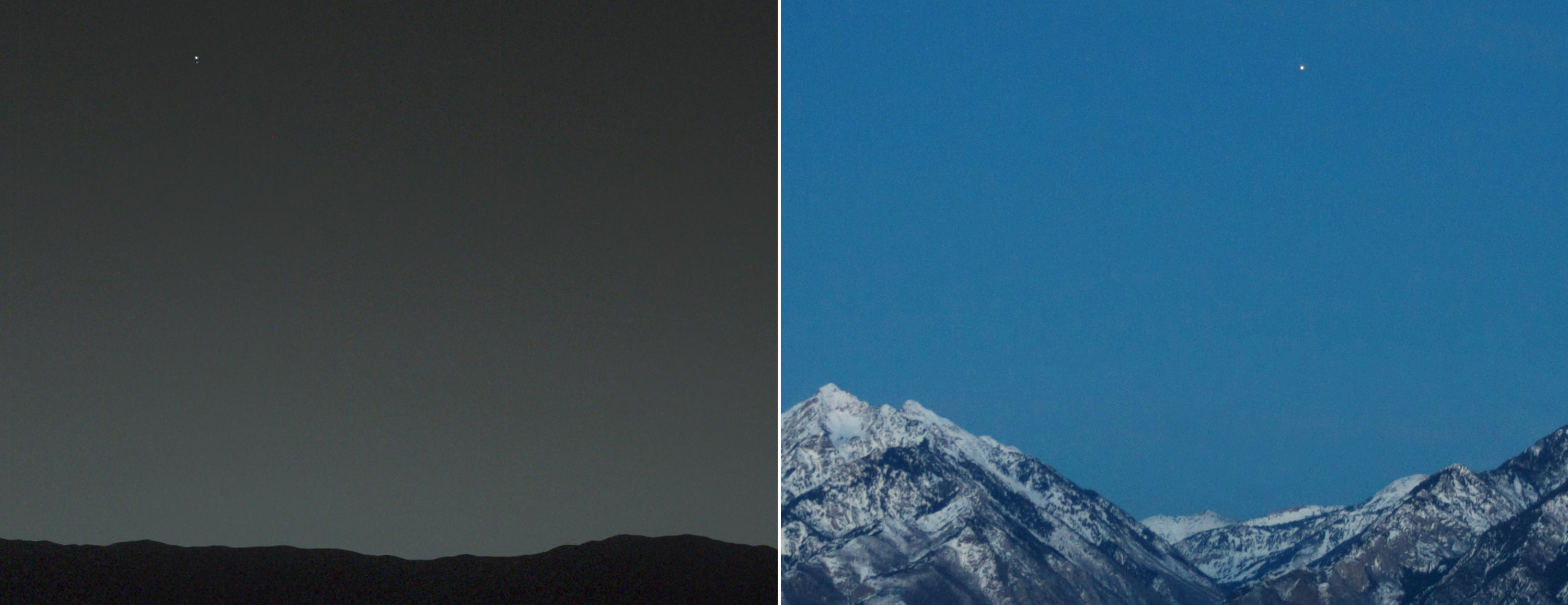
Image of the Day… Earth Seen From Mars & Mars Seen From Earth !!!


View larger. | Via ridingwithrobots.org.

Click on the picture for a larger view. To learn more about viewing Earth in Mars’ sky, see the postCuriosity rover sees Earth and moon from Mars. To learn more about viewing Mars in Earth’s sky, see EarthSky’s February 2014 guide to the five visible planets.

Source::::Earth sky news site

Natarajan


Dead Sea …Few Live Facts about This Unique Place in Earth !!!


The Dead Sea, also known as the Salt Sea, is a salt lake bordering Jordan to the east and Israel and the West Bank to the west. It’s a hypersaline lake that is truly one of Earth’s unique places. Not only is it the saltiest body of water in the world, but it is also the lowest place on the entire globe, and one of the only bodies of water you can freely float in!

Here are 10 amazing facts about this unique place, ……


facts about the dead sea
1. The surface and shores of the Dead Sea are 423 metres (1,388 ft) below sea level, making it Earth’s lowest elevation on land.
facts about the dead sea
2. The Dead Sea is 377 m (1,237 ft) deep, making it the deepest hypersaline lake in the world. A hypersaline lake is a landlocked body of water that contains significant concentrations of sodium chloride or other mineral salts, with saline levels surpassing that of ocean water.
facts about the dead sea
3. With 33.7% salinity, the Dead Sea is one of the world’s saltiest bodies of water. Although Lake Assal (Djibouti), Garabogazköl and some hypersaline lakes of the McMurdo Dry Valleys in Antarctica (such as Don Juan Pond) have reported higher salinities.
facts about the dead sea
4. The Dead Sea’s unusually high salt concentration means that people can easily float in the Dead Sea due to natural buoyancy. In this respect the Dead Sea is similar to the Great Salt Lake in Utah in the United States.
facts about the dead sea
5. The Dead Sea is roughly 8.6 times saltier than the ocean. This salinity makes for a harsh environment in which animals cannot flourish (hence its name). The high salinity prevents macroscopic aquatic organisms such as fish and aquatic plants from living in it, though minuscule quantities of bacteria and microbial fungi are present.
facts about the dead sea
6. The Dead Sea is 67 kilometres (42 mi) long and 18 kilometres (11 mi) wide at its widest point. It lies in the Jordan Rift Valley and its main tributary is the Jordan River.
facts about the dead sea
7. The Dead Sea area has become a major center for health research and treatment for several reasons. The mineral content of the water, the very low content of pollens and other allergens in the atmosphere, the reduced ultraviolet component of solar radiation, and the higher atmospheric pressure at this great depth each have specific health effects.
facts about the dead sea
8. Biblically, the Dead Sea was a place of refuge for King David. It was one of the world’s first health resorts (for Herod the Great), and it has been the supplier of a wide variety of products, from balms for Egyptian mummification to potash for fertilizers.
facts about the dead sea
9. An unusual feature of the Dead Sea is its discharge of asphalt. From deep seeps, the Dead Sea constantly spits up small pebbles and blocks of the black substance. Asphalt coated figurines and bitumen coated Neolithic skulls from archaeological sites have been found. Egyptian mummification processes used asphalt imported from the Dead Sea region.
facts about the dead sea
10. The world’s lowest road, Highway 90, runs along the Israeli and West Bank shores of the Dead Sea at 393 m (1,289 ft) below sea level.
facts about the dead sea
 Source:::::Ba-ba mail site

Natarajan

Seeing Things That are Not There … !!!


Seeing things that aren’t there!!!

Seeing animals in clouds, or a face in the moon, are examples of pareidolia. Look here for photos and to test your own ability to see things that aren’t there.

Maybe you’ve seen the proverbial bunny in a patch of clouds, or a clown’s face in a mud splatter on the side of your car? Seeing recognizable objects or patterns in otherwise random or unrelated objects or patterns is called pareidolia. It’s a form of apophenia, which is a more general term for the human tendency to seek patterns in random information. Everyone experiences it from time to time. Seeing the famous man in the moon is a classic example from astronomy. The ability to experience pareidolia is more developed in some people and less in others. Look at the photos below to learn more and test your own ability to see things that aren’t there.

Aurora borealis by Dave Bachrach.  Used with permission.

Can you see a bird in flight in this photo? It is a a photo of the aurora borealis taken on March 26, 2014 near Fairbanks, Alaska by Dave Bachrach. Used with permission.

Anonymous Swedish photograph from the late nineteenth century via Wikimedia Commons

The “face of Jesus” in this photo is actually a child with a bonnet, and the hair is vegetation in the background. Anonymous Swedish photograph from the late nineteenth century via Wikimedia Commons


Sometimes the ability to see objects in photos, where no such objects exist, has results that are not simply beautiful or intriguing, but downright bizarre. For example, consider the old photo above from an anonymous Swedish photographer of the 19th Century.

In the image above, many viewers will immediately see the image of a bearded man with wavy hair, which could be interpreted as Jesus, near the left center of the image. In fact, however, the face is just a phenomenon of light, shadow and placement. The “face of Jesus” is actually a child with a bonnet, and the hair is vegetation in the background.

You have probably have seen claims of images of Jesus in a piece of toast, or the Madonna in the misshapen form of a gourd. Although intrinsically meaningless, such images are sometimes striking. More often, though, the similarity to known persons, animals or objects is a bit more subtle.

Pareidolia of an Apache head in rocks, in Ebihens, France via Wikimedia Commons.

Erwan Mirabeau shot this rock formation in Ebihens, France. It’s reminiscent of a green haired man, known in the area as an Apache. Photo via Wikimedia Commons.


Pareidolia of dog on closet door by Chad Johns.

Pareidolia of dog on closet door by Chad Johns. Photo used with permission.

What can you see in the folds of this tissue? Many people will not see anything. It depends, in part, on the innate ability to see patterns, and in part on the natural inclinations and interests of the viewer. In some cases the image will immediately pop out, while for some folks it will come after a little close examination, and others may not be able to see it at all.

What can you see in the folds of this tissue? Many people will not see anything. It depends, in part, on the innate ability to see patterns, and in part on the natural inclinations and interests of the viewer. In some cases the image will immediately pop out, while for some folks it will come after a little close examination, and others may not be able to see it at all.

Here's a close-up.  Do you see the head of a Dachshund?  Don’t worry if you cannot, but for many the ears, eyes and snout will seem obvious.

Here’s a close-up. Do you see the head of a Dachshund?  Don’t worry if you cannot, but for many the ears, eyes and snout will seem obvious.


To a certain extent, the definition of pareidolia can be used to describe how the ancients connected the dots and came up with the patterns we know as constellations. It does not take a great deal of imagination to see a lion in Leo, a scorpion in Scorpius, or a mighty hunter in Orion. To be honest, many other constellations, such as Cancer the Crab or Capricornus the Sea Goat, stretch the pattern recognition idea a bit far, making the naming process more one of contrivance than of pareidolia.

Staying in the realm of astronomy for a bit, many have seen a face or a rabbit in the moon or any of a variety of other figures on the face of the moon for ages. Nowadays, technology has given us close-ups of other planets that serve as fodder for the pareidolia monster.

Here is the so-called

Here is the famous “face on Mars” as originally captured in a 1976 image from the Viking 1 orbiter. Click here to see how subsequent spacecraft revealed the “face” to be simply a play of light and shadows.

Image barchans Mars Global Surveyor

Glass tunnels or “ice worms” on Mars? In fact, these martian canyons contain crescent-shaped sand dunes, which are formed when the wind is predominantly from one direction. This image is an enlargement of a small section of a larger image, #M0400291, taken by NASA’s Mars Global Surveyor.


For example, some self-appointed experts have stated that the image above – which is an enlargement of a small section of image M0400291 from the Mars Global Surveyor – shows large glass tunnels on Mars, or even evidence for ice worms on the Red Planet. What the image above really shows is a convergence of deep canyons on the planet Mars. At the bottom of these canyons are crescent-shaped sand dunes, which are formed when the wind is predominantly from one direction. Such dunes are common in desert areas of the Earth and are known as barchans.

Atomic cloud over Nagasaki - August 9, 1945 - from Koyagi-jima by Hiromichi Matsuda via Wikimedia Commons

People have found many imaginary images in this photo of the atomic cloud over Nagasaki – August 9, 1945 – from Koyagi-jima by Hiromichi Matsuda. Photo via Wikimedia Commons


Although deliberately manipulated (“photoshopped”) photos are very easily made today and cannot be ruled out for many pareidolia images, hoaxes are considerably less likely in older images. Consider the old Swedish image above in which the “face” of Jesus is actually a baby with a bonnet. Or consider the image above from the Nagasaki Atomic Bomb Museum, shot by Hiromichi Matsuda, showing the mushroom cloud over the city just 20 minutes after detonation.

With just a casual glance, most people will notice nothing in the bomb cloud other than the expected shape. But for someone with an eye for pareidolic images, several things can pop out. Let’s consider just one, that the head of an apparently sleeping woman with 1940s-style hair, facing the right from just left of the top center area of the cloud.

Go ahead, try to see the lady’s face before you look farther down. Truth be told, there are a number of things to be seen in this image, but the point to make is that these are all purely coincidental. There is absolutely no reason to believe that any of the images have any meaning whatsoever except the meaning that an active and creative mind may give them. They are not symbols or signs from the spirit world. They are not warnings about the future or indications of the waywardness of our ways. They are simply the result of  coincidental patterns that the human mind chooses to interpret in particular ways.

It goes without saying, I hope, that this just happens to be a photo from the tragic bombing of Nagasaki, but has nothing else to do with Nagasaki or even with the atomic bomb. Similar patterns can be found in many many other images and natural formations.

In some ways, the pareidolic images we discover tend to indicate things about which we are most interested, whether they be people, puppies or planes. Finding such “embedded” images can fun and interesting, almost a hobby for some. But for some they can also fuel obsessiveness and paranoia. Enjoy finding your own pareidolic images, but keep in mind that what you are seeing is not really there, but in your mind.

Click image to expand.

Now, if you did not successfully see the lady in the Nagasaki image, click on the image above for a larger annotated image. (Can you also see the puppy in her hair?)

Bottom line: Seeing recognizable objects or phenomena in otherwise random or unrelated objects or patterns is called pareidolia. It’s a form of apophenia, which is a more general terms for seeing apparently meaningful connections between unrelated patterns, data or phenomena. Everyone experiences it from time to time. Nearly everyone occasionally sees animal or human shapes in clouds, for examlpe. This post contains photos that let you test your ability to see things that aren’t there.

Source:::: Larry Sessions in HUMAN WORLD BLOG … EARTH SKY NEWS SITE

Natarajan

A Giant Telescope on the Top of Mountain !!!


Eso1225c
Artist’s rendering of the future telescope which will be the ‘largest eye on the sky.’

On June 19, the top of Cerro Armazones, a 10,000-foot mountain in northern Chile’s Atacama Desert, was blown up to make way for

European Extremely Large Telescope, or E-ELT.


The telescope’s main mirror will measure almost 130 feet, making it the biggest optical/near-infrared telescope in the world, according to the

European Space Agency (ESO). In a statement, officials called it the “world’s biggest eye on the sky.”


Screen Shot 2014 06 19 at 11.08.38 AM

The location of Cerro Armazones, where the European Extremely Large Telescope will be built.


The mission of the telescope will be to “tackle some of the biggest scientific challenges of our time,” ESO said. It will do this by “allowing detailed studies of subjects including planets around other stars, the first objects in the Universe, super-massive black holes, and the nature and distribution of the dark matter and dark energy which dominate the Universe.”

The first use of the telescope is set to take place in the early 2020s.


Source::: : Business Insider …AU

NATARAJAN


Have a Look at The Customozied Jumbo Jets of Billionaires !!!


Boeing 747 8 Interior

Boeing

Boeing 747-8 custom interior with 4786 sq. ft. of space.


The $65 million Gulfstream G650 may be the pinnacle of the private jet market, but it just doesn’t do the job for billionaires who prefer to fly with more than a dozen or so passengers.


For that, the uber wealthy turn to Airbus and Boeing, who are more than happy to customize their jets — even the widebodies that can carry hundreds of people — for private use.

Commercial jet manufacturers have been replacing the rows of economy seats in their aircraft with sofas and entertainment centers since the late 1990s. A recent influx of billionaires from Russia, the Middle East, and China has led to a new focus on this part of the business. Since opening the private jet branch in 1997, Airbus has sold over 170 aircraft. Boeing got started in 1996, and has delivered on 195 of 217 total orders received.

The main reason to go with an Airbus A380 or a Boeing 747 over a puny Gulfstream or Bombardier? According a “Billionaires Study” commissioned by Airbus, the wealthiest among us like to travel with family members and business associates. (This, apparently, is particularly true for Middle Eastern oil magnates.)

That’s not to say outfitting a jumbo jet for personal use is always a rational economic decision. For some, the bigger and more luxurious the plane, the better. That’s why Airbus and Boeing don’t just sell their planes, they offer a wide variety of customization options to give customers exactly what they want.

So how much does a personalized widebody plane cost? The manufacturers don’t exactly publish price lists, but we’ve seen figures between $80 million for a Boeing 737, $280 million for a Boeing 747-8, and up to $300 million for an A380.

Here’s a look at what’s available for billionaires ready to spend that big a pile of dough:


Boeing 787 Interior

Boeing

Boeing 787 interior ready for conversion.


ACJ319_Cabin_Tyrolean_Jet_Services_Airbus1

Airbus

Airbus A319 Corporate Jet.


Boeing Deer Jet

Deer Jet

Deer Jet owned Boeing with bedroom suite and shower.


Boeing Jet Interior

Boeing

Boeing interior with shower and king-sized bed.


Boeing 747 8 Sleeping Space

Boeing

Boeing 747-8 with sleeping space for 8.


ACJ318_Airbus_Tyrolean_Jet_Services_cabin1

Airbus

Airbus A318 Corporate Jet.


Airbus Phoenix_cabin_concept_Majhong_table_arrangement1

Airbus

Airbus Asian market interior with mahjong table.


Boeing Jet Shower

Boeing

Boeing interior shower.


ACJ319_Acropolis_Aviation_on_VVIP _angled_view_1

Airbus

Airbus A319 custom interior.

Read more: http://www.wired.com/2014/06/the-jumbo-jets-boeing-and-airbus-turn-into-posh-private-planes/#ixzz352DvEjqr

Source:::: Business Insider Select.au

Natarajan


Image of the Day…


“Fireflies flew up into the sky & became stars OR stars descend down onto the tree to become fireflies… ” 🙂

Fireflies and stars, by Abhijit Juvekar.

Our friend Abhijit Juvekar wrote:

A jungle full of fireflies, few trees like this were really filled up with hundreds of fireflies in small area. They displayed a synchronized light pattern a mating time where males put up the light show to attract females. The moonlit forest added the fill light while the stars in background completed the frame to witness this most dramatic scene.

Place – Malshej ghat, India.

Source:::: earth sky news site

Natarajan

Tallest Tower Ever …. @ China …An Eco Friendly Construction Concept…


While the architectures of yesteryear are often blamed for urban decay, today’s buildings could be responsible for its renewal.

Jutting from the ground like two giant stalagmites, the latest design from UK architecture firm Chetwoods is going to blow the world’s tallest building, the Burj Khalifa, out of the water—and save the world while it’s at it. Standing a full kilometer (3,281 ft) tall, the structure might be the key to solving China’s catastrophic pollution problem on every level. Bestowing upon the project the hopeful moniker, ‘The Phoenix Towers,’ Chetwoods hopes to resurrect the Chinese city of Wutan from its ashes.

By using a complex mechanical system to simultaneously filter Wuhan’s air and water, collect solar, wind, and hydrogen power, provide produce from a massive vertical garden, harvest rainwater, house restaurants and businesses, boil biomass, and generally aim to solve every major ecological crisis faced by central China’s “Fourth Pole,” the Phoenix Towers just might live up to their name. “It doesn’t just stand there and become an iconic symbol of Wuhan, it has to do a job,” founder Laurie Chetwood said in an interview with Dezeen. “We’ve applied as many environmental ideas as we possibly could to justify the shape and the size of them.”


Aside from their super-sustainable abilities, one of the coolest things about the Phoenix Towers is that Chetwoods designed them to resonate with local religion and philosophy. The towers link Western technology and architecture to the Chinese myths of the phoenix; two towers represent the dual gender the legendary bird has in Chinese iconography, and the spirit of rebirth is spread throughout all eight hectares of the the half-mile high towers. With these spiritual considerations in mind, the firm makes a peace offering to the the somewhat rocky history of Western insensitivity when it comes to development in China. The towers also aim to attract eco-tourism, with profit margins further extending that olive branch.


While the architectures of yesteryear are often blamed for urban decay, today’s buildings could be responsible for its renewal.

Jutting from the ground like two giant stalagmites, the latest design from UK architecture firm Chetwoods is going to blow the world’s tallest building, the Burj Khalifa, out of the water—and save the world while it’s at it. Standing a full kilometer (3,281 ft) tall, the structure might be the key to solving China’s catastrophic pollution problem on every level. Bestowing upon the project the hopeful moniker, ‘The Phoenix Towers,’ Chetwoods hopes to resurrect the Chinese city of Wutan from its ashes.

By using a complex mechanical system to simultaneously filter Wuhan’s air and water, collect solar, wind, and hydrogen power, provide produce from a massive vertical garden, harvest rainwater, house restaurants and businesses, boil biomass, and generally aim to solve every major ecological crisis faced by central China’s “Fourth Pole,” the Phoenix Towers just might live up to their name. “It doesn’t just stand there and become an iconic symbol of Wuhan, it has to do a job,” founder Laurie Chetwood said in an interview with Dezeen. “We’ve applied as many environmental ideas as we possibly could to justify the shape and the size of them.”


Aside from their super-sustainable abilities, one of the coolest things about the Phoenix Towers is that Chetwoods designed them to resonate with local religion and philosophy. The towers link Western technology and architecture to the Chinese myths of the phoenix; two towers represent the dual gender the legendary bird has in Chinese iconography, and the spirit of rebirth is spread throughout all eight hectares of the the half-mile high towers. With these spiritual considerations in mind, the firm makes a peace offering to the the somewhat rocky history of Western insensitivity when it comes to development in China. The towers also aim to attract eco-tourism, with profit margins further extending that olive branch.


While the architectures of yesteryear are often blamed for urban decay, today’s buildings could be responsible for its renewal.

Jutting from the ground like two giant stalagmites, the latest design from UK architecture firm Chetwoods is going to blow the world’s tallest building, the Burj Khalifa, out of the water—and save the world while it’s at it. Standing a full kilometer (3,281 ft) tall, the structure might be the key to solving China’s catastrophic pollution problem on every level. Bestowing upon the project the hopeful moniker, ‘The Phoenix Towers,’ Chetwoods hopes to resurrect the Chinese city of Wutan from its ashes.

By using a complex mechanical system to simultaneously filter Wuhan’s air and water, collect solar, wind, and hydrogen power, provide produce from a massive vertical garden, harvest rainwater, house restaurants and businesses, boil biomass, and generally aim to solve every major ecological crisis faced by central China’s “Fourth Pole,” the Phoenix Towers just might live up to their name. “It doesn’t just stand there and become an iconic symbol of Wuhan, it has to do a job,” founder Laurie Chetwood said in an interview with Dezeen. “We’ve applied as many environmental ideas as we possibly could to justify the shape and the size of them.”


Aside from their super-sustainable abilities, one of the coolest things about the Phoenix Towers is that Chetwoods designed them to resonate with local religion and philosophy. The towers link Western technology and architecture to the Chinese myths of the phoenix; two towers represent the dual gender the legendary bird has in Chinese iconography, and the spirit of rebirth is spread throughout all eight hectares of the the half-mile high towers. With these spiritual considerations in mind, the firm makes a peace offering to the the somewhat rocky history of Western insensitivity when it comes to development in China. The towers also aim to attract eco-tourism, with profit margins further extending that olive branch.


Over the next three years, the Phoenix Towers will move from concept into construction, at which point the city of Wuhan will be ready to retake flight


source::::businessinsider select.au

Natarajan..


Image of the Day…


Hatta Dam, day to night

A composite image created from two photos – one day and one night – of Hatta Dam in the United Arab Emirates.

Hatta Dam in the UAE, by Justin Ng.

Hatta is a sheikhdom in the Hajjar mountains of the United Arab Emirates. It’s about 115 kilometers (71 miles) east of the city of Dubai and is a popular vacation place for Dubai residents. Justin Ng of Singapore visited there in May, 2014, when he captured two photos – a day image and a night image – to create this interesting composite. He wrote:

The image is a result of blending a day image and a night image together to present the beauty of Hatta Dam during the day and night in a single photograph.

Read more about how he did it at Justinngphotos.com

Justin Ng used these two photos to create the composite of Hatta Dam, day to night, on the page above.