” Serene Saturn….”


Saturn

From a distance Saturn seems to exude an aura of serenity and peace.

In spite of this appearance, Saturn is an active and dynamic world.  Its atmosphere is a fast-moving and turbulent place with wind speeds in excess of 1,100 miles per hour (1,800 km per hour) in places. The lack of a solid surface to create drag means that there are fewer features to slow down the wind than on a planet like Earth.

Mimas, to the upper-right of Saturn, has been brightened by a factor of 2 for visibility.

In this view, Cassini was at a subspacecraft latitude of 19 degrees North. The image was taken with the Cassini spacecraft wide-angle camera on Feb. 4, 2015 using a spectral filter centered at 752 nanometers, in the near-infrared portion of the spectrum.

The view was obtained at a distance of approximately 1.6 million miles (2.5 million kilometers) from Saturn. Image scale is 96 miles (150 kilometers) per pixel.

The Cassini mission is a cooperative project of NASA, ESA (the European Space Agency) and the Italian Space Agency. The Jet Propulsion Laboratory, a division of the California Institute of Technology in Pasadena, manages the mission for NASA’s Science Mission Directorate, Washington. The Cassini orbiter and its two onboard cameras were designed, developed and assembled at JPL. The imaging operations center is based at the Space Science Institute in Boulder, Colorado.

For more information about the Cassini-Huygens mission visit http://www.nasa.gov/cassini and http://saturn.jpl.nasa.gov. The Cassini imaging team homepage is at http://ciclops.org.

Credit: NASA/JPL-Caltech/Space Science Institute

Source….www.nasa.gov

Natarajan

Image of the Day….Solar Arrays on the International Space Station…

Expedition 43 Flight Engineer Samantha Cristoforetti of the European Space Agency (ESA) photographed the giant solar arrays on the International Space Station on Feb. 12, 2015.

The space station’s solar arrays contain a total of 262,400 solar cells and cover an area of about 27,000 square feet (2,500 square meters) — more than half the area of a football field. A solar array’s wingspan of 240 feet (73 meters) is longer than a Boeing 777’s wingspan, which is 212 feet (65 meters). Altogether, the four sets of arrays can generate 84 to 120 kilowatts of electricity — enough to provide power to more than 40 homes. The solar arrays produce more power than the station needs at one time for station systems and experiments. When the station is in sunlight, about 60 percent of the electricity that the solar arrays generate is used to charge the station’s batteries. At times, some or all of the solar arrays are in the shadow of Earth or the shadow of part of the station. This means that those arrays are not collecting sunlight. The batteries power the station when it is not in the sun.

Image Credit: ESA/NASA 

Source………www.nasa.gov

Natarajan

Image of the Day….A Fantastic View From ISS.. ” !!!

European Space Agency astronaut Samantha Cristoforetti took this photograph from the International Space Station and posted it to social media on Jan. 30, 2015. Cristoforetti wrote, “A spectacular flyover of the Gulf of Aden and the Horn of Africa. #HelloEarth”

Image Credit: NASA/ESA/Samantha Cristoforetti 

SOURCE:::: www. nasa.gov.

Natarajan

America to Australia in 6 Hours !!!


From America to Australia in Under 6 Hours

Just 100 years ago, getting from America to Europe was a voyage that took several days by ocean liners. With the invention of airplanes, that travel time was significantly shortened to under 24 hours. At the apex of the era of transatlantic flight, the Concorde was able to fly 100 passengers at mach 2.0 speeds from New York to London in just over 3.5 hours.

Now, the European Space Agency (ESA) just greenlighted the next stage of modern transportation – the hypersonic flight. The ESA has approved a new round of funding to project LAPCAT (Long-Term Advanced Propulsion Concepts and Technologies).
Hypersonic Plane

Ignoring its funny name, the new plane will fly at mach 5.0 speeds (that’s five times the speed of sound!), using liquid hydrogen engines. The planes will be able to travel from England to Australia in four hours, carry 300 passengers and even fly to space in just 15 minutes.

The new kind of engine is being developed by the British company Reaction Engines, who is said to invest over 60 million GBP in the development, and are going to start builing a full-scale prototype engine.

Hypersonic Plane

Current jet engines require that airplanes carry liquid oxygen as a coolant because in speeds beyond mach 3.0 the engines cannot use external oxygen for cooling. The new type of engine can use external oxygen freely, allowing it to cool down its engines from over 1,000°c (1,832°f) to -150°c (-328°f) in a fraction of a second.
Hypersonic Plane

Experts are hailing this development as the biggest advancement in aviation since the invention of the jet engine. The cost of a single plane is estimated to be a whopping $1.1 Billion and will have no windows.


Hypersonic passenger plane LAPCAT A2 explainer


The Long-term Advanced Propulsion Concept and Technologies (LAPCAT) was developed by British company Reaction Engines Limited (REL) and funded by the European Space Agency (ESA). The 139-meter long hypersonic plane has four liquid hydrogen-powered Synergistic Air-Breathing Rocket Engine (SABRE) engines and can carry up to 300 passengers.
It can travel up to 6,100 kilometer per hour – five times faster than the Airbus A380. By using liquid hydrogen as fuel instead of fossil fuel it is also greener and would only produce water vapor and nitrous oxide instead of carbon emissions. SOURCE: Research and Technology Agency, Reaction Engines Limited (REL), Transport Research & Innovation Portal


SOURCE:::: http://www.ba-bamail.com and YOU TUBE

Natarajan

Rosetta’s Lander Philae Touches Down on Comet…

Rosetta’s Lander Philae Touches Down on Comet

Early this morning, the European Space Agency’s Rosetta spacecraft deployed its comet lander, “Philae.” At 11:03 a.m. EST, ESA confirmed that signals were received from Philae on the surface of comet 67P/Churyumov-Gerasimenko. It is the first time in history that a spacecraft has landed on a comet. Rosetta is an international mission led by the ESA, with instruments provided by its member states, and additional support and instruments provided by NASA.
> LIVE: ESA’s Rosetta Coverage


SOURCE:::www.nasa.gov

Natarajan

” No Need for India to Knock at the Doors of Elite Space Club …” !!!

The ‘New York Times’ Publishes Racist Comic About India’s Space

Mission

Last week, India became the first Asian nation to reach Mars, and the first in the world to do so on its first attempt.

The spacecraft called Mars Orbiter Mission (MOM) in English and “Mangalyaan” or “mars craft” in Hindi was launched in November and reached the orbit on Wednesday, to much jubilation from the public.

India’s first interplanetary mission is all the more creditable because, at $72 million, Mangalyaan cost just a fraction of NASA’s $670 million Maven, and $2 billion Curiosity Rover. It also cost less than to produce the film Gravity, and at Rs.7 or 11 cents, per kilometer, cost less than the per-kilometer cost of commuting by autorickshaw in most Indian cities.

So yesterday’s New York Times’ comic by Heng, titled “India’s budget mission to Mars” seems in poor taste.

2014-09-29-racistcomic.jpg

The comic depicts a poor Indian farmer in traditional garb, accompanied by a bored-looking cow, eagerly knocking on the door of “Elite Space Club”. The two people in the elite space club drinking wine and reading about India’s mission in the papers look perturbed and hesitant to open the door. It is also worth noting that the members of the elite space club are male, white, elderly and look wealthy. Whether meant to be funny or ironic, the racial, national and classist stereotyping is apparent.

In reaching Mars, the Indian Space Research Organization (ISRO) joins the ranks of Soviet space program, NASA and European Space Agency. It not only did so on a budget, but also battling “brain drain“. It’s a commonly lamented problem that many of the country’s brightest scientists and engineers end up working internationally, and tend to shy away from research in India, especially an area like space research, because it’s not as lucrative.

The comic strip comes at the time of Indian Prime Minister, Narendra Modi’s maiden visit to the United States. Addressing a 20,000 strong crowd at Manhattan’s iconic Madison Square Garden yesterday, he emphasized India’s new role on the world stage and its growing economic clout. “When people ask if we still play with snakes in our country, I tell them that now we play with the mouse,” Mr Modi said, drawing attention to the changing stereotype of India from a nation of snake charmers to one of technical prowess.

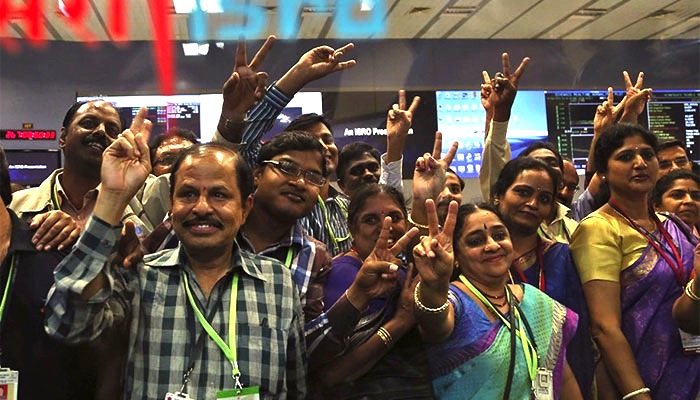
In case the Times is wondering what interplanetary-mission-heading Indian scientists look like then here you go, this is what they look like:

2014-09-29-isroscientists.jpg

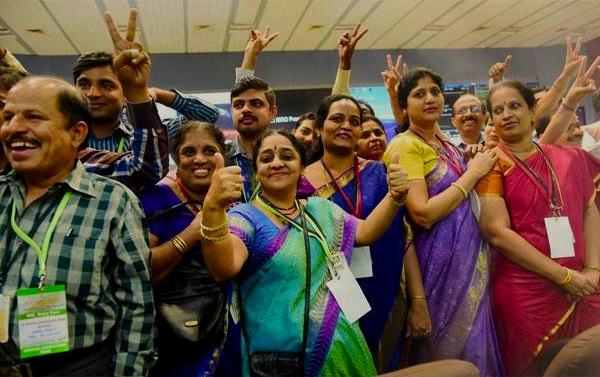
And this:

2014-09-29-isro2.jpg

And this:

2014-09-29-isro3.jpg

The male engineers are wearing Western gear, while some of the female engineers are rocking traditional silk saris, the kind usually worn on special occasions, and jasmine flowers in their hair. On regular days, they work in full suits. There are no farm animals in sight at the ISRO office. And they certainly don’t look desperate for membership into some secret elite club. In fact, their jubilance says it all.

See, there are lots of socially and economically elite people in the world — being elite is like winning the lottery. But only a handful of human beings in history can claim to have sent a spaceship to another planet. That is brilliance and merit. That is actualizing human potential and literally moving humanity forward — like inventing the wheel, or, you know, sending a spaceship to Mars. One doesn’t have to be a rocket scientist to understand that.

SOURCE::::   IN  http://www.huffingtonpost.com/  

NATARAJAN