” How to Take Astrophotos with Your Smartphone …” ?

Got a smartphone and a telescope?

It’s a sight now common at many star parties. Frequently, you see folks roaming through the darkness, illuminated smartphone aimed skyward. Certainly, the wealth of free planetarium apps has done lots to kindle a renewed interest in the night sky.

Inevitably, after peering through the eyepiece of a telescope, the question then arises:

“Can I get a picture of that with my phone?”

The short answer is yes, with a little skill and patience.

Now simply aiming a camera at the eyepiece of a telescope — known as afocal astrophotography — and shooting without removing the camera lens and physically coupling it to the telescope is a tricky balancing act. Back in the olden days, the Moon and perhaps the brighter planets were the only bright target within bounds of afocal film photographers, and only then after a lengthy set of estimations to hit the correct focal length.

The advent of digital cameras and ‘live preview’ means that you can now simply aim, shoot, and throw away or delete anything off center or out of focus. Digital “film” is cheap, and most folks simply use trial and error to get the ‘keepers’. The Moon is an especially bright and easy target for beginners to practice on.

moon with iphone

Of course, your typical smartphone, like a webcam, has an imaging chip much smaller than a DSLR. This is why astrophotographers are often tempted to take out a second mortgage (“we don’t really need that second car, do we?” is a common spousal refrain) in pursuit of excellence. Another drawback is that through a smartphone, a planet may look like an overexposed blob.

A simple but effective way to get around this is to affix a light reducing filter to the eyepiece. In fact, I’ve used a variable polarizer during live broadcasts of the Virtual Star Party to great effect. And as with webcam imaging, smartphone astrophotographers now often use automated stacking programs to clean up images and tease out detail. Being an old timer, my faves are still K3CCD Tools and Registax, though many young guns out there now use DeepSkyStacker as well.
telescope

Now, I’ll admit, I’m an “Android guy,” and I have put most of my efforts over the years into planetary imaging with a homemade webcam. We therefore sought out in-the-field expertise from someone on the forefront of iPhone astrophotography.

Andrew Symes has been taking images of the solar system and beyond with his iPhone coupled to his Celestron NexStar 8″ SE telescope for years. He also has one of the few handles on Twitter that we’re envious of, @FailedProtostar. He also ventures out into the chilly nights frequent to his native of Ottawa, Canada to practice his craft, as he observes in temperatures that would drop a Tauntaun.

We caught up with Andrew recently to ask him about some tips of the trade.

sun iphone

Universe Today: I know from doing webcam photography that acquiring, centering and focusing are often more than half the battle. Any tips for accomplishing these?

Andrew: Acquiring, centering, and focusing the objects I’m photographing is definitely the big challenge! To speed and simplify the process, I have a dedicated eyepiece that I use in association with my phone and adapter. Before even heading outside, I attach the adapter to this eyepiece, insert my phone, and hold the unit up to a light source to see if the camera lens is properly aligned with the eyepiece.

It usually takes a bit of fiddling to get things set properly because if the adapter and eyepiece are not perfectly aligned, nothing will show up on the camera screen. It’s better to get that process out of the way in a lit environment than outside in the dark.

I then set that unit aside, and use a separate “adapter-less” zoom eyepiece to locate and center the object in the telescope. Once I’ve acquired the object and am successfully tracking it, I remove my zoom eyepiece and drop in the eyepiece/adapter/phone combo. At that point, the object is usually visible on screen but out of focus since the focus required for the iPhone is different from what works for my eyes!

To ensure proper focus, I display the object on my phone’s screen using a live video app called FiLMiC Pro and adjust the focus until it is sharp. I use that app because it has a digital zoom function that lets me get a closer look at the object than the standard iPhone video camera view. Only once I’m confident that I’ve achieved good focus and am tracking the object properly, will I start to record video or shoot individual frames.

Universe Today: A question I always like to ask everyone… what was your biggest mistake? Are there any pitfalls to avoid?

Andrew: There are a few pitfalls to avoid when doing iPhone astrophotography. In the past, I would attach the adapter outside while the eyepiece was in the telescope but this caused a number of problems. Often, I would accidentally bump the object out of view while attaching and adjusting the adapter and have to align everything all over again.

The weather is also often cold here, and it’s VERY difficult to attach the adapter properly with gloves on, so I would either get really cold hands or spend a lot of unnecessary time fumbling with the adapter with gloved hands. For those reasons, I now prepare the eyepiece/adapter/phone unit indoors in advance as described above.

I also now make sure that my iPhone is fully charged before heading outdoors as I’ve found that the iPhone battery drains very quickly when the camera is running constantly — especially in cold weather. Even with an almost-full battery, there are times here in winter when the phone will simply shut down due to the low temperature so I make sure to only start capturing photos/videos once I’m completely confident in my setup.

Universe Today: You’re really pushing the envelope by doing deep sky astro-pics with an iPhone … anything else that you’re experimenting with or working on?

Andrew: My main focus is definitely still on iPhone astrophotography because I like the quick and “light” setup. I don’t need to bring a laptop outside and don’t need equipment that I wouldn’t normally have on me anyway (other than the adapter itself.)

So, I want to keep pushing the envelope with what I can capture using the phone and my goal is now is to see how far I can go with deep-sky objects. I’d really like to add the Ring and Dumbbell Nebulae to my portfolio, for example, and see if it’s possible to grab even fainter ones.

There are also some non-deep sky targets I’d like to try. I haven’t been successful at capturing a telescopic photo of the ISS, and would love to see if I can catch it transiting the Sun or Moon with my phone. I also still need to capture Uranus and Neptune to round out a solar system collage I put together in 2014!

Lastly, I’m continually experimenting with photo apps to see which are best at capturing and/or processing telescopic images, and have just started using both an iPhone 4S and iPhone 6 to take photos and video. Surprisingly, I still prefer the 4S for planetary imaging as I haven’t been able to properly capture the true colors of planets with the iPhone 6 yet.

The 6 has better camera resolution but seems to be adjusting the exposure of small, faint objects like planets differently than the 4S, so I need to change my routine and techniques to compensate. The methods I’ve become accustomed to using with the 4S don’t seem to translate directly to the 6 so I have some learning yet to do!


messier 13Andrew Symes

Amazing stuff, for sure. And to think, we were all gas-hypering film and using absurdly long focal lengths to get blurry planetary images just a few decades ago!

-Check out more of Andrew”s images, as well as read more about how he does it.


Read more: http://www.universetoday.com/118527/iphone-astrophotography-how-to-take-amazing-images-of-the-sky-with-your-smartphone-tonight/#ixzz3Qdd7YglB

SOURCE::::

Natarajan


Beagle 2 Spacecraft… Lost in 2003 … Found in Mars in 2015 !!!

Long-Lost Spacecraft Spotted on Mars

Long-Lost Spacecraft Spotted on Mars

IT turns out the Beagle has landed after all — but it never called home.

The gone-but-not-forgotten spacecraft Beagle-2 went AWOL on Christmas Day, 2003, when it was supposed to land on Mars and start transmitting data back to Earth.

Instead, the British-built craft went dark. After several months, it was declared lost — presumed to have been destroyed during its approach or while trying to land on the red planet.

On Friday, more than 11 years later, European Space Agency officials reported that the Beagle-2 had been finally found — thanks to extensive detective work based on new photos taken by the high-resolution camera on NASA’s Mars Reconnaissance Orbiter.

DISCOVERY: Have scientists solved the Beagle 2 mystery?

The photos show the craft landed safely on Mars and partially deployed — but was unable to fully deploy and start communicating.

Still, it was a vindication of sorts for space scientists who had wondered for more than a decade about the fate of their pet project, which was designed to search for signs of life on Mars.

Rudolf Schmidt, ESA’s Mars Express project manager at the time, called the finding “excellent news.”

He said not knowing what happened to Beagle-2 had “remained a nagging worry.”

Soon after Beagle-2’s disappearance, NASA landed both Spirit and Opportunity near the Martian equator.

Both sent back troves of images and discoveries, providing the sort of information astronomers had been seeking when the first Mars probes began.

There it is ... This NASA annotated image shows a bright feature interpreted as the Beagl

There it is … This NASA annotated image shows a bright feature interpreted as the Beagle 2 Lander with solar arrays at least partially deployed on the surface of Mars. Pic: AFP PHOTO/NASA Source: AFP

Mars is notoriously hard to reach. In a half-century of launch attempts, more than half of the missions by various countries have failed to get off the ground on Earth or overshot Mars.

Landing on the red planet is particularly treacherous because of the thin atmosphere.

Incoming spacecraft travelling at 19,300kph have only minutes to slow to a stop.

The Martian terrain is also full of obstacles — boulders, cracks and cliffs — and a wrong move can doom a spacecraft.

The Mars Reconnaissance Orbiter, which has circled the planet since 2006, has periodically searched for spacecraft missing in action.

Still missing is NASA’s Mars Polar Lander, which lost contact during its arrival at the south pole in 1999.

Officials said careful analysis of the high-resolution photos showed the Beagle-2 had landed within its expected landing area in a basin close to the Martian equator. Signs of key entry and descent components were also spotted.

Identifying the craft was made more difficult by its small size — it is just over 1.8 metres wide with its solar panels unfurled.

 An undated computer generated image made available in London, Sunday June 1 2003 by the the European Space Agency, of the Ma...

Lost in space … A computer generated image of the Mars Express in orbit around Mars. Pic: AP Photo/European Space Agency Source: AP

The 143-pound Beagle-2 was named for the ship that carried naturalist Charles Darwin on his voyage of discovery in the 1830s.

It is shaped like an oversized pocket watch and was designed to descend through the Martian atmosphere, deploy parachutes, and “bounce” to a safe landing on inflatable bags.

Experts who helped identify the lander at the University of Arizona’s Lunar and Planetary Lab said the photographs are “consistent” with only a partial deployment of the Beagle-2 upon landing.

They said a failure to fully deploy would explain why no data or signals from the craft were ever received, since a complete deployment of all of its solar panels would have been needed for successful transmissions.

Alfred McEwen, chief investigator of the project, said the special camera had been used to search for all of the landers that have tried to descend to the surface of Mars.

“This the first time we found one that didn’t send a signal after it landed,” he said.

The Beagle has landed ... A computer-generated image showing the Beagle 2 Probe on surfac

The Beagle has landed … A computer-generated image showing the Beagle 2 Probe on surface of Mars. Pic: AP Photo/European Space Agency Source: AP

“If the landing sequence works correctly, the probe sends a radio signal, and you can use that to pinpoint where it is coming from, even if it broadcasts only very briefly. But in the case of Beagle-2, we didn’t get anything. All we had to go by was the target landing area.”

Experts who worked on the project said the Beagle-2 mission can now be classified a partial success — even if it never provided information about possible life on Mars.

UK Space Agency chief executive David Parker said the discovery of the craft showed its complex landing procedures had worked.

“This finding makes the case that Beagle-2 was more of a success than we previously knew and undoubtedly an important step in Europe’s continuing exploration of Mars,” he said.

The Beagle-2 was launched on ESA’s Mars Express orbiter. It was released from its mother ship on December 19, 2003, and was supposed to land six days later, but no communications with the lander were ever established.

Professor Mark Sims of the University of Leicester, who worked on the project, said the new information shows the team came extremely close to its goal of getting data from Mars, with the deployment failing only in its final stage.

“To be frank, I had all but given up hope of ever knowing what happened to Beagle-2,” he said, admitting he was troubled every Christmas Day by the unknown fate of the craft.

SOURCE:::: http://www.news.com.au

Natarajan

Jan 17 2015

Image of the Day…. Interior View of International Space Station…!!!

This image of the interior view from the International Space Station’s Cupola module was taken on Jan. 4, 2015. The large bay windows allows the Expedition 42 crew to see outside. The Cupola houses one of the space station’s two robotic work stations used by astronauts to manipulate the large robotic arm seen through the right window. The robotic arm, or Canadarm2, was used throughout the construction of the station and is still used to grapple visiting cargo vehicles and assist astronauts during spacewalks. The Cupola is attached to the nadir side of the space station and also gives a full panoramic view of the Earth.

Image Credit: NASA 


SOURCE::: http://www.nasa.gov

Natarajan

Jan 17 2015

Image of the Day…Liftoff of SpaceX Resupply Mission to the International Space Station …

SpaceX’s Falcon 9 rocket lifts off from Space Launch Complex 40 at Cape Canaveral Air Force Station carrying the Dragon resupply spacecraft to the International Space Station. Liftoff was at 4:47 a.m. EST on Saturday, Jan. 10, 2015. The commercial resupply mission will deliver 3,700 pounds of scientific experiments, technology demonstrations and supplies, including critical materials to support 256 science and research investigations on the space station.


SOURCE:::: www. nasa.gov

Natarajan

JAN 11 2015

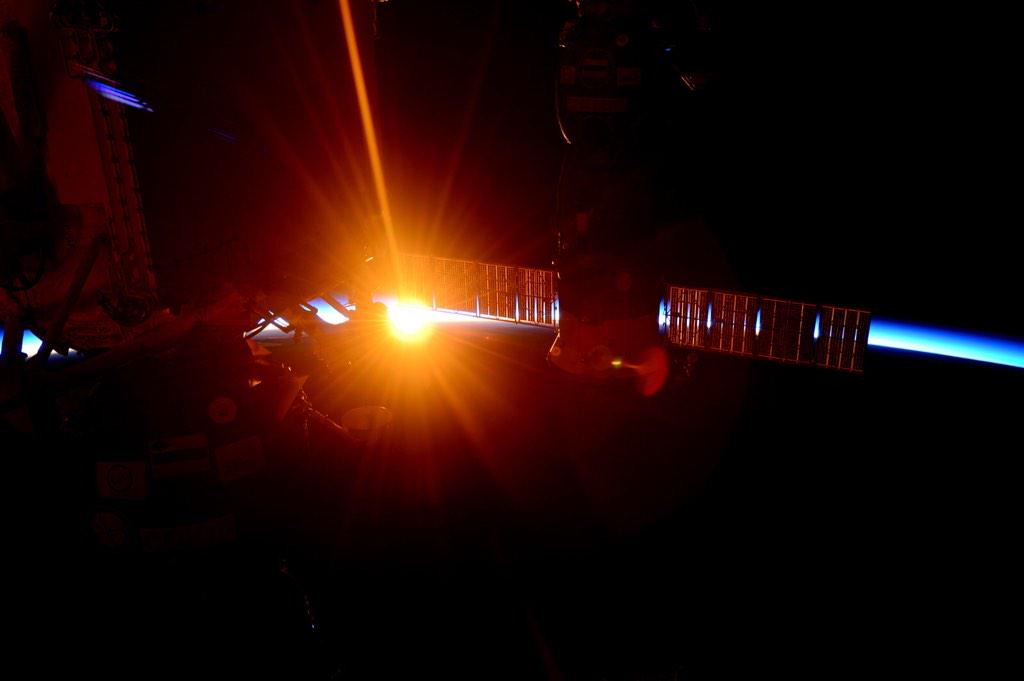
International Space Station Astronaut Wakes up to an Incredible Sight from Space …

View image on Twitter

NASA astronaut Terry W. Virts woke up to an incredible sight from space Thursday morning — one he said was “better than any present” he could ask for.

“Sunrise on Christmas morning- better than any present I could ask for!!!!” tweeted Virts, who is currently aboard the International Space Station.


The image was widely circulated on the social media platform, amassing nearly 3,000 retweets and more than 4,200 favorites.

“So awesome,” one person tweeted back at him.

“Astonishing,” echoed another.

“What a view,’ wrote one more.

SOURCE:::  IN  www.theblaze.com

Natarajan

Christmas Greeting Message From International Space Station Astronauts …

Expedition 42 Commander Barry Wilmore and Flight Engineer Terry Virts send greetings and talk a little about their own Christmas Day in space.

Aboard the International Space Station, Expedition 42 Commander Barry Wilmore and Flight Engineer Terry Virts of NASA offered their thoughts and best wishes to the world for the Christmas holiday during downlink messages from the orbital complex on December 17. Wilmore has been aboard the research lab since late September and will remain in orbit until mid-March 2015. Virts arrived at the station in late November and will stay until mid-May 2015.

SOURCE:::: http://www.earthsky.org

Natarajan

” Suggest a Suitable Name to Space Robot and Win a Prize from NASA …” !!!

Name a Flying Space Robot, and Win a Prize From NASA

NASA needs your help to name a new space robot, and you could win some cash doing it.

NASA officials are asking space fans around the world to help name, and design a mission patch for, a new free-flying robot expected to launch to theInternational Space Station in 2017. The first-place winner of the challenge will receive $1,000. Officials with the space agency put out the call to any interested space fans at New York Comic Con on Saturday.

“We have this new free-flying robot that we’re building,” Jason Crusan, director of NASA’s Advanced Exploration Systems division, told a full house at Comic Con. “We don’t know what to call it. ‘Free-flying robot’ sounds kind of boring and not all that exciting, so we’re asking you to actually name the robot for us.”

Image: Free-flying robotNASA / TOPCODER
A sketch shows how a free-flying robot on the International Space Station could be moved by remote control to get a better video angle.

Second, third and fourth place also come with cash prizes. Second place will win $500, with third and fourth prize taking home $250 each. NASA has teamed up with Topcoder to organize the contest.

If an artist’s depiction of the new space automaton is any indication, the new robot may look like something out of “Star Wars.” In the artist’s concept, the robot could appear as a small, ball-shaped droid that will use fans to move itself around the interior of the International Space Station. It is expected to be able to fly itself, or be operated by remote control.

The new free-flying bot would join a group of other free-fliers already on the station. NASA’s SPHERES robots (the name is short for Synchronized Position Hold, Engage, Reorient, Experimental Satellites) are already used on the orbiting outpost.

To participate in the NASA challenge to name the new robot, space fans need to register with Topcoder. Participants will reach a checkpoint where they will receive feedback on their initial designs on Oct. 22, and the challenge ends on Oct. 27. Officials will announce the winners of the competition on Nov. 2.

To participate in the challenge and learn more about it, go tohttp://www.topcoder.com/challenge-details/30046039/?type=design&noncache=true.

— Miriam Kramer, Space.com

This is a condensed version of a report from Space.com. Read the full report.Follow Miriam Kramer on Twitter and Google+. Follow Space.com on Twitter,Facebook and Google+.

First published October 15th 2014, 5:55 am  in http://www.nbcnews.com

NatarajanBO