
 Today I found out how the Himalayas formed.
The Himalayas, which stretch some 2,900 kilometres between India, Pakistan, China, and Nepal, is the world’s tallest mountain range. In addition to Mount Everest, the world’s tallest mountain by peak elevation standing at 8,848 meters tall, the range also features several other mountain peaks over 8,000 meters. It is the only mountain range to boast mountains over 8,000 meters—the runner-up is a mountain range in South America, whose tallest peak is just 6,962 meters tall.
Millions of years ago, these mountain peaks didn’t exist. The Asian continent was mostly intact, but India was an island floating off the coast of Australia. Around 220 million years ago, around the time that Pangea was breaking apart, India started to move northwards. It travelled some 6,000 kilometres before it finally collided with Asia around 40 to 50 million years ago. Then, part of the Indian landmass began to go beneath the Asian one, moving the Asian landmass up, which resulted in the rise of the Himalayas. It’s thought that India’s coastline was denser and more firmly attached to the seabed, which is why Asia’s softer soil was pushed up rather than the other way around.
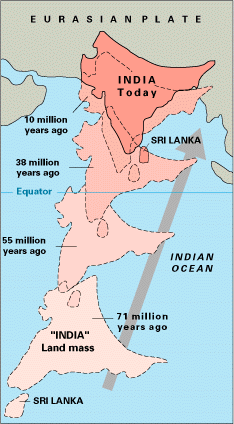 The mountain range grew very rapidly in comparison to most mountain ranges, and it’s actually still growing today. Mount Everest and its fellows actually grow by approximately a net of about a centimetre or so every year. That’s in comparison to the Appalachian Mountains, which developed some 300 million years ago or more, which is actually decreasing in peak elevations as it erodes.
The continued growth in the Himalayas is likely due to the Indian tectonic plate still moving slowly but surely northward. We know the plate is still moving in part because of the frequent earthquakes in the region.
Now, if you do the math, you’d find that if the Himalayas had been growing at the current rate for 40 million years, they should be about 400 km tall! Once the infrastructure was in place, this would have given us a much cheaper way to put things into low Earth orbit and beyond. (For reference, the International Space Station typically orbits at between 300 km to 400 km.)
So what happened? In part, the rate of vertical growth has varied over time, including in favor of more horizontal growth. And, of course, gravity and erosion having limited the mountains’ growth significantly.
India merging into Asia became the accepted theory about how the Himalayas were formed around 1912. That’s when Alfred Wegener, a German meteorologist, came up with the “Theory of Continental Drift” which gave us our first ideas about Pangea, tectonic plates, and the thought that continents were moving away from or closer to each other.
What does the future for the Himalayas look like? Undoubtedly, the mountains will continue to grow, though at the same time eroding too; but the net is expected to continue to grow as the Indian tectonic plate doesn’t look like it’s going to slow down any time soon. That means more earthquakes and, over time, slightly taller mountains to climb.
source::::today i foundout .com
natarajan
With distinctive white rings encircling its eyes, the silvereye looks just like one of the feathered stars of hit video game Angry Birds.
There’s no computer wizardry at work here, though. The silvereye is a real-life eye-opener.
Also known as wax-eye, or white-eye, the diminutive birds can be found in New Zealand, as well as Australia and some of the southwest Pacific Islands, including Fiji.

Eye eye: The bird that looks distinctly cartoon-like

Distinctive: The silvereye has a conspicuous white ring around the eye


Silvereyes stay in pairs all year but in the winter they form big flocks, often flying at night in search of food.
As the breeding season approaches the pairs break away to form individual territories and the first year birds pair up. Prolific breeders, they raise two to three broods per season, with between two to five eggs per brood.
Both adults incubate for about 11 days and the chicks fledge at about 10 days. The young are independent at three weeks and will breed at about nine months old.

Here’s looking at you: The silvereye’s eyes are so bright they almost look painted on

They have recorded that these little birds can live up to 12 years.
The Silvereye was first recorded in New Zealand in 1832, but arrived in greater numbers in 1856.
source:::: TED THORNHILL in mailonline.com.uk
natarajan
Read more: http://www.dailymail.co.uk/news/article-2516875/Thought-Angry-Birds-This-bright-eyed-species-looks-like-flown-straight-famous-video-game.html#ixzz2mO3vnq3l


 Take off with Natarajan