Joke of the Day… ” Chinese Custom…” !!!


A Chinese moves to USA after 50 years of living in Shanghai.

He bought a home on a small piece of land. The friendly American neighbor decides to go across and welcome the new guy. He goes next door but on his way up the drive-way he sees the Chinese man running around his front yard chasing about 10 hens.

Not wanting to interrupt these ‘Chinese customs’, he decides to put the welcome on hold for the day.

Next day he decides to try again, but just as he is about to knock on the front door, he looks through the window and sees the Chinese urinate into a glass and then drink it. Not wanting to interrupt another ‘Chinese custom’, he decides to put the welcome on hold for yet another day.

A day later he decides to give it one last go, but on his way next door, he sees the China-man leading a bull down the drive-way, …pause…., and then put his left ear next to the bull’s butt.

The American bloke can’t handle this, so he goes up to the China-man and says, ‘Jeez Mate, what the hell is it with your Chinese customs? I come over to welcome you to the neighborhood and see you running around the yard after hens. The next day you are pissing in a glass and drinking it, and then today you have your head so close to that bull’s butt, it could just about shit on you.’

The China man is very taken back and says, ‘Sorry sir, you no understand, these no Chinese customs I doing, these American Customs.’

‘What do you mean ‘ says the neighbor, ‘Those aren’t American customs.’

“Yes, they are. Man at travel agent tell me,” replied the China-man  “He says, to become true American, I must learn to
….. chase chicks,
….. get piss drunk,
and
…. listen to bull-shit….!!!

Source:::: unknown… Input from a friend of mine
Natarajan

Image of the Day…. View of Alps from Space …

View of the Alps From Space

Expedition 42 Flight Engineer Samantha Cristoforetti of the European Space Agency (ESA) took this photograph of the Alps from the International Space Station, andposted it to social media on Tuesday, Dec. 23, 2014. She wrote, “I’m biased, but aren’t the Alps from space spectacular? What a foggy day on the Po plane, though! #Italy”

Image Credit: NASA/ESA/Samantha Cristoforetti 

SOURCE:::: http://www.nasa.gov

Natarajan

Joke of the Day…” What did you do in Texas …” ?

One day, a cowboy rode into a Wild, Wild West town. The people in the town love to play jokes on visitors. After tying his horse to the pole outside a bar, the cowboy went in. “A cup of milk please.” he said to the bartender. After drinking, he went out, only to find his horse missing. Knowing that the villagers did it, he went back into the bar and said to everybody,” I am going to have another drink and when I finish it, I want to see my horse outside! Or else, I will have to do what I did in Texas – HERE!” The people were very frightened. When he finished his drink, he went outside and saw his horse. The villagers had put it back. Curious, the bartender asked the cowboy,” What did you do in Texas?”

The Cowboy replied,” Well, I had to walk home !!! 

SOURCE:::: http://www.joke a day.com

Natarajan

Forward this joke to your friends >>


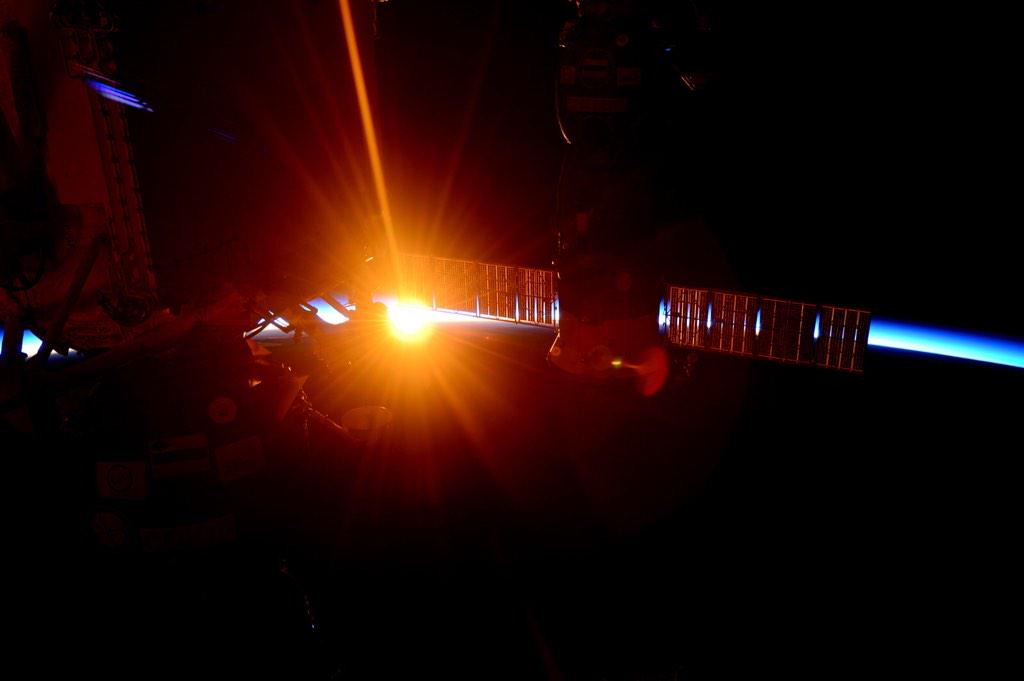
International Space Station Astronaut Wakes up to an Incredible Sight from Space …

View image on Twitter

NASA astronaut Terry W. Virts woke up to an incredible sight from space Thursday morning — one he said was “better than any present” he could ask for.

“Sunrise on Christmas morning- better than any present I could ask for!!!!” tweeted Virts, who is currently aboard the International Space Station.


The image was widely circulated on the social media platform, amassing nearly 3,000 retweets and more than 4,200 favorites.

“So awesome,” one person tweeted back at him.

“Astonishing,” echoed another.

“What a view,’ wrote one more.

SOURCE:::  IN  www.theblaze.com

Natarajan

Christmas Greeting Message From International Space Station Astronauts …

Expedition 42 Commander Barry Wilmore and Flight Engineer Terry Virts send greetings and talk a little about their own Christmas Day in space.

Aboard the International Space Station, Expedition 42 Commander Barry Wilmore and Flight Engineer Terry Virts of NASA offered their thoughts and best wishes to the world for the Christmas holiday during downlink messages from the orbital complex on December 17. Wilmore has been aboard the research lab since late September and will remain in orbit until mid-March 2015. Virts arrived at the station in late November and will stay until mid-May 2015.

SOURCE:::: http://www.earthsky.org

Natarajan

Image of the Day… Colorful Christmas Island …

When Aqua flew over Christmas Island on Nov. 11, 2014, the MODIS instrument aboard took a visible picture of Christmas Island.
Image Credit: NASA Goddard MODIS Rapid Response

When Aqua flew over Christmas Island on Nov. 11, 2014, the MODIS instrument aboard took a visible picture of Christmas Island. Image Credit: NASA Goddard MODIS Rapid Response

A NASA satellite has captured a colourful photo of Christmas Island in the Southern Indian Ocean from space.

Christmas Island, an Australian Territory, is a coral atoll (a ring-shaped reef, island, or chain of islands made up of coral) in the northern Line Islands.

When NASA’s Aqua satellite flew over Christmas Island on November 11, 2014, the Moderate Resolution Imaging Spectroradiometer took a visible picture of the small atoll.

The island is only 135 square kilometres in area and has a tropical equatorial climate with a wet season that runs from December to April.

Although an Australian Territory, Christmas Island is located 2,600 km north-west of Perth, Western Australia.

The island is famous for land dwelling red crab which scramble to the sea each November to release eggs.

(This article was published on December 24, 2014)
SOURCE::::www.thehindubusinessline.com
Natarajan


Image of the Day… Frosty Slopes on MARS…!!!

This image of an area on the surface of Mars, approximately 1.5 by 3 kilometers in size, shows frosted gullies on a south-facing slope within a crater.

At this time of year, only south-facing slopes retain the frost, while the north-facing slopes have melted. Gullies are not the only active geologic process going on here. A small crater is visible at the bottom of the slope.

The image was acquired on Nov. 30, 2014, by the High Resolution Imaging Science Experiment (HiRISE) camera, one of six instruments on NASA’s Mars Reconnaissance Orbiter. The University of Arizona, Tucson, operates HiRISE, which was built by Ball Aerospace & Technologies Corp., Boulder, Colorado. NASA’s Jet Propulsion Laboratory, a division of the California Institute of Technology in Pasadena, manages the Mars Reconnaissance Orbiter Project for NASA’s Science Mission Directorate, Washington.

> More information and image products

Image Credit: NASA/JPL-Caltech/University of Arizona
Caption: Livio Tornabene, Ryan Hopkins, Kayle Hansen and Eric Pilles  

SOURCE:::: http://www.nasa.gov

Natarajan

Joke of the Day… ” Do you think I am a stupid …” ? !!!

Two guys were fishing down by the Ohio River on different sides of the riverbank at night. Guy number one was catching a whole bunch of fish for his family, but guy number two hadn’t caught any and was frustrated and called out to guy number one “How come you’ve been catching all them there fish and I ain’t caught a single one?”

Guy number one replied, ” I don’t know…. why don’t ya come on over here?”

“I don’t know…. I don’t see a bridge, and their aint no boat, and I don’t swim to well”

Guy number one picks up his flashlight, turns it on, and replies, ” Why don’t you walk across this here beam off light?”

Guy number two was outraged and replied “do you think am stupid? When I get half way you’ll turn it off!!!” 

SOURCE:::: http://www.joke a day.com

Natarajan

Image of the Day…” Holiday Lights On the Sun …” !!!

Holiday Lights on the Sun: Imagery of a Solar Flare

The sun emitted a significant solar flare, peaking at 7:28 p.m. EST on Dec. 19, 2014. NASA’s Solar Dynamics Observatory, which watches the sun constantly, captured an image of the event. Solar flares are powerful bursts of radiation. Harmful radiation from a flare cannot pass through Earth’s atmosphere to physically affect humans on the ground, however — when intense enough — they can disturb the atmosphere in the layer where GPS and communications signals travel. This flare is classified as an X1.8-class flare. X-class denotes the most intense flares, while the number provides more information about its strength. An X2 is twice as intense as an X1, an X3 is three times as intense, etc.

> Video: Holiday Lights on the Sun

Image Credit: NASA/SDO 

SOURCE:::: http://www.nasa.gov

Natarajan

Astronaut’s-Eye View of NASA’s Orion Spacecraft Re-entry…

New video recorded during NASA’s Orion return through Earth’s atmosphere provides viewers a taste of what the vehicle endured as it returned through Earth’s atmosphere during its Dec. 5 flight test.
Image Credit:
NASA

New video recorded during the return of NASA’s Orion through Earth’s atmosphere this month provides a taste of the intense conditions the spacecraft and the astronauts it carries will endure when they return from deep space destinations on the journey to Mars.

Among the first data to be removed from Orion following its uncrewed Dec. 5 flight test was video recorded through windows in Orion’s crew module. Although much of the video was transmitted down to Earth and shown in real time on NASA Television, it was not available in its entirety. Also, the blackout caused by the superheated plasma surrounding the vehicle as it endured the peak temperatures of its descent prevented downlink of any information at that key point. However, the cameras were able to record the view and now the public can have an up-close look at the extreme environment a spacecraft experiences as it travels back through Earth’s environment from beyond low-Earth orbit.

The video begins 10 minutes before Orion’s 11:29 a.m. EST splashdown in the Pacific Ocean, just as the spacecraft was beginning to experience Earth’s atmosphere. Peak heating from the friction caused by the atmosphere rubbing against Orion’s heat shield comes less than two minutes later, and the footage shows the plasma created by the interaction change from white to yellow to lavender to magenta as the temperature increases.

As Orion emerges safely on the other side of its trial by fire, the camera continues to record the deployment of the series of parachutes that slowed it to a safe 20 mph for landing and the final splash as Orion touched down on Earth.

NASA's Orion spacecraft is viewed by media at NASA's Kennedy Space Center, Fla. on Dec. 19, 2014.
NASA’s Orion spacecraft is viewed by members of the media at the Launch Abort System Facility at NASA’s Kennedy Space Center in Florida. Orion made the 8-day, 2,700 mile overland trip back to Kennedy from Naval Base San Diego in California. Analysis of date obtained during its two-orbit, four-and-a-half hour mission Dec. 5 will provide engineers detailed information on how the spacecraft fared. The Ground Systems Development and Operations Program led the recovery, offload and transportation efforts.
Image Credit:
NASA/Dimitri Gerondidakis

Orion was then retrieved by a combined NASA, U.S. Navy and Lockheed Martin team and carried back to shore aboard the Navy’s USS Anchorage. After returning to shore, it was loaded on to a truck and driven back to NASA’s Kennedy Space Center in Florida, where it arrived on Thursday.

Orion traveled 3,600 miles above Earth on its 4.5-hour flight test – farther than any spacecraft built for humans has been in more than 40 years. In coming back from that distance, it also traveled faster and experienced hotter temperatures – 20,000 mph and near 4,000 degrees Fahrenheit, to be exact. Orion will travel faster and experience even higher temperatures on future missions, when it returns from greater distances, but this altitude allowed engineers to perform a good checkout of Orion’s critical systems – in particular its heat shield.

Orion’s flight test was a critical step on NASA’s journey to Mars. Work already has begun on the next Orion capsule, which will launch for the first time on top of NASA’s new Space Launch System rocket and travel to a distant retrograde orbit around the moon.

To view the video of Orion’s re-entry, visit:

https://www.youtube.com/watch?v=MtWzuZ6WZ8E 

SOURCE::::www.nasa.gov

Natarajan