October 24 1946…. This Date in Science…First Ever Photo of Earth From Space !!!

This date in science: First-ever photo of Earth from space

White Sands Missile Range/Applied Physics Laboratory
On October 24, 1946, a movie camera on board the V-2 rocket captured the first photo of Earth from outer space.

October 24, 1946. Were you alive at a time when we’d never seen Earth from space? Not many of us were, and it’s hard to imagine. But if you can imagine it, think how you’d have felt seeing this first-ever photograph of Earth from outer space, taken on today’s date in 1946. On this date, a group of soldiers and scientists in the New Mexico desert launched a V-2 rocket – fitted with a 35-millimeter motion picture camera – to a suborbital altitude of 105 kilometers (65 mi). The camera was destroyed after being dropped back to Earth, but the film survived.

Photo credit: White Sands Missile Range/Applied Physics Laboratory

First photo of Earth from space, October 24, 1946  via White Sands Missile Range/Applied Physics Laboratory
Air & Space magazine tells the story of this major event in space history:

Snapping a new frame every second and a half, the rocket-borne camera climbed straight up, then fell back to Earth minutes later, slamming into the ground at 500 feet per second. The camera itself was smashed, but the film, protected in a steel cassette, was unharmed.

Fred Rulli was a 19-year-old enlisted man assigned to the recovery team that drove into the desert to retrieve film from those early V-2 shots. When the scientists found the cassette in good shape, he recalls, “They were ecstatic, they were jumping up and down like kids.” Later, back at the launch site, “when they first projected [the photos] onto the screen, the scientists just went nuts.”

Before 1946, the highest pictures ever taken of the Earth’s surface were from the Explorer II balloon, which had ascended 13.7 miles in 1935, high enough to discern the curvature of the Earth. The V-2 cameras reached more than five times that altitude, where they clearly showed the planet set against the blackness of space. When the movie frames were stitched together, Clyde Holliday, the engineer who developed the camera, wrote in National Geographic in 1950, the V-2 photos showed for the first time “how our Earth would look to visitors from another planet coming in on a space ship.”

.

V-2 #21, launched on March 7, 1947, took this picture from 101 miles up. The dark area at the upper left is the Gulf of California. White Sands Missile Range/Naval Research Laboratory.

V-2 #21, launched on March 7, 1947, took this picture from 101 miles up. The dark area at the upper left is the Gulf of California. White Sands Missile Range/Naval Research Laboratory.
Scientists quickly got better at taking Earth’s picture. Here’s one from about six months later, taken from V-2 #21, launched on March 7, 1947. This picture is also from 101 miles up. The dark area at the upper left is the Gulf of California. Image via White Sands Missile Range/Naval Research Laboratory.
Bottom line: On October 24, 1946, a movie camera on board the V-2 rocket captured the first photo of Earth from outer space.


SOURCE::::::EARTH SKY NEWS SITE

Natarajan
” Satellite Image of India During Diwali” …Real and Fake !!!

The Hindu festival of Diwali celebrates the victory of Good over the Evil and Light over Darkness. It also marks the beginning of the Hindu New Year. This year, Diwali falls on October 23. Lighting lamps, candles, and fireworks are a big part of Diwali. It’s a celebration of light! But can you see those celebratory lights from space? The answer is no. NASA saysthe extra light produced during Diwali is so subtle that space images don’t show it. This post is about a real satellite image of India during Diwali, versus a false one that’s been circulating on the Internet for a few years, especially around the time of the Diwali festival.

First, a real image:

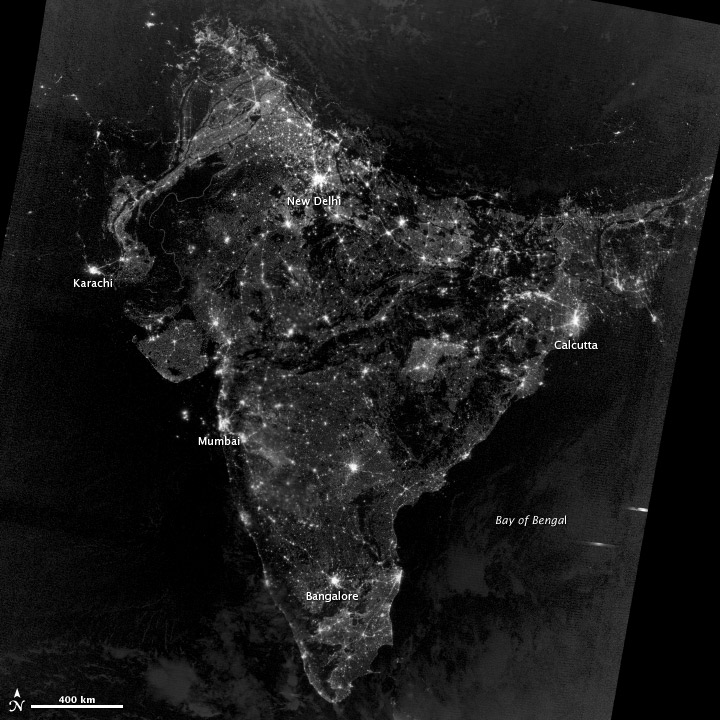
The image above – which has been artificially brightened – shows what India looked like from space on the night during Diwali in November, 2012. It’s what India looks like from space onany night, according to NASA.

This image is from a NASA satellite known as Suomi NPP, for National Polar-orbiting Partnership. An instrument carried on this satellite – which detects light in a range of wavelengths from green to near-infrared – acquired this image in a single night. The image has been brightened to make the city lights easier to distinguish.

Most of the bright areas are cities and towns in India, which is home to more than 1.2 billion people and has at least 30 cities with populations over 1 million. Cities in Bangladesh, Nepal, and Pakistan are also visible near the edges of the image.

Now, the fake one:

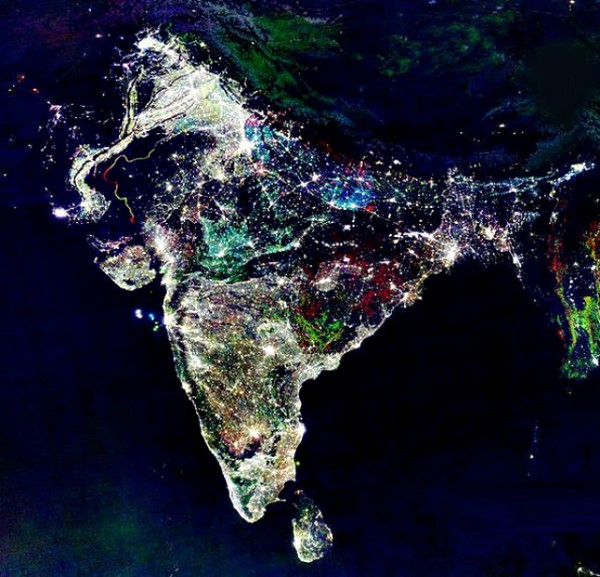
In contrast, here is the false Diwali image, which has been circulating via the Internet for some years. It doesn’t show what it claims to show; that is, it doesn’t show India on a single night during the Diwali festival.

This image comes from satellite data, too, but not a single satellite on a single night. It’s based on data from U.S. Defense Meteorological Satellite Program (DMSP) satellites, and it’s a color-composite created in 2003 by NOAA scientist Chris Elvidge to highlight population growth over time. In this image, white areas show city lights that were visible prior to 1992, while blue, green, and red shades indicate city lights that became visible in 1992, 1998, and 2003 respectively.

Bottom line: This post contains a real space image of India, taken during the 2012 Diwali festival. The image is shown in contrast to another space image – a composite, put together with data taken over many years – which has circulated in recent years. The composite image does not show India during Diwali. NASA says the extra light so many enjoy during Diwali would not be visible from space.

SOURCE::::earthskynews

Natarajan

” When there is a Turbulence During your Flight …”

plane stormShutterstock

[Editorial note: This is an updated version of an earlier post. Turbulence is once again the news, after a Singapore Airlines flight encountered rough conditions while landing in Mumbai. recently. 

Turbulence is far and away the No. 1 concern of nervous flyers.

If you’re among those seeking reassurance, please refer to my earlier essay on the topic, a version of which also appears in chapter two of the my book. Many anxious passengers have found this discussion helpful.

READ IT HERE.

In the meantime, I’ll go ahead and reiterate some points:

1. First and foremost, turbulence is, for lack of a better term, normal. Every flight, every day, will encounter some degree of rough air, be it a few light burbles or a more pronounced and consistent chop that sometimes gets your coffee spilling and the plates rattling in the galley. From a pilot’s perspective, garden-variety turbulence is seen as a comfort and convenience issue, not a safety issue per se. It’s annoying, but it is not dangerous.

2. In rare circumstances, however, it’s worse, to the point where a plane’s occupants can be injured or, even more uncommonly, aircraft components can be damaged. How rare? Put it this way: The type of encounter that United and Cathay ran into is the sort of thing even the most frequent flyer will not experience in a lifetime. And of the small number of passengers injured each year, the vast majority of them are people who did not have their seat belts on when they should have.

3. Can turbulence occur unexpectedly — or, as the news people have been embellishing it, “out of nowhere”? Yes. Pilots receive weather and turbulence forecasts prior to flight; once aloft we get periodic updates from our dispatchers and meteorologists on the ground. We have weather radar in the cockpit, as well as our eyes to see and avoid the worst weather. And perhaps most helpful of all, we receive real-time reports from nearby aircraft. With all of these tools at our disposal, we have a pretty good idea of the where, when, and how bad of the bumps. But every so often they happen without warning. Almost always it’s a mild nuisance, but the lesson here is to always have your belt fastened, even when conditions are smooth.

4. Do pilots keep their belts fastened in the cockpit? Yes, always. Is this one of those things that, well, hey, we sometimes ignore and get lackadaisical about? No, and neither should you.

5. For what it’s worth, thinking back over the whole history of modern commercial aviation, I cannot recall a single jetliner crash caused by turbulence, strictly speaking. Maybe there have been one or two, but airplanes are engineered to withstand an extreme amount of stress, and the amount of turbulence required to, for instance, tear off a wing, is far beyond anything you’ll ever experience.

6. During turbulence, the pilots are not fighting the controls. Planes are designed with what we call positive stability, meaning that when nudged from their original point in space, by their nature they wish to return there. The best way of handling rough air is to effectively ride it out, hands-off. (Some autopilots have a turbulence mode that desensitizes the system, to avoid over-controlling.) It can be uncomfortable, but the jet is not going to flip upside down.

7. Be wary of analogies. You might hear somebody compare turbulence to “driving over a rough road,” or to “a ship in rough seas.” I don’t like these comparisons, because potholes routinely pop tires, break axles and ruin suspensions, while ships can be capsized or swamped. There are no accurate equivalents in the air.

8. Be wary of passenger accounts in news stories. Not to insult anyone’s powers of observation, but people have a terrible habit of misinterpreting and exaggerating the sensations of flight, particularly if they’re scared. Even in considerably bumpy air — what a pilot might call “moderate turbulence,” a plane is seldom displaced in altitude by more than 20 feet, and usually less. Passengers might feel the plane “plummeting” or “diving” — words the media can’t get enough of — when in fact it’s hardly moving.

9. Will climate change increase the number of severe turbulence encounters? Possibly, but in the meantime remember there are also more airplanes flying than ever before. The worldwide jetliner fleet has more than doubled in the past 20 years, and it continues to grow. It stands to reason that as the number of flights goes up, the number of incidents will also go up, regardless of changes in the weather.

SOURCE:::: http://www.businessinsider.com

Natarajan

Kindly have a look at my earlier blog post on this subject…pl click the following link and read further…


https://natarajank.com/2013/08/30/what-causes-turbulance-is-it-dangerous/

natarajan

Read more: http://www.businessinsider.com/Here’s What It Really Means When There’s Turbulence During A Flight, According To A Pilot#ixzz3GqakAfaI

World’s Best and Worst Airports !!!

Airport with a spa

There were no surprises when it came to naming the best airport, with Singapore’s Changi International taking the title it’s held every year since the survey began 18 years ago.

It’s success is credited to the spa, pool, gym, four-storey slide and movie theatres that make the airport a destination in itself.

Offering almost as many cool perks as its Singapore counterpart, South Korean’s Seoul Incheon International was named second best.

Amsterdam Schiphol and Hong Kong International Airport (last year’s third and fourth best airports) dropped out from the top five to ninth and seventh spots, respectively.

Helsinki International Airport, Munich International Airport and Vancouver International Airport wrapped up the top five.

Changi is the clear winner 18 years in a row.

Changi is the clear winner 18 years in a row. Source: Supplied 

Incheon International Airport in South Korea came in at a close second.

Incheon International Airport in South Korea came in at a close second

Best Airports of 2014

1. Changi Airport, Singapore

2. Incheon International Airport, South Korea

3. Helsinki Airport, Finland

4. Munich Airport, Germany

5. Vancouver International Airport, Canada

6. Kuala Lumpur International Airport, Malaysia

7. Hong Kong International Airport, Hong Kong

8. Tokyo Haneda International Airport, Japan

9. Schiphol Amsterdam Airport, Netherlands

10. Zurich Airport, Switzerland


Worst Airports of 2014

1. Benazir Bhutto International Airport, Islamabad, Pakistan

2. King Abdulaziz International Airport, Jeddah, Saudi Arabia

3. Tribhuvan International Airport, Kathmandu, Nepal

4. Manila Ninoy Aquino International Airport, Philippines

5. Tashkent International Airport, Uzbekistan

6. Paris Beauvais-Tille Airport, France

6. Frankfurt Hahn Airport, Germany

8. Bergamo Orio al Serio Airport, Italy

9. Tegel Airport, Berlin, Germany

10. LaGuardia Airport, New York City


This article originally appeared on CNN …  and news.com.au

Natarajan

India”s NIRBHAY Subsonic Cruise Missile… Few Facts on its Launch …

Nirbhay, India’s first home-grown subsonic cruise missile, was on Friday successfully test-launched from the Interim Test Range in Chandipur, near Balasore in Orissa.

This is Nirbhay’s second launch, the first being terminated mid-way on 12 March 2013 owing to a technical snag. Nirbhay, with an expected strike range of 800-1000 km, is the first missile being made completely in Bangalore.

Here are some facts of the missile:

1) Nirbhay is a subsonic cruise missile – it starts off as a rocket and then turns into an aircraft.

2) Nirbhay is expected to have an expected strike range of 800-1000 km.

3) The missile was nurtured at the Defence Research and Development Organisation’s premier laboratory Aeronautical Development Establishment in Bangalore’s C V Raman Nagar.

4) The cost of one missile is Rs 10 crore.

5) It has good loitering capability, good control and guidance, high degree of accuracy in terms of impact and very good stealth features.

6) The Nirbhay missile is similar to the US Tomahawks, which can fly like an aircraft and capable of travelling up to 1,000 km.

7) It can fly at tree-top level making it difficult to detect on radar and as it approaches the target, the missile can determine the point of impact while hovering over the target.

8) It gives India the capacity to launch different kinds of payloads at different ranges from various platforms at a very low cost. It can be launched from a mobile launcher.

SOURCE::: REDIFF.COM  
Natarajan

” Suggest a Suitable Name to Space Robot and Win a Prize from NASA …” !!!

Name a Flying Space Robot, and Win a Prize From NASA

NASA needs your help to name a new space robot, and you could win some cash doing it.

NASA officials are asking space fans around the world to help name, and design a mission patch for, a new free-flying robot expected to launch to theInternational Space Station in 2017. The first-place winner of the challenge will receive $1,000. Officials with the space agency put out the call to any interested space fans at New York Comic Con on Saturday.

“We have this new free-flying robot that we’re building,” Jason Crusan, director of NASA’s Advanced Exploration Systems division, told a full house at Comic Con. “We don’t know what to call it. ‘Free-flying robot’ sounds kind of boring and not all that exciting, so we’re asking you to actually name the robot for us.”

Image: Free-flying robotNASA / TOPCODER
A sketch shows how a free-flying robot on the International Space Station could be moved by remote control to get a better video angle.

Second, third and fourth place also come with cash prizes. Second place will win $500, with third and fourth prize taking home $250 each. NASA has teamed up with Topcoder to organize the contest.

If an artist’s depiction of the new space automaton is any indication, the new robot may look like something out of “Star Wars.” In the artist’s concept, the robot could appear as a small, ball-shaped droid that will use fans to move itself around the interior of the International Space Station. It is expected to be able to fly itself, or be operated by remote control.

The new free-flying bot would join a group of other free-fliers already on the station. NASA’s SPHERES robots (the name is short for Synchronized Position Hold, Engage, Reorient, Experimental Satellites) are already used on the orbiting outpost.

To participate in the NASA challenge to name the new robot, space fans need to register with Topcoder. Participants will reach a checkpoint where they will receive feedback on their initial designs on Oct. 22, and the challenge ends on Oct. 27. Officials will announce the winners of the competition on Nov. 2.

To participate in the challenge and learn more about it, go tohttp://www.topcoder.com/challenge-details/30046039/?type=design&noncache=true.

— Miriam Kramer, Space.com

This is a condensed version of a report from Space.com. Read the full report.Follow Miriam Kramer on Twitter and Google+. Follow Space.com on Twitter,Facebook and Google+.

First published October 15th 2014, 5:55 am  in http://www.nbcnews.com

NatarajanBO

” Hud Hud ” Rips off the Roof Of Visakhapatnam Airport ….


Cyclone Hudhud severely damaged Visakhapatnam airport, blowing the roof top. Airport authorities cancelled all flights from and to the city as a precaution. The extent of the damage to the facility may delay the restoration of the overall operations. The Visakhapatnam airport is the most important and biggest in Andhra Pradesh, with major domestic and international flights operating in and out of the facility.

Source::::yahoo india.com

Natarajan


Image of the Day… Earth and Moon as Seen From Mercury !!!

MESSENGER spacecraft sees lunar eclipse from Mercury

The MESSENGER spacecraft, now orbiting Mercury, caught the images to make this movie of last Wednesday’s lunar eclipse. See Earth and moon from Mercury!

Earth and Moon from Mercury orbit, with Moon entering eclipse.  Imaged on Wednesday, October 8, 2014 by MESSENGER, a spacecraft in orbit around Mercury.

The MESSENGER spacecraft – which has been orbiting the sun’s innermost planet Mercury since 2011 – made this movie of the the Hunter’s Moon passing into the Earth’s shadow on October 8, 2014. The movie consists of 31 MDIS NAC (Mercury Dual Imaging System Narrow Angle Camera) frames taken two minutes apart from 09:18 UTC to 10:18 UTC on October 8. MESSENGER made the movie from a distance of 107 million kilometers / 66 million miles.

Notice the orientation of bright side of Earth. Earth’s shadow always extends in the direction opposite this bright side – or day side – approximately 1,400,000 kilometers / 1,000,000 miles into space. On October 8, the moon passed into the shadow, causing the eclipse.

The images have been enlarged 2 times and the moon brightened 25 times. The Earth was five pixels wide and the Moon one pixel wide.

The Earth – moon pair appeared in front of the constellation Aries, near the border of the constellation Pisces, as seen from Mercury.

The Earth was very bright magnitude minus 4.38 and the Moon was magnitude minus 0.03.

Read more from Emily Lakdawalla at the Planetary Society

Bottom line: The MESSENGER spacecraft, now orbiting Mercury, caught the images to make this movie of last Wednesday’s lunar eclipse. See Earth and moon from Mercury!

SOURCE:::: earthskynews

Natarajan

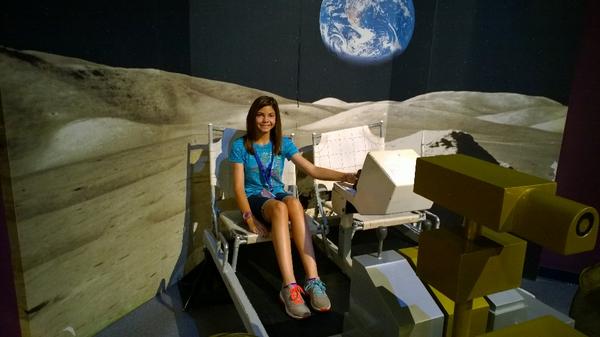
This Teen Wants to be the First Person Landing on MARS !!!

Alyssa Carson, from Louisiana, wants to be the first person on Mars

Determined ... Alyssa Carson wants to be the first person on Mars. Picture: Twitter.

Determined … Alyssa Carson wants to be the first person on Mars. Picture: Twitter. Source: Supplied

THIS 13-year-old girl has been training to be an astronaut for nine years and is determined to become the first person to land on Mars.

Alyssa Carson is the first person to have attended all three of NASA’s world space camps.

The Louisiana teenager speaks Spanish, French and Chinese, and is prolific on social media.

She told the BBC that she wants to inspire other children to achieve their dreams.

“I have thought about possibly being other things but being an astronaut was always first on my list,” she said. “I don’t want one obstacle in the way to stop me from going to Mars … Failure is not an option”.


And NASA is not discounting her ambitions. Her call sign at the US space agency is “Blueberry”.

“She is of the perfect age to one day become an astronaut and eventually travel to Mars,” NASA’s Paul Foremantold the BBC. “She is doing the right thing, she is doing the right training, taking all the right steps to actually become an astronaut.”

View image on Twitter

Bret Carson, Alyssa’s dad, said he has spoken to his daughter about the possibility that she may never return from Mars but he says she isn’t worried about that.

“We have the next 20 years planned out, we know what she’s doing, she’s looking at going on a mission to mars in 2033,” he said. “In 20 years I may not ever see her again, there are options out there where they go to mars and not come back, and we’ve had those discussions, and if that’s the only option she still wants to go.”

Source:::: news.com.au

Natarajan

NASA Invites Public to send their Names into Space !!!

Over 2.8 lakh people from around the world, including 21,729 Indians, have so far submitted their names to be inscribed on a NASA microchip that will eventually fly to Mars.

NASA is giving people a chance to shoot their names up into space on the first Orion mission, scheduled to for launch on December 4, and then eventually to the Red Planet.

http://mars.nasa.gov/layout/embed/image/485snm/

Currently, 2,80,429 people have submitted their names to fly into space.

The highest number of names submitted to NASA so far from a single country – a total of 1,13,121 – comes from the USA while the third-largest submission of names is from India, with 21,729 space enthusiasts from the nation giving their names.

Other countries with high participation include UK (22,491 names), Philippines (9,869 names) and Canada (7,760 names). Currently, only 1,828 names have been submitted from China and 1,620 from Pakistan.

The collected names will be included on a microchip the size of a dime. The first trip will be on board NASA’s initial test flight for the new Orion spacecraft. It is set for a 4.5-hour mission in orbit around Earth.

“After returning to Earth, the names will fly on future NASA exploration flights and missions to Mars. With each flight, selected individuals will accrue more miles as members of a global space-faring society,” NASA said.

To sign up, users have to go to NASA’s name-collecting site, fill out some basic information, and submit. The site then generates a digital “boarding pass.”

The deadline for getting your name on Orion’s inaugural flight is October 31.

SOURCE::::: THE HINDU.COM

Natarajan

Keywords: NASAOrion