அமெரிக்காவை ஆட்டுவிக்கும் மாய சக்தி எது தெரியுமா ?

புதிய நிதிநிலை அறிக்கையை இறுதிசெய்வதில் ஏற்பட்ட சிக்கல் காரணமாக, ஒரு பகுதி அரசுத் துறை நிறுவனங்களை மூடியிருக்கிறது அமெரிக்கா. மொத்தம் உள்ள 20 லட்சம் மத்திய அரசு ஊழியர்களில் சுமார் எட்டு லட்சம் ஊழியர்கள் சம்பளம் இல்லா விடுப்பில் செல்ல அரசு உத்தரவிட்டுள்ளது. ராணுவம், சுகாதாரம் உள்ளிட்ட அதி முக்கியத் துறைகள் நீங்கலாக ஏனைய துறைகளின் செயல்பாடு முடங்கியிருக்கும். உலகெங்கும் பங்குச் சந்தைகளில் இதன் தாக்கம் எதிரொலிக்கும். இந்த முடக்கம் நீளும்போது, அமெரிக்கா பொருளாதார இழப்பை எதிர்கொள்ளும்.

ஆளும்கட்சிக்குச் சிக்கலான சூழல் ஏற்படும்போதெல்லாம் இப்படி ஒரு நடவடிக்கை எடுப்பது அமெரிக்க அரசுக்கு வழக்கம். 1977-லிருந்து இப்படி 17 முறை அரசுத் துறை நிறுவனங்களை வெள்ளை மாளிகை மூடியிருக்கிறது என்றாலும், 1995 இறுதியில் கிளின்டனின் ஆட்சியில் நடந்த வரலாற்றின் நீண்ட – 21 நாட்கள் முடக்கத்துக்குப் பின் இதுவே முதல் முறை.

ஆளும் ஜனநாயகக் கட்சிக்கும் குடியரசுக் கட்சிக்கும் இடையிலான அரசியல் சண்டையின் விளைவு இது.

தனியார் பிடியில் அமெரிக்க மருத்துவத் துறை சிக்கியிருக்கும் சூழலில், மருத்துவக் காப்பீடு இல்லாதவர்கள் அங்கு சமாளிப்பது கடினம். ஆனால், உலகை ஆளத் துடிக்கும் ‘வல்லர’சின் குடிமக்களில் பாதிக்கும் மேற்பட்டோர் இன்னமும் முழு மருத்துவக் காப்பீட்டு வசதி இல்லாத நிலையிலேயே இருக்கின்றனர். இத்தகைய சூழலில், அடுத்து வரும் தேர்தலில் ஜனநாயகக் கட்சியை முன்னகர்த்த ஒபாமா தேர்ந்தெடுத்த பகடைக்காய் மருத்துவக் காப்பீட்டுச் சீர்திருத்தத் திட்டம். நான்கு கோடி அமெரிக்கர்களை மருத்துவக் காப்பீட்டுக்குள் கொண்டுவர வழிவகுக்கும் திட்டம் இது.

பொருளாதார நெருக்கடிகளைச் சுட்டிக்காட்டி, ஏற்கெனவே அமெரிக்க அரசு செய்ய வேண்டிய செலவுகளில் சுமார் ரூ.4.81 லட்சம் கோடியை வெட்டும் திட்டத்தில் இருக்கும் எதிர்க்கட்சியான குடியரசுக் கட்சி, “இது அமெரிக்கர்கள் நலத் திட்டம் அல்ல; ஒபாமா நலத் திட்டம்” என்று திட்டத்தில் உள்ள சில குறைகளைக் கூறி முட்டுக்கட்டை போடுகிறது. நாடாளுமன்றத்தின் இரு சபைகளிலும் பெரும்பான்மை இல்லாத சூழலில், எதிர்க்கட்சியுடனான பேச்சுவார்த்தை தோற்றதால், நிதிநிலை அறிக்கையை இறுதிசெய்யாமல், அரசுத் துறைகளை முடக்கியிருக்கிறார் ஒபாமா. மக்களின் அனுதாபத்தைத் தான் பெற முடியும் என்று அவர் நம்புகிறார். ஒபாமா கணக்கே பலிக்கும் என்பது வெளிப்படை. எனினும், எப்படி இந்த அரசியலாட்டம் நடக்கிறது? பெருநிறுவனங்களின் லாபி.

இந்தியா எந்தக் கொள்கையை வாரிக்கொள்ளத் துடிக்கிறதோ, எல்லாத் துறைகளையும் யாரிடம் தாரைவார்க்கத் துடிக்கிறதோ அந்தத் தனியார்மயத்தின் கரங்களில்தான் உலகின் வல்லமை மிக்க தேசத்தை ஆட்டுவிக்கும் கயிறுகளின் முடிச்சுகள் இறுகியிருக்கின்றன!

source::::The Hindu….Tamil
natarajan

Eleven Indian Companies in FORBES FAB 50 List …

China and India dominate the Forbes 2012 list of 50 best publicly traded companies in Asia-Pacific.

China tops the list with 23 companies in the list. A slowing economy has seen the best companies emerge successful, Forbes said. 15 companies are new in the list this year.

India is ranked second with 11 Indian companies in Forbes 2012 list, up from up from seven last year. The companies were selected from a pool of 1,295 companies that had at least $3 billion in annual revenue or market cap.

1. Tata Consultancy Services
(Rank 4)

Tata Consultancy Services is an IT services, business solutions and outsourcing organisation with over 238,583 IT consultants in 42 countries.  The company was founded in 1968.


2. ITC
(Rank 5)

ITC is an Indian public conglomerate company headquartered in Kolkata, West Bengal.

Founded in 1910 as the Imperial Tobacco Company of India, today its diversified business includes Fast Moving Consumer Goods (FMCG), Hotels, Paperboards, Paper & Packaging and Agri Business.

3. HDFC Bank
(Rank 6)

Incorporated in August 1994, HDFC Bank is the fifth largest bank in India by assets. HDFC Bank has 1,986 branches and over 5,471 ATMs, in 996 cities in India.

4. Bharti Airtel
(Rank 9)

Founded in 1995, Bharti Airtel is a leading integrated telecommunications company with operations in 20 countries across Asia and Africa.

Headquartered in New Delhi, India, the company ranks amongst the top 5 mobile service providers globally in terms of subscribers.

5. Tata Motors
(Rank 16)

Founded in 1945, Tata Motors is the world’s eighteenth-largest motor vehicle manufacturing company, fourth-largest truck manufacturer and second-largest bus manufacturer by volume.

Tata Motors has produced and sold over 6.5 million vehicles in India since 1954.

6. Sun Pharmaceutical Industries
(Rank 18)

Sun Pharmaceutical Industries based in Mumbai, manufactures and sells pharmaceutical formulations and active pharmaceutical ingredients (APIs) primarily in India and the United States.

Sun Pharma was established by Dilip Shanghvi in 1983 in Kolkata.

7. Bajaj Auto
(Rank 27)

Bajaj Auto founded by Jamnalal Bajaj at Rajasthan in the 1930s is based in Pune, Maharashtra, with plants in Chakan (Pune), Waluj (near Aurangabad) and Pantnagar in Uttaranchal.

Bajaj Auto manufactures automobiles, scooters, motorcycles and the auto rickshaws. Bajaj Auto is the world’s third-largest manufacturer of motorcycles.

8. Kotak Mahindra Bank
(Rank 29)

Kotak Mahindra Bank is an Indian financial service firm established in 1985.  It was previously known as Kotak Mahindra Finance Limited, a non-banking financial company.

In February 2003, Kotak Mahindra Finance Ltd, the group’s flagship company was given the license to carry on banking business by the Reserve Bank of India (RBI).

9. HCL Technologies
(Rank 33)

HCL Technologies offers a range of outsourcing services, business process outsourcing and infrastructure services.

Founded in 1991, HCL Technologies is fourth largest IT company in India and is ranked 48 in the global list of IT services providers.

10. Titan Industries
(Rank 37)

Titan Industries is the world’s fifth largest wrist watch manufacturer and India’s leading producer of watches under the Titan, Fastrack, Sonata, Nebula, RAGA, Regalia, Octane and Xylys brand names.

Founded in 1987, it is a joint venture between the Tata Group, and the Tamil Nadu Industrial Development Corporation (TIDCO).

Its product portfolio includes watches, accessories and jewellery, in both contemporary and traditional designs.

11. Asian Paints
(Rank 41)

Founded in 1942, Asian Paints is headquartered in Mumbai.  It manufactures a wide range of paints for decorative and industrial use. Asian Paints is India’s largest and Asia’s third largest paint company.

source:::: Rediff.com

natarajan

Do You Know …What is Government Shutdown ?

Know : What is a Government Shutdown?


For the Non-US people around the world few may not be aware of what a shutdown of government means and what it does! You are not the only person to have this doubt many has it. A basic stuff here…

us

In U.S. politics, a government shutdown is a situation in which the government stops providing all but “essential” services. Typically, federal services that continue despite a shutdown include the National Weather Service and its parent agencies, medical services at federal facilities, the postal service, armed forces, air traffic management, and corrections (the penal system). A government shutdown is similar to a lockout in the private sector.


Effects :

A federal government shutdown causes a large number of civilian federal employees to be furloughed. Military personnel and essential employees are not furloughed, but may not be paid as scheduled.

The exact details of which government functions would stop during a shutdown is determined by the Office of Management and Budget. However, some specific aspects have applied to all shutdowns in the past. Among these is the closure of national parks and passport offices. ”Emergency personnel” continue to be employed, including the military, federal law enforcement agents, doctors and nurses working in federal hospitals, and air traffic controllers. Members of Congress continue to be paid, because their pay cannot be altered except by direct law. Mail delivery is not affected as it is self-funded.

Shutdowns in the past have also affected the Washington, D.C., municipal government, putting a stop to schools and to utilities such as garbage collection.

Find Answers more for questions like (click the question)

List of similar Shutdowns

Year Start date End date Total days Explanation
1976 September 30 October 11 10 Citing out of control spending, President Gerald Ford vetoed a funding bill for the United States Department of Labor and the United States Department of Health, Education, and Welfare (HEW), leading to a partial government shutdown. On October 1, the Democratic-controlled Congress overrode Ford’s veto but it took until October 11 for a continuing resolution ending funding gaps for other parts of government to become law.
1977 September 30 October 13 12 The Democratic-controlled House continued to uphold the ban on using Medicaid dollars to pay for abortions, except in cases where the life of the mother was at stake. Meanwhile, the Democratic-controlled Senate pressed to loosen the ban to allow abortion funding in the case of rape or incest. A funding gap was created when disagreement over the issue between the houses had become tied to funding for the Departments of Labor and HEW, leading to a partial government shutdown. A temporary agreement was made to restore funding through October 31, 1977, allowing more time for Congress to resolve its dispute.
1977 October 31 November 9 8 The earlier temporary funding agreement expired. President Jimmy Carter signed a second funding agreement to allow for more time for negotiation.
1977 November 30 December 9 8 The second temporary funding agreement expired. The House held firm against against the Senate in its effort to ban Medicaid paying for the abortions of victims of statutory rape. A deal was eventually struck which allowed Medicaid to pay for abortions in cases resulting from rape, incest, or in which the mother’s health is at risk.
1978 September 30 October 18 18 Deeming them wasteful, President Carter vetoed a public works appropriations bill and a defense bill including funding for a nuclear-powered aircraft carrier. Spending for the Department of HEW was also delayed over additional disputes concerning Medicaid funding for abortion.
1979 September 30 October 12 11 Against the opposition of the Senate, the House pushed for a 5.5 percent pay increase for congress members and senior civil servants. The House also sought to restrict federal spending on abortion only to cases where the mother’s life is in danger, while the Senate wanted to maintain funding for abortions in cases of rape and incest.
1981 November 20 November 23 2 President Ronald Reagan pledged that he would veto any spending bill that failed to include at least half of the $8.4 billion in domestic budget cuts that he proposed. Although the Republican controlled Senate passed a bill that met his specifications, the Democratic House insisted on larger cuts to defense than Reagan wanted and for congressional and civil servant pay raises. A compromise bill fell $2 billion short of the cuts Reagan wanted, so Reagan vetoed the bill and shut down the federal government. A temporary bill restored spending through 15 December and gave Congress the time to work out a more lasting deal.
1982 September 30 October 2 1 Congress passed the required spending bills a day late.
1982 December 17 December 21 3 The Democratic controlled House and the Republican controlled Senate wished to fund jobs, but President Reagan vowed to veto any such legislation. The House also opposed plans to fund the MX missile. The shutdown ended after Congress abandoned their jobs plan, but Reagan was forced to yield on funding for both the MX and Pershing II missiles. He also accepted funding for the Legal Services Corporation, which he wanted abolished, in exchange for higher foreign aid to Israel.
1983 November 10 November 14 3 The Democratic controlled House increased education funding, but cut defense and foreign aid spending, which led to a dispute with President Reagan. Eventually, the House reduced their proposed education funding, and also accepted funding for the MX missile. However, the foreign aid and defense cuts remained, and oil and gas leasing was banned in federal wildlife refuges. Abortion was also prohibited for being paid for with government employee health insurance.
1984 September 30 October 3 2 The House wished to link the budget to both a crime-fighting package President Reagan supported and a water projects package he did not. The Senate additionally tied the budget to a civil rights measure designed to overturn Grove City v. Bell. Reagan proposed a compromise where he abandoned his crime package in exchange for Congress dropping theirs. A deal was not struck, and a three-day spending extension was passed instead.
1984 October 3 October 5 1 The three-day spending extension expired, forcing a shutdown. Congress dropped their proposed water and civil rights packages, while President Reagan kept his crime package. Funding for aid to the NicaraguanContras was also passed.
1986 October 16 October 18 1 A dispute over multiple issues between the Democratic controlled House and President Reagan and the Republican Senate forced a shutdown. The Democratic controlled House dropped many of their demands in exchange for a vote on their welfare package, and a concession of the sale of then-government-ownedConrail.
1987 December 18 December 20 1 Democrats, who now controlled both the House and the Senate, opposed funding for the Contras, and wanted the Federal Communications Commission to begin reenforcing the “Fairness Doctrine“. They yielded on the “Fairness Doctrine” in exchange for non-lethal aid to the Contras.
1990 October 5 October 9 4 President George H.W. Bush vowed to veto any continuing resolution that was not paired with a deficit reduction package, and did so when one reached his desk. The House failed to override his veto before a shutdown occurred. Congress then passed a continuing resolution with a deficit reduction package that Bush signed to end the shutdown.
1995 November 13 November 19 5 In the shutdown of 1995 and 1996 President Bill Clinton vetoed a continuing resolution passed by the Republican-controlled Congress. A deal was reached allowing for 75 percent funding for four weeks, and Clinton agreed to a seven-year timetable for a balanced budget.
1995 December 16 January 6, 1996 21 Subsequently the Republicans demanded President Clinton propose a budget with the seven-year timetable using Congressional Budget Office numbers, rather than Clinton’s Office of Management and Budget numbers. However, Clinton refused. Eventually, Congress and Clinton agreed to pass a compromise budget.
2013 October 1 Ongoing Ongoing Due to disagreement regarding inclusion of language delaying the Affordable Care Act, the Government has not passed a funding bill. Negotiations have come to a stop and government shutdown is in progress. See also United States federal government shutdown of 2013.
Courtesy :Wikipedia and latimes.com

source::::: Reblogged From propelsteps in wordpress.com

natarajan

Why Do We Call The Stock Market Trends “Bullish “& “Bearish ???


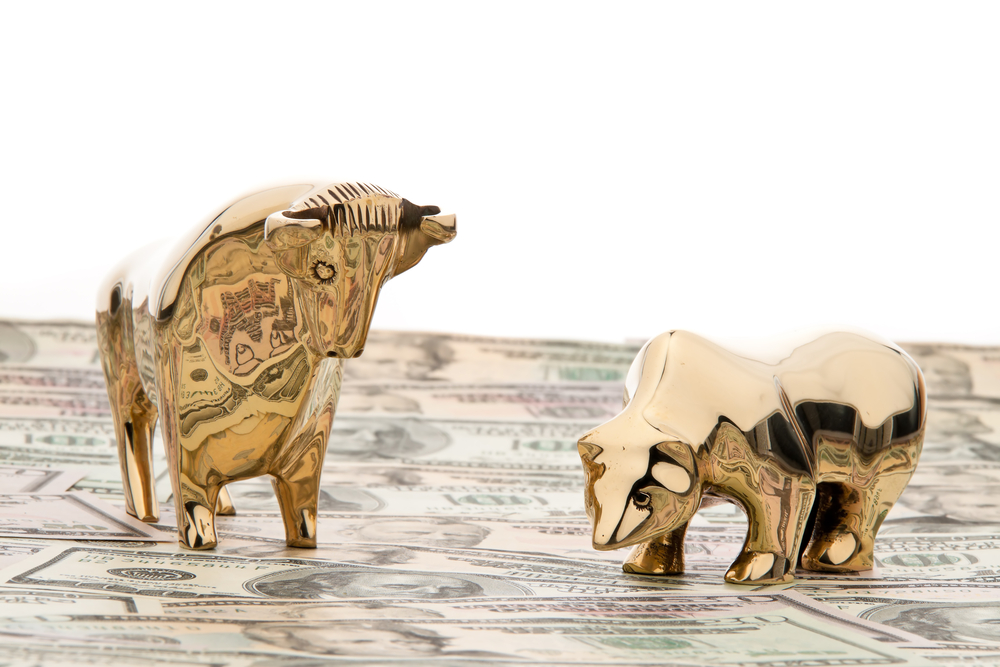
bull-bearFor those who don’t know, a “bear” market, or when someone is being “bearish” in this context, is marked by investors being very conservative and pessimistic, resulting in a declining market generally marked by the mass selling off of stock.  A “bull” market is simply the opposite of that, with investors being aggressive and positive, with stock prices rising as a result of this optimism.  This “bull” and “bear” terminology first popped up in the 18th century in England.

There are a couple different possible sources for the “bear” part of this tandem, but the leading theory is that it derived from an old 16th century proverb: “selling the bear’s skin before one has caught the bear” or alternatively, “Don’t sell the bear’s skin before you’ve killed him,” equivalent to, “Don’t count your eggs before they’re hatched.”

By the early 18th century, when people in the stock world would sell something they didn’t yet own (in hopes of turning a profit by eventually being able to buy the thing at a cheaper rate than they sold it, before delivery was due), this gave rise to the saying that they “sold the bearskin” and the people themselves were called “bearskin jobbers”.

One of the earliest references of this comes from an issue of The Tatler, April 26, 1709:

Forasmuch as it is very hard to keep land in repair without ready cash, I do, out of my personal estate, bestow the bear-skin, which I have frequently lent to several societies about this town, to supply their necessities;  I say, I give also the said bear-skin as an immediate fund to the said citizens forever…

In a later edition, June 23, 1709, it goes on to state:

I fear the word Bear is hardly to be understood among the polite people; but I take the meaning to be, that one who insures a real value upon an imaginary thing, is said to sell a Bear, and is the same thing as a promise among courtiers, or a vow between lovers…

Yet another early instance of the term is in Daniel Defoe’s The Anatomy of Change Alley, published in 1719, around the time the term was popularized to something of the same type of definition we use today:

Those who buy Exchange Alley Bargains are styled buyers of Bear-skins.

The use of the word “bear” in this way was popularized thanks to one of the early market bubbles known as the South Sea Bubble.  While it was a long and incredibly complex market scheme that led to the bubble, the gist of it was that the South Sea Company, formed in 1711, was granted by Britain a monopoly on all trade to South America and would be given an annual sum (6% interest plus expenses) from the government.  In exchange, the new company agreed to take over large portions of the government’s debt. (In fact, this was primarily how the company actually made money throughout its century and a half it was in business, simply by dealing in government debt.)

Thanks to this deal and an amazing amount of government corruption, insider trading, and other unscrupulous practices by certain shareholders who knew well that the company’s trade business had little hope of ever being profitable, the burgeoning company’s stock soared. At its peak, based on the stock price, the company was worth about £200 million (by purchasing power, today this would be about £24 billion or $37 billion; by average earnings, it would be £350 billion or $537 billion).

Besides the fact that they didn’t even have their first trading shipment until 1717, 6 years after the trading company first formed, one of the problems was that having an exclusive monopoly on trading to South America from the British government at the time wasn’t saying much as most of the region was almost entirely held by Spain, who Britain was at war with.  Nevertheless, amid rampant and widely published rumors (deftly planted by certain stock holders to jack up the price) of the vast wealth from gold and other resources in those regions and the potential promise of soon securing trade rights from Spain, the stock prices soared, even though the company itself wasn’t really doing any actual trading and their main asset, the monopoly on trade to Middle and South America, was essentially worthless, as the core stock holders knew well.

Spain did eventually grant the South Sea Company rights to trade in the regions held by Spain, but only one ship load per year total was allowed in exchange for a percentage of the profits.  Needless to say, the inability to do any actual real volume of trading and the fact that war once again broke out in 1718 between Spain and Britain causing much of the company’s scant physical assets to be seized by Spain, the market crash that followed wasn’t pretty.

As to the “bull” name for rising markets, in this case we have to do a little more speculation as the documented evidence just isn’t there. The leading theory is that it came about as a direct result of the term “bear”.  Specifically, the first known instance of the market term “bull” popped up in 1714, shortly after the “bear” term popped up.  At the time, it was something of a common practice to bear and bull-bait. Essentially, with bear baiting, they’d chain a bear (or bears) up in an arena, and then set some other animals to attack the bear(s) (usually dogs) as a form of entertainment for spectators seated in the arena.

While bears were one of the more popular animals to use in these games, bulls were also commonly used. More rarely, other animals were used such as in one instance where an ape was tied to a pony’s back and dogs were set on them.  According to one spectator, the spectacle of the dogs tearing the pony to shreds while the ape screamed and desperately tried to stay on the pony’s back, out of reach of the snapping jaws of the dogs, was “very laughable”…

In any event, the popularity of bear and bull baiting, along with perhaps the association with bulls charging, is thought to have probably been why “bull” was chosen as something of the antithesis of a “bear”, shortly after “bear” first popped up in the sto

Bonus Fact:

  • A common myth often put forth as to the origin of “bull” and “bear” market terminology is that it comes from the last names of two prominent banking businesses, the Bulteels and the Barings, the former supposedly tending to be extremely aggressive in their investments and the latter supposedly being much more conservative.  While both the Barings bank and the Bulteel bank did in fact exist, there are a couple problems here. The first is that the only Bulteel bank around this era wasn’t prominent at all, certainly not enough to spawn such a term. Second, and more importantly, is that both the Barings bank and the Bulteel bank were founded well after “bull” and “bear” were already common stock market terms.

source::::todayifoundout.com

natarajan
Read more at http://www.todayifoundout.com/index.php/2013/04/origin-of-the-stock-market-terms-bull-and-bear/#OB8ww6J5Ev94BP4W.99 ck sense.  But, of course, we can’t be at all sure on this one as there wasn’t the more lengthy documented progression of definition as with the “bear”  term.


Facebook CEO Mark Zuckerberg ….With a changed Fortune in 2013 !!!

Facebook CEO Mark Zuckerberg is the sixth richest American in the tech industry.

This time last year, Facebook FB -4.03% CEO Mark Zuckerberg’s net worth was languishing. After his company’s disappointing initial public offering in May 2012, the hoodie-wearing executive was worth $9.4 billion, down about $8.1 billion in the three months following Facebook’s debut on the Nasdaq.

A lot has changed in 12 months.

On this year’s Forbes 400, Zuckerberg has a net worth of $19 billion, making him the sixth richest member to hail from the technology industry. One of the biggest dollar gainers this year, Zuckerberg is one of 48 people whose fortunes have derived largely from technology companies. On this year’s rankings of the nation’s richest people, technology is the second-highest represented industry, behind investments, with 98.

Bill Gates remains the king of tech–and everything else–with a net worth of $72 billion. He’s been the nation’s wealthiest individual since 1994, and, after adding $6 billion to his coffers in the last year, recently reclaimed the title of world’s richest from Mexican telecom mogul Carlos Slim.

Following Gates, the top five richest in tech remains unchanged. Larry Ellison takes second spot –ranked No. 3 on the list with a net worth of $41 billion –followed by Amazon CEO Jeff Bezos,who added $4 billion to his net worth in the last year, climbing to $27.2 billion. Google cofounders  Larry Page and Sergey Brin rode a strong 12 month rise in Google shares–up 28%–to place fourth and fifth among American tech billionaires.

Steve Ballmer, now worth $18 billion, benefited from the Microsoft stock bump that came after he announced he’d be stepping down as CEO of the Redmond, Wash.-based software giant. On Aug. 23, the day Ballmer announced he would be departing, Microsoft shares closed up more than 7%. That contributed to the $2.1 billion rise in Ballmer’s net worth over the past year.

Last year’s only woman among tech’s top 10, Laurene Powell Jobs, loses her top 10 perch (though remains on The Forbes 400), despite finding herself $700 million richer. Steve Jobs’ widow and Silicon Valley’s richest woman is replaced this year by Dish Network CEO Charles Ergen, who is up $3.5 billion this year to $12 billion. Dish Network’s stock is up nearly 40% in the last 12 months.

FORBES used stock prices from Aug 23, 2013 to calculate values for The Forbes 400 rankings.


source::::Forbes .com

natarajan

” Customer Is Always Right ” !!!


 Senior’s Banking… PRICELESS!!


Shown below, is an actual letter that was sent to a bank by a  Senior customer ..
The bank manager thought it amusing enough to have it published in the Times.

Dear Sir:

I am writing to thank you for bouncing my cheque with which I endeavored to pay my plumber last month.

By my calculations, three nanoseconds must have elapsed between his presenting the cheque and the arrival in my account of the funds needed to honor it.

I refer, of course, to the automatic monthly deposit of my entire pension, an arrangement which, I admit, has been in place for only eight years.

You are to be commended for seizing that brief window of opportunity, and also for debiting my account £30 by way of penalty for the inconvenience caused to your bank.

My thankfulness springs from the manner in which this incident has caused me to rethink my errant financial ways. I noticed that whereas I personally answer your telephone calls and letters, — when I try to contact you, I am confronted by the impersonal, overcharging, pre-recorded, faceless entity which your bank has become.

From now on, I, like you, choose only to deal with a flesh-and-blood person.

My mortgage and loan repayments will therefore and hereafter no longer be automatic, but will arrive at your bank, by cheque, addressed personally and confidentially to an employee at your bank whom you must nominate.

Be aware that it is an OFFENCE under the Postal Act for any other person to open such an envelope.

Please find attached an Application Contact which I require your chosen employee to complete.

I am sorry it runs to eight pages, but in order that I know as much about him or her as your bank knows about me, there is no alternative.

Please note that all copies of his or her medical history must be countersigned by a Notary Public figure, and the mandatory details of his/her financial situation (income, debts, assets and liabilities) must be accompanied by documented proof.

In due course, at MY convenience, I will issue your employee with a PIN number which he/she must quote in dealings with me.

I regret that it cannot be shorter than 28 digits but, again, I have modelled it on the number of button presses required of me to access my account balance on your phone bank service.

As they say, imitation is the sincerest form of flattery.

Let me level the playing field even further.

When you call me, press buttons as follows:

IMMEDIATELY AFTER DIALING, PRESS THE STAR (*) BUTTON FOR ENGLISH

#1. To make an appointment to see me

#2. To query a missing payment.

#3. To transfer the call to my living room in case I am there.

#4 To transfer the call to my bedroom in case I am sleeping.

#5. To transfer the call to my toilet in case I am attending to nature.

#6. To transfer the call to my mobile phone if I am not at home.

#7. To leave a message on my computer, a password to access my computer is required.

Password will be communicated to you at a later date to that Authorized Contact mentioned earlier.

#8. To return to the main menu and to listen to options 1 to 9

#9. To make a general complaint or inquiry.

The contact will then be put on hold, pending the attention of my automated answering service.

While this may, on occasion, involve a lengthy wait, uplifting music will play for the duration of the call.

Regrettably, but again following your example, I must also levy an establishment fee to cover the setting up of this new arrangement.

May I wish you a happy, if ever so slightly less prosperous New Year?

Your Humble Client

source::::: unknown…input from a friend of mine…
natarajan

Changi Airport in Singapore to get new retail and leisure complex….

An artist impression of Project Jewel at Changi Airport. Picture: Supplied

An artist impression of Project Jewel at Changi Airport.

A NEW architecturally striking shopping and leisure complex is being built at Changi Airport in Singapore. Codenamed “Project Jewel”, the complex will be built on a 3.5ha site where the carpark in front of Terminal 1 now lies.

It is expected to open in 2018.

Built to link terminals one, two and three, it is being designed by a consortium of consultants led by architect Moshe Safdie.

The complex will have a glass and steel facade with a large indoor garden and a waterfall.

A new, multi-storey basement carpark will be built as part of the redevelopment and Terminal 1 will be expanded to allow more space for the arrival hall, baggage claim areas and
taxi bays.

The improvements will increase the terminals’ passenger handling capacity to 24 million a year.
The gardens and waterfall at the complex at Changi Airport in Singapore. Picture: Supplied

The gardens and waterfall at the complex at Changi Airport in Singapore.


An artist impression of inside the complex. Picture: Supplied

An artist impression of inside the complex….


Why Every Indian Should Salute This Indian ?

Armstrong Pame‘It is very sad that many of us are yet to discover the Northeastern part of India. After having been to every state of India, people often refuse to believe that I am an Indian,’ says Armstrong Pame, the admirable IAS officer from Manipur who built a 100 km long road in a remote part of the hill state without government help.

The ‘People’s Road’, built with people’s help, connects his district to the rest of the state and further to Nagaland and Assam. Pame, 28, raised most of the funds for the project through Facebook and has been given the name ‘Miracle Man’ by the villagers for giving them their first motorable road.

Armstrong Pame shares his thoughts about India in Rediff.com’s continuing special series where various Indians speak about what they love most about our country.

Our freedom-fighters fought the good fight with zeal, enthusiasm and braveness to give to us that freedom which is the utmost need for any societal growth.

It is time to question ourselves: do we still have the same passion and the zeal within us?

If we do have it, it is time to look beyond me, myself, and I! We are here to live life, and not just to survive it, we live to create positive impacts around us each day.

Our nation is progressing well but not as good enough to show the growth story as one that is of equity, progress and benefit to one and all.

This freedom that we celebrate should be a celebration to help spread the message that each one of us is committed to imparting freedom to every citizen to pursue what their dreams and aspirations are.

Let every unborn child – boy or girl – be born in an India which will make the child grow to the fullest potential. Let there be no fear in our hearts, let’s take our country forward.

The greatest thing about India is its diversity and this is its worst too – because we are not able to fully channelise this to something positive, rather this has often been used as a dividing force.

It is also very sad that many of us are yet to discover the Northeastern part of India. After having been to every state of India, people often refuse to believe that I am an Indian.

The interior part of mainland India — be it central, northern or southern — doesn’t know this northeastern part of the country. They are terribly amazed to see that their fellow brethren can look so different!

I believe many places in the Northeast are not in any way less than some of the best tourist destination like Shimla, Mussoorie or elsewhere. Do come and see how good the Northeast is, and how simplistic and lovely your fellow citizens are.

We are eternally emotional wherever we are. The good thing about being emotional is that we are forever supportive of a good cause. The support and help received from every citizen across the globe is once again proof that we all have an undying spirit to support the good cause.

Maybe our country is the only place where one still believes in community, where family values reign over individual gains.

This tradition and culture of ours is truly the envy of others. If we are to strive towards living life to the fullest we are to only strengthen this bond.

Delhi is undoubtedly my favourite place in India. Having spent a good part of my youth there, and the best of my college days there. However, I am saddened every time I see news about Delhi: bad news always comes first.

Meeting old friends there has become very difficult, especially catching up with them late in the evenings has become even worse. The city is no longer safe. Why do we feel insecure in our own home? I wish to see India as a very safe place for everyone.

Let every Indian say — “Make me live life to the fullest, to be all that I can be so that I can help others be all that they can be”.

Armstrong PameArmstrong Pame is a 2009 batch Indian Administrative Officer and the first from the Zeme tribe of Nagaland. He is an alumnus of Delhi’s St Stephen’s College.

He was recently invited by Facebook at the headquarters in California to share with them how he used the social media site to raise funds for a noble project like the ‘People’s Road’.   


source ::::::Rediff.com

natarajan