Image of the Day…. Smallest Full Moon On March 5 2015…

Curtis Beaird in south Georgia captured this shot.

EarthSky Facebook friend Curtis Beaird in south Georgia captured the shot above.

Tonight’s full moon is the smallest full moon of the year. We’ve heard it called the micro-moon or mini-moon. This March 5, 2015 full moon lies about 50,000 kilometers (30,000 miles) farther away from Earth than will the year’s closest full moon – the full supermoon and Northern Hemisphere’s Harvest Moon – on September 28. The March 5 moon is the year’s farthest full moon because full moon and lunar apogee – the moon’s farthest point in its monthly orbit – both fall on the same date.

Every year has a closest full moon, of course. The mini-moon returns about one month and 18 days later with each passing year, meaning that, in 2016, the year’s smallest full moon will come on April 22. In 2017, it’ll come June 9. In 2018, the year’s smallest full moon will come on July 27. And so on, no doubt until our earthly calendars are long forgotten.

By the way, as an aside, mark your calendar for that September 28, 2015 full moon – the Harvest moon – and closest full moon of this year. It’ll also stage a total eclipse of the moon, which some will call a Blood Moon eclipse. It concludes a series of four straight total lunar eclipses that started on April 15, 2014.

The crest of the moon’s full phase comes on March 5, 2015 at precisely 18:05 Universal Time.

Although the full moon occurs at the same instant all around the world, our clocks read differently in different time zones. In the United States, the moon turns exactly full onThursday, March 5, at 1:05 p.m. EST, 12:05 p.m. CST, 11:05 a.m. MST or 10:05 a.m. PST. So the Americas won’t see the moon at the instant it turns full because it happens during the daytime hours, when the moon is below the horizon and under our feet.

The moon looks full for several days around full moon.  William Vann caught this rising almost-full moon on March 4, 2015.

The moon looks full for several days around full moon. William Vann submitted this shot. It’s the rising almost-full moon on March 4, 2015.

No matter where you live worldwide, look for the full moon tonight, lighting up the nighttime from Thursday nightfall until dawn Friday. As with any moon at the vicinity of full moon, tonight’s moon rises in the east at early evening, climbs highest in the sky around midnight and sets in the west in the vicinity of sunrise.

In North America, we often call the March full moon by the names of Sap Moon, Crow Moon, Worm Moon or Lenten Moon. But in recent years, we’ve also heard the term mini-moon to describe the year’s smallest full moon. It’s not a name (like Sap Moon). It’s not bound to a particular month or season. It’s just a term to describe the year’s smallest moon.

What is a mini-moon or micro-moon? Like most astronomers, we at EarthSky have always referred to the year’s smallest full moon as an apogee full moon. The terms mini-moon andmicro-moon stem from popular culture. They roll off the tongue more easily than apogee full moon. As some indication of the appellation’s growing popularity, we’ve found that theNASA Astronomy Photo of the Day and timeanddate.org sites both like to call the smallest full moon a micro-moon.

Billie C. Barb caught this shot of the rising moon on March 4, 2015 from the state of Washington, saying it was

Billie C. Barb submitted this photo of the rising moon on March 4, 2015 from the state of Washington, saying it was “. . . a love affair between the moon and the evergreens.”

Bottom line: The micro-moon or mini-moon – smallest full moon of 2015 – comes on March 5, 2015 It lies about 50,000 kilometers (30,000 miles) farther away from Earth than will the full moon supermoon of September 28, 2015.

SOURCE:::: http://www.earhskynews.org

Natarajan

Image of the Day…. ” Astronaut Salutes Leonard Nimoy From Orbit…”

International Space Station astronaut Terry Virts (@AstroTerry) tweeted this image of a Vulcan hand salute from orbit as a tribute to actor Leonard Nimoy, who died on Friday, Feb. 27, 2015. Nimoy played science officer Mr. Spock in the Star Trek series that served as an inspiration to generations of scientists, engineers and sci-fi fans around the world.

Cape Cod and Boston, Massachusetts, Nimoy’s home town, are visible through the station window.

SOURCE:::::: http://www.nasa.gov

Natarajan

Picture of the Day… Half Moon !!!


Photograph of Half Moon  as appeared on the clear blue  sky of Brisbane  on 25 th Feb Evening.

This Picture was Taken by my son Senthil Natarajan  right from the front lawns of his Home at  Brisbane , Australia .

He is not a Professional Photographer , but has got a keen interest in photography and enjoys  his moments with his camera.

I admire his skill and this Picture in particular … Looks like a PICTURE  captured by the crew of International Space Station  from Spaceship !!!

He has posted this picture  in his FB Column … Having appreciated my son for this photograph , i thought that i should share this  picture with my friends and followers of my site thro this Post

Image Credit….Senthil Natarajan

Natarajan


Watch Sunday Spacewalk on March 1…

NASA astronaut Terry, Virts Flight Engineer of Expedition 42 is seen working to complete a cable routing task while near the forward facing port of the Harmony module on the International Space Station. February 21, 2015. Image credit: NASA

NASA astronaut Terry, Virts Flight Engineer of Expedition 42 is seen working to complete a cable routing task while near the forward facing port of the Harmony module on the International Space Station. February 21, 2015. Image credit: NASA

On Sunday (March 1, 2015) two NASA astronauts aboard the International Space Station (ISS) will perform the last of Expedition 42’s scheduled spacewalks. The spacewalk will begin around 6:10 a.m. Central Time and is expected to last about 6 hours, 45 minutes. NASA Television coverage on Sunday will begin at 5 a.m. Central time. Watch here

NASA astronauts Barry Wilmore and Terry Virts completed the first spacewalk on February 21 and the second on Wednesday (February 25.)

The spacewalks are designed to prepare the orbiting laboratory for future arrivals by U.S. commercial crew spacecraft. The astronauts are laying cables along the forward end of the U.S. segment to bring power and communication to two International Docking Adapters slated to arrive later this year. The new docking ports will welcome U.S. commercial spacecraft launching from Florida beginning in 2017, permitting the standard station crew size to grow from six to seven and potentially double the amount of crew time devoted to research.

When astronaut Terry Virts returned the airlock after Wednesday’s spacewalk, he reported a minor seepage of water in his helmet. The Mission Management Team reviewed the status of spacewalk preparations as well as an analysis of the minor seepage of water and on Friday morning, the team expressed a high degree of confidence was that the suit’s systems are all in good shape and gave approval to proceed with Sunday’s spacewalk as planned.

Spacewalk specialists reported that Virts’ suit — serial number 3005 — has a history of what is called “sublimator water carryover”, a small amount of residual water in the sublimator cooling component that can condense once the environment around the suit is re-pressurized following its exposure to vacuum during a spacewalk, resulting in a tiny amount of water pushing into the helmet.

Spacewalkers Terry Virts and Barry Wilmore work outside Pressurized Mating Adapter-2. Image credit: NASA TV

Spacewalkers Terry Virts and Barry Wilmore work outside Pressurized Mating Adapter-2. Image credit: NASA TV

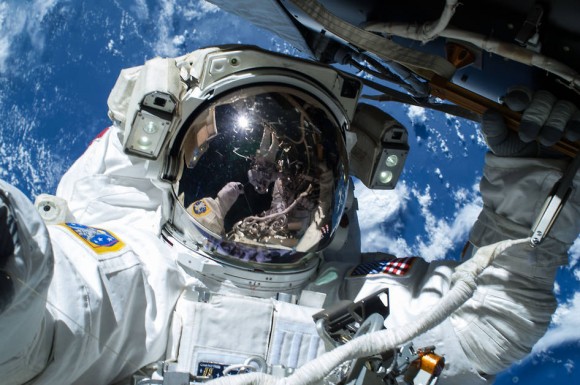
NASA astronaut Barry Wilmore works outside the International Space Station on the first of three spacewalks preparing the station for future arrivals by U.S. commercial crew spacecraft, Saturday, February 21, 2015. Fellow spacewalker Terry Virts, seen reflected in the visor, shared this photograph on social media.  View larger. \  Image credit; NASA

NASA astronaut Barry Wilmore works outside the International Space Station on the first of three spacewalks preparing the station for future arrivals by U.S. commercial crew spacecraft, Saturday, February 21, 2015. Fellow spacewalker Terry Virts, seen reflected in the visor, shared this photograph on social media.
View larger. | Image credit: NASA

During Sunday’s spacewalk, Virts and Expedition 42 Commander Barry Wilmore will deploy 400 feet of cable along the truss of the station and install antennas as part of the new Common Communications for Visiting Vehicles (C2V2) system that will provide rendezvous and navigational data to visiting vehicles approaching the station, including the new U.S. commercial crew vehicles

NASA astronaut Terry Virts Flight Engineer of Expedition 42 on the International Space Station is seen working to complete a cable routing task while the sun begins to peak over the Earth’s horizon on February 21 2015. Image credit: NASA

NASA astronaut Terry Virts Flight Engineer of Expedition 42 on the International Space Station is seen working to complete a cable routing task while the sun begins to peak over the Earth’s horizon on February 21 2015. Image credit: NASA

All three spacewalks are in support of the long-planned ISS reconfiguration from its current configuration, which was designed to support visiting Space Shuttles, to its new configuration optimived for future visiting commercial crew and cargo vehicles.

While cargo vehicles attach to the ISS using the process of berthing, whereby they are captured with the station’s robotic arm and positioned below a berthing port prior to being bolted into place, commercial crew vehicles will not use this method.

This is because the process of un-berthing takes a long time to complete, since cables and ducting between the visiting spacecraft and the ISS must first be manually disconnected, control boxes installed, hatches closed, and then the visiting spacecraft must be maneuvered away from the station with the robotic arm.

This means that berthing ports cannot support a rapid evacuation of crew from the ISS should it ever be necessary, which will be one of the primary roles of the commercial crew vehicles as they serve as “lifeboats” during their crew’s stay at the ISS.

Instead, crewed vehicles will attach to the ISS via a process of docking, whereby the visiting spacecraft flies itself all the way into its docking port and attaches via a capture ring striking a corresponding attachment mechanism..

The leading end effector of the Canadarm2 (bottom foreground) will be lubricated Wednesday when astronauts Barry Wilmore conduct their second spacewalk.  Imge credit: NASA TV

The leading end effector of the Canadarm2 (bottom foreground) will be lubricated Wednesday when astronauts Barry Wilmore conduct their second spacewalk. Image credit: NASA TV

Bottom line: NASA astronauts Barry Wilmore and Terry Virts aboard the International Space Station (ISS) completed the first of three spacewalk on February 21, 2105 and the second on February. On Sunday (March 1, 2015) they will perform the last of Expedition 42’s scheduled spacewalks. The astronauts are securing cables to prepare the orbiting laboratory for future arrivals by U.S. commercial crew.

SOURCE::::www.earthsky.org

Natarajan

Image of the Day… ” Photo of Meteor Shower Captured thro Airplane Window ” !!!

Another good reason to grab that window seat! Colin Legg captured this great photo of a meteor shower, seen from an airplane window.

View larger. | Alpha Centaurid Meteor Shower @ 40,000 ft by Colin Legg Photography

View larger. | Alpha Centaurid Meteor Shower @ 40,000 ft by Colin Legg Photography

Leave it to Colin Legg – one of the most amazing sky photographers we know – to catch a meteor shower from the window seat of an airplane. Colin wrote to EarthSky:

Valentines day (night), red eye flight back to Perth.

I had another go at night shots out the plane window … this time under very dark no moon conditions. Most of the flight was bumpy due to cold fronts, but things calmed down once we crossed the Western Australia coastline. I fired off a 20-minute burst of 1-second exposures, shielding the camera from cabin lights under a black hood.

Amazingly, the Alpha Centaurid meteor shower was also active!

Apologies for the excessive noise. Due to plane motion and minor turbulence, I couldn’t expose for much longer than 1 second and keep the stars sharp. Notwithstanding, it is quite amazing that modern day cameras can capture so much detail in 1 second on a no moon night.

Western Australia, ~40,000 ft, 10:50 -> 11:10 pm WST, Feb 14 2015

Bottom line: On Valentines Day night, 2015, Colin Legg caught the Alpha Centaurid meteor shower from the window seat of an airplane.

SOURCE:::: http://www.earthskynews.org

Natarajan

” Passengers Found Themselves in a Close Call after their Flight Flew into a Hailstorm “…

Damaged: A shock flight for passengers on Brazilian TAM Airlines Flight JJ 3307.

Damaged: A shock flight for passengers on Brazilian TAM Airlines Flight JJ 3307. Source: Supplied 

PASSENGERS on a Brazilian Airlines flight found themselves in a close call earlier this month after one of its jets unknowingly flew into a destructive hailstorm.

Brazilian TAM Airlines Flight JJ 3307 took off in Rio de Janeiro en route to the Brazilian city of Natal on February 9 and climbed to approximately 18,000 feet when the flight entered what has been described as a “cloud of hail”.

Local media Odia suggest lightning damaged the flight’s weather radar, steering the flight into dangerous territory and leaving its pilots powerless to know what lay ahead.

Reports indicate that as the plane was turning back, a hail strike hit, cracking the plane’s three-layered windscreen and crushing its nose. Pictures reveal the sheer power of the thunderstorm.

Despite the drama, the flight was able to make it to land safely within forty minutes.

No injuries were reported.

“In the path (the air) passed through a turbulent area and hail damage was not detected by radar,” TAM said in a statement.

“The landing was carried out at the Galeão International Airport, with complete safety for the passengers and crew.”

SOURCE::::: http://www.news.com.au

Natarajan

Image of the Day… Daytime Moon Covers Venus…

When the daytime moon covers Venus

Beautiful time-sequenced images from 2007, when the daytime moon covered the brightest planet, Venus.

When the moon occulted - over covered over - the planet Venus on June 17, 2007.  Photo by Alfons Gabel.

We don’t usually run photos from years ago as our Today’s Image. But with Venus blazing away in the west after sunset, we figured … yes! On June 18, 2007, the crescent moon eclipsed Venus. The 2007 occultation of Venus by the moon was visible in broad daylight from Europe and later at sunset from the Middle East and India. Alfons Gabel – a team member at Trebur Observatory – caught the occultation from Germany. He wrote:

Reading your article about stars and planets in the daytime, I remembered a daytime occultation of Venus I recorded in 2007. Using the waning moon as an indicator in the broad afternoon sky, even Venus was easily visible to the unaided eye – surprisingly bright.

Although not on the central line at my location in Klein-Winternheim near the 2000-year-old city of Mainz, Venus disappeared for 1 hour and 22 minutes behind the moon.

Such a long period was only possible, because Venus followed the moon’s sidereal motion with one fifth of its speed.

The creeping disappearance and even the reappearance at the bright edge of the moon were unforgettable impressions.

Best greetings from the Rhine river!

Best greetings to you as well, Alfons, and thank you for the images on this page!

By the way, the moon will occult Venus twice in 2015: October 8 and December 7.

More info about 2015 planetary occultations here.

More photos from the June, 2007 occultation of Venus


Close-up of the June 17, 2007 occultation of planet Venus by the moon.  Photo by Alfons Gabel.

Comparison of the brightness of the planet Saturn - and that of the planet Venus - during an occultation by the moon.  Photo by Alfons Gabel.

Bottom line: Beautiful time-sequenced image from 2007, when the daytime moon covered the brightest planet, Venus. Photo by Alfons Gabel in Germany.

SOURCE:::: http://www.earhskynews.org

Natarajan

” Your Plane Could Be Operated by Remote Control , if the Latest Trial in Sweden Takes off …” !!!

The technology means air traffic controllers can work from anywhere. Picture: Saab

The technology means air traffic controllers can work from anywhere. Picture: Saab Source: YouTube

YOUR plane could soon be operated by remote control if the latest trial in Sweden takes off.

Örnsköldsvik airport in the northeast of Sweden has ditched its control tower and is now landing planes via remote control from an airport sitting 100km away. And there are plans for a similar system to come to Australia.

Air traffic controllers for Örnsköldsvik now sit in a computer simulated room at the larger Sundsvall airport surrounded by giant television screens beaming footage to them of Örnsköldsvik’s incoming planes.

Air traffic controllers sit in a room hundreds of kilometres away where they are beamed f

Air traffic controllers sit in a room hundreds of kilometres away where they are beamed footage of incoming planes. Picture: Saab. Source: YouTube

The only airport in the world to be managed by remote control, it is called the Remote Tower System (RTS) and is being trialled in Sweden as a way of improving accuracy and cutting costs.

It works by streaming high definition images of incoming planes at Örnsköldsvik to a Remote Tower Control room based in Sundsvall. Using high tech cameras, sensors and microphones — the RTS collects data about the plane to provide a simulated digital visual to the controllers as well as surround sound audio of the incoming plane.

The technology has been designed by Saab, the Swedish defence and security company, who says it provides “enhanced situational awareness” for air traffic controllers.

New features include object tracking and alerting, night vision, image enhancement, onscreen display of plane statistics, runway incursion warnings and options for zooming and switching to infra-red view in thick fog and darkness.

The system will use real time object tracking. Picture: Saab.

The system will use real time object tracking. Picture: Saab. Source: YouTube

Mikael Henriksson, the project manager of the RTS in Sundsvall, told NPR it’s a “paradigm shift” for the industry. “For the air traffic controller, this is like airline pilots going from propeller to jet,” he said.

NPR spoke to Erik Backman who runs the RTS in Sundsvall, who says he was dubious when he first saw the mock-up technology in 2004. However a decade later he says they’ve been landing planes remotely for months without any major problems.

The use of remote control towers has been explored by the aviation industry as a way of cutting costs at airports too quiet to warrant full time air traffic controllers.

Later this year a US airport, Leesburg Executive Airport in Virginia, will be installing the RTC, making it the first remote-controlled operated airport in the country.

This airport is operated by remote control... really?

Saab believes regional airports can be operated by remote towers. Picture: Saab. Source: YouTube

Australia is also considering installing the technology with plans to control planes at Adelaide airport by air traffic controllers sitting in Melbourne, 700km away.

Rob Walker, spokesman for Airservices Australia, told the Adelaide Advertiser that the increase in air traffic across Australia requires an upgraded and centralised air traffic system.

He said this system would allow controllers monitoring aircraft in Adelaide to be based in Melbourne and aircraft in Cairns to be monitored from Brisbane.

“There is no change in the number of controllers but only where the service is delivered from … and safety is not an issue,’’ he said. Changes will not be made until 2017.

SOURCE::::: http://www.news.com.au

Natarajan

Selfie of Curiosity ‘Mojovae’ Site on Mount Sharp of MARS !!!!


This self-portrait of NASA’s Curiosity Mars rover shows the vehicle at the “Mojave” site, where its drill collected the mission’s second taste of Mount Sharp.

The scene combines dozens of images taken during January 2015 by the Mars Hand Lens Imager (MAHLI) camera at the end of the rover’s robotic arm.  The pale “Pahrump Hills” outcrop surrounds the rover, and the upper portion of Mount Sharp is visible on the horizon.  Darker ground at upper right and lower left holds ripples of wind-blown sand and dust.

An annotated version, Fig. A, labels several of the sites Curiosity has investigated during three passes up the Pahrump Hills outcrop examining the outcrop at increasing levels of detail. The rover used its sample-collecting drill at “Confidence Hills” as well as at Mojave, and in late February was assessing “Telegraph Peak” as a third drilling site.

The view does not include the rover’s robotic arm.  Wrist motions and turret rotations on the arm allowed MAHLI to acquire the mosaic’s component images. The arm was positioned out of the shot in the images, or portions of images, that were used in this mosaic. This process was used previously in acquiring and assembling Curiosity self-portraits taken at sample-collection sites “Rocknest” (http://photojournal.jpl.nasa.gov/catalog/PIA16468), “John Klein” (http://photojournal.jpl.nasa.gov/catalog/PIA16937) and “Windjana” (http://photojournal.jpl.nasa.gov/catalog/PIA18390).

Curiosity used its drill to collect a sample of rock powder from target “Mojave 2” at this site on Jan. 31, 2015.  The full-depth, sample-collection hole and the shallower preparation test hole beside it are visible in front of the rover in this self-portrait, and in more detail at http://photojournal.jpl.nasa.gov/catalog/PIA19115 .  The Mojave site is in the “Pink Cliffs” portion of the Pahrump Hills outcrop. The outcrop is an exposure of the Murray formation, which forms the basal geological layer of Mount Sharp.  Views of Pahrump Hills from other angles are at http://photojournal.jpl.nasa.gov/catalog/PIA19039 and the inset at http://mars.jpl.nasa.gov/msl/multimedia/images/?ImageID=6968 .

The frames showing the rover in this mosaic were taken during the 868th Martian day, or sol, of Curiosity’s work on Mars (Jan. 14, 2015).  Additional frames around the edges to extend the amount of terrain included in the scene were taken on Sol 882 (Jan. 29, 2015).  The frames showing the drill holes were taken on Sol 884 (Jan. 31, 2015).

For scale, the rover’s wheels are 20 inches (50 centimeters) in diameter and about 16 inches (40 centimeters) wide.  The drilled holes in the rock are 0.63 inch (1.6 centimeters) in diameter.

MAHLI was built by Malin Space Science Systems, San Diego. NASA’s Jet Propulsion Laboratory, a division of the California Institute of Technology in Pasadena, manages the Mars Science Laboratory Project for the NASA Science Mission Directorate, Washington. JPL designed and built the project’s Curiosity rover.

More information about Curiosity is online at http://www.nasa.gov/msl and http://mars.jpl.nasa.gov/msl/.

Credit: NASA/JPL-Caltech/MSSS

SOURCE:::::: http://www.nasa.gov

Natarajan

Image of the Day…. ISS astronauts’ Space Walk Today… Feb 25…

Today’s spacewalk – the 2nd of 3 planned – began at 7:10 a.m. EST (1210 UTC) and will last 6.5 hours. This post has links to today’s live coverage, plus spectacular images from Saturday’s spacewalk.

NASA astronaut Barry Wilmore works outside the International Space Station on the first of three spacewalks preparing the station for future arrivals by U.S. commercial crew spacecraft, Saturday, February 21, 2015. Fellow spacewalker Terry Virts, seen reflected in the visor, shared this photograph on social media.  View larger. \  Image credit; NASA

NASA astronaut Barry Wilmore works outside the International Space Station on the first of three spacewalks preparing the station for future arrivals by U.S. commercial crew spacecraft, Saturday, February 21, 2015. Fellow spacewalker Terry Virts, seen reflected in the visor, shared this photograph on social media.
View larger. | Image credit: NASA

Today – February 25, 2015 – beginning at 7:10 a.m. EST (1210 UTC), International Space Station (ISS) astronauts are performing the second of three spacewalks to prepare the orbiting laboratory for future arrivals by U.S. commercial crew spacecraft. NASA TV coverage has begun and will go until 2 p.m. EST (1900 UTC) Wednesday. Watch here

NASA astronauts Barry Wilmore and Terry Virts completed the first spacewalk on February 21 and the third is scheduled for Sunday, March 1.

The spacewalks are designed to lay cables along the forward end of the U.S. segment to bring power and communication to two International Docking Adapters slated to arrive later this year. The new docking ports will welcome U.S. commercial spacecraft launching from Florida beginning in 2017, permitting the standard station crew size to grow from six to seven and potentially double the amount of crew time devoted to research.

NASA astronaut Terry Virts Flight Engineer of Expedition 42 on the International Space Station is seen working to complete a cable routing task while the sun begins to peak over the Earth’s horizon on February 21 2015. Image credit: NASA

Ground controllers have maneuvered the space station’s large robotic arm Canadarm2 in place for work planned for Wednesday’s spacewalk. Spacewalkers Barry Wilmore and Terry Virts will start their spacewalk at 7:10 a.m. EST to lay more cables and lubricate one of Canadarm2’s two latching end effectors, which serve as tip or base for the robotic arm. They will also prepare the Tranquility module for the relocation of the Permanent Multipurpose Module and the new Bigelow Expanded Activity Module later this year.

All three spacewalks are in support of the long-planned ISS reconfiguration from its current configuration, which was designed to support visiting Space Shuttles, to its new configuration optimived for future visiting commercial crew and cargo vehicles.

While cargo vehicles attach to the ISS using the process of berthing, whereby they are captured with the station’s robotic arm and positioned below a berthing port prior to being bolted into place, commercial crew vehicles will not use this method.

This is because the process of un-berthing takes a long time to complete, since cables and ducting between the visiting spacecraft and the ISS must first be manually disconnected, control boxes installed, hatches closed, and then the visiting spacecraft must be maneuvered away from the station with the robotic arm.

This means that berthing ports cannot support a rapid evacuation of crew from the ISS should it ever be necessary, which will be one of the primary roles of the commercial crew vehicles as they serve as “lifeboats” during their crew’s stay at the ISS.

Instead, crewed vehicles will attach to the ISS via a process of docking, whereby the visiting spacecraft flies itself all the way into its docking port and attaches via a capture ring striking a corresponding attachment mechanism.

The leading end effector of the Canadarm2 (bottom foreground) will be lubricated Wednesday when astronauts Barry Wilmore conduct their second spacewalk.  Imge credit: NASA TV

Bottom line: NASA astronauts Barry Wilmore and Terry Virts aboard the International Space Station completed the first of three spacewalk on February 21, 2105. The second is scheduled for Wednesday, February 25 and the third for Sunday, March 1. The astronauts are securing cables to prepare the orbiting laboratory for future arrivals by U.S. commercial crew.

SOURCE::::: http://www.earthskynews.org

Natarajan