108 Names of Lord Ganesha ….with Meanings ….

108 Names of Lord Ganesha (with meanings)

Fun & Info @ Keralites.net


1. Akhurath – One who has Mouse as His Charioteer

2. Alampata – Ever Eternal Lord

3. Amit – Incomparable Lord

4. Anantachidrupamayam – Infinite and Consciousness Personified

5. Avaneesh – Lord of the whole World

6. Avighna – Remover of Obstacles

7. Balaganapati – Beloved and Lovable Child

8. Bhalchandra – Moon-Crested Lord

9. Bheema – Huge and Gigantic

10. Bhupati – Lord of the Gods

11. Bhuvanpati – God of the Gods

12. Buddhinath – God of Wisdom

13. Buddhipriya – Knowledge Bestower

14. Buddhividhata – God of Knowledge

15. Chaturbhuj – One who has Four Arms

16. Devadeva – Lord of All Lords

17. Devantakanashakarin – Destroyer of Evils And Asuras

18. Devavrata – One who accepts all Penances

19. Devendrashika – Protector of All Gods

20. Dharmik – One who gives Charity

21. Dhoomravarna – Smoke-Hued Lord

22. Durja – Invincible Lord

23. Dvaimatura – One who has two Mothers

24. Ekaakshara – He of the Single Syllable

25. Ekadanta – Single-Tusked Lord

26. Ekadrishta – Single-Tusked Lord

27. Eshanputra – Lord Shiva’s Son

28. Gadadhara – One who has The Mace as His Weapon

29. Gajakarna – One who has Eyes like an Elephant

30. Gajanana – Elephant-Faced Lord

31. Gajananeti – Elephant-Faced Lord

32. Gajavakra – Trunk of The Elephant

33. Gajavaktra – One who has Mouth like An Elephant

34. Ganadhakshya – Lord of All Ganas (Gods)

35. Ganadhyakshina – Leader of All The Celestial Bodies

36. Ganapati – Lord of All Ganas (Gods)

37. Gaurisuta – The Son of Gauri (Parvati)

38. Gunina – One who is The Master of All Virtues

39. Haridra – One who is Golden Coloured

40. Heramba – Mother’s Beloved Son

41. Kapila – Yellowish-Brown Coloured

42. Kaveesha – Master of Poets

43. Krti – Lord of Music

44. Kripalu – Merciful Lord

45. Krishapingaksha – Yellowish-Brown Eyed

46. Kshamakaram – The Place of Forgiveness

47. Kshipra – One who is easy to Appease

48. Lambakarna – Large-Eared Lord

49. Lambodara – The Huge Bellied Lord

50. Mahabala – Enormously Strong Lord

51. Mahaganapati – Omnipotent and Supreme Lord

52. Maheshwaram – Lord of The Universe

53. Mangalamurti – All Auspicious Lord

54. Manomay – Winner of Hearts

55. Mrityuanjaya – Conqueror of Death

56. Mundakarama – Abode of Happiness

57. Muktidaya – Bestower of Eternal Bliss

58. Musikvahana – One who has mouse As charioteer

59. Nadapratithishta – One who Appreciates And Loves Music

60. Namasthetu – Vanquisher of All Evils & Vices & Sins

61. Nandana – Lord Shiva’s Son

62. Nideeshwaram – Giver of Wealth and Treasures

63. Omkara – One who has the Form Of OM

64. Pitambara – One who has Yellow-Coloured Body

65. Pramoda – Lord of All Abodes

66. Prathameshwara – First Among All

67. Purush – The Omnipotent Personality

68. Rakta – One who has Red-Coloured Body

69. Rudrapriya – Beloved Of Lord Shiva

70. Sarvadevatman – Acceptor of All Celestial Offerings

71. Sarvasiddhanta – Bestower of Skills And Wisdom

72. Sarvatman – Protector of The Universe

73. Shambhavi – The Son of Parvati

74. Shashivarnam – One who has a Moon Like Complexion

75. Shoorpakarna – Large-Eared Lord

76. Shuban – All Auspicious Lord

77. Shubhagunakanan – One who is The Master of All Virtues

78. Shweta – One who is as Pure as the White Colour

79. Siddhidhata – Bestower of Success & Accomplishments

80. Siddhipriya – Bestower of Wishes and Boons

81. Siddhivinayaka – Bestower of Success

82. Skandapurvaja – Elder Brother of Skand (Lord Kartik)

83. Sumukha – Auspicious Face

84. Sureshwaram – Lord of All Lords

85. Swaroop – Lover of Beauty

86. Tarun Ageless

87. Uddanda – Nemesis of Evils and Vices

88. Umaputra – The Son of Goddess Uma (Parvati)

89. Vakratunda – Curved Trunk Lord

90. Varaganapati – Bestower of Boons

91. Varaprada – Granter of Wishes and Boons

92. Varadavinayaka – Bestower of Success

93. Veeraganapati – Heroic Lord

94. Vidyavaridhi – God of Wisdom

95. Vighnahara – Remover of Obstacles

96. Vignaharta – Demolisher of Obstacles

97. Vighnaraja – Lord of All Hindrances

98. Vighnarajendra – Lord of All Obstacles

99. Vighnavinashanaya – Destroyer of All Obstacles & Impediments

100. Vigneshwara – Lord of All Obstacles

101. Vikat – Huge and Gigantic

102. Vinayaka – Lord of All

103. Vishwamukha – Master of The Universe

104. Vishwaraja – King of The World

105. Yagnakaya – Acceptor of All Sacred & Sacrficial Offerings

106. Yashaskaram – Bestower of Fame and Fortune

107. Yashvasin – Beloved and Ever Popular Lord

108. Yogadhipa – The Lord of Meditation


source::::: input from a friend of mine….

natarajan


Message For The Day….Elders Should Show The Way to Their Children For The Right Path …

For the wisdom of discrimination to dawn on people, elders must first set an example in discrimination and detachment. If they run after sensory pleasures with feverish excitement, how can the youth be blamed for their selfishness and greed? The elders must practise what they preach, show how a divine life confers mental poise, joy, contentment and harmony. They must spend at least some time everyday in the recital of the Lord’s Name or on Meditation. Then, children too, will imbibe that atmosphere and acquire peace for sure. Today, many speak with full passion that there is nothing as sweet as the Name of the Lord, but they do not repeat it at all. Children will easily discover the hoax, if one neglects their own spiritual progress on the path, but preaches it. The accountability of those who profess the spiritual path is great and must not be undermined.


Sathya Sai Baba

Message For The Day….What is “Samskrithi ” and “Samskara” ?….

‘Samskrithi’, the Sanskrit word for culture, is derived from the root word ‘Samskara’ which means the dual process of removing dust and dirt, and planting the virtues of Truth, Right Conduct, Love, Non-violence and Love. Certain obligatory rites of initiation and purification prescribed by the Vedas for one’s spiritual upliftment, are also referred to as Samskaras. There are 48 such, but all of them can be reduced to just one, which is the final and fulfilling one – recognition of one’s identity with the Divine. Man (Nara) is God (Narayana). The individual entity (Jiva) is Divinity (Brahman) seen through the limitations of primal ignorance.

Sathya Sai Baba

Divine Images with Message for The Day ….

Sooo Sweetttt !!!!
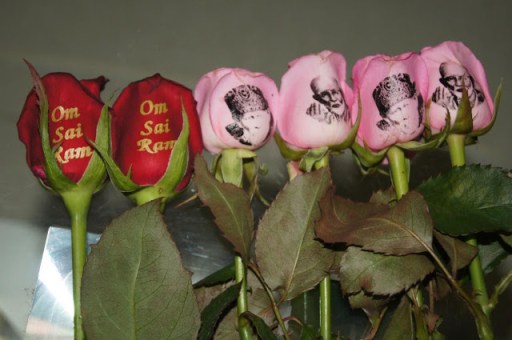
Pune based Businessman Shri Naveen Dev has drawn the picture of Shri Saibaba and wrote Om Sairam on Rose flowers with the help of advance machine and paid his obeisance by offering the flowers to Saibaba in Shirdi
Quote of BABA:
Recognize God (Khuda) by your wisdom!
[You never know in which form, He might come to visit you in order to bless you] 
source:::: H.Deepa in shirdi sai speaks
natarajan

Message For The Day….Walk the Path Shown to You by Vedic Sriptures ….

Walk the path shown to you by the Ramayana, Mahabharatha, Bhagavatha and other scriptures. Proceed along that path, unmindful of halts and handicaps, approvals or disapproval of kith and kin, of praise or blame from society. What exactly is praise or blame? They are words – just sound waves coming from across the air; waves that strike your ear. Let them strike only the outer ear, do not welcome them in. Grace is won by suffering alone. The Lord incarnates in the world when unrighteousness becomes rampant. Therefore adharma(unrighteousness) has to be suffered so that each one may have the joy of welcoming the Lord and experiencing His Presence.


Sathya Sai Baba


Message For The Day….Divinity is Imminent and Inherent in Every Soul….

All objects are suffused by the same Divine Principle. All names are attributes of His glory. Divinity is imminent and inherent in every soul, and the process of reminding people of this fact began with the very dawn of human history. What is to be done to lead a Divine life? Remove the fog which hides the Truth! The fog of illusion makes you believe that you are something inferior, momentary, evanescent and material! That is incorrect! All are holy, pure and are part of Eternity. Each one of you shine in proportion to your spiritual efforts (Sadhana), just as bulbs spread illumination according to their wattage. There is no body which is not sustained by the Absolute. There is no name that does not indicate the Universal. All are His!


Sathya Sai Baba

What One Man”s Dedication Brought in !!!

Sri Valli-Teyvanai Samedha MuruganMarch 20, 1968: It was a dark day indeed for the priest at the Ratnagiri Hill Temple, located between Vellore and Arcot about a hundred miles from Chennai. Three months had gone by since he was last paid, and his patience was running out. “How much longer must this go on?” he thought to himself. He was in a particularly sour mood this morning and decided to not perform his obligatory daily worship service in the main shrine of the temple.

Rathinagiri Bala Murugan Adimai:

What One Man’s Dedication Brought !!!

Pl read further ….

natarajan

Rathinagiri Tavatiru Balamurugan Adimai in 1968

 
About this time, Satchidanandam–a 27-year-old clerk–strolled into the temple for his usual morning worship. When he saw the condition of the main shrine, he was shocked. Not only were the lamps and incense not lit, but also fresh flowers and sacraments had not been gathered and prepared. Nor had the puja implements been cleaned and set out.

“Where is the priest?” he thought to himself. “Why is he not performing the morning puja?” Satchidanandam could not help feeling a special concern for the welfare of this particular temple. His father, Kandaswami Mudaliar, had initiated the construction of the 156 steps leading up to its entrance in 1936 and orchestrated its kumbhabhishekam (major consecration) in 1938.

Although young Satchidanandam was discouraged by what he saw, he still circumambulated the shrine and stood before the Deity to pray. As he began to commune with the shakti that he felt emerging from within the shrine, he fell into a swoon. The experience took him by surprise.

Nothing like this had ever happened to him before. As he leaned against a pillar for support, his body quivered with bliss as his head filled with a golden light. Just as he was about to merge into a sea of oneness, Lord Muruga appeared before him in His etherial body. Although the presence of this legendary God was powerful, He vanished almost as soon as he appeared–like a bolt of lightening.

Slowly, young Satchidanandam settled back into a calm and peaceful physical consciousness. He knew it would take some time to fully digest what had just happened. For now, however, he was aware only of a mighty determination to restore this neglected temple to the state of its original elegance and beauty. At that very moment, the transformed young man took a vow to never leave the Ratnagiri Hill Temple until it had been fully renovated.

Tavatiru Bala Murugan Adimai
Thus began the work that was to be his life’s mission. The residents of the nearby village of Kilminnal stopped calling the young man “Satchidanandam.” Instead, they referred to him as Balamurugan Adimai–or just “Swamiji ” for short.

In the 36 years that have passed since the clerk-turned-holy-man took his vow to do this work, he has not left the temple precincts even once, and his life has been one of exemplary simplicity and austerity. Aside from worshiping and meditating three times daily–at 4:30 in the morning, 12 noon and six in the evening–he remains fully available as a servant of the God that appeared before him during his one unforgettable life-changing experience. Most of his time is spent fully immersed in the supervision of temple construction and the hosting of guests. At 9:00 pm he retires to his room for meditation and sleep. His few personal needs are easily met.

Swamiji is an expert in working with people. He takes special care to become knowledgeable in every aspect of temple construction so that, whether he is talking with sthapatis about stone work or silversmiths about metal crafting, he can negotiate knowledgeably on even the smallest details of their work. He even becomes actively involved with the supervision of photographers and journalists who come regularly to publicize the progress of the on-going renovation.

The neglected Ratnagiri Hill Temple, for which songs were composed and sung by Saint Arunagirinathar in the 14th century, was originally only 200 square feet in size. Today, due to the inspiration and hard work of Balamurugan and the people who help him, it covers more than 30,000 square feet.

Over time Swamiji has also become a spiritual guide and social leader for the residents of Kilminnal. Besides catalyzing their mystical and religious inclinations, he also provides assistance of a more practical sort. So far, he has built a school, a hospital and a number of roads; and provided much-needed water to the area by digging wells and constructing massive tanks for water storage.

It’s no wonder the local people love him and gladly volunteer their time and energy to lift large, heavy granite stones to the hilltop for the temple construction. In 1987, Swamiji began building his school for the youth of the surrounding rural areas by first constructing the Ratnagiri Nursery, which

opened with two teachers and 18 students. Through the years that followed, he constructed additional buildings to provide classroom and library space for education in a variety of fields including math, science, language, literature and computer science.

Sample of Rathinagiri Tavatiru Bala Murugan Adimai’s handwriting .

Today, Swamiji’s school campus includes ample kitchen and bathroom facilities, a large conference hall, several libraries and 24 classrooms. It employs 43 teachers and 12 staff members and provides education for 900 students. The hospital, which Swamiji began constructing in 1988, now has 26 staff members and makes medicine available at subsidized rates to local residents. Monthly eye camps sponsored by the hospital provide poor villagers with cataract operations, free of charge. Medical specialists from Chennai visit every Sunday. The Accident Relief Center, aided by State Government and run by the hospital, provides a fully equipped mobile van–the first of its kind in the Vellore district–for emergency outcalls.
Rathinagiri Tavatiru Balamurugan Adimai today

Rathinagiri Tavatiru Balamurugan Adimai
The future of Kilminnal and the Ratnagiri Hill Temple look bright as long as 64-year-old Balamurugan Adimai is around. Although one might assume that the continued improvement, maintenance and management of the temple, school and hospital facilities that have already been created might constitute a full-time job, such might not be the case for the ever-vibrant Balamurugan.

If the past provides any indication of what the future might bring–which usually it does–there should be good reason to assume that more dynamic creativity can be expected from Balamur ugan Adimai.

1968: Satchidanandam enjoys a vision of Lord Muruga. Local villagers name him “Balamurugan.”
1970: Balamurugan begins his service. A well is dug for the temple and nearby village of Kilminnal. The main Ratnagiri mandapam (worship hall) and an entrance Ganesha shrine and mandapam at the base of Ratnagiri Hill are constructed.
1973: Two more temple mandapams and a large marriage hall are built. Six staff buildings and eight guest cottages are also constructed.
1974: An ornate temple entry arch is erected, and electricity is installed to provide night lighting for the temple.
1975: A five-story rajagopuram (main temple tower) is completed. Two 8,000-liter water tanks are installed for use by local residents. A large dining hall and kitchen are built.
1978: A post office and police station for Kilminnal are constructed. Ten staff buildings and four guest cottages are added to the temple.
1988: The long-term construction of a school for local youth begins. A 25-bed hospital is completed.
2003: A separate building for computer training is constructed for the school. Science and library annexes are also added.
Courtesy: Hinduism Today magazine July/August/September 2004  and murugan.org

natarajan

Visit http://www.Ratnagiri.org official website of Rathinagiri Bāla Murugan Tiru Kovil

Message For The Day….You Must Love God and Lead Your Life with Good Conduct …

Many of you often come to Puttaparthi or visit other holy places. You hear scholars expounding the scriptures. You have observed great and noble souls. What is the benefit? How have you improved by all this? Have you succeeded in at least recognising your rajasik (passionate) and thamasik (dark) habits and tendencies? Recognizing them as deleterious is the first step in removing them. Have you become more and more serene and poised (Sathvik) as the years go by, or are you the same dull or perhaps fiery individual? If you must know the Lord, you must love the Lord and lead your life with good conduct. Hatred or even indifference will result only in misunderstanding. Develop close association with the Lord and He will reveal Himself to you.

Sathya Sai Baba