Prior to the age of the airliner, Zeppelin airships ruled the skies over the north Atlantic — connecting cities like New York with Western Europe. Zeppelin’s fleet of airships included such colossal creations like the Graf Zeppelin and the Hindenburg along with the less famous Graf Zeppelin II.
Before the modern jumbo jet and its first class suites, the biggest and grandest thing in luxury air travel was the German Zeppelin Airship.
Of all the massive Zeppelin’s constructed, the most famous was the Hindenburg. The Hindenburg was designed to ferry passengers across the Atlantic in serenity, with the dirigible floating smoothly through the clouds.
The Hindenburg was the first of two “Hindenburg” Class airships constructed by the Zeppelin Company. Construction of the airship began in 1931 and was completed in 1936. The Hindenburg, along with its highly successful predecessor, the Graf Zeppelin, made numerous trans-Atlantic crossings in their brief but illustrious career.
Constructed out of an aluminum alloy called duralumin, the Hindenburg’s massive frame work was filled with 7 tons of hydrogen. Hydrogen is much lighter than air, and allows the massive Zeppelin to carry more people in greater levels of luxury. However, with an ignition source, an oxidizer, and right concentration, hydrogen can also be incredibly flammable.
The Hindenburg entered passenger service in May of 1936 and carrier up 50 passengers in luxury across the Atlantic.
The legend of the Hindenburg’s luxurious amenities are well know, but most have not seen them in living color. So take the opportunity to check out these wonderful photos of the Zeppelin’s passengers spaces courtesy of airships.net and the German Federal Archive.
LZ-129 Hindenburg: A Detailed History

Hindenburg’s Transatlantic Service to North America
On May 6, 1936, LZ-129 began the service it was built for; regular transatlantic crossings between Germany and the United States, carrying up to 50 passengers with both comfort and speed.

The passengers on Hindenburg’s maiden voyage to America included celebrities, wealthy travelers, journalists, and members of the Nazi elite. (See complete passenger list with photos and biographies.)
The flight featured the first Catholic mass ever said in the air, and a broadcast over the NBC radio network including a recital on Hindenburg’s specially-made lightweight duralumin piano.
[Read an account of Hindenburg’s maiden voyage to North America by United Press reporter Webb Miller, who was a passenger on the flight.]
Hindenburg’s Arrival in America after Maiden Voyage to USA
Hindenburg’s 2-1/2 day crossing of the North Atlantic was an astounding accomplishment at a time when even the fastest transatlantic ocean liners (such as the Blue Riband-winning Queen Mary, Normandie, and Bremen) made the trip in five days, and slower ships took as long as 10 days.
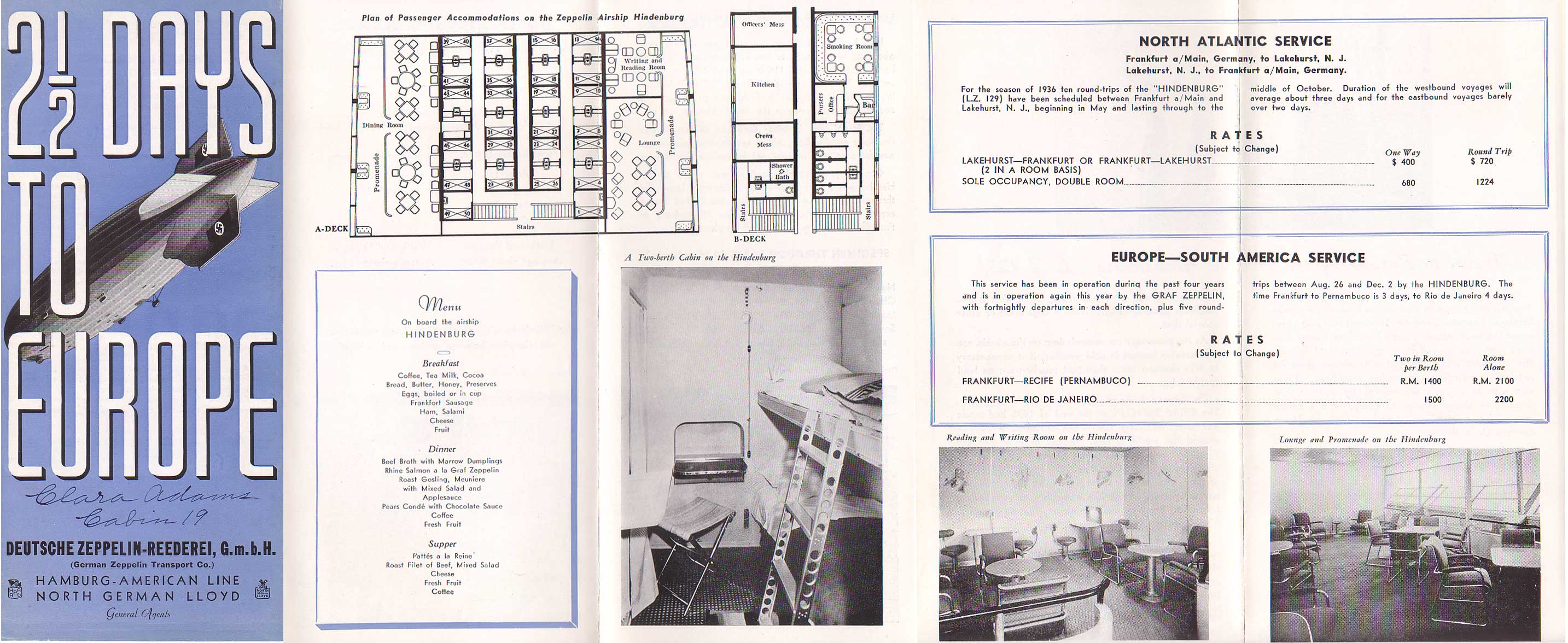
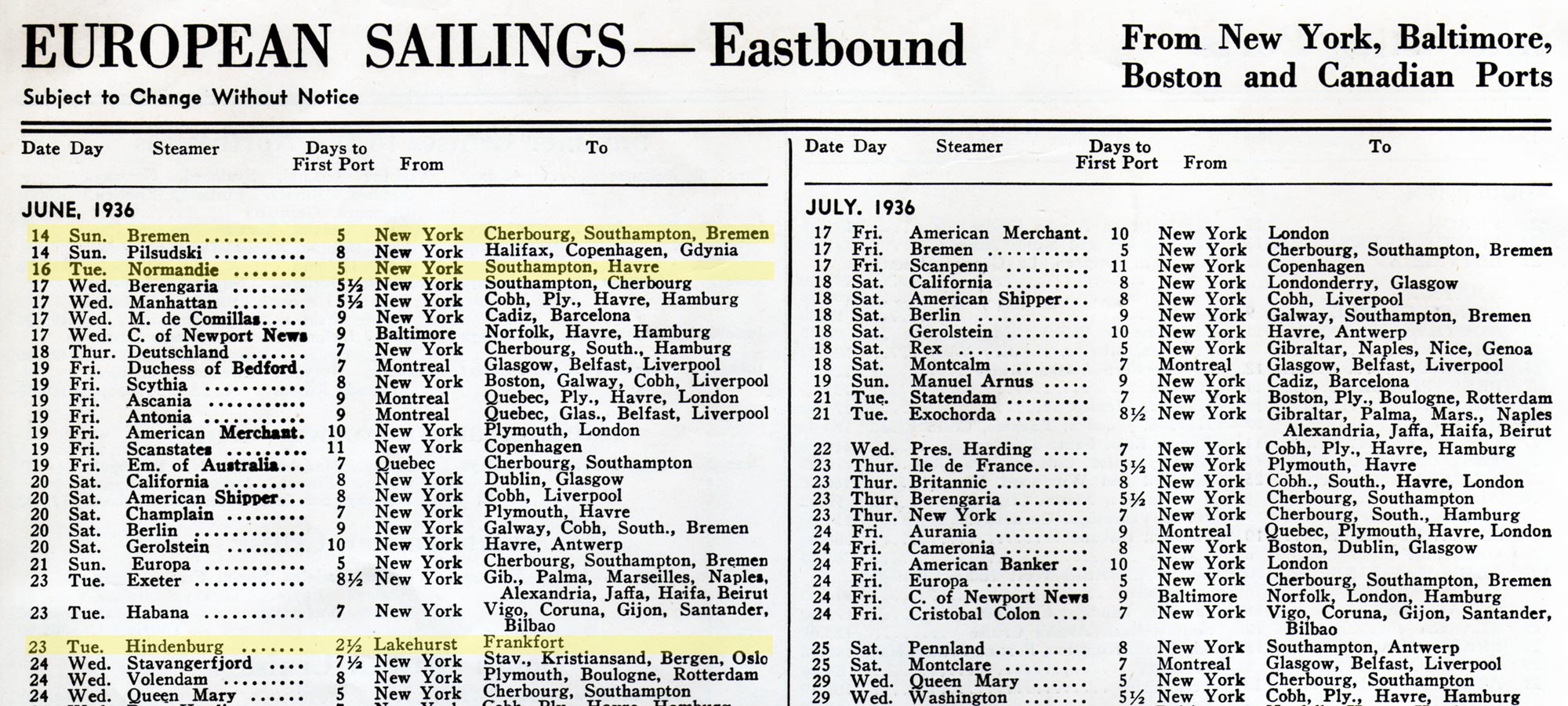
Hindenburg’s fastest crossing of the North Atlantic took place in August, 1936; the ship lifted off from Lakehurst, New Jersey at 2:34 AM on August 10th and landed in Frankfurt the next day, after a flight of just 43 hours and 2 minutes.
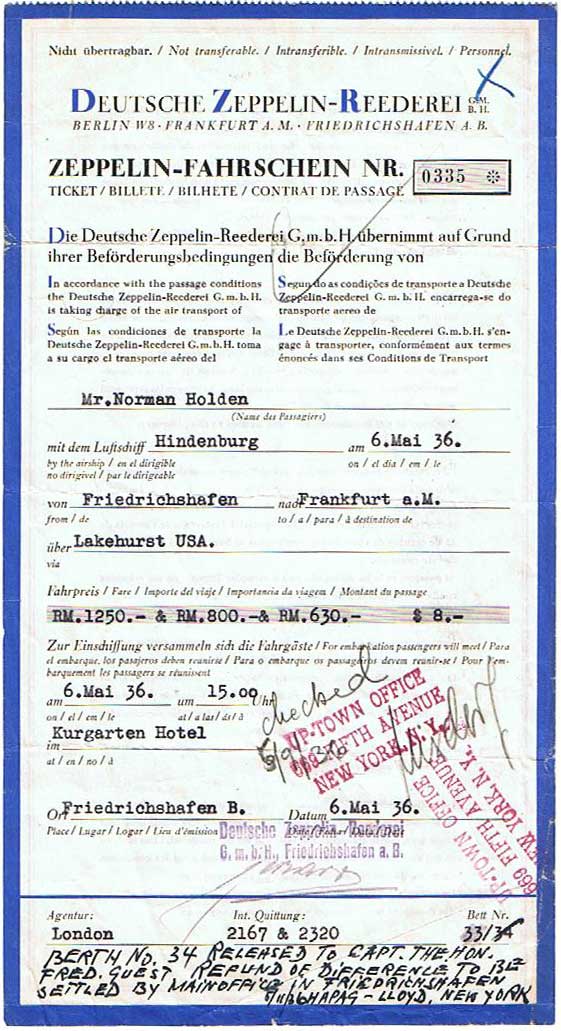
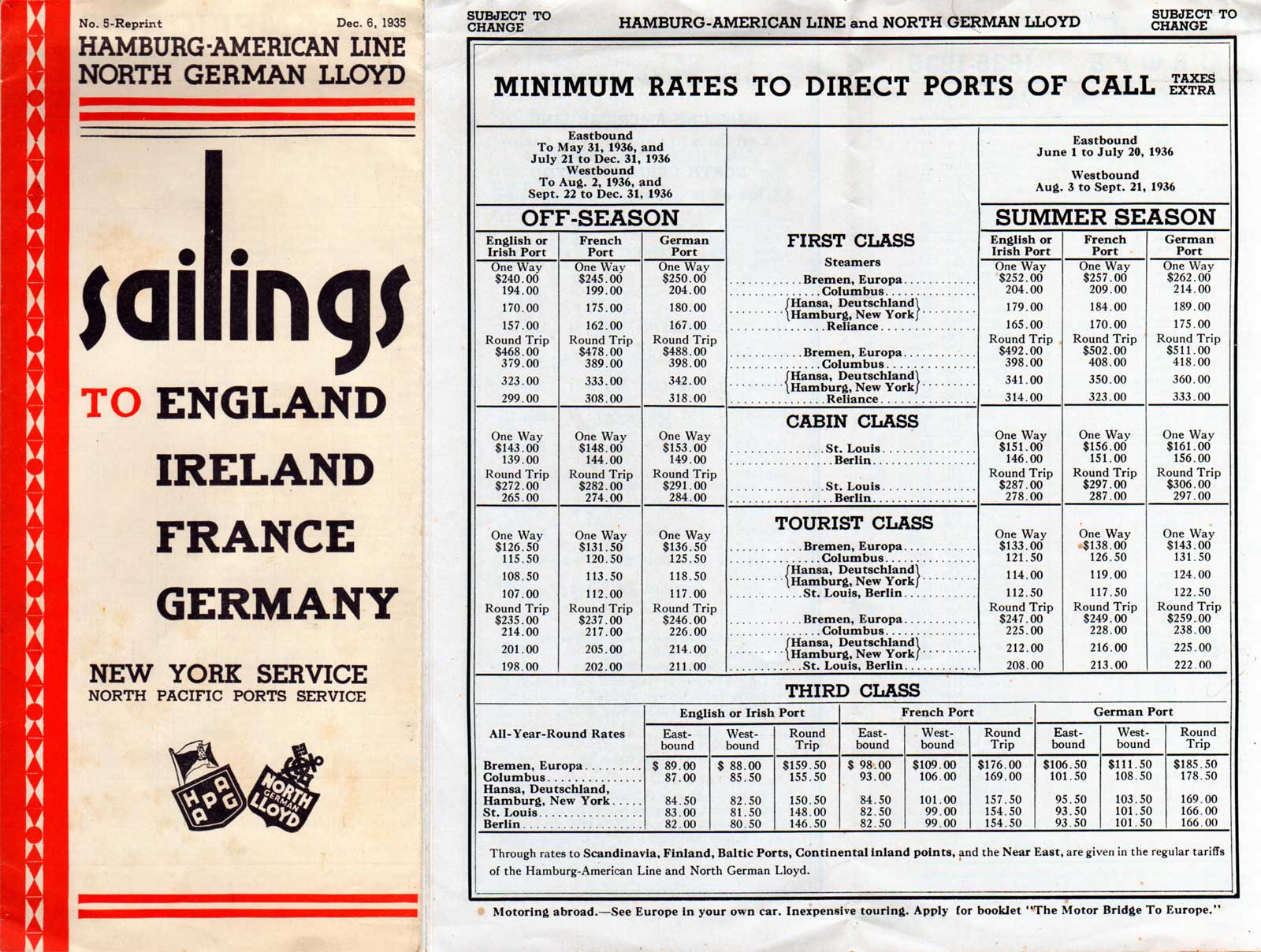
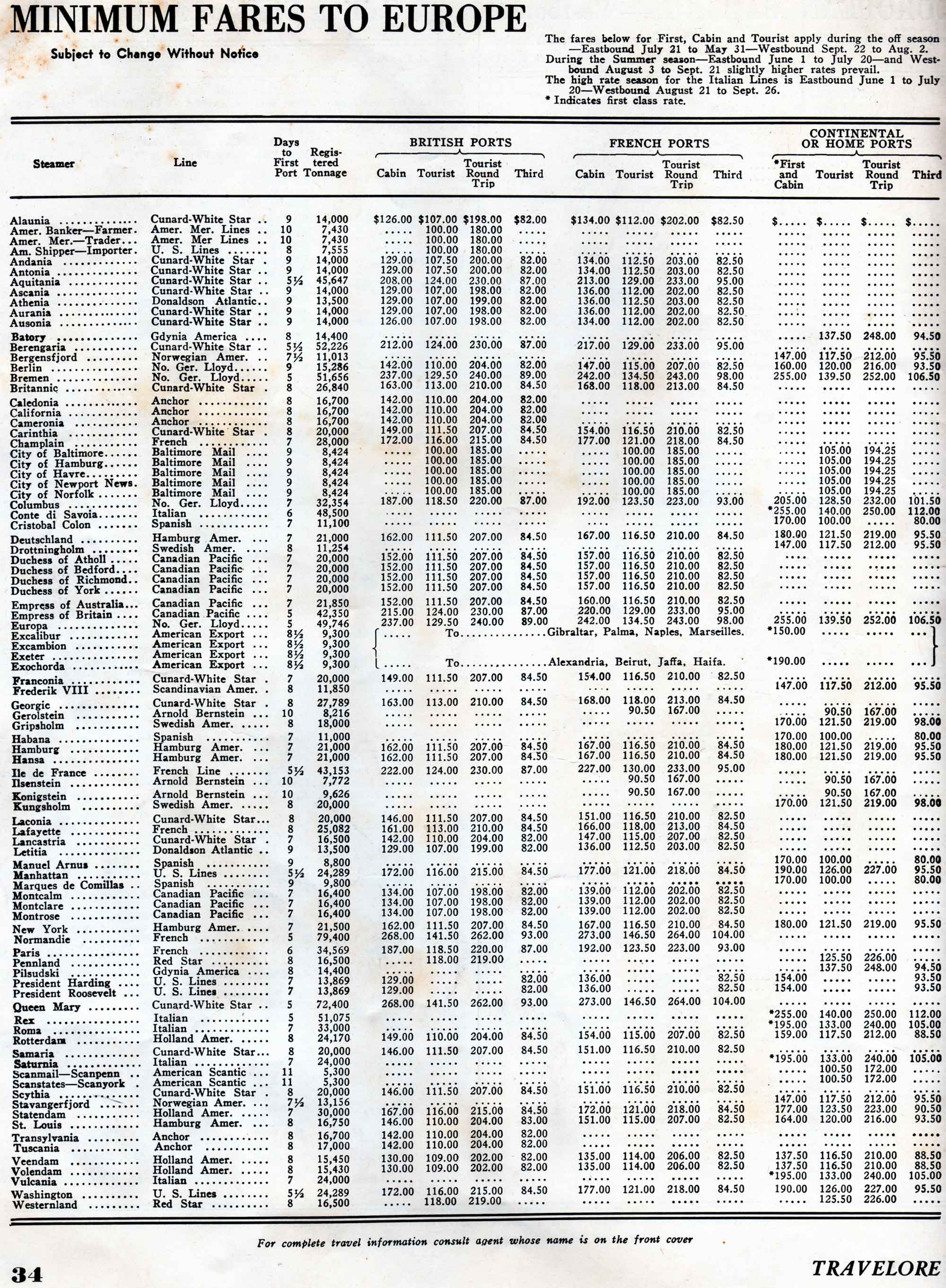
Of course, Hindenburg’s speed came at a price; passage between Europe and America via Hindenburg cost $400 one way in 1936, and $450 in 1937, while first class passage on a German ocean liner could be had for as little as $157. The best German liners of the day, Bremen and Europa, charged $240 (HAPAG/NDL rate brochure), and rates on Cunard’s Queen Mary were similar (Cunard rate brochure). And a passenger could cross the Atlantic in third class for just $82.00 (see complete 1936 transatlantic rates; view jpg or download .pdf).
(Converting these prices to current values is a theoretically complicated exercise, since different economists approach this topic with different assumptions, but those who are interested in converting these fares to current prices might look athttp://eh.net/howmuchisthat orhttp://www.measuringworth.com/uscompare.)
In addition to revenue from passengers and freight, Hindenburg derived income from the large quantities of mail it carried. (See examples of Hindenburg mail.) Because of Hindenburg’s irregular sailing dates during its maiden season, coupled with the high price of postage for zeppelin mail, most of the letters carried in 1936 were philatelic (items designed especially for stamp collectors or those seeking a souvenir of the zeppelin service) rather than commercial, but plans to introduce a more regular schedule in 1937 and possibly lower the cost of postage left the DZR hopeful that significant income could be earned by carrying business mail.
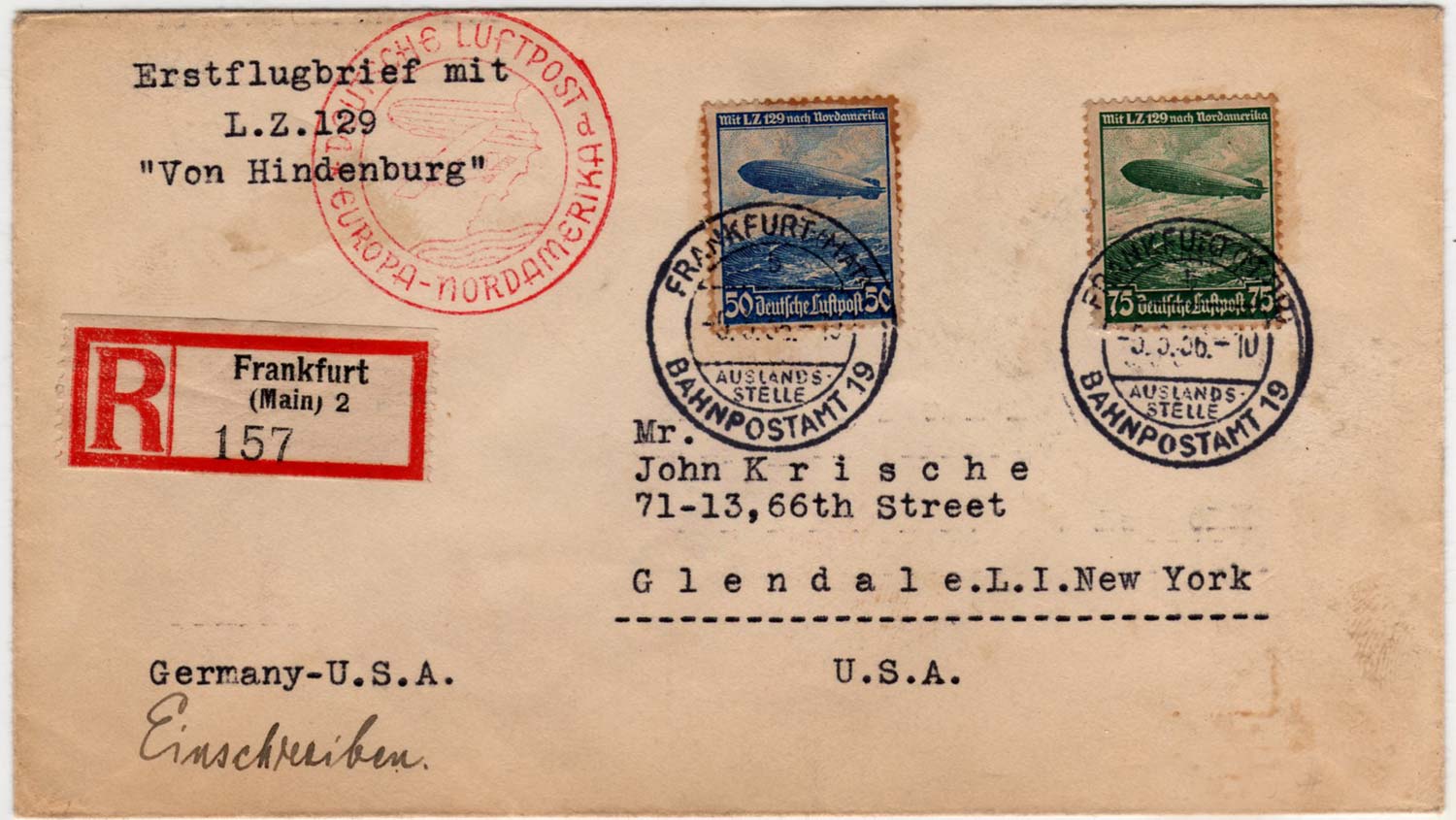
Registered mail carried on Hindenburg’s first flight from Europe to North America (Sieger 406D)
By the end of 1936, Hindenburg had crossed the Atlantic 34 times, carrying over 3,500 passengers and more than 66,000 pounds of mail and freight, and the ship’s highly successful 1936 season seemed to indicate that regular transatlantic air service had arrived.
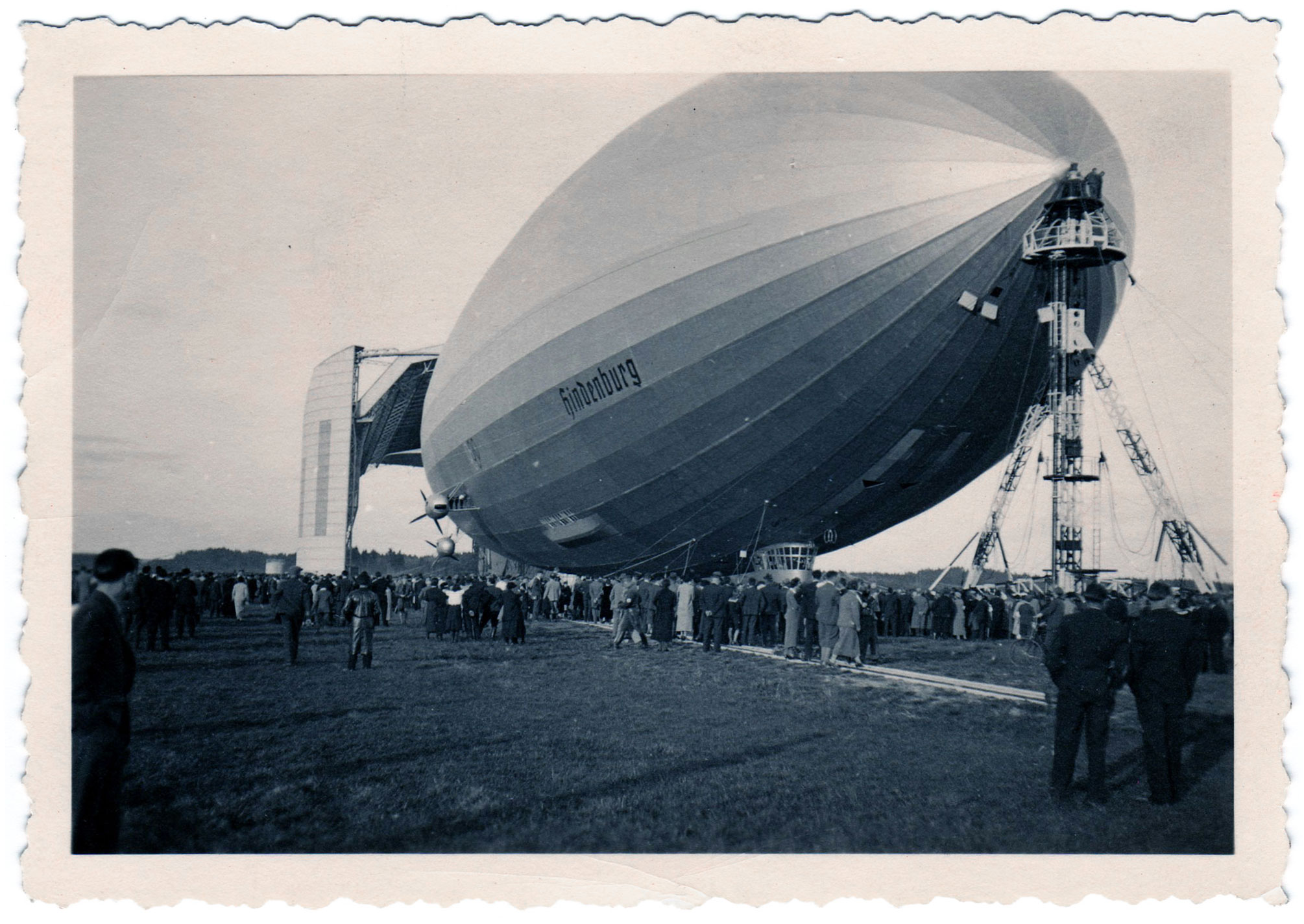
On October 9, 1936, just before Hindenburg’s last flight from the United States to Germany, 72 wealthy and influential passengers were invited on what became known as theMillionaires Flight; a 10-1/2 hour cruise over New England to generate support for a German-American transatlantic zeppelin service. The passengers were awestruck by the ship, the Hindenburg received wide coverage in the press, and the future of the passenger zeppelin seemed brighter than ever.
Hindenburg’s 1937 Season
With the success of Hindenburg’s 1936 season, eighteen round-trip flights between Germany and the United States were scheduled for 1937, and a companion ship, LZ-130, was nearing completion at the Zeppelin Company construction shed in Friedrichshafen.
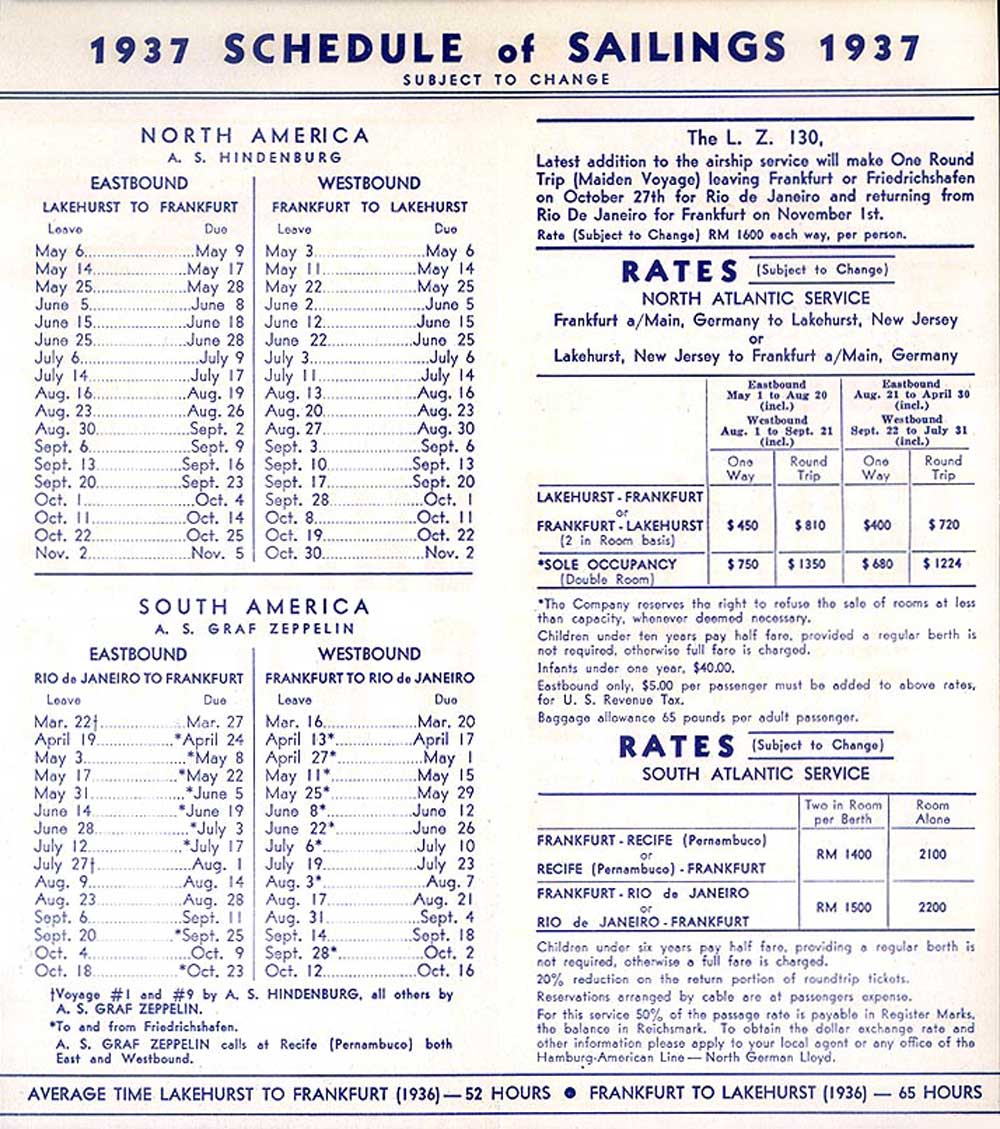
During the winter between the 1936 and 1937 seasons Hindenburg underwent maintenance and renovations at Frankfurt. Since the ship was being operated with hydrogen — rather than the helium for which it had been designed — it had a greater lifting capacity, andadditional passenger cabins were added to take advantage of the additional lift.
Hindenburg made six successful flights in 1937, including a round-trip from Germany to Brazil, and test flights in which World War I ace and Luftwaffe leader Ernst Udet attempted to fly a small airplane onto a trapeze-hook mounted on the airship.
On Hindenburg’s first North American flight of the 1937 season, under the command of Captain Max Pruss, theHindenburg crashed at Lakehurst, New Jersey, killing 13 of the 36 passengers, 22 of the 61 crew, and a civilian member of the ground handling team, and the era of transcontinental passenger zeppelin travel came to an end.
The Hindenburg Disaster
For complete information about the crash of the Hindenburg at Lakehurst, New Jersey, on May 6, 1937, visit the Hindenburg Disaster.

Other link for inf.
 Take off with Natarajan