Vinayaka Chaturthi

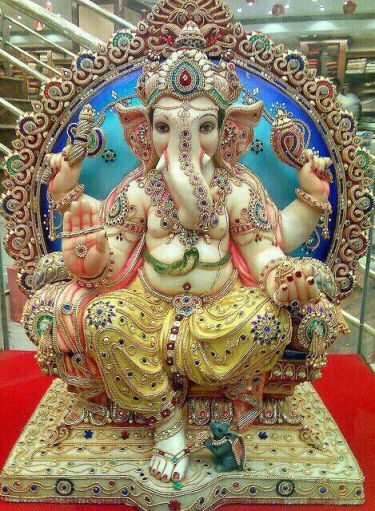
Vinayaka is the Lord of Gnanam. If we pray to him, he would bestow upon us the Knowledge that would liberate us from the cycle of birth and death which is samsara. The tradition of Vinayaka worship is part of our ancient culture and has been given to us by our rishis so that we may understand the truth about our life. The word ‘Vinayaka’ is Vi + Nayaka. The word ‘Nayaka’ means Leader and the prefix ‘Vi’ indicates Supreme. Thus Vinayaka is the Supreme Leader or God. Only because he is the Supreme, we pray to him first before starting anything auspicious. Even while writing a major work like poetry, there is first the invocation to Lord Vinayaka which you can see from Bhagavan’s Aksharamanamalai, so that He would clear all the obstacles on the path. Even while writing anything there is the tradition of affixing the “Pillayar Suzhi” on the top of the page. Thus we are taught to think of the Lord in all our activities. The form of Vinayaka appears like the Om symbol signifying his primordial nature.
In the Puranas, Vinayaka’s father Lord Siva had a fruit of Gnanam. There was a contest between Vinayaka and his younger brother Muruga as to who would get this great fruit. The test was to go around the world and whoever returned first would get the coveted fruit. Vinayaka cleverly went around his parents Siva and Parvati and got the fruit. He ate the fruit and became a Jnani. Thus he became the God for Jnanam. Similarly, in the Hindu Pantheon, various Gods represent various qualities ― Sarasvati for learning, Lakshmi for wealth, Kali for valour, Hanuman for strength and so on. By worshipping them we try to obtain such qualities for our life.
On the day of Vinayaka Chaturthi, we worship a clay image of the Lord. God is formless in nature but we cannot imagine anything that is formless. It is not possible for us to imagine even how air looks like because it is formless. That is why for the purpose of worship we create a form that symbolises Him. We worship Him for nine days and then immerse the idol in a tank or well so as to restore him to his original formless nature. What does this convey to us? We were also originally one with God and formless and we have now taken on a form and the big stomach of the idol shows how we have been only pampering the body and living at the level of the body only and all our pujas have been essentially in the form of “stomach puja”! In fact, the prasadam for this puja is ‘Kozhakkattai’ which too has significance. The outer layers represent the pancha kosas or the five sheaths that cover the soul and the inner sweet is called the Pūraṇam. This is symbolic of how all beings are made up of. Pūraṇam means Totality or Self. The Self or soul covered by the five sheaths is the Pūraṇam and it is all sweetness. Thus even in the offering of prasadam we are taught a great truth. Thus our rishis are constantly reminding us of our true nature and the goal of life so that we may acquire the right knowledge in order to be liberated from this bondage of repeated births. Thus for nine days we concentrate on the various aspects of the Lord and this helps us in our spiritual development. Finally, we are shown how to attain the formless state ― by having a holy dip in the waters of the Self (as Andal has shown in Tiruppavai). By merging and dissolving in the waters of the Self within us, the mind that is with form becomes formless and attains oneness with the Self. This is the state of Jnanam which is to regain our true nature by merging in the Self in our own Heart. This is the significance of the clay idol being immersed in a pond or tank at the end of the worship.
Thus we see that our rishis were very great and intelligent to give us such a ritual wherein as we keep doing our puja, we would be able to slowly understand and attain the goal of life. Why should they use an elephant head to represent Lord Vinayaka? The significance of this has been given to us by Bhagavan Ramana Maharshi. The trunk of the elephant descends from the head and curls to the right side of the chest. It indicates that the mind that is residing in the head has to be brought to the spiritual Heart which is situated on the right side of the chest. This is not the physical heart which is on the left side. Thus even the path to attaining Jnanam has been clearly delineated by the rishis. The working centre of the mind has to descend from the head to the Heart. This is the spiritual journey or sadhana one has to undertake in order to regain one’s formless nature and attain Liberation. Thus as we keep doing the puja, year after year, we would start contemplating on the various principles indicated in this worship and this will lead us to an enquiry into our true nature. Thus over a period of time, our attention would be drawn from puja to enquiry which is the essence of Jnana Margam and we would be embarked on an inner journey that will lead us to our supreme destination.
Thus every year we worship Lord Vinayaka to remind ourselves that Jnanam is the path to Moksham and we pray to the Lord to grant us the Supreme Knowledge. When our prayers are strong and the mind pure, the Lord would come to us alive in the form of a Guru and instruct us on the path to be taken by which we would reach Him. The Guru is the guide to take us to Him. Thus all our rituals and festivals have a great significance which is to help us to go back to the Lord who is our Source. Our pujas are not meaningless rituals as some tend to think these days. Many people in family life think that puja and rituals need not be done because they have gone above them. They should realise that even if they have spiritually evolved, they need to do it in order to set the right example for their children to practise. Then only such great traditions can be maintained. Even great saints like Kanchi Paramacharya and others had always performed such pujas for the sake of others. Even Lord Krishna says in Bhagavad Gita, Stanza 3:21, “Whatever a great man does, only that other people follow; whatever example he sets, that the world follows.” Thus we should not stop our pujas and other traditions just because we feel we no longer require it. We may have to do it for the sake of others. Moreover, if we don’t do them out of lethargy or complacency, our elders in the family may feel bad about it and treat it as indifference. This shows that we have a karma to do such things. And till there are no expectations in the family and there is no feeling of guilt, we should fulfil all our karmas without escaping. Then one day they would all end and nobody would mind even if we don’t perform our pujas. Thus we should be clear as to why we have to do all these pujas and rituals. All such activities done in the right manner would surely elevate us.
We are indeed fortunate to be born in this Punya Bhoomi called ‘Bharata’ wherein spirituality is in our culture and our blood itself! In fact, in the name Bharata (also known as ‘Bharat’ in Hindi), ‘Bha’ means light which refers to the inner light or the light of knowledge which is spiritual knowledge and ‘rata’ means devoted to or intent upon. Thus the word ‘Bharata’ means those devoted to or keen on acquiring the inner light which is the Self. Thus Bharata is the nation of those who are keen to attain the Self for which they are seeking spiritual knowledge. This means that the people of Bharata were primarily spiritual seekers and this is our heritage. This was how the people of our country lived in ancient times. That is why our country has produced numerous rishis and saints from the time immemorial because seeking the Self has
been part of our culture and heritage and is there in the nature of all those who are born in this sacred land called Bharata. Having been born in this glorious land, we should not miss the opportunity of acquiring spiritual knowledge and seeking the Self which is the supreme goal of life. Let us therefore follow the path of our ancient ones and achieve the grand purpose of life in this very birth itself!
Let me wish you all an enlightening Vinayaka Chaturthi!
source::::input from a friend of mine
natarajan



 Take off with Natarajan