This $300 million airliner is the hottest new trend in private jets….

image

Kestrel Aviation Management   Boeing 787-8 BBJ.

In July, China’s HNA Aviation Group will welcome a shiny new Boeing 787-8 Dreamliner to its fleet.

This plane is special because it is the first 787 Dreamliner to be built purely as a private jet.

HNA’s new Dreamliner is symbolic of a hot new trend in private and corporate aviation — long-range, mid-size, wide-body airliners.

“It’s an emerging market that didn’t really exist in the past,” Kestrel Aviation Management CEO Stephen Vella told Business Insider. Kestrel oversaw the design, engineering, and fabrication of HNA’s new Dreamliner which has an estimated total cost topping $300 million.

Airbus and Boeing have long offered versions of its airliners to private customers under their Airbus Corporate Jet and Boeing Business Jet programs. However, buyers of these airliner-based private jets have long gravitated to either four-engine, jumbo jets like the Boeing 747 or smaller, narrow-body jets such as the Airbus A320.

“The market is traditionally separated into two buckets,” Vella said. “The big Boeing 747s and Airbus A340s primarily catered to heads of state while the smaller Airbus A320 and Boeing 737s are popular corporate runabouts as well as secondary planes in government fleets.”
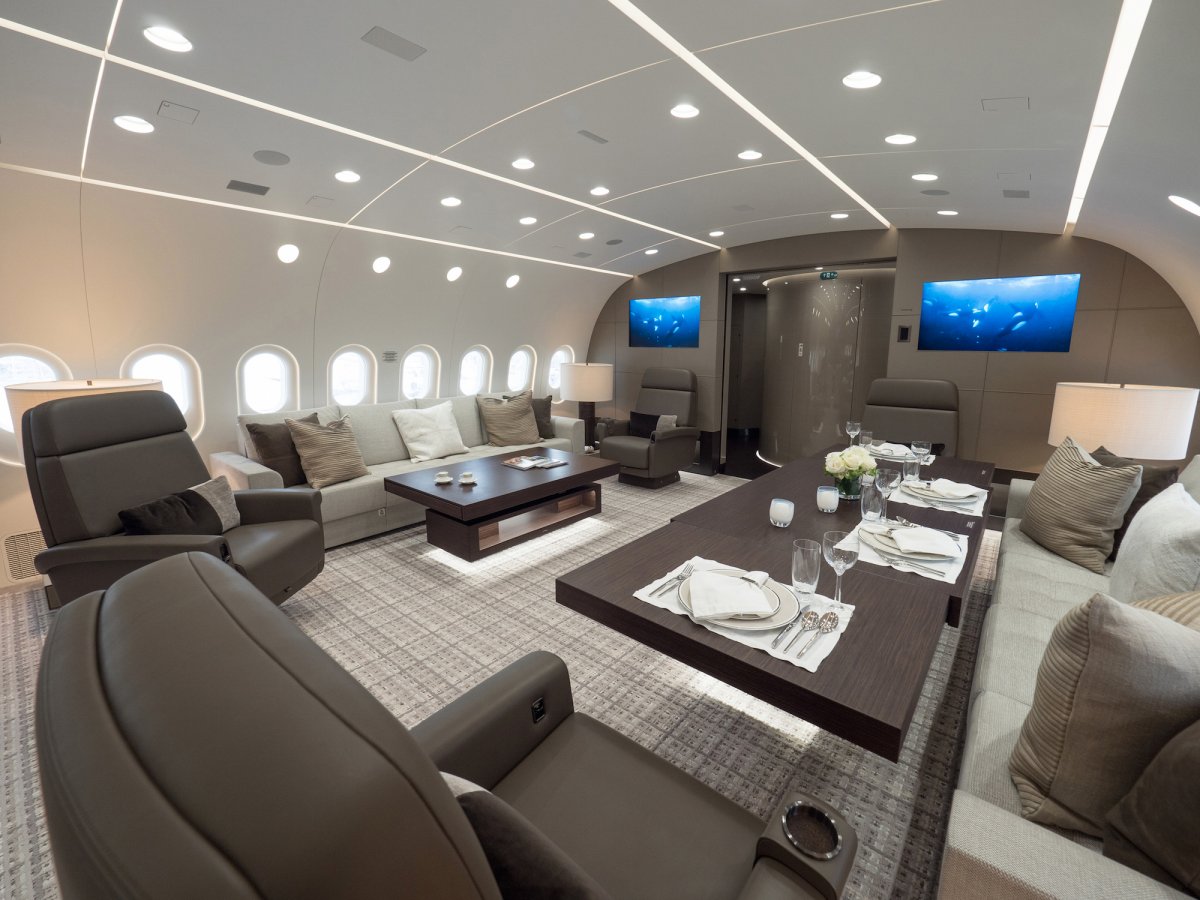
image (1)


Boeing 787-8 BBJ interior.

Although twin-engine, mid-size, wide-body jets such as the Boeing 767 and the Airbus A330 have long been available, they never quite caught on with the private jet crowd.

However, in recently years, ultra high-end private jet customers have become increasingly interested in the new generation mid-size, wide-body planes such as the Dreamliner and Airbus A350.

What’s changed?

According to Vella, several factors led to the shift.

First, leading business men and heads of state are generally pressed for time. As a result, they prefer be to able to fly anywhere they need to go non-stop. Until recently, this simply wasn’t possible in a twin-engined jet. The traditional thinking in the aviation dictates that there’s safety in the number of engines a plane has.

Regulating bodies such as the US Federal Aviation Administration have even placed limits on which ultra-long-range intercontinental routes twin-engine jets can fly. As a result, government and corporate clients looking for a plane which the range and capability to go anywhere in the world had to turn to four-engined jumbos.

However, with the incredible reliability of modern turbofan engines, the regulatory limitations on twin-engined jets have essentially been wiped out. Now, planes such as the A350 and the 787 can fly anywhere the owner requires, but in a slightly smaller and more affordable package. For instance, HNA’s new state-of-the-art composite Boeing has a range of 9,800 miles even when packed with passengers, luggage, and fuel. A similarly outfitted A350 ACJ will be able to delivery that type performance as well.

“You can fly between virtually any two points on the globe,” Vella said of the Dreamliner.

Secondly, the price of crude oil has fallen dramatically over the past two years. Even though cheaper fuel makes buying and operating a thirsty, four-engined, jumbo jet much more attractive, low crude prices have also cut dramatically into the income of Middle Eastern governments. Unfortunately for the 747 BBJ, they are also some of the plane’s biggest customers.

According to Vella, all major Middle Eastern governments such as Saudi Arabia, operate large royal fleets, many of which are jumbo jets, for elite members of the ruling family and officials to use.

Over the next decade or so, these fleets with need to be updated. Vella, whose company has bought and sold more than $50 billion worth of commercial and private jets, believes the Middle Eastern clientele are ready to do some belt-tightening and downsize to smaller planes.

Finally, another factor that has benefited the Dreamliner-sized jet is the increasing public sensitivity towards political largess. Unlike the US, where the plane that operates as Air Force One is held in high esteem and seen as a symbol of national power, the public in many countries view a large presidential aircraft as a sign of political over indulgence.

According to Vella, this is a particularly sensitive issue in Europe. However, a smaller aircraft with the performance capabilities of a jumbo, but in a less attention-getting package is a reasonable alternative.

“The mid-size jets have less ramp presence,” Vella said. “They offer the owner much more discretion.”

After all, it’s hard to arrive discretely in a jumbo jet no matter where you go. Even at the world’s busiest international airports, an aircraft the size of a 747 or Airbus A380 is conspicuous.

But all of this requires some perspective. Even the “smaller” 787 BBJ is still an absolutely massive aircraft. At 186 ft. long, even Donald Trump’s converted Boeing 757 is dwarfed by the new Dreamliner. And with 2,400 sq. ft. of living space, it offers the same amount of room as an average American suburban home.

What’s coming

According to the long-time aviation executive, over the next 15-20 years, demand from just the Middle East for Boeing 787-sized private jets will top 30 aircraft. That may not sound like many planes, but at more than $300 million a pop, that’s about $10 billion in business from just a handful of customers.

In fact, Vella believes demand from East Asia will be just as intense over that period of time.

“Because of the high number of long distance and (trans-oceanic) flights the customers make, these are the perfect planes for Asia,” Vella added.

Whether the market for these mid-size, twin-engine wide-body private jets actually skyrockets remain to be seen. But with the unprecedented level of advanced technology, luxury, and performance it can offer, they are an undeniably attractive option for the right buyer.

Source…..BENJAMIN ZHANG   in http://www.businessinsider.com.au

Natarajan

Man lives 555 days without a Heart …

1465822719821

While waiting for a human heart transplant, Stan Larkin lived 555 days without the organ at all.

To passers-by, the 25-year-old Ypsilanti, Michigan, resident appeared to be a typical young adult. He enjoyed taking his three toddlers to the park and hanging out with his younger brother, Dominique.
What wasn’t obvious was that a gray backpack Larkin carried was what kept him alive. Inside that bag was the power source for an artificial heart pumping in his chest.
Larkin’s real heart was removed from his body in November 2014. It was replaced with a device that allowed Larkin to stay home instead of in a hospital while waiting to receive a transplant.
It finally arrived this year, in May. Now, Larkin is recovering from his procedure at the University of Michigan Frankel Cardiovascular Center. He is scheduled to return home as early as next week.
“Most people would be scared to go so long with [an artificial heart], but I just want to tell them that you have to go through the fear, because it helps you,” Larkin said. “I’m going home so fast after the transplant because it helped me stay healthy before the transplant.”
At any given time, there are about 4,000 patients nationwide waiting for human heart transplants, according to the U.S. Organ Procurement and Transplantation Network.
Some patients with end-stage heart failure may wait months or even years before a suitable donor heart becomes available, said Dr. Billy Cohn, a cardiovascular surgeon and director of the Center for Technology and Innovation at the Texas Heart Institute.
“Many of these patients have hearts that are so weak, the kidneys, liver and other critical organs will fail while they are waiting,” said Cohn, who was not involved in Larkin’s care. “Many of these patients would die without some form of support,” such as an artificial heart.

‘A machine was going to be my heart’

Larkin didn’t realize that his heart was suffering until nine years ago, when he collapsed without warning while playing in a basketball game. It turned out that Larkin had a genetic form of heart disease called familial cardiomyopathy. His brother, Dominique, 24, was soon found to have it, too.
The condition occurs when heart muscle stretches and enlarges the open area of at least one heart chamber, inhibiting the organ from pumping blood efficiently.
The type of cardiomyopathy seen in Stan and Dominique, called arrhythmogenic dysplasia, causes arrhythmias and failure on both sides of the heart, said Dr. Jonathan Haft, a cardiac surgeon at the University of Michigan who operated on the brothers.
“It’s an awful condition to have,” Haft said. “But the technology available and the technology that is evolving in the field of heart failure is very exciting. … The total artificial heart falls into that category.”
Both brothers eventually progressed to heart failure and cardiogenic shock, and they were equipped with artificial heart devices in late 2014. Dominique stayed in the hospital with his device for six weeks before receiving a human heart transplant.
But Larkin, who was thriving with the device, was the perfect candidate to live outside the hospital, Haft said.
“I was shocked when the doctors started telling me that I could live without a heart in my body and that a machine was going to be my heart. Just think about it — a machine,” Larkin said.

‘It feels like a real heart’

It’s not the first time a patient has lived for a long time with an artificial heart, but Larkin became the first patient in Michigan to go home with the portable device.
The SynCardia temporary artificial heart in Larkin’s chest replaced his failing heart, including its chambers and four valves. Two tubes, exiting the left side of Stan’s body beneath the ribcage, connected the artificial heart to a 13-pound machine called the Freedom Driver.
 
The driver, which was carried in a backpack, not only powered the artificial heart, it delivered pumps of compressed air into the heart’s ventricles, allowing blood to be pumped through the body.
“Stan was very active and did an immaculate job taking care of himself and taking care of the equipment used to keep him alive,” Haft said.
With his life-saving backpack in tow, Larkin played pick-up games of basketball, enjoyed time with his children and rode in the car with his friends.
“It’s just like a real heart,” Larkin said. “It’s just in a bag with tubes coming out of you, but other than that, it feels like a real heart. … It felt just like a backpack with books in it, like if you were going to school.”
Voncile McCrae, Larkin’s mother, often helped him change the bandages covering the holes in his body where the tubes emerged.
We had to be careful so that he wouldn’t get an infection,” McCrae said, chuckling about how she had been scared to touch the tubes and handle the Freedom Driver machine. “Now, I’m a pro.”

‘An amazing brother’

The technology that, temporarily, was a part of Larkin’s body shows just how advanced artificial heart devices have become since the world’s first self-contained artificial heart was implanted in a patient in 2001, said Dr. Laman Gray, Jewish Hospital chair in cardiovascular surgery at the University of Louisville.
Gray was one of the celebrated surgeons who performed that first artificial heart procedure. He has closely followed developments in the fields of cardiac surgery, such as Larkin’s case.
“I think there’s good science here, and there have been really great advancements in this area,” Gray said. “We’re making great progress, and people are living normal lives. There’s definitely a place for total artificial hearts and a need for them.”
Dominique said he and his brother are grateful that their needs were met — and that they survived.
“I have an amazing brother,” Dominique said. “He has been here with me since the beginning and has never let me down. … I’m blessed to have him in my life.”
Source…..By Jacqueline Howard, CNN ….www.stumbleupon.com
Natarajan

Operation Sulaimani: A District Collector’s Mind Blowing Initiative to Feed the Hungry in Kozhikode…!!!

The people of Kozhikode are silently funding an initiative that feeds anyone who is hungry for free, with utmost dignity.

“Nalla Manushyar Aanu” – “They are good people.” This is a default comment that you will hear about the people of Kozhikode, Kerala. From its fabled auto drivers who return every penny of change, to its palliative clinic that provides free care for the terminally ill, to simple heart-warming selfless conversations, the tales of Kozhikode’s good hearted people are greatly cherished.

Now here is a reason why you will also chime in with some words of praise – Kozhikode makes sure no one in the city goes hungry! Be it the poorest, the not so poor, be it you or me – the hungry will be served food for free, with utmost dignity.

People in need can collect a free meal coupon from any of the distribution centres and walk into any restaurant in the city – a meal will be served, no questions asked, no explanations sought.

K2

Restaurants in Kozhikode serve meals to the hungry in exchange for free coupons given away by the authorities.

Pic for representation purposes only: kerala.in

“We cannot ask a hungry person to get his hunger attested by a certified gazetted officer! That is why we insisted on the philosophy that ‘no questions will be asked’. If you ask for a food coupon, you will get it, it is as dignified as that,” says District Collector of Kozhikode, Prashant Nair, the chief architect of this project called ‘Operation Sulaimani’, eponymous of Kozhikode’s very own local black tea, served with a dash of lemon and cardamom.

The project was launched by Kozhikode’s District Collector, Prashant Nair, who envisaged this as a community owned and community driven initiative in its entirety. The Collector’s office initiated it and the Kerala State Hotel and Restaurants Association roped in over 125 city restaurants to become a part of this.

But, there are no big sponsors nor do any government funds flow in. The small and big contributions by the citizens are dropped into little boxes with ‘Operation Sulaimani’ inscribed on them.

K4

The volunteer team has placed the boxes across the city, into which nameless donations are made. This money is used to reimburse the meal coupons that are collected at the restaurants. Interestingly, Team Sulaimani does not take a penny from the collected money to meet its administrative costs. This money is meant only to feed the hungry, they insist.

In April 2015, Operation Sulaimani made the free meal coupons available at the Collectorate, Village and Taluk offices. Coupons were also distributed along with newspapers with the intent that people who read newspapers can offer the coupons to those in need. An army of volunteers went around the city to spread the word and distributed the coupons.

Just two days after the launch of Operation Sulaimani, the Collector got a massive one crore donation offer, which he refused. Yes, he refused!

Kozhikode Collector, Prasanth Nair

Kozhikode Collector, Prasanth Nair

The team believe that the spirit of Operation Sulaimani lies in the collective responsibility taken by the people to care for each other rather than an act of benevolence by any individual or organization.

This collective spirit has proved to be indeed powerful by feeding 9000 people in the last one year, not running out of funds, and not showing signs that the city’s good spirit will allow them to run out too.

One of the striking aspects of Operation Sulaimani is the fact that it gets fulfilled within the capabilities of existing systems. No big kitchens to feed the hungry were built and no massive funds were sought in the name of hunger eradication. By leading people to any restaurant in any part of the city, it blended the cause into the everyday function of Kozhikode’s restaurants.

The District Collector adds, “There is no food wastage nor do we have to worry about the safety of the food. If we had chosen to build a large kitchen to supply free food, we would have all these problems. But we just decided to use the existing system and make the best use of it.”

One of the restaurants in the vicinity of the city mental hospital feeds several people who come in with coupons. The restaurant owner says his life has never before felt so blessed.

sulaimani1

Coupons can be exchanged at local restaurants for free meals.

Many restaurant owners like him do not want to take the reimbursements but Team Sulaimani insists that they are paid.

Some people doubt if such a facility will be misused, but the team is not worried about that. Rather, it is finding it challenging to reach more people who are in need. The members found that hunger is not just about the people on the streets, the homeless, it is also discreetly present within our communities. Reaching these people and making them aware that food is the last thing they need to worry about is what the team is obsessed with.

If you noticed, we haven’t got any quotes from any beneficiary of Operation Sulaimani nor put up their photos. Team Sulaimani believes that the dignity of the people should not be infringed on, and we salute that spiri

Source…..Ranjini Sivaswany in http://www.the betterindia.com

Natarajan

No-fuel Plough Invented by UP Farmer Costs Only Rs 3000, Beats Expensive Bullocks and Tractors…!

A farmer in Banda, Uttar Pradesh, upcycled an old bicycle to make a low cost plough, and then inspired his neighbours to do the same.

50-year-old Ram Prasad hires farm lands following the Bataidari system, or sharecropping, where a landowner gives his land on rent to farmers who plough the land and share the sales with the owner, in Chahnehra village of Banda, about 130 kilometres south of Kanpur.

When the farmlands were facing serious droughts, he had to sell his bullock to feed his family. Without his bullock and less money to maintain tractors and such equipment, times were difficult. Add to that the unpredictable weather: sometimes grave droughts, and sometimes premature rains. When Prasad realised that all these factors only burdened farmers with rising costs and no returns, he was adamant that he had to improvise an economical way to sustain farming.

It took him seven years to experiment with various materials. He finally got a breakthrough by converting an old cycle he found in his backyard, with some pieces of iron, into a plough.

The ploughing machine that he invented would cost only Rs 3000 to 4000.

Compared to the cost of a mini plough, bullocks or tractors, this is a more economical option for farmers.

plough

Representational image

The machine is simple, economical, and easy to assemble. With a single wheel, front and rear handles, and three diggers attached to it, the machine does not require fuel such as diesel or kerosene to operate.

“All it requires is two men,” said Prasad to Times of India, “I have also helped many farmers by converting their old bicycles into a ploughing machine.” He also adds that other than just ploughing, the machine also can be used for weeding and sowing.

Ploughs currently available in the market start at Rs 20,000, and are either manually operated, or mounted on a bullock or a tractor. But the cost only increases with bullocks and tractors. Generally, a pair of bullocks cost Rs 50,000, while a tractor costs as much as Rs 500,000. Along with that, there’s the variable price of fuel or fodder, which creates a dent in their finances.

Prasad’s innovation has caused a significant reduction in production costs. All it needs is a cycle. Plus, there’s no fuel requirement. In situations of droughts and economic crises, such an invention could change the lives of farmers tremendously.

Source….www.the betterindia.com

Natarajan

This Experiment Using a Glass Cover and the Sun Can Generate Water Even in Drought Affected Areas!

In a semi-arid region of Satara district in Maharashtra, there is a plot of lush green land with about 20 fully-grown, beautiful trees – all of which were the part of a very efficient experiment. The seedlings for these trees were fed with water obtained from dry soil, with the help of solar energy.

“I did my PhD in America way back in the late 1970s. And most of my work was around solar distillation of water. I looked at everything that could possibly be done with solar energy at that time and found that if you dig a small hole in the desert, and cover it with plastic, solar energy heats the soil and you can collect a cup of water every day. This was something that remained at the back of my mind for years,” says Dr. Anil Rajvanshi, Director of Nimbkar Agricultural Research Institute (NARI) – a non-profit research and development institute based in Phaltan, Maharashtra.

In 1981, Dr. Rajvanshi returned to India with the aim of using his education to work for the development of rural India, and started establishing the energy and sustainable development work at NARI.

solarenergy5

Dr. Anil Rajvanshi

“I came to this very dry and partially semi-arid region. Sometime in the 1980s, the Government of India conducted a very large-scale tree plantation program. But of the many seeds that were planted, only a few resulted in fully-grown trees. Most of the seeds perished,” he remembers. So, going back to the knowledge he had gained while studying, Dr. Rajvanshi started an experiment to grow trees using water distilled with the help of solar energy, at NARI in 1988.

The basis of the experiment was that soil contains some moisture and roots of plants utilise this water with the help of osmosis – a process in which a solvent (water in this case), passes through a semi permeable membrane from a region of less solute concentration to a region of more concentration. Roots absorb water from the soil through osmosis. But in semi-arid and arid regions, the water is so tightly bound with the soil that seedlings cannot extract it because of less osmotic potential.

This is how the experiment was done:

solarenergy2

Five pits, each of dimensions 0.9m X 0.9m X 0.6m, were dug in a barren land in the NARI campus. These pits were covered with Soil Water Evaporation Stills (SWES) – tilted glass covers connected with water collection bottles placed beside the pits.

When sunlight fell on the pits, it heated up the soil and the water in the soil evaporated, only to be collected in the form of water droplets on the glass covers. These droplets slid into the bottles.

solarenergy3

Three experiments were conducted with these SWES. The water collected in the bottles everyday was given to the seedlings in the morning. In Experiment 1, the water was supplied in equal amounts to some seedlings. In Experiment 2, the water collected from SWES over a period of seven days was supplied to another set of seedlings once a week. And in Experiment 3, the seedlings were rain-fed. The growth of the trees was monitored for diameter, plant height and mortality every three months. And the results were extraordinary.

The survival rate of seedlings fed from SWES was 100% and if one SWES fed 4 plants, an average of 70-80 ml of water was given to each seedling. The growth rate of the trees in Experiment 1 was higher than in Experiment 3.

solarenergy4

According to Dr. Rajvanshi, the production of water from soil in arid regions is an age-old technology and has been used as a strategy for human survival in deserts. However, there is limited data on its daily use, seasonal variation, etc.

“We used to get water from the pits every day and that turned out to be sufficient for the plants. The soil would get heated and the moisture in the soil, which you could not get otherwise, we were able to extract and feed to the plants. The trees were able to grow even in the worst season. Today, we have 15-20 fully grown trees in a place that was once completely barren. They are huge now,” he says.

Dr. Rajvanshi has been working in the field of rural development for the last three decades.

solarenergy1

Born and brought up in Lucknow, he went to the US to pursue higher studies at the University of Florida after his Bachelor’s and Master’s degrees in mechanical engineering from IIT Kanpur. He taught at the University of Florida for over two years and then returned to India

Dr. Rajvanshi feels that with the worsening drought conditions in many regions of Maharashtra, this technique can be used in some form or the other to help people in the region. “If not to grow plants, it can be used to provide sufficient water for people to drink if we conduct a similar experiment at a large scale and think more in that direction,” he concludes.

Source…..Tanaya Singh in http://www.the betterindia.com

Natarajan

Secret Rooms Inside Abandoned Sewers….!!!

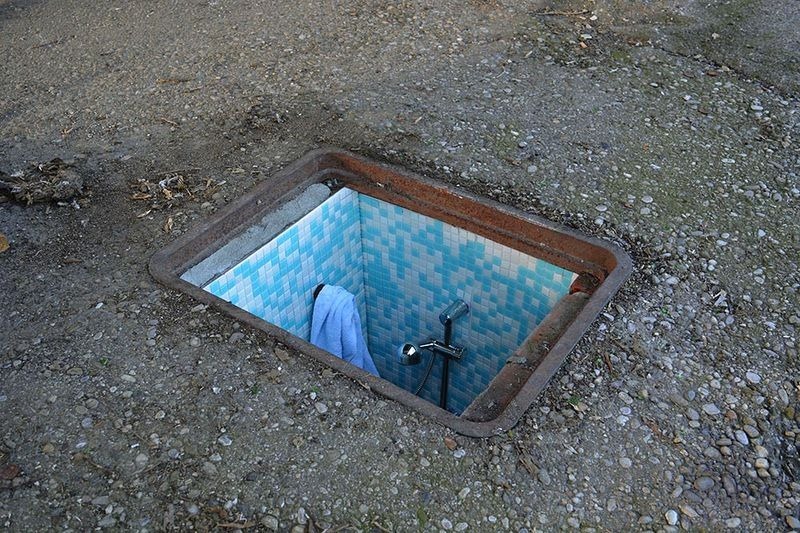
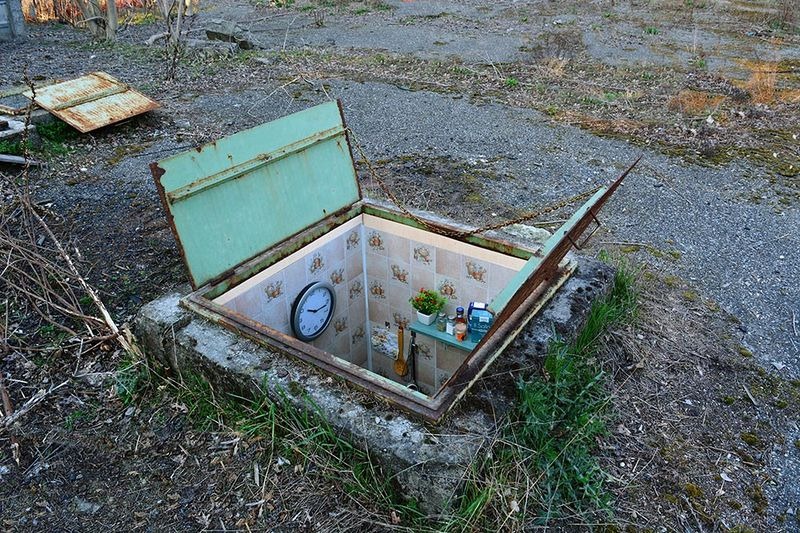
Italian street artist Biancoshock has just finished installing a couple of secret, miniature rooms, hidden under manhole covers, inside an abandoned sewer somewhere in the streets of Milan. This satiric “intervention” —a word that the artist uses for all his artworks— was inspired by the hundreds of people who are forced to live in extreme conditions, such as inside sewers, as in Bucharest where some 600 people live underground. Biancoshock calls this tiny project “Borderlife”.

If some problems can not be avoided, make them comfortable. -Biancoshock

biancoshock-borderlife-1


biancoshock-borderlife-3

biancoshock-borderlife-2

via Colossal

Source…..www.amusingplanet.com

Natarajan

Breakthrough by Indian Scientists in the US Checks Effectiveness of Cancer Treatment Within Hours…

Thanks to the development of nano-technology, it will now be possible to measure how effective a round of cancer therapy is, within hours of the treatment. This project has been kick-started by a group of Indian scientists from Massachusetts Institute of Technology (MIT) and Harvard Medical School.

The development is a major breakthrough because it will be possible to prevent the side-effects of chemotherapy right from the start in case the treatment plan is not working for the patient, and will help prevent long agonizing months of waiting.

Picture for representation only. Source: Sadasiv Swain/Flickr

“We have developed a nano-technology, which first delivers an anticancer drug specifically to the tumour, and if the tumour starts dying or regressing, it then starts lighting up the tumour in real time,” Shiladitya Sengupta, a principal investigator at MIT’s Brigham and Women’s Hospital (BWH), told PTI.

The breakthrough was published online in ‘The Proceedings of the National Academy of Sciences.’ One of the authors of the paper is Ashish Kulkarni, who hails from a tiny village in the state of Maharashtra. Kulkarni pursued his Ph.D. in chemistry from the University of Cincinnati. “Our long-term goal is to find a way to monitor outcomes very early so that we don’t give a chemotherapy drug to patients who are not responding to it,” he said.

Most of the team members are Indian researchers except for one. This development will help keep track of the effectiveness of immunotherapy, which signals significant progress.

Shiladitya Sengupta

Source: www.dfhcc.harvard.edu

Current tracking methods, which are based on the measurements of the size or the metabolic state of the tumour, don’t always manage to detect the effectiveness of the treatment.

Source….Boshika Gupta in http://www.the betterindia.com

Natarajan

Mangalore Boy Uses Kites to Harness Wind Power & Generate Electricity…!!!

A young boy in Mangalore bagged the Gandhian Young Technological Innovation Award for his innovative project that harnessed the power of wind, through kites.

22-year-old Royston Vijay Castellino, who studied at the Srinivas Institute of Technology, Mangalore, looked into the impact of wind power systems, and concluded that they have limitations to produce electricity. However, his innovative model, which uses a kite to harness wind from high altitudes, wipes out those inefficiencies.

Calling it the “Winds of Change”, he has also applied for a patent.

kites

Representational image

Source: Wikimedia Commons

In 2015, he had completed a project on this as part of his BE electronics and electrical engineering course in his final year. The aim of his project, according to Castellino, was to make wind power generation low cost, increase efficiency, and make it useful in generating electricity in rural areas.

When he experimented on kites, he discovered that the power is at its peak from a kite when it is rotated to make an infinity symbol in the sky. “I also observed that a four-line kite gives more power than a dual-line kite. So, I started to build a strong base with a four-line kite control system,” he said.

To work on the model, he said that he first ordered a four-line power kite from China. Then, he found bicycle parts, crank wheels and sprockets to use as materials. He modified a ceiling fan with permanent magnets, and then wound the rims of the bicycle wheel with threads. He used a wireless transmitter and receiver circuit to control the kite through a motor, and a chain drive to increase the speed. “The output can be improved by increasing the area of the kite,” he explained, “And the project can be made fully automatic by installing sensors on the kite which determine the position of the kite and send data to the base station.”

Since wind energy can be intermittent, he said that two similar kites can produce continuous power. “By installing two kites, energy can be transferred to the utility grid directly. This project can be made highly portable by using a vehicle as a base station which consists of a generator and control system.”

Last year, he was awarded the Project of the Year Award by Karnataka State Council for Science and Technology, at a competition organised by Indian Institute of Science in Bengaluru.

Source……Neeti Vijaykumar in http://www.the betterindia.com

Natarajan

Dharavi…….. Redesigned !!!

A potter in Dharavi

IMAGE: Is this all a potter’s wheel can churn out, ask Jorge Mañes Rubio and Amanda Pinatih. Photograph: Kind courtesy Design Studio Dharavi<

Museum is not exactly the word that comes to mind when you step into this little square of open land near the Kumbharwada (Potters’s Colony) signal in Dharavi, Mumbai’s much coveted real estate that sprawls over nearly 600 acres, houses families cheek-by-jowl in tiny one-room homes that lean into each other, accessed by everything from roads to very, very, very narrow lanes bisected by vein-like gutters though which flows sludge-like, smelly dark liquid… the amalgamated refuse of the thousands of people who inhabit this patch of land once infamously known as Asia’s largest slum and then made famous by Danny Boyle’s Slumdog Millionaire.

In front of you is a bright white 8 feet by 4 feet cart, a little like the one you see pushed vegetable vendors all over Mumbai. Only, it is larger, made of metal, brightly lit, with brick-coloured panels that open welcomingly to 24 feet, can bear the weight of almost 1,000 kgs and looks quite out-of-place.

It is this dichotomy that, hope Amsterdam-based artists Jorge Mañes Rubio and Amanda Pinatih, will draw the people of Mumbai in. And inspire the people of Dharavi, many of whom stand around stoically, wondering what was happening.

“Museum,” say best friends Akansha, Ayesha and Riya, bright eyed 10-year-old Class 6 students who stay nearby. They explain that museums normally “carry things about the past” but this one is different. This one, they proudly say, showcases “Dharavi ki kala (the creativity of Dharavi).”

That, says 31-year-old Rubio, is the museum’s very purpose. Both Rubio and Pinaith admire the way the denizens of Dharavi have found ways to earn a living. “You can bring a purse here,” says Rubio, “or a jacket, or hand over a design for shoes, and they will replicate it for you.”

What they hope this museum will do is help the citizens of Dharavi tap into their creativity.

Looking around him, says Rubio, is motivation enough, as he recalls his first visit to Dharavi four years ago. Crammed into tiny spaces, where you would believe a nuclear family could live, hundreds of cottage industries flourish, making everything from earthen lamps to designer rip-off to food products to even soaps.

With a dash of creativity, they hope these entrepreneurs — from those who maintain their generations old family trade to those who are using the latest technology to set up new business — will be able to expand the scope of what they do, reach wider audiences and make more money.

To break the communication barrier, and earn the trust of the residents of Dharavi, they turned to URBZ, an experimental urban research and action collective. It was here that they met Shyam Kanle, who lives in Dharavi and has been working to improve the condition of its residents. Kanle, who belongs to a family of basket weavers and broom makers, stepped in as facilitator.

On February 18, the museum launched in Kumbharwada with exhibits made by the potters, given a design and colour spin by Rubio and his team, whose effort is being supported by the Creative Industries Fund NL and The Art of Impact.

The museum, says Rubio, who has bundled up his hair in a bun to beat the heat, is interactive and will include workshops and, like a few days ago, even a cricket match. Each of the items in the museum, emphasises Rubio, is made by local talent.

Cricket bats at the Design Museum Dharavi

Yes, those are bats and you are supposed to play with them. To add some more change, Design Museum Dharavi offers modified gloves and stumps too.

Photograph: Kind courtesy Design Museum Dharavi

Cricket bats at the Design Museum Dharavi

Twenty-seven hand-crafted bats, made from recycled wood in different shapes, sizes and designs, are tested by four teams from across Dharavi. Each has a brightly coloured grip. The leather gloves, too, are handcrafted and features different styles. Each team had its own uniquely designed tee shirt.

Photograph: Kind courtesy Design Museum Dharavi

Cricket bats at the Design Museum Dharavi

Now that the bats and gloves had been designed, it was time for some intense concentration and a game of cricket. Even the pink stumps did not distract the players.

While some of the bats worked, others shattered in a matter of minutes.

Photograph: Kind courtesy Design Museum Dharavi

Cricket match at the Design Museum Dharavi

But the teams had a good time, and slipper-clad team Purple won the Golden Stumps 🙂

Photograph: Kind courtesy Design Museum Dharavi

Pots and brooms at the Design Museum Dharavi.

The launch exhibit celebrated matkas (pots used to store water and keep it cool), brooms and tea cups.

Pots, that were generally stacked one top the other to save space, were given an exotic design spin.

Photograph: Uttam Ghosh/Rediff.com

Tea cups at the Design Museum Dharavi.

Why should a cup look like a cup? “Why indeed?” asks Rubio as he spotlights the exotic shapes of the cups, with handles shaped like the human ear, triangles or even rectangles, all inspired, he solemnly assures, from the varied ways in which he has watched the Dharavi residents pick up a hot cup of chai.

Photograph: Uttam Ghosh/Rediff.com

Tea cups at the Design Museum Dharavi.

Resting on a pristine white block placed on a brightly coloured reed mat are still more exotic tea cups even more exotic handles. A couple look like diyas and we wonder how useful they would be while sipping a hot beverage.

Photograph: Uttam Ghosh/Rediff.com

Tea cups at the Design Museum Dharavi.

Experiment is everything, seems to be the motto. So there are more cup; some with saucers. “Sharing a cup of tea or sipping it from a saucer,” says Rubio is something he has noticed as he watched endless cups of chai make their way down thirsty throats.

Photograph: Uttam Ghosh/Rediff.com

Jorge and Amanda take a moment to pose with Shyam

Rubio and Pinatih share a moment with Shyam Kanle, who has helped them with the project, as they celebrate the launch of what has been called the first ever moving slum museum in the world.

Photograph: Uttam Ghosh/Rediff.com

Best friends Akansha, Ayesha and Riya smile for the camera

Best friends Akansha, Ayesha and Riya, who stay nearby, pose in front of the three-sided broom (in the corner) which they have made themselves and of which they are very, very proud.

A broom at the Design Museum Dharavi.

You might thing that broom is good for dusting…

Photograph: Uttam Ghosh/Rediff.com

Rubio with a broom at the Design Museum Dharavi.

…But Rubio has other ideas. “Why not look at it as hand-held fan,” he asks with a smile.

Photograph: Uttam Ghosh/Rediff.com

Design samples at the Design Museum Dharavi

These exhibits grabbed a lot of attention. Not only were they bright and colourful, nobody seemed to know what they actually were.

“Diaries?” somebody ventured. Touching them put paid to that idea.

“Tiles?”

“Door-stoppers?”

“Coasters?”

“Design samples,” says Rubio, “that the potters can offer as options to their clients.”

Photograph: Uttam Ghosh/Rediff.com

Children at the Design Museum Dharavi

And these, ladies and gentlemen, were the most excited visitors to the museum.

Photograph: Uttam Ghosh/Rediff.com

Savera R Someshwar / Rediff.com

Source…….www.rediff.com

Natarajan

An Oxford professor has won £500,000 for solving a 300-year-old mathematical mystery…!!!

Oxford University professor Sir Andrew Wiles has been awarded the prestigious Abel Prize for his “stunning proof” of Fermat’s Last Theorem.

Wiles life has been dedicated to the three-century-old theorem which has been his “passion from an early age” after he read “The Last Problem” by ET Bell.

His proof was first published in 1994 while working at Princeton University in New Jersey — he will collect the award 22 years later at a ceremony in Oslo in May.

The theorem, created in 1637 by French mathematician Pierre de Fermant, says that there are no solutions in integers — or whole numbers — to the equation  xn + yn = zn when n is greater than 2.


Wiles’ work isn’t merely a solution to the theory, his findings have shaped mathematics and the entire approach to the field, and were originally submitted as a 200-page file.

The Abel Prize is awarded by the Norwegian Academy of Sciences and Letters and is widely regarded as the most prestigious award in its field. As well as a trophy, winners of the award also take home six million Norwegian Krone (£500,000, $700,000).

When asked what it feels like to solve a puzzle that has mystified mathematicians for centuries, he said: “It’s thrilling. It’s the experience we live for, this insight, that suddenly you see everything clearly before you that’s been so obscure and so frustrating for so long.”

andrew wiles

The Norwegian academy lauded the professor’s groundbreaking work, saying: “Wiles’ proof was not only the high point of his career — and an epochal moment for mathematics — but also the culmination of a remarkable personal journey that began three decades earlier.”

This isn’t the first time Wiles has been recognised for his contributions to mathematics. He was knighted in 2000, and also won the US National Academy of Science’s Award in Mathematics, the Wolf Prize, and the Royal Medal of the Royal Society.

The Abel Prize was created in honour of Niels Henrik Abel, a Norwegian mathematician who died in 1829. It was created in 2001 and first awarded a year later. Previous winners include economist John F Nash Jr, who was the subject of the film “A Beautiful Mind,” and Sir Michael Atiyah for his work on the Atiyah-Singer theorem.

Source…… Charles Clark in http://www.businessinsider.com

Natarajan