Message For The Day…God is In Your Heart !!!

Brindavan is not a specific place on the map; it’s the Universe! All human beings are cowherds; all animals are cows. Every heart is filled with the longing for the Lord; the flute is the call of the Lord; the sport Raasakreeda (the sportive dance of little Krishna and the Gopees), is the symbol of the yearning and the travail to merge in God. The Lord manifests such Grace that each one of you has the Lord all for yourself; you need not be sad that you won’t have Him; nor need you be proud that you have Him and no one else can have Him! The Lord is installed in the altar of each and every one of your hearts. Revere the gift of this body, the senses, the intelligence, the Will and all the instruments of knowledge, action and feeling as essential for His work.

 Sathya Sai Baba

How Swami Sathya Sai “s Vibuthi Turned Sunil Gavaskar Fit For Test Match !!!!!

How Vibhuti allowed Sunil Gavaskar to play in Australia.

Shammi Paranjape, a close relative of Sunil Gavaskar (sister-in-law), shares this amazing episode that happened miles away down under in Australia:

“One of the very first experiences Sunil Gavaskar had was during the Indian tour of Australia in 1977, when Bishen Singh Bedi was captain of the Indian cricket team.

During the three-day match against Victoria, Sunil slipped on the ground while fielding and tore a muscle in his thigh. It turned out to be a severe injury. In those days, the Indian team did not have a physiotherapist traveling with them, so Sunil’s injury was shown to the home team’s physiotherapist.

After he was examined, Sunil was informed that it was a severely torn muscle and he would be out of the game for the next six weeks. This was a big blow as the next Test match was starting within a week’s time.

Sunil was in excruciating pain and unable to stand or put any pressure on the right leg. He phoned Pammi (his wife) in India and informed her about this development. Pammi immediately told him, ‘Apply Baba’s Vibhuti’.

Sunil said that he had none with him. ‘I’ll send you some right away. Apply it in the affected area, I’m sure it will work’, she replied.

The prospect of Sunil being fit enough to play for the next Test, which was four days away, seemed a total impossibility, so he was not picked for that particular match in the Test squad. In the meanwhile, Sushil Doshi, one of the Hindi commentators of All India Radio happened to be leaving for Australia.

Pammi arranged to send Baba’s Vibhuti through him. Sushil Doshi arrived two days prior to the Test match in Brisbane and handed over the Vibhuti packet to Sunil. Sunil, who was still hobbling around with that painful leg immediately applied almost half of the Vibhuti packet on the affected area hoping for a miracle.”

For what happened next, let Sunil Gavaskar himself relate:

(From an article Sunil had written for the November 2000 issue of ‘Sanathana Sarathi’ – the Ashram Magazine)

“After I started applying Vibhuti, there was marked improvement and on the eve of the Test Match, I requested the team management not to rule me out but to have a fitness test on the morning of the Test Match. From barely being able to put weight on my leg, I was able to walk comfortably in just two days. But there was a stiff soreness that was worrying.

On the morning of the match, I applied Vibhuti to the leg and went to the ground. That was going to be my first attempt to try and run after a gap of eight days.

Even as I stepped on to the ground to give my fitness trial, I realised that the stiffness was almost gone. At the Queensland Cricket Ground in those days, you had to descend a few steps to the ground and it was these few steps which were painful previously, and I had to walk down gingerly. But on this day, I felt confident enough getting down these steps normally.

I took a light jog around the ground and with every stride I could feel the soreness going away. Though I did not do anything silly as a quick dash or sprint, I felt confident enough to play in the Test and so informed the management who accepted it and included me in the playing eleven. It was unbelievable.”

Incidentally, Sunil went on to score his eleventh Test century in that match!

source::::Devotees experiences on the Miracles 0f Swami Sathya Sai Baba…SriSathyasai.org.in
Reference: “Blossoms in the Eternal Spring” by Mrs. Shammi Paranjape. Page: 16-17. Published by Rupa and Co., 2004.
Natarajan

“No Frills ” Hospitals In India !!!!….A Mix Of Wal-Mart and Low Cost Airline !!!!

What if hospitals were run like a mix of Wal-Mart and a low-cost airline? The result might be something like the chain of “no-frills” Narayana Hrudayalaya clinics in southern India.

Budget Hospital India

In this picture taken on February 7, 2013 hospital staff work at one of the post-operative pediatrics observation and care units of the Narayana Hrudayalaya cardiac-care hospital in Bangalore. A group of Indian doctors believe they can cut the cost of heart surgery to an astonishing 800 USD at their “no thrills” low-cost hospital.

Using pre-fabricated buildings, stripping out air-conditioning and even training visitors to help with post-operative care, the group believess it can cut the cost of heart surgery to an astonishing 800 dollars.

“Today healthcare has got phenomenal services to offer. Almost every disease can be cured and if you can’t cure patients, you can give them meaningful life,” says company founder Devi Shetty, one of the world’s most famous heart surgeons.

“But what percentage of the people of this planet can afford it? A hundred years after the first heart surgery, less than 10 percent of the world’s population can,” he told AFP from his office in hi-tech hub Bangalore.

Already famous for his “heart factory” in Bangalore, which does the highest number of cardiac operations in the world, the latest Narayana Hrudayalaya (“Temple of the Heart”) projects are ultra low-cost facilities.

The first is a single-storey hospital in Mysore, two hours drive from Bangalore, which was built for about 400 million rupees (7.4 million dollars) in only 10 months and recently opened its doors.

Set amid palm trees and with five operating theatres for cardiac, brain and kidney procedures, Shetty boasts how it was built at a fraction of the cost of equivalents in the rich world.

“Near Stanford (in the US), they are building a 200-300 bed hospital. They are likely to spend over 600 million dollars,” he said.

“There is a hospital coming up in London. They are likely to spend over a billion pounds,” added the father of four, who has a large print of mother Teresa on his wall — one of his most famous patients.

“Our target is to build and equip a hospital for six million dollars and build it in six months.”

The Mysore facility represents his vision for the future of healthcare in India — and a model likely to burnish India’s reputation as a centre for low-cost innovation in the developing world.

Air-conditioning is restricted to operating theatres and intensive care units. Ventilation comes from large windows on the wards.


Budget Hospital India

A group of Indian doctors believe they can cut the cost of heart surgery to an astonishing 800 USD at their “no thrills” low-cost hospital.

Relatives or friends visiting in-patients undergo a four-hour nursing course and are expected to change bandages and do other simple tasks.


In its architecture, Shetty rejected the generic multi-storey model, which requires costly foundations and steel reinforcements as well as lifts and complex fire safety equipment.

Much of the building was pre-fabricated off site and then quickly assembled.

The Mysore facility will be followed by others in the cities of Bhubaneswar and Siliguri.

Each will owe its existence to Shetty’s original success story, his pioneering cardiac hospital in Bangalore which opened in 2001.

About 30 heart surgeries are performed there daily, the highest in the world, at a break-even cost of 1,800 dollars. Most patients are charged more than this, but some of the poorest are treated for free.

Its success has made Shetty a wealthy man and earned him international renown. Al-Jazeera recently broadcast a six-part series on the hospital whose wards are packed with low-income farmers and labourers.

In the crammed waiting room, families from across South Asia wait for appointments with the boss who juggles them between stints in theatre.

“We saw him on TV recently and we could see his commitment to poor people and middle class people like us,” said Ranjan Bhattacharya, a civil servant, who had brought his ill wife 2,000 kilometres (1,200 miles) by train from northeast India.

In its dealings with suppliers, the hospital group works like a large supermarket, buying expensive items such as heart valves in bulk.

By running the operating theatres from early morning to late at night, six days a week, it is inspired by low-cost airlines which keep their planes in the air as much as possible.

The British-trained surgeon sniffs at the output of Western counterparts who might do a handful of operations a week. Each of his surgeons does up to four a day on a fraction of the wages of those in the West.

“Essentially we realised that as you do more numbers, your results get better and your cost goes down,” he said.

Public spending on health in India amounts to just four percent of GDP, less than Afghanistan, according to the World Health Organization.

A lack of private insurance and a public system that has “collapsed” according to the country’s rural development minister means an estimated 70 percent of healthcare spending is borne by Indians out of their own pockets.

So is Shetty a sharp-witted businessman who has spotted a gap in the market or a philanthropist?

“We believe that charity is not scalable. If you give anything free of cost, it is a matter of time before you run out of money, and people are not asking for anything free,” he said.

His first foreign venture is a hospital on the Cayman Islands, targeting locals who would normally travel to the US for expensive treatment, and he says he would love to expand into Africa.

From 6,000 beds now in 17 clinics, he aims to expand privately-run Narayana Hrudayalaya Hospitals to a group with 30,000 beds in the next five years.

“The current regulatory structures, the current policies and business strategies (for healthcare) that we have are wrong. If they were right, we should have reached 90 percent of the world’s population,” he said.

source::::businessinsider.com

Natarajan

Read more: http://www.businessinsider.com/inside-indias-no-frills-hospitals-where-heart-surgery-costs-just-800-2013-4#ixzz2RAscwJhp

Dicky Bird ….@ 80 and Well set For a Splendid Century !!!!!


Dickie Bird turned 80 on Friday 19 april . And cricket’s favourite umpire remains as enagingly passionate as ever about life and the sport he loves.

 ‘cricketers used to have a laugh back in my day. Not any more’!!!


Cricket's favourite umpire is as passionate as ever about the game as he hits 80 not out

A life in sport: Dickie Bird at his home in Barnsley, which is cluttered with all his cricket memorabilia..


Some of the best stories about Harold “Dickie” Bird involve his pathological fear of lateness. There was one occasion when he arrived at Buckingham Palace at 5am for one of his 29 meetings with the Queen.

And another when he felt a policeman’s hand on his collar as he tried to climb over the front gates of the Oval, some six hours before play was due to start.

So it was a surprise to arrive at his 17th-century cottage in Barnsley, around 10am last Tuesday, and find Bird frantically fiddling with his shirt buttons. “Alarm clock ran out of batteries,” he spluttered.

Keith Lodge, his old friend from the Barnsley Chronicle and the co-author of his latest book, hovered indulgently like a favourite nanny. “Good thing I rang you, Dickie,” he said. “We would have been standing outside in the cold all morning.”

It was a humorous moment, and Bird saw the funny side. But there was an element of pathos too.

As he approaches his 80th birthday on Friday, his health is not as robust as it was. Four years ago, he suffered a stroke that robbed him of his morning bounce.

“It struck at 3am,” he said. “I had a severe pain in my neck and then it worked down my body. I stuck it out until the morning and managed to dial 999.

“The ambulance came and got me away pretty quickly to the hospital, and then they kept me in for five or six weeks.

“I gradually got my strength back, but I have to speak slowly, because if I speak quickly then I can’t get my words out. It’s also left me very emotional – I was always emotional, but not like I am now.

“And you’ve got to make yourself go in the morning every day, because you don’t want to get out of bed, you just want to lie there. You get depressed at times.

“But you just have to fight against it. I can drive now. I have all my movements but I find buttons and shoelaces difficult. But I can’t grumble because some of the cases that I saw in hospital – dear me.”

The carers have left and Bird is independent again, still living in the house that he bought as Yorkshire’s opening batsman in the 1960s.

Today, it has become a shrine to the persona he inhabited for another three decades after that. “Dickie Bird here, Test match umpire,” he still likes to say, when he rings up to discuss the latest local prospect – or, more likely, the evils of the TV review.

The walls are covered with photographs of Bird himself, standing in his white cap behind the stumps as Richard Hadlee, or Kapil Dev, or Imran Khan roars in to bowl.

The desk carries a miniature version of the statue erected to him in the centre of Barnsley. “It stands on the exact spot where I was born, 100 yards from the town hall – trips come from all over to see my statue and go around the market.”

Neither would you want to put a dirty mug down on the living-room coffee table, so crammed is it with memorabilia. Pride of place goes to two books with gilt-edged pages.

One is a commemorative copy of his autobiography, which sold a mind-boggling 750,000 copies. The other is bound in red leather and was presented to him by Eamonn Andrews when he appeared on a 1992 edition of This Is Your Life.

So how did the umpire’s book come to outsell those of the men whom he invigilated? “People have took to me, haven’t they? I don’t know what it is. I talk to everybody and I think that’s why.

“The characters have gone out of all sports haven’t they? There’s no Lambs, Bothams or Dennis Lillees any more. We used to have a laugh in Test matches, which they don’t today – they don’t even smile.”

There is a very British charm to Bird, a Norman Wisdom-style twinkle. A man with a wide variety of nervy mannerisms, he occasionally forgot to laugh at himself – as when the water-pipes burst at Headingley, and he was left wagging his finger at an irate crowd.

But he would banter with the players as if he was still one of them, and they loved him for it.

On the field, Bird was known for being a not-outer. Our own cricket correspondent, Derek Pringle, has never quite forgiven him for turning down an lbw against Gordon Greenidge; the wicket would have completed a hat-trick.

But then Bird, so cautious by nature, could hardly help taking refuge in the “benefit of the doubt”. As a batsman who made only two hundreds in 93 first-class appearances, anxiety was his Achilles’ heel.

“If you’d seen me in one net batting and Geoffrey Boycott in the other, and I’d said to you ‘Which is the England player?’ you’d have said me,” Bird explained, while tapping a finger to his forehead. “But Boycott had it, something up here, more mental strength.

“If I got a series of low scores I worried. A lot thought that I would never make it as an umpire because of that. But it was amazing. I told myself once I crossed that line I were going to enjoy it, have a smile and a laugh.

“I used to have a joke with the crowd, but I never let it interfere with my decision making. And that took all of the pressure off me.”

Inevitably, Bird laments the passing of the glory days, when decisions went unchallenged by ball-tracking technology and Ian Botham could smash spectacular sixes after a night on the tiles.

It is hard to see Steven Finn stopping in his delivery stride to sneak a rubber snake into the umpire’s pocket, as Lillee once did. And nor do relationships achieve the same depth when there is always a plane to catch the morning after a game.

“You can’t buy respect, you have to earn it,” Bird said. “And I can honestly tell you I had not one problem with any professional cricketer.

“If I went to Pakistan, Imran Khan and Javed Miandad invite me round for a meal at their place. If I go to Australia the first man to ring me is Dennis Lillee.

“If I go to est Indies, the first man on the phone will be Garfield Sobers, the greatest that’s ever lived. You’ll never see another like him, not in your lifetime.”

Yet Bird still loves the modern game, even if his passion may not burn as bright as it once did. He remains an ever-present in the stands, both at Yorkshire’s home matches and those of Barnsley FC.

“It’s still the greatest game in the world, cricket,” he said. “I think young Joe Root is one to watch, because mentally I have never met anyone like him.” He leaned forward and tapped his forehead again. “Played up here, is cricket.”

And now it was time to go, because Bird’s solicitor was at the door. “I want to go back over my will,” he said, with a slightly unnerving grin. “My plan is for my ashes to be buried under my statue. What do you think?”

  • Dickie Bird – 80 Not Out, written with Keith Lodge, is published by Hodder & Stoughton, priced £20.

source::::Simon Briggs in THE TELEGRAPH UK

Natarajan


Laughter…. The Best Medicine For Stress !!!!!!

A husband, proving to his wife that women talk more than men, showed her a study which indicated that men use on the average only 15,000 words a day, whereas women use 30,000 words a day.

She thought about this for a while and then told her husband that women use twice as many words as men because they have to repeat everything they say.

He said, “What?”

Jennifer had applied for a job and when she returned home, her mother asked how the interview went.
“Pretty good, I think,” replied Jennifer, “but if I go to work there I won’t get a vacation until I’m married.”
Her mother, of course, had never heard of such a thing. “Is that what they told you?”
“No”, replied Jennifer, “but right on the application it said ‘vacation time may not be taken until you’ve had your First Anniversary

Patient explains “Doctor, you must help me. I’m under such a lot of stress at work and I keep losing my temper with people. I yell at them, get cranky and abuse them all the time.
Doctor: Well, tell me about your problem in details. I think I can help you out.
Patient: Why the hell are you practicing medical? Nonsense! I just did, didn’t I … are you a stupid fool? Get lost you idiot and don’t make me lose my temper!!

A man receives a call from his Credit Card Company, “Sir, we have detected an unusual pattern of spending on your card, and we are calling to see if everything is alright.”
“Yes,” replied the man. “My card was stolen over a month ago.” “Why didn’t you report your card as stolen?” asked the card company representative. The man replied, “Well, whoever stole my card is spending a lot less than my wife!”

source::::siliconindianet
Natarajan

தீப ஆரத்தியின் அர்த்தம் !!!

அறிவார்ந்த ஆன்மிகம்

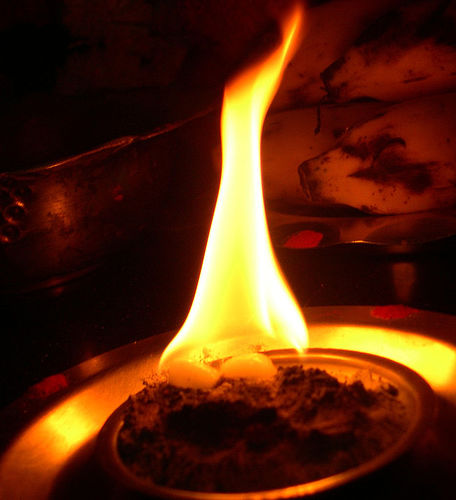
ம் வழிபாட்டு முறைகளில் பலவும் காரணம் புரியாத சடங்குகளாகவும் சம்பிரதாயங்களாகவும் ஆகி விடுகின்றன. அவற்றை அப்படியே நாமும் பின்பற்றுகிறோமே ஒழிய அவற்றில் புதைந்துள்ள ஆழ்ந்த பொருளை நாம் உணரத் தவறி விடுகிறோம்.  உதாரணத்திற்கு கோயில்களில் இறைவனுக்கு தீப ஆரத்தி எடுப்பதை எடுத்துக் கொள்வோம். தீப ஆரத்தி எடுப்பதை நாம் நாள் தோறும் பார்க்கிறோம் என்றாலும் அது எதற்காக என்றும், ஆரத்தி எடுப்பதன் பின்னால் உள்ள தத்துவம் என்ன என்றும் நம்மில் பெரும்பாலானோர் அறிவதில்லை. அதன் உண்மைப் பொருளை இப்போது பார்ப்போம்.
பூஜையில் இறைவனுக்குச் செய்யப்படும் பதினாறு வகை உபசாரங்களில் தீப ஆரத்தியும் ஒன்று. அதை வடமொழியில் ஷோடச உபசாரா என்று சொல்வார்கள். பூஜை காலத்தில் தீப ஆரத்தி எடுப்பதற்கு முன்பு இறைவன் விக்கிரகத்தின் முன் திரை போட்டு இருப்பார்கள். அந்தத் திரை மறைப்பதால் நம்மால் இறைவனைக் காண முடியாது. ’நான்’என்னும் அறியாமைத் திரை நம்முள் இருக்கும் வரை அதைத் தாண்டி உள்ள எல்லாம் வல்ல இறைவனை நம்மால் அறிந்து கொள்ள முடியாது என்பதை அது குறிக்கிறது. அந்தத் திரை விலகினால் மட்டுமே இறைவனைக் காண முடியும். அப்போதும் கூட இறைவன் மிகத் தெளிவாகத் தெரிவது இல்லை. இறைவனை மிகத் தெளிவாக அறிய ஞானம் என்ற விளக்கு வேண்டும். அந்த ஞான விளக்கொளி இருந்தால் தான் இறைவனை முழுமையாகத் தரிசிக்கும் அனுபவம் வாய்க்கும். அந்த ஞான ஒளி தான் தீப ஆரத்தி. நான் என்னும் ஆணவத் திரை விலகிய பின்னர் ஞானத்தின் துணையுடன் இறைவனைக் காண முடியும் என்பதை தீப ஆரத்தி விளக்குகிறது.
திரை விலகுதல், தீப ஆரத்தி காட்டுதல், இருள் நீங்குதல், இறைவனைக் காணல் எல்லாம் ஏக காலத்தில் நிகழ்வது போல ஆணவம் விலகி, ஞானம் பெற்று, அறியாமை நீங்கி, இறைவனை உணர்தல் எல்லாம் ஏக காலத்தில் மனிதன் மனதில் நிகழ வேண்டும் என்பதை தீப ஆரத்தி குறிப்பால் உணர்த்துகிறது.
உள்ளத்தில் ஞான விளக்கேற்றுவது குறித்து பத்தாம் திருமுறையில் திருமூலர் மிக அழகாகக் கூறுவார்.
  விளக்கினை ஏற்றி வெளியை அறிமின்
விளக்கினின் முன்னே வேதனை மாறும்
விளக்கை விளக்கும் விளக்கு உடையார்கள்
விளக்கில் விளங்கும் விளக்காவர் தாமே!
இதன் பொருள்: உங்களுக்குள் இருக்கும் ஞான விளக்கை ஏற்றி பரஞான வெளியாக இருக்கும் பரம் பொருளை அறியுங்கள். அந்த ஞான விளக்கின் முன்னே உங்கள் வேதனைகள் மாறும். அந்த ஞான விளக்கை விளங்கிக் கொள்ளும் ஞானம் உடையவர்கள் தாங்களே ஞான விளக்காக விளங்குவார்கள்.
(ஞான விளக்கின் ஒளியின் அனைத்தையும் காணும் போது அறியாமையால் நாம் உணர்கின்ற துன்பங்கள் தானாக மாறி விடும் என்றும் ஞானம் பெற்றவர்கள் தாமாக மற்றவர்களுக்கு ஞான விளக்காக இருந்து வழிகாட்டுவார்கள் என்றும் திருமூலர் விளக்குகிறார்.)
கற்பூர தீப ஆரத்தியில் இன்னொரு மெய்ஞான உண்மை வலியுறுத்தப் படுகிறது. கற்பூரம் ஏற்றப்படும் போது அது எரிந்து ஒளி கொடுத்து பின் கடைசியில் இருந்த சுவடே இல்லாமல் முடிந்து விடுகிறது. கற்பூரம் நான், எனது என்ற எண்ணங்களால் ஏற்படும் வாசனைகளைக் குறிக்கிறது. இறைவனில் இருந்து தனிமைப்படுத்திக் கொண்டு வாழும் தன்மையைக் குறிக்கிறது. ஆனால் எல்லாம் இறைவன் என்ற ஞானம் பற்றிக் கொள்ளும் போது மனிதனின் வாசனைகளும், அறியாமையும் கொஞ்சம் கொஞ்சமாய் அழிய மற்றவர்களுக்கு ஒளி தரும் வாழ்க்கையை மனிதன் வாழ ஆரம்பிக்கிறான். அவன் காலம் முடிந்து விடும் போது அவன் வாசனைகளும் முடிந்து போகின்றன. ஒளிமயமான, உபயோகமான வாழ்க்கை வாழ்ந்து முடித்து இருந்த சுவடில்லாமல் அவன் இறைவனுடன் ஐக்கியமாகி விடுகிறான். இது கற்பூர தீப ஆரத்தி மூலமாக உணர்த்தப்படும் இன்னொரு மாபெரும் தத்துவம்.
தீப ஆரத்தியின் முடிவில் தீபத்தின் மேல் நம் கைகளை வைத்துக் கண்களில் ஒற்றிக் கொண்டு தலையையும் தொட்டுக் கொள்கிறோம். ’இந்த ஞான ஒளி என் அகக் கண்களைத் திறக்கட்டும். என் எண்ணங்களும், நோக்கங்களும், அறிவும் மேன்மையானதாக இருக்கட்டும்.’ என்ற பாவனையில் செய்யப்படும் செயலே அது.
எந்திரத்தனமாகக் கோயிலுக்குச் சென்று தீப ஆரத்தியைக் கண்டு இறைவனை வணங்கி அங்கிருந்து எந்த பாதிப்பும் இல்லாமல் கிளம்பி விடாமல் மேற்கண்ட தத்துவக் கண்ணோட்டத்தோடு தீப ஆரத்தியைக் கண்டு வணங்குங்கள். அதுவே உண்மையான பயனுள்ள வழிபாட்டு முறை. அப்படி உயர்ந்த பாவனையுடன் வழிபட ஆரம்பிக்கும் போது மிக மேன்மையான ஆன்மிக அனுபவத்தை உணர்வீர்கள். உண்மையான வழிபாட்டின் பலனை அடைவீர்கள்!
சரி அப்படியானால் மனிதர்களுக்கும் ஆரத்தி எடுக்கிறார்களே அது எதற்காக என்ற கேள்வி ஒருவர் மனதில் எழுவது இயற்கை. அதற்கான பதிலையும் பார்ப்போம்.
புதிதாய் திருமணம் முடிந்து வீட்டுக்கு வரும் தம்பதியர், குழந்தை பெற்றுக் கொண்டு வீடு திரும்பும் தாய், தொலை தூரங்களுக்குச் சென்று வெற்றிகரமாக ஒரு செயலை முடித்து விட்டு வருபவர் முதலானோருக்கு ஆரத்தி எடுக்கும் வழக்கம் நம் நாட்டில் இருக்கிறது.
அவர்களுக்கு ஆரத்தி எடுப்பது இறைவனுக்கு ஆரத்தி எடுக்கும் முறையில் இருப்பதில்லை. அவர்களுக்கு ஒரு தாம்பாளத் தட்டில் தண்ணீருடன் மஞ்சள் மற்றும் சுண்ணாம்பு கலந்து தண்ணீரை சிவப்பாக்கிக் கொள்கிறார்கள். பின் எண்ணெய் தோய்த்த திரியை விளிம்பில் வைத்து தீபமாக்கி ஆரத்தி எடுக்கிறார்கள்.
ஒவ்வொரு மனிதனைச் சுற்றிலும் ஆரா(aura)என்ற சூட்சுமப் பகுதி இருக்கிறது. மனிதனுக்கு ஏற்படும் திருஷ்டி மற்றும் அவனைச் சேரும் தீய கிருமிகள் ஆகியவை அந்த சூட்சும பகுதியில் முதலில் பதிந்து பின்னரே அவனுள் புகுகின்றன. திருமணம், குழந்தை பெறுதல், வெற்றியடைதல் ஆகியவற்றால் பலருடைய  திருஷ்டி மணமக்கள், தாய்-சேய், வெற்றியாளர் மீது அதிகம் விழ வாய்ப்பு அதிகம் உள்ளது.
மஞ்சள் மற்றும் சுண்ணாம்பு இரண்டிற்கும் விஷக் கிருமிகளை அழிக்கும் சக்தி இருப்பதாக நம் முன்னோர் கண்டிருந்தார்கள் எனவே தான் திருஷ்டி கழிக்கும் சக்தி உள்ள கிருமி நாசினிகளான மஞ்சளையும் சுண்ணாம்பையும் தண்ணீரில் கலந்து திருஷ்டி கழித்து அந்தத் தண்ணீரை வெளியேயே கொட்டி விடுகிறார்கள். வீட்டினுள் நுழையும் முன்பே ஆரா சரீரத்தில் சேர்ந்துள்ள திருஷ்டி மற்றும் கிருமிகளை அகற்றி தூய்மைப்படுத்திய பின்னரே சம்பந்தப் பட்டவர்களை வீட்டுக்குள் அழைத்துக் கொண்டு போகும் வழக்கம் உள்ளது.
எனவே அது போல் ஆரத்தி எடுக்கும் போது பொருள் அறிந்து சரியான பாவனையுடன் செய்வது முக்கியம். அப்போது தான் அதன் பலனும் முழுமையாக இருக்கும்.
source:::::input from a friend of mine
Natarajan

Message For The Day…A dose of Dhyanam and Japam as Breakfast !!!!!

I know how systematic you all are in eating and drinking. You take pretty good care of the body. I do not condemn it; I only want that you should take equally good care of the needs of the spirit also. Take a dose of Dhyanam (meditation) and Japam(repetition of holy Names) as the morning breakfast; Puja andArchana (prayer and worship) as lunch at noon; someSathsang (holy company) or Sathchinthana (holy thoughts) or reading of holy books or Nama likhitha (writing of holy Names) as afternoon tea and snacks; an hour of bhajan as dinner; and a small ten-minute manana (reflection) as the cup of milk before going to bed. This diet is enough to keep your inner being happy and healthy. That is My advice to you today.


Sathya Sai Baba

Message For The Day….Respect For Women is the Real Culture ….

Do not be carried away by the modern day talk of establishing absolute equality. Each one has a certain corpus of intelligence and a peculiar bundle of instincts, impulses and past impressions (vasanas). The more you divert or diminish their impact on you, greater the achievements. Use all chances you have to develop good health, skills and character. That is your highest duty. Seize every chance to serve the sick and needy with love. Do not by any action of yours, cause pain to another, nor suffer pain yourself by foolishness or sheer bravado. Make lasting friendships with good and the noble. Honour elders and women. Treat women with the highest respect. By honouring women, you bring honour to yourself and your society. Respect for women is the mark of real culture.

 Sathya Sai Baba