Image of the Day…Space Station Flyover of the Mediterranean…

Nighttime photograph from low Earth orbit of Mediterranean showing clouds and city lights

Expedition 46 flight engineer Tim Peake of the European Space Agency (ESA) shared this stunning nighttime photograph with his social media followers on Jan. 25, 2016, writing, “Beautiful night pass over Italy, Alps and Mediterranean.”

Image Credit: ESA/NASA

Source…….www.nasa.gov

Natarajan

Image of the Day….” View from space…”

View from space: Mississippi River flooding

Two satellite images show the contrast between the flooded Mississippi River this month and the same area last year. Check out the difference!

View larger. | January 11, 2016. Image credit: NASA

View larger. | January 11, 2016. Image credit: NASA

In early January 2016, communities along the southern reaches of the Mississippi River faced severe flooding from rains that fell weeks earlier and well to the north. These two NASA satellite images show the Mississippi River as it runs through southern Mississippi and Louisiana. The above image was acquired on January 11, 2016. The image below shows the river at a normal level last January (January 24, 2015.)

View larger. | January 24, 2015. Image credit: NASa

View larger. | January 24, 2015. Image credit: NASa

Heavy rains in December 2015 drenched parts of Missouri and Illinois, and the pulse of fresh water has finally reached Louisiana and Mississippi. On January 11, the U.S. Army Corps of Engineers opened the Bonnet Carré Spillway near New Orleans in preparation for the southward-moving pulse of flood water.

Substantial flooding is unusual on the Mississippi River in winter. As reported by Weather Underground, this event was only the second time that a winter flood has made the top-40 list of flood crests at St. Louis in more than 200 years of records. (The other flood occurred in December 1982 during a major El Niño.)

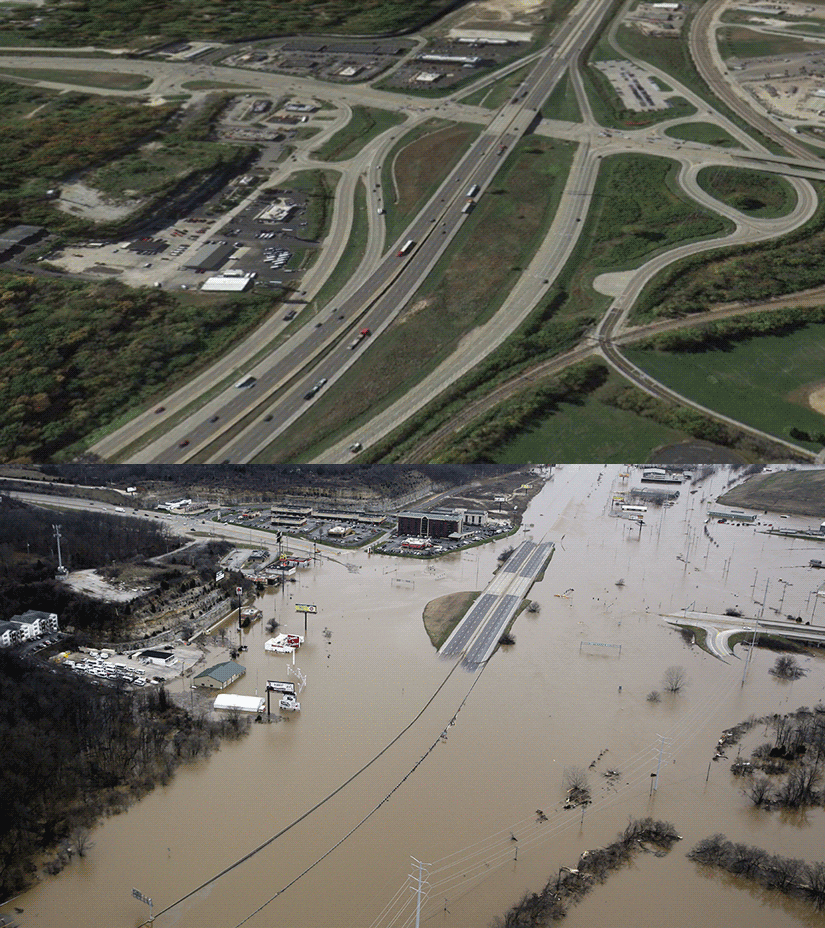
Before/after images of Interstate 44 flooded in Valley Park, Missouri.  Credit: AP Photo/Jeff Roberson and Google Earth

According to John Kimball, a hydrology, ecology, and remote sensing expert at the University of Montana, the soil within the upper Missouri basin remained largely frozen. There was no rapid thaw or snowmelt that helped raise the river’s level. But elsewhere in the Mississippi Basin, precipitation that might typically fall as snow in December and January instead fell as rain. Kimball said:

There has been much higher than normal rainfall over the southern and central portion of the Mississippi basin this winter, attributed to the strong El Niño. This led to soil saturation and more rapid and abundant runoff than in a normal winter.

The saturated ground set the stage for the central and southern Mississippi basin to feel the effects of the approaching flood water.

Over the course of a few weeks, the excess water (with contributions from the Ohio and Missouri rivers) made its way south. When the top image was acquired on January 11, river gauge observations and forecasts for the Mississippi River in Natchez, Mississippi, showed that the river stood at about 16.5 meters (54 feet)—about 2 meters above flood stage—and still rising.

Farther south in Louisiana, the Bonnet Carré Spillway was opened for the 11th time in its history to reduce pressure on levees in southeast Louisiana. The spillway was erected in 1931 to control flooding in the Lower Mississippi Valley by diverting water to Lake Pontchartrain. According to Richard Kesel of Louisiana State University, the Morganza Spillway to the north had not been opened—indicative that flooding was not anticipated to be a huge problem.

Bottom line: Two satellite images show the contrast between the flooded Mississippi River in January, 2016 and the same area last year, when the river was at a normal level.

Source…….www.earthsky.org

Natarajan

Image of the Day….”Flower Blooms in Space “….!

Flower blooms in space

Here it is! A flower grown on the International Space station blooms.

First flower grown in space

On Saturday (January 16, 2016), International Space Station (ISS) astronaut Scott Kelly tweeted out an image of what he described as the first flower grown in space.

The orange zinnia – a plant related to the sunflower – is from a small garden on the ISS in theVEG-01 module – known as “Veggie” – an experiment focused on growing plants in space. The plant in the picture is the first of the zinnia’s to successfully flower.

On November 16, 2015 NASA astronauts activated the Veggie plant growth system and its rooting “pillows” containing zinnia seeds on the space station in the first-ever flowering crop experiment on the orbiting laboratory. In the days since, LED lights were on for 10 hours and off for 14 hours in order to stimulate the plants to flower.

In late December, Kelly tweeted that the plants weren’t looking too good, and told the ground team:

You know, I think if we’re going to Mars, and we were growing stuff, we would be responsible for deciding when the stuff needed water. Kind of like in my backyard, I look at it and say ‘Oh, maybe I should water the grass today.’ I think this is how this should be handled.

The Veggie team on Earth created what was dubbed The Zinnia Care Guide for the On-Orbit Gardener, and gave basic guidelines for care while putting judgment capabilities into the hands of the astronaut who had the plants right in front of him. Rather than pages and pages of detailed procedures that most science operations follow, the care guide was a one-page, streamlined resource to support Kelly as an autonomous gardener. By the first week in January, the flowers were on the rebound.

The Veggie plant growth facility was installed on the ISS in early May of 2014, and the first crop – red romaine lettuce – was activated for growth. The first growth cycle faced some issues, but the crew was able to harvest and eat lettuce from the second crop in August, 2015.

Although Kelly has made the claim that these are the first flowers grown in space, The Verge reports that this might not be true. Astronaut Don Pettit grew a sunflower on the ISS in in 2012 that looked like this.

NASA is maturing Veggie technology aboard the space station to provide future pioneers with a sustainable food supplement – a critical part of NASA’s Journey to Mars.

Enjoying EarthSky? Sign up for our free daily newsletter today!

Bottom line: On January 16, 2016, astronaut Scott Kelly tweeted out an image of an orange zinnia – the first flower grown aboard International Space Station (ISS).

Read more from NASA

Source………www.earthsky.org

Natarajan

Space Station Fly over of British Columbia’s Coast Mountains…

Snowcapped rocky mountain range on the coast photographed from orbit

ESA astronaut Tim Peake (@astro_timpeake) took this photograph over the west coast of Canada from the International Space Station on Dec. 31, 2015, and shared it with his Twitter followers on Jan. 5, writing, “I was lucky enough to fly a helicopter in these Rocky Mountains once – I’m a bit higher this time! #Principia”

The photograph shows Canada’s Coast Range of mountains, with King Island and Burke Channel in the center. The Pacific Ocean is visible at the bottom and north is to the left.

Image Credit: ESA/NASA

Source……www.nasa.gov.in

Natarajan

South India Looks Spectacular from Space. As Proved by These Tweets from the ISS…..

Selected specially for a year-long mission, American astronaut Scott Kelly has been on the International Space Station (ISS) since March 2015. Early this morning, as the ISS was passing above the Indian coast, he posted some mind-bendingly beautiful photos of South India.

Here it is (here’s what we look like) from space. SPACE, you guys.

A rare glimpse of beautiful South ! from

Embedded image permalink

  1. Sandy and green on the South coast.

    Embedded image permalink

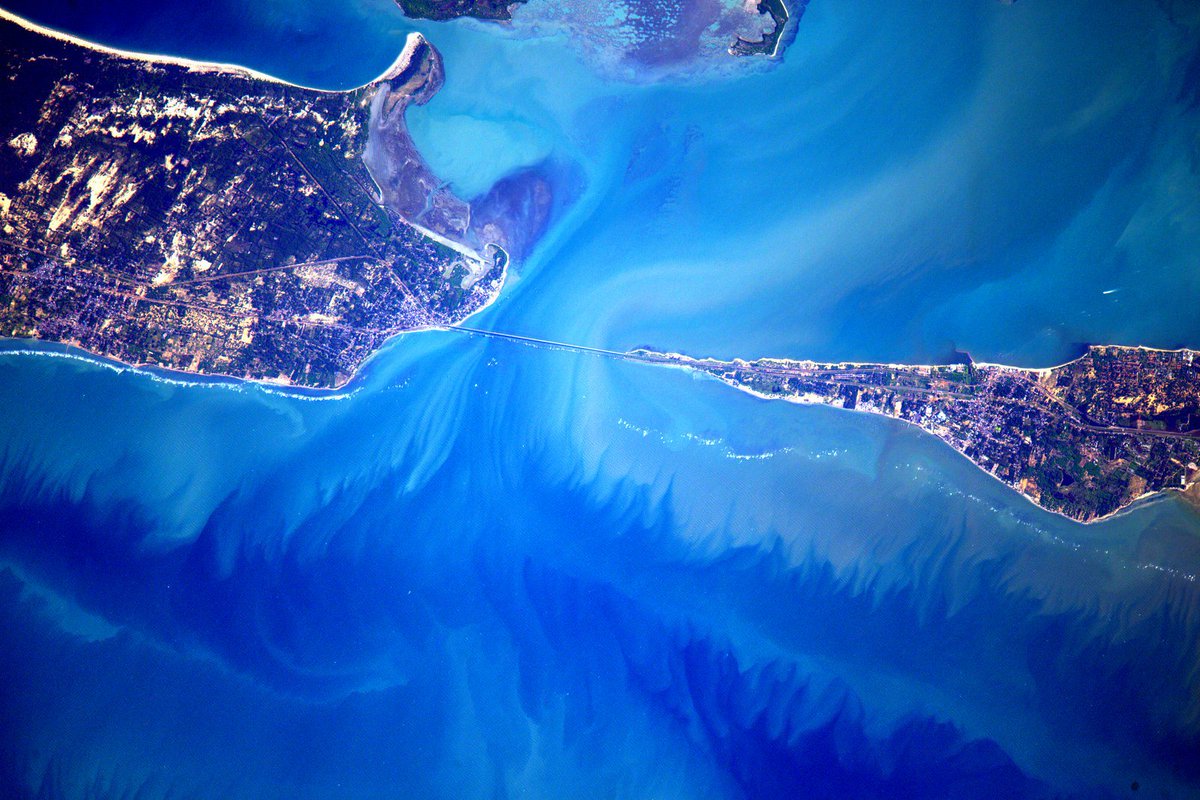
    1. The Southern tip of and its blue waters.

      Embedded image permalink

      SPECTACULAR.

      Source……..www.the betterindia.com

      Natarajan

Image of the Day….” Spectacular new image of earthrise”

A new earthrise photo, as seen from the moon by the Lunar Reconnaissance Orbiter.

Spectacular new image of earthrise seen from the moon, from NASA’s Lunar Reconnaissance Orbiter using cameras operated by Arizona State University. Africa, the south Atlantic Ocean and the eastern edge of South America can be seen. The large tan area on the upper right is the Sahara Desert. In the foreground on the moon, you are seeing the Compton crater. Read more about this image.

As seen from any one spot on the moon’s surface, Earth never rises or sets. Because one side of the moon always faces Earth, the Earth hangs relatively motionless in the lunar sky. But orbiting spacecraft can see earthrises and earthsets. This week, Arizona State University emailed us this amazing new image of an earthrise seen from the moon, along with Q-and-A with Mark Robinson, who is the principal investigator for the cameras aboard NASA’s Lunar Reconnissance Orbiter. In it, Robinson talked about this image, which was acquired by the orbiter’s camera (the LROC) in October.

Q: How did you know this image would be possible?

A: [The LROC has] taken pictures of the Earth more than 10 times in the past. We wanted to get a limb shot (showing the edge of the moon). What makes it really hard is getting the moon in the foreground … That was not by accident. We have software tools that allow us to visualize observations. We know where the spacecraft is going to be in the future … We determined from which orbits the Earth will be visible near the limb. Once we know the ground track where the Earth will be visible, we then find a view with a dramatic foreground.

Question: What are some of the pieces that had to come together to make this photo?

Answer: Just a few of the steps: You have to roll the spacecraft, in this case about 70 degrees, but the spacecraft is traveling at over 1,600 meters per second. We’re restricted in the length of one exposure time to something close to 0.4 milliseconds. You also move the spacecraft in the direction of flight so that you can get a wide enough field of view. When a spacecraft is in an elliptical orbit, the timing changes from image-to-image in an orbit. We have to compute all of that beforehand to get it exactly right … That timing has to be precisely carried out … We have to predict the temperature of the CCD (electronic equivalent of film). The Wide Angle Camera (WAC) is imaging an area multiple times while the Narrow Angle Cameras (NAC) takes just one picture. We blow up the WAC images and combine them to produce higher resolution, and then overlay this sharper image on the NAC image. We wanted the Earth to be on the horizon, and that only happens from certain areas of the moon. It’s only when the spacecraft is above the boundary between the nearside and farside that you can see the Earth behind the limb (edge of the moon).

Q: LRO has been in orbit for more than six years. If you picked the best shots to show your friends, what are they?

A: We’ve taken more than a million images. My answer changes every three days. The Apollo landing sites are fantastic. You can see the tracks the astronauts left on the surface of the moon. To me, as a scientist, it’s really great because it helps me visualize the photographs they took on the surface. The significance of the geologic context. ‘All right, now I know they got that soil sample there, and I can see what it looks like.’

Bottom line: NASA’s Lunar Reconnaissance Orbiter acquired this new image of Earthrise from the moon in October, 2015, using the orbiter’s camera (the LROC) operated by Arizona State University.

Source…..www.earthsky.org

Natarajan

” Jaw-dropping images of Earth from space in 2015″

Astronauts on board the International Space Station beamed back some spectacular views of Earth this year.

The Earth Observations team at NASA’s Johnson Space Center selected the 15 best photographs, which we’ve republished here.

Astronauts aboard the International Space Station took this image of Adele Island, off Australia’s north coast, on June 11, 2015. The tiny island is only 2.9 kilometres (2 miles) long.

Astronauts aboard the International Space Station took this image of Adele Island, off Australia’s north coast, on June 11, 2015. The tiny island is only 2.9 kilometres (2 miles) long.

This image shows landscapes of the arid Sahara and the dark green marshes of Lake Chad, which stand out in the foreground.

This image shows landscapes of the arid Sahara and the dark green marshes of Lake Chad, which stand out in the foreground.

Hawaii’s Kilauea volcano is seen on the left in a photo taken in February.

Hawaii’s Kilauea volcano is seen on the left in a photo taken in February.

The peaks of Colombia’s Santa Marta are so high that trees cannot grow. The highest peak has a permanent snow cap and is the only place where snow can be seen from the tropical beaches of the Caribbean coast.

The peaks of Colombia’s Santa Marta are so high that trees cannot grow. The highest peak has a permanent snow cap and is the only place where snow can be seen from the tropical beaches of the Caribbean coast.

Southern Scandinavia is illuminated under a full moon in this image, which also features a green aurora to the north and the Baltic Sea, seen as a black patch in the lower right of the photo.

Southern Scandinavia is illuminated under a full moon in this image, which also features a green aurora to the north and the Baltic Sea, seen as a black patch in the lower right of the photo.

The Paraná River, South America’s second-largest, pours brown muddy water into a wide estuary known as the River Plate.

The Paraná River, South America’s second-largest, pours brown muddy water into a wide estuary known as the River Plate.

The snow-covered Himalaya range is seen near the China–India border.

The snow-covered Himalaya range is seen near the China–India border.

Laguna Colorada, a lake in the Bolivian Andes Mountains, lies at 4,300 metres (14,100 feet) above sea level. Algae in the water is responsible for the lake’s deep red-brown color.

Laguna Colorada, a lake in the Bolivian Andes Mountains, lies at 4,300 metres (14,100 feet) above sea level. Algae in the water is responsible for the lake's deep red-brown color.

Fish farms are seen on the coast of China’s northeast province of Liaoning.

Fish farms are seen on the coast of China’s northeast province of Liaoning.

This September image shows the winding border between Pakistan and India, one of the few places on Earth where an international boundary can be seen at night.

This September image shows the winding border between Pakistan and India, one of the few places on Earth where an international boundary can be seen at night.

Brightly-coloured salt ponds are seen on the coast of Tunisia’s port city, Sfax.

Brightly-coloured salt ponds are seen on the coast of Tunisia's port city, Sfax.

Red-brown coastal lagoons are seen on this stretch of Western Australia’s coastline, in a photo taken on June 11.

Red-brown coastal lagoons are seen on this stretch of Western Australia's coastline, in a photo taken on June 11.

This photo, taken on June 15, shows the northern tip of Massachusetts’ Cape Cod.

This photo, taken on June 15, shows the northern tip of Massachusetts' Cape Cod.

The Mekong River, Southeast Asia’s largest river, flows on the border between Thailand and Laos. Heavy monsoon rainfall at the end of July created a red-brown channel of floodwater.

The Mekong River, Southeast Asia’s largest river, flows on the border between Thailand and Laos. Heavy monsoon rainfall at the end of July created a red-brown channel of floodwater.

A red sprite — a major electrical discharge thought to occur during large thunderstorms — is captured above the white light of an active thunderstorm high over Missouri or Illinois.

A red sprite — a major electrical discharge thought to occur during large thunderstorms — is captured above the white light of an active thunderstorm high over Missouri or Illinois.

Source……..

Curiosity’s 10 best images of Mars in 2015….

As of December, 2015, Curiosity has acquired over 292,000 images from Mars’ surface. Here are our picks for the top 10 images by the rover in 2015.

Strata rocks and dark sand in an area that has been named

Strata rocks and dark sand in an area that has been named ‘Kimberley.’ The strata in the foreground dip towards the base of Mount Sharp, indicating flow of water toward a basin that existed before the larger bulk of the mountain formed. The images obtained by NASA’s Curiosity rover in October, 2015, led scientists conclude there were ancient lakes on this area. Credits: NASA/JPL-Caltech/MSSS

Since its August 5-6, 2012 landing on Mars – an event known to space scientists as seven minutes of terror – NASA’s Curiosity rover has been studying the surface of Mars. Its job now is to determine whether the Gale Crater area, the area in which it landed, ever had the right conditions to support microbial life. As of December, 2015 – using its 17 cameras – Curiosity has acquired over 292,000 images from the surface of Mars. The images on this page are our picks of some of the best images captured by the rover in 2015.

Curiosity has seen a lot of layered rocks on the surface of Mars, like these amazing rocks captured on July, 2015. Credits: NASA/JPL-Caltech/MSSS

Curiosity has seen a lot of layered rocks on the surface of Mars, like these amazing rocks captured in July, 2015.Read more about this image. Credits: NASA/JPL-Caltech/MSSS

The rover mission’s official name is the Mars Science Laboratory. The rover itself is 9 feet (about 3 meters) long and 7 feet (about 2.7 meters) wide, and weighs about 2,000 pounds (900 kg).

 It is not Arizona or Utah...this is planet Mars as seen by Curiosity on September, 2015.  This image shows regions that include a long ridge teeming with hematite, an iron oxide. Just beyond is an undulating plain rich in clay minerals. And just beyond that are a multitude of rounded buttes, all high in sulfate minerals. The changing mineralogy in these layers of Mount Sharp suggests a changing environment in early Mars, though all involve exposure to water billions of years ago. Image via NASA/JPL-Caltech/MSSS

It’s not Arizona or Utah … this is planet Mars as seen by Curiosity on September, 2015. This image shows regions that include a long ridge teeming with hematite, an iron oxide. Just beyond is an undulating plain rich in clay minerals. And just beyond that are a multitude of rounded buttes, all high in sulfate minerals. The changing mineralogy in these layers of Mount Sharp suggests a changing environment in early Mars, though all involve exposure to water billions of years ago. Image via NASA/JPL-Caltech/MSSS

Sunset in Mars' Gale Crater. NASA's Curiosity Mars rover captured the sun setting on April 15, 2015 from the rover's location in Gale Crater. The color has been calibrated and white-balanced to remove camera artifacts. Mastcam sees color very similarly to what human eyes see, although it is actually a little less sensitive to blue than people are. Dust in the Martian atmosphere has fine particles that permit blue light to penetrate the atmosphere more efficiently than longer-wavelength colors. That causes the blue colors in the mixed light coming from the sun to stay closer to sun's part of the sky, compared to the wider scattering of yellow and red colors. Image via NASA/JPL-Caltech/MSSS

Sunset on Mars. The Curiosity rover captured the sun setting on April 15, 2015 from the Gale Crater. The color has been calibrated and white-balanced to remove camera artifacts. The rover’s ‘Mastcam’ sees color very similarly to what human eyes see, although it is actually a little less sensitive to blue than people are. Dust in the Martian atmosphere has fine particles that permit blue light to penetrate the atmosphere more efficiently than longer-wavelength colors. That causes the blue colors in the mixed light coming from the sun to stay closer to sun’s part of the sky, compared to the wider scattering of yellow and red colors. Image via NASA/JPL-Caltech/MSSS

Two orbiters that were already studying Mars when Curiosity arrived. They are the Mars Reconnaissance Orbiter, and Mars Odyssey. These two act as satellites, relaying pictures and data from the rover back to Earth.]

Diverse composition of mineral veins at the

Diverse composition of mineral veins at the ‘Garden City’ site investigated by Curiosity suggests multiple episodes of groundwater activity. The prominent mineral veins vary in thickness and brightness, and include: 1) thin, dark-toned fracture filling material; 2) thick, dark-toned vein material in large fractures; 3) light-toned vein material, which was deposited last. Researchers used the Mastcam and other instruments on Curiosity in March and April 2015 to study the structure and composition of mineral veins at Garden City, for information about fluids that deposited minerals in fractured rock there. Image via NASA/JPL-Caltech/MSSS

Because color images use much more data or bandwidth to be transmitted to our planet, a lot of black and white images are sent to the orbiting spacecraft that occasionally passes over t

he rover’s location for a short time. However, some color images are eventually sent.

This is an area lining the northwestern edge of Mount Sharp. The scene combines multiple images taken with the Mast Camera on NASA’s Curiosity Mars rover on Sept. 25, 2015. Dunes are larger than wind-blown ripples of sand or dust that Curiosity and other rovers have visited previously. You can see the dark dunes by clicking again after opening this panorama. Image via NASA/JPL-Caltech/MSSS

Giant antennas at California (USA), Australia and Spain compose the Deep Space Network that receives pictures and data from the Mars spacecraft as well as from other interplanetary spacecraft.

A Selfie on Mars. Curiosity extended its robotic arm and used the camera on the arm's end to capture this self portrait on October 6,2015. The image was taken at the

A selfie on Mars. Curiosity extended its robotic arm and used the camera on the arm’s end to capture this self portrait on October 6, 2015. The image was taken at the ‘Big Sky’ site, where its drill collected the mission’s fifth taste of Mount Sharp. Image via NASA/JPL-Caltech/MSSS

Dark rocks on route to Mountains. Diverse terrain is visible on this image taken on Mount Sharp on April 10, 2015. The color has been approximately white-balanced to resemble how the scene would appear under daytime lighting conditions on Earth. Image via NASA/JPL-Caltech/MSSS]

Dark rocks on route to mountains. Diverse terrain is visible on this image taken on Mount Sharp on April 10, 2015. The color has been approximately white-balanced to resemble how the scene would appear under daytime lighting conditions on Earth. Image via NASA/JPL-Caltech/MSSS

Damage on the aluminum wheels is evident after 7 miles (11.3 km) on the odometer of the Curiosity rover. Mars' terrain and diverse rocks led to more wheel damage than was expected. However scientists think the 20 inches (51 cm) wheels may permit the rover to continue its mission. Image via NASA/JPL-Caltech/MSSS

Damage on the aluminum wheels is evident after 7 miles (11.3 km) on the odometer of the Curiosity rover. Mars’ terrain and diverse rocks led to more wheel damage than was expected. However scientists think the 20 inches (51 cm) wheels may permit the rover to continue its mission. Image via NASA/JPL-Caltech/MSSS

A Solar Eclipse from Mars. Curiosity captured Phobos, one of the two small martian moons passing in front of the Sun in July, 2015. Although Phobos is only about 14 miles (22.5 km) in diameter, it orbits Mars at just 6,000 km ( 3,728 miles) which is relatively close. Image via NASA/JPL-Caltech/MSSS

A Solar Eclipse from Mars. Curiosity captured Phobos, one of the two small martian moons passing in front of the Sun in July, 2015. Although Phobos is only about 14 miles (22.5 km) in diameter, it orbits Mars at just 6,000 km ( 3,728 miles) which is relatively close. Image via NASA/JPL-Caltech/MSSS

Where is Curiosity right now? The rover is located in an area of Mount Sharp that has been named Namib dune. The rover is analyzing the composition and grain size of a ripple.

Source….www.earthsky.org

Natarajan

Image of the Day…”Zinnia Flowers @ International Space Station…”

Zinnia Flowers Starting to Grow on the International Space Station

Zinnia flowers are starting to grow in the International Space Station's Veggie facility

Zinnia flowers are starting to grow in the International Space Station’s Veggie facility as part of the VEG-01 investigation. Veggie provides lighting and nutrient supply for plants in the form of a low-cost growth chamber and planting “pillows” to provide nutrients for the root system. These plants appear larger than their ground-based counterparts and scientists expect buds to form on the larger plants soon.

The Veggie facility supports a variety of plant species that can be cultivated for educational outreach, fresh food and even recreation for crew members on long-duration missions. Previously, the facility has grown lettuce — which was consumed by the crew earlier this year — and now investigators are attempting to grow Zinnia flowers. Understanding how flowering plants grow in microgravity can be applied to growing other edible flowering plants, such as tomatoes.

Image Credit: NASA

Image of the Day…” Blue Marble Earth Image …”

New Earthrise Image from LRO spacecraft

NASA’s Lunar Reconnaissance Orbiter (LRO) recently captured a unique view of Earth from the spacecraft’s vantage point in orbit around the moon.

“The image is simply stunning,” said Noah Petro, Deputy Project Scientist for LRO at NASA’s Goddard Space Flight Center in Greenbelt, Maryland. “The image of the Earth evokes the famous ‘Blue Marble’ image taken by Astronaut Harrison Schmitt during Apollo 17, 43 years ago, which also showed Africa prominently in the picture.”

In this composite image we see Earth appear to rise over the lunar horizon from the viewpoint of the spacecraft, with the center of the Earth just off the coast of Liberia (at 4.04 degrees North, 12.44 degrees West). The large tan area in the upper right is the Sahara Desert, and just beyond is Saudi Arabia. The Atlantic and Pacific coasts of South America are visible to the left. On the moon, we get a glimpse of the crater Compton, which is located just beyond the eastern limb of the moon, on the lunar farside.

LRO was launched on June 18, 2009, and has collected a treasure trove of data with its seven powerful instruments, making an invaluable contribution to our knowledge about the moon. LRO experiences 12 earthrises every day; however the spacecraft is almost always busy imaging the lunar surface so only rarely does an opportunity arise such that its camera instrument can capture a view of Earth. Occasionally LRO points off into space to acquire observations of the extremely thin lunar atmosphere and perform instrument calibration measurements. During these movements sometimes Earth (and other planets) pass through the camera’s field of view and dramatic images such as the one shown here are acquired.

This image was composed from a series of images taken Oct. 12, when LRO was about 83 miles (134 kilometers) above the moon’s farside crater Compton. Capturing an image of the Earth and moon with LRO’s Lunar Reconnaissance Orbiter Camera (LROC) instrument is a complicated task. First the spacecraft must be rolled to the side (in this case 67 degrees), then the spacecraft slews with the direction of travel to maximize the width of the lunar horizon in LROC’s Narrow Angle Camera image. All this takes place while LRO is traveling faster than 3,580 miles per hour (over 1,600 meters per second) relative to the lunar surface below the spacecraft!

The high-resolution Narrow Angle Camera (NAC) on LRO takes black-and-white images, while the lower resolution Wide Angle Camera (WAC) takes color images, so you might wonder how we got a high-resolution picture of the Earth in color. Since the spacecraft, Earth, and moon are all in motion, we had to do some special processing to create an image that represents the view of the Earth and moon at one particular time. The final Earth image contains both WAC and NAC information. WAC provides the color, and the NAC provides high-resolution detail.

“From the Earth, the daily moonrise and moonset are always inspiring moments,” said Mark Robinson of Arizona State University in Tempe, principal investigator for LROC. “However, lunar astronauts will see something very different: viewed from the lunar surface, the Earth never rises or sets. Since the moon is tidally locked, Earth is always in the same spot above the horizon, varying only a small amount with the slight wobble of the moon. The Earth may not move across the ‘sky’, but the view is not static. Future astronauts will see the continents rotate in and out of view and the ever-changing pattern of clouds will always catch one’s eye, at least on the nearside. The Earth is never visible from the farside; imagine a sky with no Earth or moon – what will farside explorers think with no Earth overhead?”

NASA’s first Earthrise image was taken with the Lunar Orbiter 1 spacecraft in 1966. Perhaps NASA’s most iconic Earthrise photo was taken by the crew of the Apollo 8 mission as the spacecraft entered lunar orbit on Christmas Eve Dec. 24, 1968. That evening, the astronauts — Commander Frank Borman, Command Module Pilot Jim Lovell, and Lunar Module Pilot William Anders — held a live broadcast from lunar orbit, in which they showed pictures of the Earth and moon as seen from their spacecraft. Said Lovell, “The vast loneliness is awe-inspiring and it makes you realize just what you have back there on Earth.”

Source…….www.nasa.gov

Natarajan