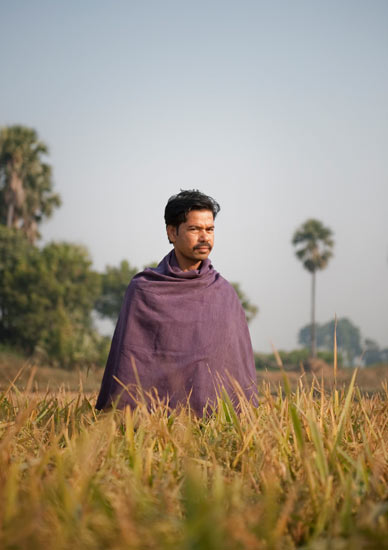
Sumant Kumar was overjoyed when he harvested his rice last year. There had been good rains in his village of Darveshpura in north-eastIndia and he knew he could improve on the four or five tonnes per hectare that he usually managed. But every stalk he cut on his paddy field near the bank of the Sakri river seemed to weigh heavier than usual, every grain of rice was bigger and when his crop was weighed on the old village scales, even Kumar was shocked.
This was not six or even 10 or 20 tonnes. Kumar, a shy young farmer in Nalanda district of India’s poorest state Bihar, had – using only farmyard manure and without any herbicides – grown an astonishing 22.4 tonnes of rice on one hectare of land. This was a world record and with rice the staple food of more than half the world’s population of seven billion, big news.
Link to video: Rice farming in India: ‘Now I produce enough food for my family’It beat not just the 19.4 tonnes achieved by the “father of rice”, the Chinese agricultural scientist Yuan Longping, but the World Bank-funded scientists at the International Rice Research Institute in the Philippines, and anything achieved by the biggest European and American seed and GM companies. And it was not just Sumant Kumar. Krishna, Nitish, Sanjay and Bijay, his friends and rivals in Darveshpura, all recorded over 17 tonnes, and many others in the villages around claimed to have more than doubled their usual yields.
The villagers, at the mercy of erratic weather and used to going without food in bad years, celebrated. But the Bihar state agricultural universities didn’t believe them at first, while India’s leading rice scientists muttered about freak results. The Nalanda farmers were accused of cheating. Only when the state’s head of agriculture, a rice farmer himself, came to the village with his own men and personally verified Sumant’s crop, was the record confirmed.
 A tool used to harvest rice. Photograph: Chiara GoiaThe rhythm of Nalanda village life was shattered. Here bullocks still pull ploughs as they have always done, their dung is still dried on the walls of houses and used to cook food. Electricity has still not reached most people. Sumant became a local hero, mentioned in the Indian parliament and asked to attend conferences. The state’s chief minister came to Darveshpura to congratulate him, and the village was rewarded with electric power, a bank and a new concrete bridge.
That might have been the end of the story had Sumant’s friend Nitish not smashed the world record for growing potatoes six months later. Shortly after Ravindra Kumar, a small farmer from a nearby Bihari village, broke the Indian record for growing wheat. Darveshpura became known as India’s “miracle village”, Nalanda became famous and teams of scientists, development groups, farmers, civil servants and politicians all descended to discover its secret.
When I meet the young farmers, all in their early 30s, they still seem slightly dazed by their fame. They’ve become unlikely heroes in a state where nearly half the families live below the Indian poverty line and 93% of the 100 million population depend on growing rice and potatoes. Nitish Kumar speaks quietly of his success and says he is determined to improve on the record. “In previous years, farming has not been very profitable,” he says. “Now I realise that it can be. My whole life has changed. I can send my children to school and spend more on health. My income has increased a lot.”
What happened in Darveshpura has divided scientists and is exciting governments and development experts. Tests on the soil show it is particularly rich in silicon but the reason for the “super yields” is entirely down to a method of growing crops called System of Rice (or root) Intensification (SRI). It has dramatically increased yields with wheat, potatoes, sugar cane, yams, tomatoes, garlic, aubergine and many other crops and is being hailed as one of the most significant developments of the past 50 years for the world’s 500 million small-scale farmers and the two billion people who depend on them.
 People work on a rice field in Bihar. Photograph: Chiara GoiaInstead of planting three-week-old rice seedlings in clumps of three or four in waterlogged fields, as rice farmers around the world traditionally do, the Darveshpura farmers carefully nurture only half as many seeds, and then transplant the young plants into fields, one by one, when much younger. Additionally, they space them at 25cm intervals in a grid pattern, keep the soil much drier and carefully weed around the plants to allow air to their roots. The premise that “less is more” was taught by Rajiv Kumar, a young Bihar state government extension worker who had been trained in turn by Anil Verma of a small Indian NGO called Pran (Preservation and
Proliferation of Rural Resources and Nature), which has introduced the SRI method to hundreds of villages in the past three years.
While the “green revolution” that averted Indian famine in the 1970s relied on improved crop varieties, expensive pesticides and chemical fertilisers, SRI appears to offer a long-term, sustainable future for no extra cost. With more than one in seven of the global population going hungry and demand for rice expected to outstrip supply within 20 years, it appears to offer real hope. Even a 30% increase in the yields of the world’s small farmers would go a long way to alleviating poverty.
“Farmers use less seeds, less water and less chemicals but they get more without having to invest more. This is revolutionary,” said Dr Surendra Chaurassa from Bihar’s agriculture ministry. “I did not believe it to start with, but now I think it can potentially change the way everyone farms. I would want every state to promote it. If we get 30-40% increase in yields, that is more than enough to recommend it.”
The results in Bihar have exceeded Chaurassa’s hopes. Sudama Mahto, an agriculture officer in Nalanda, says a small investment in training a few hundred people to teach SRI methods has resulted in a 45% increase in the region’s yields. Veerapandi Arumugam, the former agriculture minister of Tamil Nadu state, hailed the system as “revolutionising” farming.
SRI’s origins go back to the 1980s in Madagascar where Henri de Laulanie, a French Jesuit priest and agronomist, observed how villagers grew rice in the uplands. He developed the method but it was an American, professor Norman Uphoff, director of the International Institute for Food, Agriculture and Development at Cornell University, who was largely responsible for spreading the word about De Laulanie’s work.
Given $15m by an anonymous billionaire to research sustainable development, Uphoff went to Madagascar in 1983 and saw the success of SRI for himself: farmers whose previous yields averaged two tonnes per hectare were harvesting eight tonnes. In 1997 he started to actively promote SRI in Asia, where more than 600 million people are malnourished.
“It is a set of ideas, the absolute opposite to the first green revolution [of the 60s] which said that you had to change the genes and the soil nutrients to improve yields. That came at a tremendous ecological cost,” says Uphoff. “Agriculture in the 21st century must be practised differently. Land and water resources are becoming scarcer, of poorer quality, or less reliable. Climatic conditions are in many places more adverse. SRI offers millions of disadvantaged households far better opportunities. Nobody is benefiting from this except the farmers; there are no patents, royalties or licensing fees.”
 Rice seeds. Photograph: Chiara GoiaFor 40 years now, says Uphoff, science has been obsessed with improving seeds and using artificial fertilisers: “It’s been genes, genes, genes. There has never been talk of managing crops. Corporations say ‘we will breed you a better plant’ and breeders work hard to get 5-10% increase in yields. We have tried to make agriculture an industrial enterprise and have forgotten its biological roots.”
Not everyone agrees. Some scientists complain there is not enough peer-reviewed evidence around SRI and that it is impossible to get such returns. “SRI is a set of management practices and nothing else, many of which have been known for a long time and are best recommended practice,” says Achim Dobermann, deputy director for research at the International Rice Research Institute. “Scientifically speaking I don’t believe there is any miracle. When people independently have evaluated SRI principles then the result has usually been quite different from what has been reported on farm evaluations conducted by NGOs and others who are promoting it. Most scientists have had difficulty replicating the observations.”
Dominic Glover, a British researcher working with Wageningen University in the Netherlands, has spent years analysing the introduction of GM crops in developing countries. He is now following how SRI is being adopted in India and believes there has been a “turf war”.
“There are experts in their fields defending their knowledge,” he says. “But in many areas, growers have tried SRI methods and abandoned them. People are unwilling to investigate this. SRI is good for small farmers who rely on their own families for labour, but not necessarily for larger operations. Rather than any magical theory, it is good husbandry, skill and attention which results in the super yields. Clearly in certain circumstances, it is an efficient resource for farmers. But it is labour intensive and nobody has come up with the technology to transplant single seedlings yet.”
But some larger farmers in Bihar say it is not labour intensive and can actually reduce time spent in fields. “When a farmer does SRI the first time, yes it is more labour intensive,” says Santosh Kumar, who grows 15 hectares of rice and vegetables in Nalanda. “Then it gets easier and new innovations are taking place now.”
In its early days, SRI was dismissed or vilified by donors and scientists but in the past few years it has gained credibility. Uphoff estimates there are now 4-5 million farmers using SRI worldwide, with governments in China, India, Indonesia, Cambodia, Sri Lanka and Vietnam promoting it.
Sumant, Nitish and as many as 100,000 other SRI farmers in Bihar are now preparing their next rice crop. It’s back-breaking work transplanting the young rice shoots from the nursery beds to the paddy fields but buoyed by recognition and results, their confidence and optimism in the future is sky high.
Last month Nobel prize-winning economist Joseph Stiglitz visited Nalanda district and recognised the potential of this kind of organic farming, telling the villagers they were “better than scientists”. “It was amazing to see their success in organic farming,” said Stiglitz, who called for more research. “Agriculture scientists from across the world should visit and learn and be inspired by them.”
 A man winnows rice in Satgharwa village. Photograph: Chiara GoiaBihar, from being India’s poorest state, is now at the centre of what is being called a “new green grassroots revolution” with farming villages, research groups and NGOs all beginning to experiment with different crops using SRI. The state will invest $50m in SRI next year but western governments and foundations are holding back, preferring to invest in hi-tech research. The agronomist Anil Verma does not understand why: “The farmers know SRI works, but help is needed to train them. We know it works differently in different soils but the principles are solid,” he says. “The biggest problem we have is that people want to do it but we do not have enough trainers.
“If any scientist or a company came up with a technology that almost guaranteed a 50% increase in yields at no extra cost they would get a Nobel prize. But when young Biharian farmers do that they get nothing. I only want to see the poor farmers have enough to eat.”
source:::: John Vidal in The Observer UK
Natarajan




 Take off with Natarajan