Every day, Google’s Street View cars capture massive amounts of data and the company then publishes them on Google Maps at regular intervals. Until now, the only images you could see on Google Maps were the latest images. Starting today, however, you will also be able to go back in time and see older images.
When you’re in the Street View interface, you will now see a small clock icon on the page. Once you click that, a preview image with a timeline underneath it will appear and allow you to see the older images.
It looks like Google’s Street View cars pass by most locations about twice per year. There is a bit of variation here, however, and some urban areas especially have more historical images available while some rural areas may have fewer. In many regions of the world, Google only started collecting this imagery in the last few years (it launched in the U.S. in 2007), so that may also limit the availability of historical images.
Google tells me this update is meant to be part of the company’s effort to “create a digital mirror and true record of the world.”
The update is going live globally today. For now, it will only be available in the desktop version of Google Maps and it is unclear if Google plans to bring this feature to other versions of Maps later.
Here is an example of what these images look like:
One of the biggest problems still haunting the poor regions of the world is the lack of clean drinking water. This is such a nccessaity that we take for granted, but many populations do not. Now, a new solution has arisen, one that is both simple and very promising.
In the Namib desert where rain is rare but fog common, a beetle survives by condensing water on its back until drops roll down into the insect’s mouth. Now this principle has been magnified onto a grand scale, providing a possible solution to the desperate lack of water that plagues the populations of many of the world’s dry regions.
There is no lack of solutions being experimented with for water shortages. Wells, recycling techniques and methods for cleaning poisoned water have all attracted considerable efforts, particularly since the Bill and Melinda Gates foundation have made the issue a priority for their considerable resources.
However, many of these techniques have floundered; great on the page but unsuited to real world conditions. Those technologies that are cost effective represent only partial solutions, working well where a permanent water supply is available, but unsuited to regions where surface water vanishes in the dry season and groundwater is hard to reach. As deforestation and Global Warming expand the areas where water is scarce or erratic something else is needed.
While Warka Water to be treated with caution after so many false dawns, it has the advantage of being designed to match the conditions where most alternatives perform the worst.
The towers have a 9m tall bamboo or juncus frame holding up a plastic mesh net. As the temperature falls during the night water condenses onto the net and rolls down to a reservoir at the bottom of the tower. Where the beetle draws just a few life-giving drops from the Namib fog, the much larger surface area of the nets allows a 100l a night to collect under ideal conditions. Mesh is used, rather than a solid surface, so that air can circulate, bringing in ever more water.
As the designers Arturo Vittori and Andrea Vogler put it, “The lightweight structure is designed with parametric computing, but can be built with local skills and materials by the village inhabitants.”
The beetle has proven an inspiration to many but Warka Water claim their carefully shaped design produces much more water for less cost than previous versions.
The Warka Water tower is named after a fig tree native to Ethiopia, and depends for its success on a large temperature difference over a night. Since desert regions are notorious for huge temperature variations, particularly during the dry season, Warka towers should flourish where they are needed most.
“It’s not just illnesses that we’re trying to address,” Vittori told the Smithsonian Magazine, although with 1400 children a day dying from waterborne diseases that would be reason enough. “Many Ethiopian children from rural villages spend several hours every day to fetch water, time they could invest for more productive activities and education,” Vittori says. “If we can give people something that lets them be more independent, they can free themselves from this cycle.”
Vittori hopes to install two Warka Towers in Ethiopia next year, and believes that, “Once locals have the necessary know-how, they will be able to teach other villages and communities to build the Warka.” Cost estimates for the remote constructions of systems are notoriously unreliable, but Vittori believes the towers can be built for $500 each, a quarter or systems that purify equivalent amounts of water. They are seeking sponsorship to bring the idea to fruition. While we suggest Warka Beer would be a great fit, anyone wanting to get behind the idea should make contact.
In the Namib desert where rain is rare but fog common, a beetle survives by condensing water on its back until drops roll down into the insect’s mouth. Now this principle has been magnified onto a grand scale, providing a possible solution to the desperate lack of water that plagues the populations of many of the world’s dry regions.
There is no lack of solutions being experimented with for water shortages. Wells, recycling techniques and methods for cleaning poisoned water have all attracted considerable efforts, particularly since the Bill and Melinda Gates foundation have made the issue a priority for their considerable resources.
However, many of these techniques have floundered; great on the page but unsuited to real world conditions. Those technologies that are cost effective represent only partial solutions, working well where a permanent water supply is available, but unsuited to regions where surface water vanishes in the dry season and groundwater is hard to reach. As deforestation and Global Warming expand the areas where water is scarce or erratic something else is needed.
While Warka Water to be treated with caution after so many false dawns, it has the advantage of being designed to match the conditions where most alternatives perform the worst.
The towers have a 9m tall bamboo or juncus frame holding up a plastic mesh net. As the temperature falls during the night water condenses onto the net and rolls down to a reservoir at the bottom of the tower. Where the beetle draws just a few life-giving drops from the Namib fog, the much larger surface area of the nets allows a 100l a night to collect under ideal conditions. Mesh is used, rather than a solid surface, so that air can circulate, bringing in ever more water.
As the designers Arturo Vittori and Andrea Vogler put it, “The lightweight structure is designed with parametric computing, but can be built with local skills and materials by the village inhabitants.”
The beetle has proven an inspiration to many but Warka Water claim their carefully shaped design produces much more water for less cost than previous versions.
The Warka Water tower is named after a fig tree native to Ethiopia, and depends for its success on a large temperature difference over a night. Since desert regions are notorious for huge temperature variations, particularly during the dry season, Warka towers should flourish where they are needed most.
“It’s not just illnesses that we’re trying to address,” Vittori told the Smithsonian Magazine, although with 1400 children a day dying from waterborne diseases that would be reason enough. “Many Ethiopian children from rural villages spend several hours every day to fetch water, time they could invest for more productive activities and education,” Vittori says. “If we can give people something that lets them be more independent, they can free themselves from this cycle.”
Vittori hopes to install two Warka Towers in Ethiopia next year, and believes that, “Once locals have the necessary know-how, they will be able to teach other villages and communities to build the Warka.” Cost estimates for the remote constructions of systems are notoriously unreliable, but Vittori believes the towers can be built for $500 each, a quarter or systems that purify equivalent amounts of water. They are seeking sponsorship to bring the idea to fruition. While we suggest Warka Beer would be a great fit, anyone wanting to get behind the idea should make contact.
It’s not that scientists haven’t tried many solutions – wells, recycling systems, cleansing poisonious or fetid water – all of those have seen a lot of money and effort put in them.
Unfortunately, many of these techniques, while looking good on page, do not stand up to real world conditions. Now comes a solution that is so simple, yet ingenious – the Warka Towers.
These towers are 9 meters tall, built on a cheap bamboo or juncus frame and holding up a fine plastic mesh net. As the temperatures drop during the night, water condenses on the net and, like the beetle’s system, the drops of water roll down the net into a reservoir at the bottom of the tower.
But while the beetle extracts only a the few drops of water it needs to survive, the much larger area surface of the nets creates about 100 litres of water every night. Since the towers use a net and not a solid surface, the air circulates through, allowing the net to capture more and more moisture.
The architect of this brilliant idea, Artuo Vittori, says that the towers can be built for only $500 a tower, and he hopes that once more are introduced to the African continent, the local population will learn to build these towers for itself, thus populating the dry regions with these towers, an elegant solution for a terrible problem!
Gmail’s home page as it looked on March 31, 2004, shortly before the service launchedSkizzers.org
Google’s email breakthrough was almost three years in the making. But it wasn’t a given that it would reach the public at all
If you wanted to pick a single date to mark the beginning of the modern era of the web, you could do a lot worse than choosing Thursday, April 1, 2004, the day Gmail launched.
Scuttlebutt that Google was about to offer a free email service had leaked out the day before: Here’s John Markoff of the New York Timesreporting on it at the time. But the idea of the search kingpin doing email was still startling, and the alleged storage capacity of 1GB—500 times what Microsoft’s Hotmail offered—seemed downright implausible. So when Google issued a press release date-stamped April 1, an awful lot of people briefly took it to be a really good hoax. (Including me.)
Gmail turned out to be real, and revolutionary. And a decade’s worth of perspective only makes it look more momentous.
The first true landmark service to emerge from Google since its search engine debuted in 1998, Gmail didn’t just blow away Hotmail and Yahoo Mail, the dominant free webmail services of the day. With its vast storage, zippy interface, instant search and other advanced features, it may have been the first major cloud-based app that was capable of replacing conventional PC software, not just complementing it.
Even the things about Gmail that ticked off some people presaged the web to come: Its scanning of messages to find keywords that could be used for advertising purposes kicked off a conversation about online privacy that continues on to this day.
Within Google, Gmail was also regarded as a huge, improbable deal. It was in the works for nearly three years before it reached consumers; during that time, skeptical Googlers ripped into the concept on multiple grounds, from the technical to the philosophical. It’s not hard to envision an alternate universe in which the effort fell apart along the way, or at least resulted in something a whole lot less interesting.
“It was a pretty big moment for the Internet,” says Georges Harik, who was responsible for most of Google’s new products when Gmail was hatched. (The company called such efforts “Googlettes” at the time.) “Taking something that hadn’t been worked on for years but was central, and fixing it.”
It All Began With Search
Gmail is often given as a shining example of the fruits of Google’s 20 percent time, its legendary policy of allowing engineers to divvy off part of their work hours for personal projects. Paul Buchheit, Gmail’s creator, disabused me of this notion. From the very beginning, “it was an official charge,” he says. “I was supposed to build an email thing.”
He began his work in August 2001. But the service was a sequel of sorts to a failed effort that dated from several years before he joined Google in 1999, becoming its 23rd employee.
Gmail’s creator, Paul Buchheit, at his desk at Google in 1999Courtesy Paul Buchheit
“I had started to make an email program before in, probably, 1996,” he explains. “I had this idea I wanted to build web-based email. I worked on it for a couple of weeks and then got bored. One of the lessons I learned from that was just in terms of my own psychology, that it was important that I always have a working product. The first thing I do on day one is build something useful, then just keep improving it.”
With Gmail–which was originally code-named Caribou, borrowing the name of a mysterious corporate project occasionally alluded to inDilbert–the first useful thing Buchheit built was a search engine for his own email. And it did indeed take only a day to accomplish. His previous project had been Google Groups, which indexed the Internet’s venerable Usenet discussion groups: All he had to do was hack Groups’ lightning-fast search feature to point it at his mail rather than Usenet.
At first, Buchheit’s email search engine ran on a server at his own desk. When he sought feedback from other engineers, their main input was that it should search their mail, too. Soon, it did.
The fact that Gmail began with a search feature that was far better than anything offered by the major email services profoundly shaped its character. If it had merely matched Hotmail’s capacity, it wouldn’t have needed industrial-strength search. It’s tough, after all, to lose anything when all you’ve got is a couple of megabytes of space.
But serious search practically begged for serious storage: It opened up the possibility of keeping all of your email, forever, rather than deleting it frantically to stay under your limit. That led to the eventual decision to give each user 1GB of space, a figure Google settled on after considering capacities that were generous but not preposterous, such as 100MB.
“A lot of people thought it was a very bad idea, from both a product and a strategic standpoint.”Still, long before Google chose to give Gmail users 1GB of space, it had to decide that Gmail would be a commercial product at all. That wasn’t the no-brainer it might seem, even though Google had a maniacally email-centric culture itself.
In its early years, one of the defining things about the company was its obsessive focus on its search engine; that set it apart from Yahoo, Excite, Lycos and other search pioneers that had recast themselves as “portals,” expanding their ambitions to encompass everything from weather to sports to games to, yes, email. Portals had a reputation for doing many things, but not necessarily doing them all that well.
“A lot of people thought it was a very bad idea, from both a product and a strategic standpoint,” says Buchheit of his email project. “The concern was this didn’t have anything to do with web search. Some were also concerned that this would cause other companies such as Microsoft to kill us.”
Fortunately, the doubters didn’t include Google’s founders. “Larry [Page] and Sergey [Brin] were always supportive,” Buchheit says. “A lot of other people were much less supportive.”
Buchheit had been working on his project for a month or two when he was joined by another engineer, Sanjeev Singh, with whom he’d found social-networking startup FriendFeed after leaving Google in 2006. (FriendFeed was acquired by Facebook in 2009.) The Gmail team grew over time, but not exponentially; even when the service launched in 2004, only a dozen or so people were working on it.
Gmail’s first product manager, Brian Rakowski, learned about the service from his boss, Marissa Mayer, on his first day at Google in 2002, fresh out of college. (He’s still at Google today, where he currently works on Android.) What he saw got him excited, but it was still an exceptionally rough draft.
“It didn’t look anything like what Gmail does now or even what it looked like when it launched,” he says. “I was just graduated from school and was indoctrinated in usability tests and target users. I was pretty paranoid that Google engineers would love it and it wouldn’t appeal to the mass market. I agonized over it a lot.”
All along, though, Gmail’s creators were building something to please themselves, figuring that their email problems would eventually be everybody’s problems. “Larry said normal users would look more like us in 10 years’ time,” Rakowski says.
What Does Google Email Look Like?
Even in August of 2003, two years into the effort, Gmail had only the most rudimentary of front ends. That’s when another new Google recruit, Kevin Fox, was assigned to design the service’s interface. (After leaving Google, he reuinited with Buchheit and Singh at FriendFeed.)
Fox knew that Gmail needed to look Googley; the challenge was that it wasn’t entirely clear what that meant. The company didn’t yet offer an array of services: Other than the company’s eponymous search engine, one of the few other precedents Fox could draw inspiration from was Google News, which had debuted in September of 2002. But search and News were both websites. Gmail was going to be a web app.
“It was a fundamentally different kind of product,” he says. “Fortunately, they gave me lots of latitude to explore different design directions.” Fox aimed for something that took cues from both websites and desktop applications without mindlessly mimicking either. After three major passes on the design, he settled on the look that’s still very much recognizable in today’s version of Gmail.
Gmail as it appeared in April of 2004, in a screenshot created by its designer, Kevin FoxKevin Fox
Thinking of Gmail as an app rather than a site had technical implications, too. Hotmail and Yahoo Mail had originally been devised in the mid-1990s; they sported dog-slow interfaces written in plain HTML. Almost every action you took required the service to reload the entire web page, resulting in an experience that had none of the snappy responsiveness of a Windows or Mac program.
With Gmail, Buchheit worked around HTML’s limitations by using highly interactive JavaScript code. That made it feel more like software than a sequence of web pages. Before long, the approach would get the moniker AJAX, which stood for Asynchronous JavaScript and XML; today, it’s how all web apps are built. But when Gmail was pioneering the technique, it wasn’t clear that it was going to work.
The ambitious use of JavaScript “was another thing most people thought was a pretty bad idea,” Buchheit says. “One of the problems we had was that the web browsers weren’t very good back then…We were afraid we’d crash browsers and nobody would want to use it.”
The more JavaScript that Gmail used, the more sophisticated it could get. One of its flagship features ended up being that the messages in your inbox weren’t strictly sequential. Instead, with the aim of making it easier to follow discussion threads, all the messages in a given back-and-forth string were collected into a cluster called a conversation, with any duplicated text automatically concealed. From a design perspective, says Fox, “trying to make it so that conversations were obvious to the user and intuitive was the largest challenge.”
“We weren’t going to plaster it with banners. We committed to that from pretty early on.”Then there was Gmail’s business model. Some within Google advocated for it being a paid service, but Buchheit and others wanted the service to reach as many people as possible, which was an argument for it being free and supported by advertising. With other free email offerings of the time, that meant flashy graphical banner ads–the antithesis of the unobtrusive little text ads which, then as now, accompanied Google search results.
“We weren’t going to plaster [Gmail] with banners,” says Rakowski. “We committed to that from pretty early on.” Instead, Gmail got little text ads of its own, automatically keyed to words in the text of a user’s email. In an example Google used early on to explain the system, two ads for ticket agencies were displayed alongside a conversation that mentioned a Beach Boys concert.
As with other aspects of Gmail, it wasn’t a given that the plan to monetize it through text ads would work. “I remember trying to model out how valuable each user would be in terms of advertising,” remembers Rakowski. “We had no idea.”
Advertising wasn’t just a math problem. Other email services already scanned the text of incoming messages, to check for spam and viruses, for instance. But doing the same thing for advertising purposes was something new, and Google knew that some people might be creeped out by any tangible evidence that their messages had been read, even if the one doing the reading was a machine.
“We thought pretty hard before doing what we did,” says Harik. “We thought, is this thing a perceived privacy violation or a real one? We decided it would be an issue of perception.”
Going Public
For much of its development, Gmail had been a skunkworks project, kept secret even from most people within Google. “It wasn’t even guaranteed to launch–we said that it has to reach a bar before it’s something we want to get out there,” says Fox.
By early 2004, however, Gmail worked, and almost everybody was using it to access the company’s internal email system. It was time to settle on a schedule for a public announcement. The date the company selected was April 1.
Copernicus Center, the lunar research lab Google also announced on April 1, 2004Google
That wasn’t just another random day on the calendar. Google had begun itstradition of April Fools’ mischief in 2000; the company had a hoax in the works for 2004, involving an announcement that it was hiring for a new research center on the moon. It figured, correctly, that announcing Gmail at the same time would lead some people to think that the announcement was a prank. Especially since the 1GB of space was unimaginably ginormous by 2004 standards.
“Sergey was most excited about it,” says Rakowski. “The ultimate April Fools’ joke was to launch something kind of crazy on April 1st and have it still exist on April 2nd.”
“If you’re far enough ahead that people can’t figure out if you’re joking, you know you’ve innovated.”The team had to scamper to make the deadline, and in fact, Gmail wasn’t really ready to go: Google didn’t have the awesome server capacity in place to give millions of people reliable email and a gigabyte of space apiece. “We had a Catch-22 when we launched,” Buchheit remembers. “We couldn’t get many machines because people thought we couldn’t launch, but we couldn’t launch because we didn’t have machines.”
In the end, Gmail ended up running on three hundred old Pentium III computers nobody else at Google wanted. That was sufficient for the limited beta rollout the company planned, which involved giving accounts to a thousand outsiders, allowing them to invite a couple of friends apiece, and growing slowly from there.
As news about Gmail dribbled out on March 31 and continued into April Fools’ Day, the reaction did, indeed, include a fair amount of disbelief. “If you’re far enough ahead that people can’t figure out if you’re joking, you know you’ve innovated,” says Harik. “Primarily, journalists would call us and say ‘We need to know if you’re just kidding, or if this is real.’ That was fun.”
Once it was clear that Gmail was the real deal, the invitations became a hot property. The limited rollout had been born of necessity, but “it had a side effect,” says Harik. “Everyone wanted it even more. It was hailed as one of the best marketing decisions in tech history, but it was a little bit unintentional.”
Gmail’s use of JavaScript made features like auto-completion of contact names as you typed possibleGoogle
Bidding for invites on eBay sent prices shooting up to $150 and beyond; sites such as Gmail Swap emerged to match up those with invites with those who desperately wanted them. Having a Hotmail or Yahoo Mail email address was slightly embarrassing; having a Gmail one meant that you were part of a club most people couldn’t get into.
Despite the publicity windfall, Buchheit sounds a tad wistful about the situation, even a decade later: “I think Gmail could have grown a lot more in the first year if we’d had more resources.”
The aura of exclusivity and experimentation stuck to Gmail long after it did grow huge. Google kept increasing the number of invites each user could issue, but it didn’t open up the service to all comers until Valentine’s Day, 2007. And Gmail wore its Beta label like a badge of honor until July of 2009. (The company finally removed it as a sop to cautious business customers, who didn’t want to sign up for something that sounded unfinished.)
Gmail’s use of advertising keyed to the contents of email messages raised hackles–maybe more so than Google had anticipated. Some critics thought it invaded the privacy of the sender; others felt that the recipient was the party whose rights had been violated. Fear of inappropriate placements—such as pharmaceutical ads next to an email concerning suicide—was a common theme. And some people had reasonable questions about what Google would do with the data it collected to serve the ads, and how long it would preserve it.
Gmail’s limited release—the same thing that had some people giddily competing for invites on eBay—left others developing an antipathy to the service based on assumptions rather than reality. “I went to dinner parties at friends of friends,” says Rakowski. “People would talk about Gmail, not knowing that I worked on it, understanding it incorrectly because they hadn’t had a chance to try it.”
The annotated screenshot Google used in 2004 to explain how Gmail’s ads workedGoogle
The reaction from privacy groups got ugly fast. On April 6, 31 organizations and advocates co-signed a letter to Page and Brin, raising a gaggle of concerns about Gmail, calling it a bad precedent and asking that the service be suspended until their concerns could be addressed. “Scanning personal communications in the way Google is proposing is letting the proverbial genie out of the bottle,” they warned.
Right in Google’s own backyard, California State Senator Liz Figueroa (D-Fremont) sent Google a letter of her own, calling Gmail a “disaster of enormous proportions, for yourself, and for all of your customers.” She went on to draft a bill requiring, among other things, that any company that wanted to scan an email message for advertising purposes get the consent of the person who sent it. (By the time the California Senate passed the law, cooler heads prevailed and that obligation had been eliminated.)
Google reacted to the controversy over Gmail’s ads by listening to the critics, detailing its policies on the Gmail site and spotlighting the work of journalists who thought the controversy was silly. It didn’t cave to those who demanded fundamental change to the service, and pushed back at what it argued was irresponsible behavior by some of the service’s foes:
When we began the limited test of Gmail, we expected our service would be the subject of intense interest. What we did not anticipate was the reaction from some privacy activists, editorial writers and legislators, many of whom condemned Gmail without first seeing it for themselves. We were surprised to find that some of these activists and organizations refused to even talk to us, or to try first-hand the very service they were criticizing. As we read news stories about Gmail, we have regularly noticed factual errors and out-of-context quotations. Misinformation about Gmail has spread across the web.
That’s unfortunate for Google, but why should you care? Because it may affect your right to make your own decisions about how you read your mail. This misinformation threatens to eliminate legitimate and useful consumer choices by means of legislation aimed at innocuous and privacy-aware aspects of our service, while simultaneously deflecting attention from the real privacy issues inherent to all email systems.
“Ten years from now, we’ll probably look back at the Gmail dust-up with…befuddlement,” wrote Slate’s Paul Boutin, one of the journalists whose pro-Gmail stances Google linked to in its response to the privacy flap. Mostly, we do: In 2012, the last time Google issued an official count, Gmail had 425 million active users, which suggests that discomfort with its approach to advertising is a minority view. The issue has never vanished entirely, though. It’s still in the courts, and Microsoft continues to tell consumers that it’s a reason to use Outlook.com, Hotmail’s successor.
A Decade Later
One remarkable thing about Gmail that wasn’t obvious in 2004: Its creators built it to last. The current incarnations of Outlook.com and Yahoo Mail have nothing to do with the email services Microsoft and Yahoo offered 10 years ago. But Gmail–despite having added features more or less continuously and gone through somesignificant redesigns–is still Gmail.
“I can’t think of another app that has existed so close to its original form for 10 years,” says Fox. “Someone who had only used Gmail in its first iteration and suddenly used it today would still understand Gmail. They’d know how to use it for virtually everything they’d want to do.”
“What makes the product what it is really comes from the continuous focus on the types of problems we’re trying to solve for our users,” says Alex Gawley, Gmail’s current product manager. “If you look back to 2004, the big problems email users were facing were having to delete messages for lack of storage, not being able to find messages and crazy amounts of spam.” Today, the big opportunities include making Gmail more action-oriented–which Google is doing with features such as live flight status information displayed within messages–and reimagining it for mobile devices such as phones and tablets. Gawley says challenges like those are enough to keep the Gmail team busy for the next half-decade.
Of course, no matter how inventive Gmail remains, it’s now the establishment. When newfangled apps and services such as Mailboxand Alto come along, the experience they’re reimagining is one created by Gmail, more than any other single email client, over the last decade. The creators of any new service would be thrilled to do to Google what Google did to Microsoft and Yahoo in 2004.
Gmail’s creator Paul Buchheit in March 2014Annie Harper
Then again, some of the issues email still has may not lend themselves to the sort of problem-solving Silicon Valley knows how to tackle. When I dropped Buchheit a line at his Gmail address asking to chat with him for this story, I got an automated message explaining that he was on hiatus from email—checking in, but only sporadically. Did Gmail’s creator think that email was broken all over again?
”The problem with email now is that the social conventions have gotten very bad,” Buchheit told me once we’d made contact. “There’s a 24/7 culture, where people expect a response. It doesn’t matter that it’s Saturday at 2 a.m.–people think you’re responding to email. People are no longer going on vacation. People have become slaves to email.”
“It’s not a technical problem. It can’t be solved with a computer algorithm. It’s more of a social problem.”
Sounds like the man who fixed email in 2004 is saying that the only folks who can fix it in 2014 and beyond are those of us who use it–and sometimes abuse it–it every day.
Take advantage of day spas at the airport. Picture: Holidayextras. Source: Flickr
DAY spas, showers, free food, comfy chairs, fine dining, free internet — all facilities you’d expect to find at the airport if you’re flying at the pointy end of the plane.
These days the perks are not just for first and business class passengers. Expediabrings you the airports that have a lot more to offer than Duty Free shops and VIP Club lounges.
Samui Airport, Thailand
If you’re flying into Thailand, Koh Samui’s quaint Samui Airport sets the scene for a fly and flop holiday.
Open air, thatched roof bures stand in for gates and the terminal has sprawling manicured lawns and carved wooden chairs.
It’s more fun on the way out — deck chairs and snacks at the departure gate are free for everyone.
Samui’s open air terminal. Picture: KLGreenNYC.Source: Flickr
Incheon International Airport, Seoul
At Incheon International Airport in Seoul, the Airstar Terrace bar looking out over the runways is a popular spot to spend some time before boarding.
There’s the Cultural Museum of Korea if you ran out of time to find out about the history of the country, watch Korean movies in space age pods in the Advanced Technology area or head to the International Business Area for a game of golf, yes golf.
A movie theatre at Incheon airport. Picture: woofiegrrl.Source: Flickr
Schiphol International Airport, Amsterdam
Schiphol International Airport in Amsterdam is another hub known for looking after its guests in transit. The 24-hr library sees more than 300,000 visitors a year.
The books are focused on Dutch art and culture but there’s also a book swap section where you’ll see plenty of Dan Brown novels.
There’s also a piano next door so you can tinkle the ivories for a while. Take the kids to the Kids Forest playground, hang out on the comfy couches in the Living Room and squeeze in a quick foot massage.
A small version of the Rijksmuseum is just a taster if you missed out on the amazing State Museum in Amsterdam. Don’t forget to stop by the giant tea cups cafe.
The 24-hour library in Schiphol Airport. Picture: generalising.Source: Flickr
Changi International Airport, Singapore
Singapore’s Changi International Airport is probably one of the most well known airports for entertainment value.
A movie theatre, koi pond, outdoor pool, gardens, waterfall, spa, live butterflies … the list goes on.
If you’ve got more than five hours to spare and have had your fun at the airport, hop on one of the free two hour tours of the city. Departing four times a day, the bus tours head to Marina Bay Sands, Merlion Park, the Colonial District, Chinatown, even Little India.
The Butterfly Garden at Changi International Airport. Picture: Michael — SpencerSource: Flickr
Other honourable mentions go to Dallas/Fort Worth International Airport, where the pulled pork burgers are cheap and tasty, Dubai for the comfortable plastic lounge chairs by the departure gates and Cancun where you can drink Coronas and margaritas while lining up to check in.
A picture that requires a double take: this parrot is in fact a female model who posed for ‘world bodypainting champion’ Johannes Stötter. The Italian artist – whose frog imagewas an Internet hit – spent weeks planning the transformation, taking four hours to paint his subject with ink. The model’s arm forms the parrot’s head and beak, and her legs form the wing and tail feathers.
Flipkart, India’s answer to US online giant Amazon, said Saturday its sales would cross the milestone $1 billion-mark this year, ahead of schedule, in the country’s exploding e-commerce market.
Founded in 2007 by two ex-Amazon.com employees and university friends, Flipkart.com has become India’s biggest shopping portal hit and has drawn backers such as New-York based venture capitalists Tiger Global Management LLC.
“In March 2011 we announced by 2015 we wanted to hit $1 billion” in sales when they stood at just $10 million, said founders Sanchin Bansal and Binny Bansal, who happen to share the same surname but are unrelated.
Now the privately held firm expects to hit $1 billion in sales “one year before our target” which means “we’ve grown 100 times in the last three years,” the pair, who pool operational responsibilities, said in a statement.
The figures reinforce Flipkart’s leadership position in the Indian e-retail market.
The founders, now both 32, said they were “happy and proud” at the progress of Flipkart in which they invested an initial $10,000.
The Bansals are seen as typical of the new risk-ready breed of entrepreneurs that has emerged in India amid years of fast economic growth, relying not on inherited wealth but their own-start up talents to launch businesses.
“E-merchandise retailing sales stood at $1.6 billion in 2013. By 2018, we think they will be $14 billion and in 2023 they will reach $60 billion,” Saloni Nangia, president of leading consultancy Technopak Advisors, told AFP.
While there were already Indian online sellers, Flipkart helped sales take off by allowing customers to pay cash-on-delivery, a move Nangia calls a “game-changer”.
An increasing number of Indians are going online but they are uncomfortable giving credit card details over the Internet. Others do not have a credit card and the Flipkart method allows them to place orders.
“This cash-on-delivery system helped consumers gain trust in online shopping — they saw products arrive,” Nangia said.
Flipkart began selling books but then expanded to mobile phones, televisions, cameras, computers and home appliances.
It has yet to report a profit in the fiercely competitive market with its nearest rival, eBay-backed Snapdeal, targeting $1 billion turnover by mid-decade. The world’s biggest online retailer, Amazon, also entered the market last June.
More retailers are seen going online as real estate is costly “so it makes it hard to have bricks-and-mortar stores”, said Nangia.
India’s vast young population, rapidly embracing the Internet, would “drive the e-tailing story”, she added.
Now, months after putting retail store plans in India on hold, the world’s largest retailer, Walmart, is readying a major e-merchandising push in the country based on the Amazon model, media reports say.
THE world’s largest aircraft has been unveiled in Britain and it’s a real game changer.
The Airlander is part plane, part airship and part helicopter and it’s designed to provide an environmentally friends, easy, safe and revolutionary way to travel.
The 91 metre ship can deliver several tonnes of humanitarian aid and transport heavy freight across the world, but there are plans to create ‘luxury’ hybrids with infinity pools so lucky passengers can take a dip as they float across the African plains.
Imagine floating over cities while swimming in an infinity pool. Source: NewsComAu
Mike Durham, Technical Director of Hybrid Air Vehicles Ltd (HAV), which created the hybrid craft, says the “Airlander is a product that will change the world”.
And he could be right.
The Airlander can stay airborne for days without the need to refuel and it’s a greener, quieter and more efficient way to fly because it gets 60 per cent of its lift via helium and 40 per cent from the shape of hull.
It’s expected that there could be as many airships as helicopters in the sky in years to come and that they could be made to land on water, desert or ice.
The first passenger flight is scheduled to be in 2016 so start saving now!
These airships could land on ice, sea or desert. Source: NewsComAu
This could be a familiar sight in a few years time. Source: NewsComAu
Network Rail, which is responsible for Britain’s rail infrastructure, just opened the “world’s largest solar-powered bridge” — which stretches across the Thames, has 4,400 solar panels on it, and will provide half the energy to central London’s Blackfriars train station.
The project was one of the most complex to date for Solarcentury, which installed the panels in a series of phases over the past two years, pausing to minimise the impact on the station during the 2012 Olympic Games.
“We had different sections of roof available at different times to fit in with this complicated jigsaw of getting everything up and going,” explained Gavin Roberts, Solarcentury’s senior project manager, adding that the company had even considered shipping some of the components in via the Thames.
This is exactly the sort of project, though, that gets easier the more times a company’s done similar work — the more big, urban solar projects go up, the faster and cheaper the next one will be. Looking forward to an all-solar London Bridge
source:::: Sarah Laskow in grist.org
Sarah Laskow is a reporter based in New York City who covers environment, energy, and sustainability issues, among other things. Follow her on Twitter.
Pl click the above link and read the full story ….
The Plotclock, pictured, was designed by Thingiverse member Joo, also known as Johannes from Nuremburg. It writes the time, in hours and minutes, on a white board using a dry wipe pen, before erasing it and starting again
The traditional clock has had its day.
A German creator has designed a robot that writes the time using a dry wipe pen on a miniature white board.
Its mechanical arms then erase the time from this board, before starting again – and each time the robot writes, the numbers correspond to the real-world time as its being written.
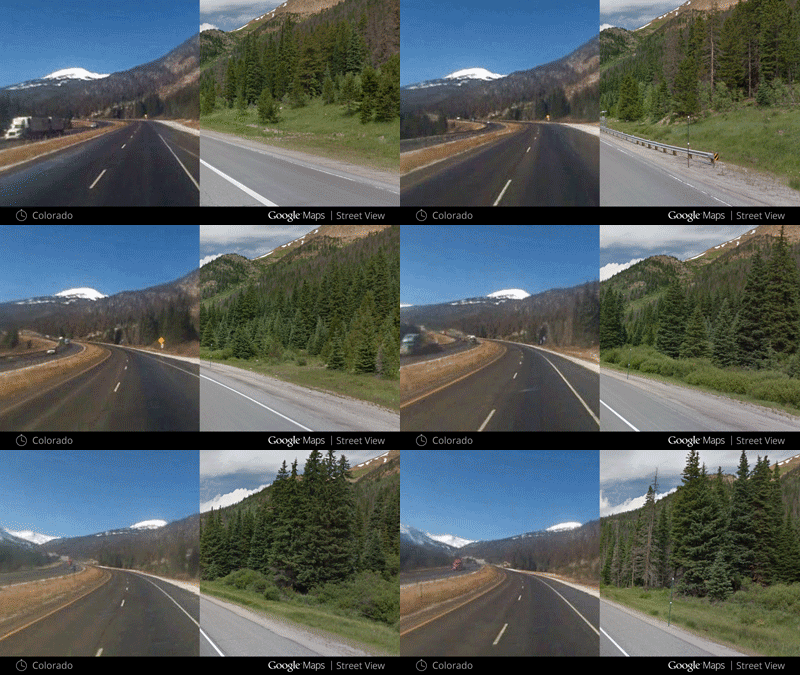
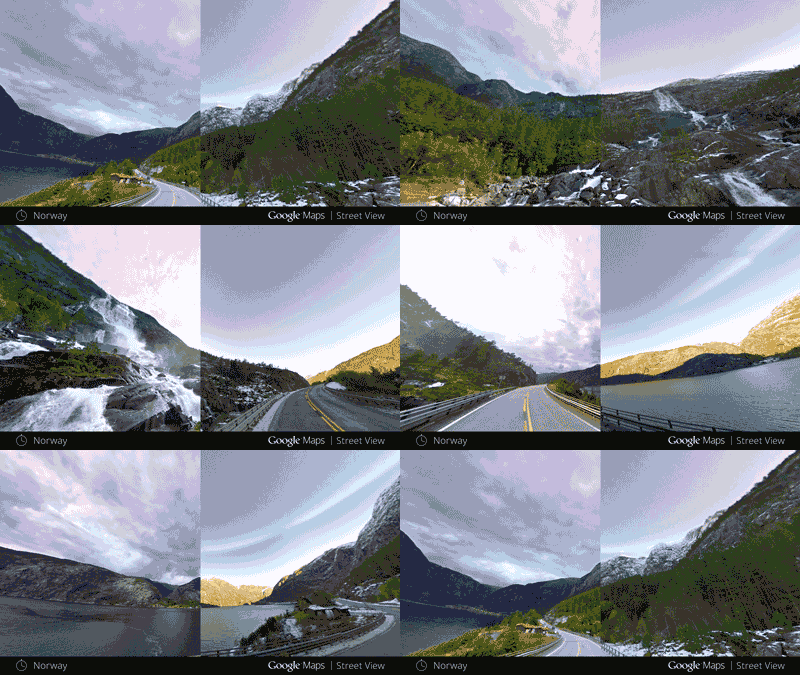 Google tells me this update is meant to be part of the company’s effort to “create a digital mirror and true record of the world.”


 Take off with Natarajan
