A Daredevil Aerial Walkway Over a Tea Park in China…..

What’s more dangerous than a glass-bottom bridge? A bridge without a bottom, of course!

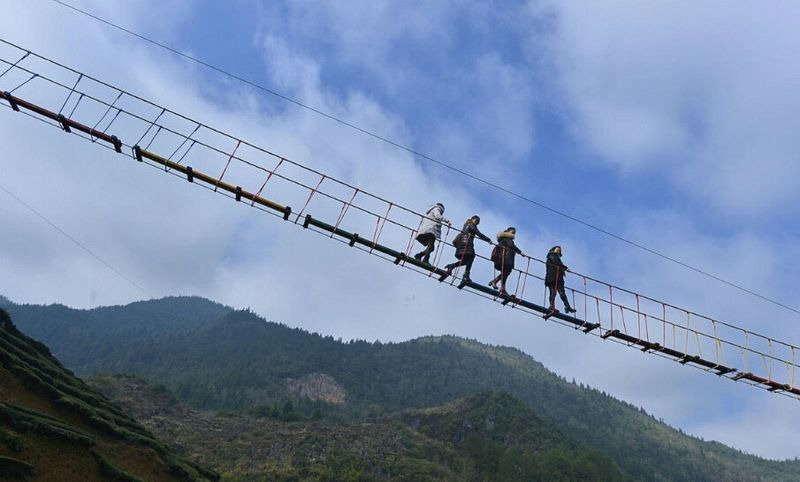
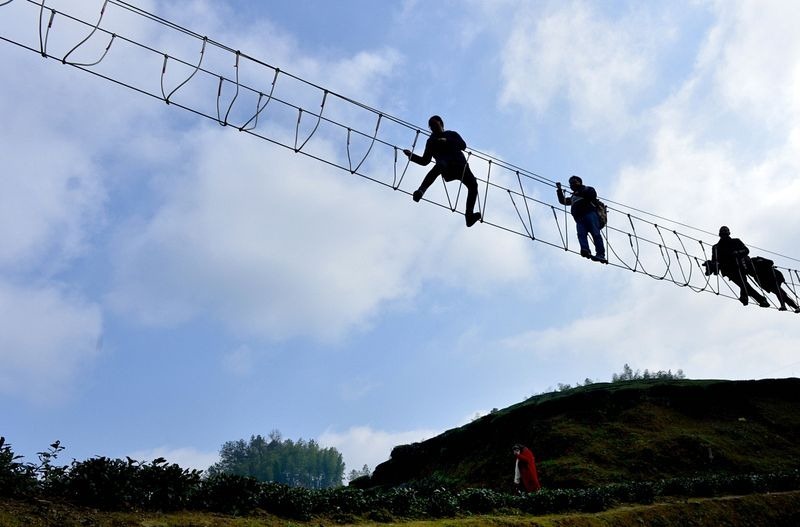
Such an aerial walkway buttressed by only ropes has opened at a tea park in Xuan’en County, in central China’s Hubei Province. The “air corridor” is suspended at least a dozen feet above the tea fields, and more than thirty feet at places, and runs for a length of about 1,000 meters. Only ropes, short wooden planks or tires are provided in the name of walkways. The scary attraction has drawn hundreds of tourists to the tea park already.

Xuan’en Country is located within the hinterlands of the Tujia and Miao ethnic minority group’s autonomous prefecture of Central China’s Hubei Province. It is part of the Wuling Mountain region in the upper reaches of the Yangtze River. This area has an ancient history of tea production.

air-corridor-xuanen-tea-park-7

air-corridor-xuanen-tea-park-1

air-corridor-xuanen-tea-park-2

air-corridor-xuanen-tea-park-3

air-corridor-xuanen-tea-park-4

air-corridor-xuanen-tea-park-5

air-corridor-xuanen-tea-park-8

Sources: China.com / JSChina.com.cn / xinhuanet.com

Source….www.amusingplanet.com

Natarajan

Curiosity’s 10 best images of Mars in 2015….

As of December, 2015, Curiosity has acquired over 292,000 images from Mars’ surface. Here are our picks for the top 10 images by the rover in 2015.

Strata rocks and dark sand in an area that has been named

Strata rocks and dark sand in an area that has been named ‘Kimberley.’ The strata in the foreground dip towards the base of Mount Sharp, indicating flow of water toward a basin that existed before the larger bulk of the mountain formed. The images obtained by NASA’s Curiosity rover in October, 2015, led scientists conclude there were ancient lakes on this area. Credits: NASA/JPL-Caltech/MSSS

Since its August 5-6, 2012 landing on Mars – an event known to space scientists as seven minutes of terror – NASA’s Curiosity rover has been studying the surface of Mars. Its job now is to determine whether the Gale Crater area, the area in which it landed, ever had the right conditions to support microbial life. As of December, 2015 – using its 17 cameras – Curiosity has acquired over 292,000 images from the surface of Mars. The images on this page are our picks of some of the best images captured by the rover in 2015.

Curiosity has seen a lot of layered rocks on the surface of Mars, like these amazing rocks captured on July, 2015. Credits: NASA/JPL-Caltech/MSSS

Curiosity has seen a lot of layered rocks on the surface of Mars, like these amazing rocks captured in July, 2015.Read more about this image. Credits: NASA/JPL-Caltech/MSSS

The rover mission’s official name is the Mars Science Laboratory. The rover itself is 9 feet (about 3 meters) long and 7 feet (about 2.7 meters) wide, and weighs about 2,000 pounds (900 kg).

 It is not Arizona or Utah...this is planet Mars as seen by Curiosity on September, 2015.  This image shows regions that include a long ridge teeming with hematite, an iron oxide. Just beyond is an undulating plain rich in clay minerals. And just beyond that are a multitude of rounded buttes, all high in sulfate minerals. The changing mineralogy in these layers of Mount Sharp suggests a changing environment in early Mars, though all involve exposure to water billions of years ago. Image via NASA/JPL-Caltech/MSSS

It’s not Arizona or Utah … this is planet Mars as seen by Curiosity on September, 2015. This image shows regions that include a long ridge teeming with hematite, an iron oxide. Just beyond is an undulating plain rich in clay minerals. And just beyond that are a multitude of rounded buttes, all high in sulfate minerals. The changing mineralogy in these layers of Mount Sharp suggests a changing environment in early Mars, though all involve exposure to water billions of years ago. Image via NASA/JPL-Caltech/MSSS

Sunset in Mars' Gale Crater. NASA's Curiosity Mars rover captured the sun setting on April 15, 2015 from the rover's location in Gale Crater. The color has been calibrated and white-balanced to remove camera artifacts. Mastcam sees color very similarly to what human eyes see, although it is actually a little less sensitive to blue than people are. Dust in the Martian atmosphere has fine particles that permit blue light to penetrate the atmosphere more efficiently than longer-wavelength colors. That causes the blue colors in the mixed light coming from the sun to stay closer to sun's part of the sky, compared to the wider scattering of yellow and red colors. Image via NASA/JPL-Caltech/MSSS

Sunset on Mars. The Curiosity rover captured the sun setting on April 15, 2015 from the Gale Crater. The color has been calibrated and white-balanced to remove camera artifacts. The rover’s ‘Mastcam’ sees color very similarly to what human eyes see, although it is actually a little less sensitive to blue than people are. Dust in the Martian atmosphere has fine particles that permit blue light to penetrate the atmosphere more efficiently than longer-wavelength colors. That causes the blue colors in the mixed light coming from the sun to stay closer to sun’s part of the sky, compared to the wider scattering of yellow and red colors. Image via NASA/JPL-Caltech/MSSS

Two orbiters that were already studying Mars when Curiosity arrived. They are the Mars Reconnaissance Orbiter, and Mars Odyssey. These two act as satellites, relaying pictures and data from the rover back to Earth.]

Diverse composition of mineral veins at the

Diverse composition of mineral veins at the ‘Garden City’ site investigated by Curiosity suggests multiple episodes of groundwater activity. The prominent mineral veins vary in thickness and brightness, and include: 1) thin, dark-toned fracture filling material; 2) thick, dark-toned vein material in large fractures; 3) light-toned vein material, which was deposited last. Researchers used the Mastcam and other instruments on Curiosity in March and April 2015 to study the structure and composition of mineral veins at Garden City, for information about fluids that deposited minerals in fractured rock there. Image via NASA/JPL-Caltech/MSSS

Because color images use much more data or bandwidth to be transmitted to our planet, a lot of black and white images are sent to the orbiting spacecraft that occasionally passes over t

he rover’s location for a short time. However, some color images are eventually sent.

This is an area lining the northwestern edge of Mount Sharp. The scene combines multiple images taken with the Mast Camera on NASA’s Curiosity Mars rover on Sept. 25, 2015. Dunes are larger than wind-blown ripples of sand or dust that Curiosity and other rovers have visited previously. You can see the dark dunes by clicking again after opening this panorama. Image via NASA/JPL-Caltech/MSSS

Giant antennas at California (USA), Australia and Spain compose the Deep Space Network that receives pictures and data from the Mars spacecraft as well as from other interplanetary spacecraft.

A Selfie on Mars. Curiosity extended its robotic arm and used the camera on the arm's end to capture this self portrait on October 6,2015. The image was taken at the

A selfie on Mars. Curiosity extended its robotic arm and used the camera on the arm’s end to capture this self portrait on October 6, 2015. The image was taken at the ‘Big Sky’ site, where its drill collected the mission’s fifth taste of Mount Sharp. Image via NASA/JPL-Caltech/MSSS

Dark rocks on route to Mountains. Diverse terrain is visible on this image taken on Mount Sharp on April 10, 2015. The color has been approximately white-balanced to resemble how the scene would appear under daytime lighting conditions on Earth. Image via NASA/JPL-Caltech/MSSS]

Dark rocks on route to mountains. Diverse terrain is visible on this image taken on Mount Sharp on April 10, 2015. The color has been approximately white-balanced to resemble how the scene would appear under daytime lighting conditions on Earth. Image via NASA/JPL-Caltech/MSSS

Damage on the aluminum wheels is evident after 7 miles (11.3 km) on the odometer of the Curiosity rover. Mars' terrain and diverse rocks led to more wheel damage than was expected. However scientists think the 20 inches (51 cm) wheels may permit the rover to continue its mission. Image via NASA/JPL-Caltech/MSSS

Damage on the aluminum wheels is evident after 7 miles (11.3 km) on the odometer of the Curiosity rover. Mars’ terrain and diverse rocks led to more wheel damage than was expected. However scientists think the 20 inches (51 cm) wheels may permit the rover to continue its mission. Image via NASA/JPL-Caltech/MSSS

A Solar Eclipse from Mars. Curiosity captured Phobos, one of the two small martian moons passing in front of the Sun in July, 2015. Although Phobos is only about 14 miles (22.5 km) in diameter, it orbits Mars at just 6,000 km ( 3,728 miles) which is relatively close. Image via NASA/JPL-Caltech/MSSS

A Solar Eclipse from Mars. Curiosity captured Phobos, one of the two small martian moons passing in front of the Sun in July, 2015. Although Phobos is only about 14 miles (22.5 km) in diameter, it orbits Mars at just 6,000 km ( 3,728 miles) which is relatively close. Image via NASA/JPL-Caltech/MSSS

Where is Curiosity right now? The rover is located in an area of Mount Sharp that has been named Namib dune. The rover is analyzing the composition and grain size of a ripple.

Source….www.earthsky.org

Natarajan

Image of the Day….Full Moon on Christmas Since 1977…

Happy Christmas to all who celebrate it!  Photo by EarthSky community member Rich Tommater in St. Petersburg, Florida.  Thanks, Rick.

This month, the December full moon falls on Friday, December 25, 2015. For Earth’s Western Hemisphere, it’s the first full moon on Christmas Day since 1977.*

We won’t have another full moon on a Christmas Day until 2034.

A 19-year cycle of the moon is the reason. Amazingly, the moon’s phases recur on (or near) the same calendar dates every 19 years. This cycle – known as the Metonic cycle – happens because 235 returns to full moon almost exactly equal 19 years.

So, in other words, the phases of the moon realign (or nearly realign) with the same calendar dates every 19 years. We just missed a full moon on Christmas 19 years ago; instead, the full moon fell on Christmas Eve. It was December 24, 1996 at 20:41 Universal Time, or UT.

But two Metonic cycles ago – 38 years (or 2 X 19 years) – the full moon fell on Christmas Day. That full moon happened on December 25, 1977 at 12:49 UT.

Astronomically speaking, the moon is only full for an instant – at the moment that it’s 180o opposite the sun in ecliptic longitude.

This month, that happens on December 25, 2015 at 11:11 UT. At United States time zones, that translates to 6:11 a.m. EST, 5:11 a.m. CST, 4:11 a.m. MST or 3:11 a.m. PST.

Although the moon turns full at the same instant worldwide, the clock reads differently by timezone. On a worldwide scale, the full moon actually comes at all hours around the clock. See the worldwide map below. The full moon takes place before sunrise December 25 in North America, noon in Europe and Africa and after sunset December 25 in eastern Asia, Australia and New Zealand.

Bottom line: The December 25, 2015 full moon is the Western Hemisphere’s first full moon on Christmas Day since 1977. We won’t have another full moon on a Christmas Day until 2034. A 19-year cycle of the moon – called the Metonic Cycle – is the reason. Explanation here.

Source…..www.earthsky.org

Natarajan

The Christmas Tree Worm ….!!!

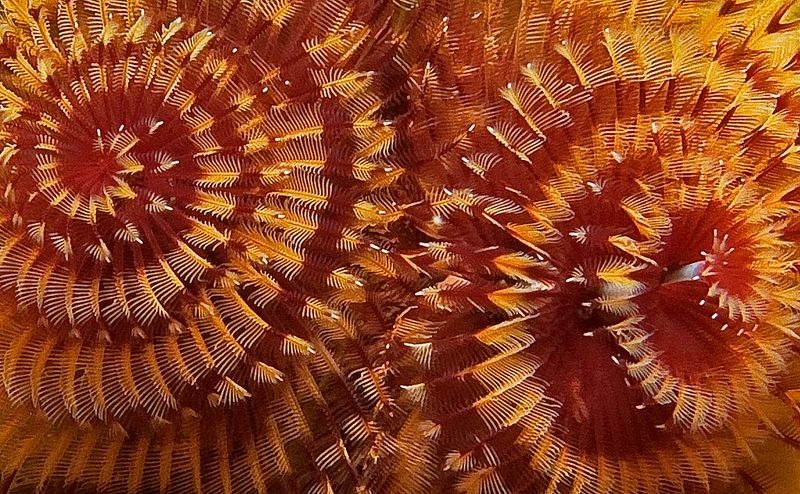
Scientifically that are called spirobranchus giganteus, but they are better known by their colloquial name — Christmas tree worm. The worm is so called not because they feed on fig trees but because they look like them.

The spirobranchus giganteus live in the ocean and sports two magnificent spirals of plumes that protrude from its tube-like body and which look like tiny Christmas trees. These plumes are composed of hair-like appendages called radioles that radiate from the worm’s central spine, and help the animal to grab food, which typically consists of microscopic plants, or phytoplankton, floating in the water. The plumes are also used for respiration. Measuring less than 4 cm in height, they come in many colors including orange, yellow, blue, and white and, are easily spotted due to their shape, beauty, and color.

christmas-tree-worm-9

Photo credit: Matt Kieffer/Flickr


The Christmas tree worm doesn’t like to move about much. Once they find a good place on a live calcareous coral, they burrow a hole and live their for the rest of their lives, occasionally emerging from their home to catch passing plankton with their fully extended plumes. They are very sensitive to disturbances and will rapidly retract into their burrows at the slightest touch or passing shadow.

christmas-tree-worm-10

christmas-tree-worm-1

christmas-tree-worm-3

christmas-tree-worm-6

christmas-tree-worm-7

christmas-tree-worm-8

Photo credit: Doug Finney/Flickr

Sources: NOAA / Marine Bio via My Modern Met

Source….www.amusingplanet.com

Natarajan


Image of the Day…”Zinnia Flowers @ International Space Station…”

Zinnia Flowers Starting to Grow on the International Space Station

Zinnia flowers are starting to grow in the International Space Station's Veggie facility

Zinnia flowers are starting to grow in the International Space Station’s Veggie facility as part of the VEG-01 investigation. Veggie provides lighting and nutrient supply for plants in the form of a low-cost growth chamber and planting “pillows” to provide nutrients for the root system. These plants appear larger than their ground-based counterparts and scientists expect buds to form on the larger plants soon.

The Veggie facility supports a variety of plant species that can be cultivated for educational outreach, fresh food and even recreation for crew members on long-duration missions. Previously, the facility has grown lettuce — which was consumed by the crew earlier this year — and now investigators are attempting to grow Zinnia flowers. Understanding how flowering plants grow in microgravity can be applied to growing other edible flowering plants, such as tomatoes.

Image Credit: NASA

” Pouring Hot Tea At -40C Near The Arctic Circle During Sunset…” !!!

Science tells us that hot water turns into a cloud of ice crystals when tossed at subzero temperatures, but Ontario based photographer Michael Davies managed capture this phenomenon on camera. This past Sunday, just 20km south of the Arctic Circle, Davies took these incredible photos of his friend Markus hurling hot tea in -40°C weather.

“Prepared with multiple thermoses filled with tea, we began tossing the water and shooting,” Davies told Huff Post. “Nothing of this shot was to chance, I followed the temperature, watched for calm wind, and planned the shot and set it up. Even the sun in the middle of the spray was something I was hoping for, even though it’s impossible to control.”

More info: michaelhdavies.com | Flickr (h/t: huffpost, colossal)

“Prepared with multiple thermoses filled with tea, we began tossing the water and shooting”

tossed-tea-arctic-photo-michael-davies-2

“Nothing of this shot was to chance, I followed the temperature, watched for calm wind, and planned the shot and set it up.”

tossed-tea-arctic-photo-michael-davies-9

“Even the sun in the middle of the spray was something I was hoping for, even though it’s impossible to control”

tossed-tea-arctic-photo-michael-davies-1

Source….www.boredpanda.com

Natarajan

Image of the Day….” Noon Time Sun and the Shadow of People around…”

Long midday shadows, near solstice, in Greece

Noontime sun near the December solstice, over the Acropolis in Athens, Greece. Notice how long everyone’s shadow is.

View larger. | Midday sun on December 18, 2015 as captured by Nikolaos Pantazis in Athens, Greece.

View larger. | Midday sun on December 18, 2015 as captured by Nikolaos Pantazis in Athens, Greece.

Nikolaos Pantazis posted this photo to EarthSky Facbook. He wrote:

Midday (almost) winter solstice sun, over the Acropolis of Athens, Greece.

This photo illustrates a cool fact of nature, which is that – for us in the Northern Hemisphere – yourlongest noontime shadow comes around the time of the December solstice. That’s because, for us in this hemisphere, the sun is making its lowest arc across the sky around now.

In the Southern Hemisphere? Then look for your noontime shadow, anyway. It’s your shortest noon shadow of the year.

Source…..www.earthsky.org

Natarajan

Image of the Day…” Blue Marble Earth Image …”

New Earthrise Image from LRO spacecraft

NASA’s Lunar Reconnaissance Orbiter (LRO) recently captured a unique view of Earth from the spacecraft’s vantage point in orbit around the moon.

“The image is simply stunning,” said Noah Petro, Deputy Project Scientist for LRO at NASA’s Goddard Space Flight Center in Greenbelt, Maryland. “The image of the Earth evokes the famous ‘Blue Marble’ image taken by Astronaut Harrison Schmitt during Apollo 17, 43 years ago, which also showed Africa prominently in the picture.”

In this composite image we see Earth appear to rise over the lunar horizon from the viewpoint of the spacecraft, with the center of the Earth just off the coast of Liberia (at 4.04 degrees North, 12.44 degrees West). The large tan area in the upper right is the Sahara Desert, and just beyond is Saudi Arabia. The Atlantic and Pacific coasts of South America are visible to the left. On the moon, we get a glimpse of the crater Compton, which is located just beyond the eastern limb of the moon, on the lunar farside.

LRO was launched on June 18, 2009, and has collected a treasure trove of data with its seven powerful instruments, making an invaluable contribution to our knowledge about the moon. LRO experiences 12 earthrises every day; however the spacecraft is almost always busy imaging the lunar surface so only rarely does an opportunity arise such that its camera instrument can capture a view of Earth. Occasionally LRO points off into space to acquire observations of the extremely thin lunar atmosphere and perform instrument calibration measurements. During these movements sometimes Earth (and other planets) pass through the camera’s field of view and dramatic images such as the one shown here are acquired.

This image was composed from a series of images taken Oct. 12, when LRO was about 83 miles (134 kilometers) above the moon’s farside crater Compton. Capturing an image of the Earth and moon with LRO’s Lunar Reconnaissance Orbiter Camera (LROC) instrument is a complicated task. First the spacecraft must be rolled to the side (in this case 67 degrees), then the spacecraft slews with the direction of travel to maximize the width of the lunar horizon in LROC’s Narrow Angle Camera image. All this takes place while LRO is traveling faster than 3,580 miles per hour (over 1,600 meters per second) relative to the lunar surface below the spacecraft!

The high-resolution Narrow Angle Camera (NAC) on LRO takes black-and-white images, while the lower resolution Wide Angle Camera (WAC) takes color images, so you might wonder how we got a high-resolution picture of the Earth in color. Since the spacecraft, Earth, and moon are all in motion, we had to do some special processing to create an image that represents the view of the Earth and moon at one particular time. The final Earth image contains both WAC and NAC information. WAC provides the color, and the NAC provides high-resolution detail.

“From the Earth, the daily moonrise and moonset are always inspiring moments,” said Mark Robinson of Arizona State University in Tempe, principal investigator for LROC. “However, lunar astronauts will see something very different: viewed from the lunar surface, the Earth never rises or sets. Since the moon is tidally locked, Earth is always in the same spot above the horizon, varying only a small amount with the slight wobble of the moon. The Earth may not move across the ‘sky’, but the view is not static. Future astronauts will see the continents rotate in and out of view and the ever-changing pattern of clouds will always catch one’s eye, at least on the nearside. The Earth is never visible from the farside; imagine a sky with no Earth or moon – what will farside explorers think with no Earth overhead?”

NASA’s first Earthrise image was taken with the Lunar Orbiter 1 spacecraft in 1966. Perhaps NASA’s most iconic Earthrise photo was taken by the crew of the Apollo 8 mission as the spacecraft entered lunar orbit on Christmas Eve Dec. 24, 1968. That evening, the astronauts — Commander Frank Borman, Command Module Pilot Jim Lovell, and Lunar Module Pilot William Anders — held a live broadcast from lunar orbit, in which they showed pictures of the Earth and moon as seen from their spacecraft. Said Lovell, “The vast loneliness is awe-inspiring and it makes you realize just what you have back there on Earth.”

Source…….www.nasa.gov

Natarajan

Places Where Three Time Zones Meet……..

When Italian mathematician Quirico Filopanti first sounded the idea of time zones in his book Miranda! published in 1858, he proposed that the world be divided longitudinally into 24 equal time zones, where each zone differs from the last by one hour. But the real world is rarely that simple. Influenced by political, geographical and social changes, the world adopted a much more complicated system where time zones differed by three-quarter, half and even quarter of an hour. Today there are as many as 40 different time zones.

With so many different time zones around it’s imperative that some of them would meet at more than one point. There are exactly twenty-two places, according to various sources, where more than three time zones meet. Some of them are obvious, such as tri-point boundaries between nations observing different time zones. The strangest ones are located in Australia because the way the country’s different states follow time.


australia-tri-points

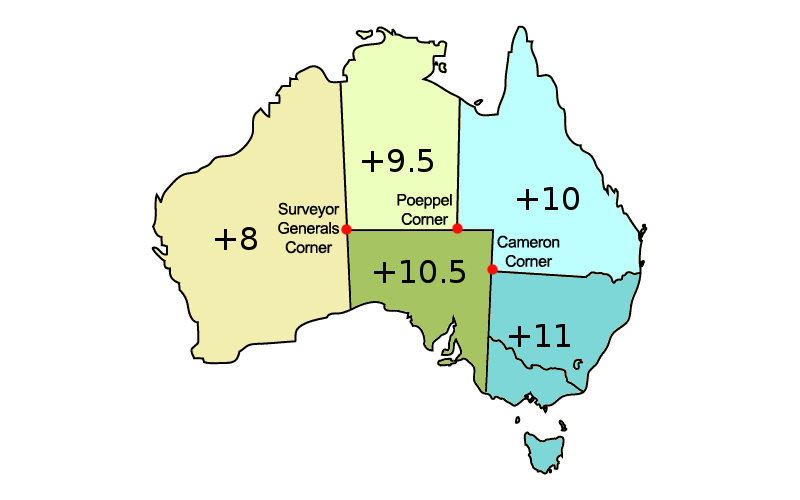
The time zones of Australia and the three state corners where three time zones meet.

Australia has three time zones, but from spring until autumn when New South Wales and South Australia adjust their clocks for daylight-savings, two additional time zones appear that horizontally break up the country’s two easternmost time zones into four. These time zones, which differ from each other by 30-minutes, meet at three different places. The most popular of them is Cameron Corner in the outback of eastern Australia, where the boundaries of states of Queensland, South Australia, and New South Wales meet. The other ones are Poeppel Corner (located at the corner of Queensland, South Australia and the Northern Territory) and Surveyor Generals Corner (located at the corner of South Australia, Western Australia and the Northern Territory). Standing at any one these locations allows any person to be at three different points of time at the same time. To take advantage of this anomaly, more than a thousand people descended on the tiny settlement of Cameron Corner on December 31, 1999, so they could celebrate the arrival of the new millennium three separate times.

cameron-corner-1

Marker at Cameron Corner. Photo credit: Kris H/Flickr


cameron-corner-2

Marker at Cameron Corner. Photo credit: Geoffrey Rhodes/Flickr


poeppel-corner

Marker at Poeppel Corner. Photo credit: Mark161/Panoramio

surveyor-generals-corner

Marker at Surveyor Generals Corner. Photo credit: jeza1/Panoramio

Another interesting place where a bunch of time zones meet is Antarctica. Being located on the South Pole, where every line of longitude meet, you might be tempted to think that all time zones meet here, but this is not the case, as time zones rarely adhere to geographical divisions. Because of the extreme day-night cycles near the times of the June and December solstices in Antarctica it is difficult to determine which time zone would be appropriate. Instead, researchers working on various stations in the Antarctic Circle observe time zones of the country the station is owned by, or the time zone of their supply base. For example, McMurdo Station and Amundsen–Scott South Pole Station use New Zealand time due to their main supply base being Christchurch, New Zealand. Many areas —those labeled in red in the map below— have no time zone at all, and follow Universal Time, by default.

antarctica-time-zones

Photo credit: Phoenix B 1of3/Wikimedia

Sources: CN Traveler / iO9

Story credit….www.amusingplanet.com
Natarajan

These Are the 6 Singaporean Satellites Being Launched by ISRO Today…17 Dec 2015…

At 6:00 pm today, Indian Space Research Organisation (ISRO) will launch six Singaporean satellites from the first launch pad at Satish Dhawan Space Centre in Sriharikota, Andhra Pradesh.

The satellites will be put into orbit by India’s Polar Satellite Launch Vehicle, in its thirty-second flight (PSLV-C29).

ISRO Satellite

PSLV-C29 on the First Launch Pad with Vehicle Assembly Building in background

PSLV-C29 will launch the satellites into a 550 km circular orbit inclined at 15 degrees to the equator. They will be launched one after the other to avoid collision, and there will be a distance of about 20 kilometres between them. The satellites being launched include one primary satellite and five co-passenger satellites.

The commercial arm of ISRO, Antrix Corporation Limited, has provided launch services for 51 commercial satellites from 20 countries so far. The six satellites being launched today include the following –

TeLEOS-1:

ISRO Satellite

TeLEOS-1 and Nanosats

This is the primary satellite weighing 400kg. It is the first Singapore commercial earth observation satellite and it is being launched for remote sensing applications. Designed and developed by Singapore Technologies Electronics, the mission life for this satellite is five years.

VELOX-CI:

ISRO Satellite \

Velox-CI and Kent Ridge-1

This is a micro satellite weighing 123kg. It will be used for research in tropical environmental monitoring using radio occultation techniques.

VELOX-II:

This satellite weight 13 kg and is a 6U-CubeSat technology demonstrator with three payloads – the communications, GPS experimental, and fault tolerant payload. A CubeSat is a type of small satellite used for space research.

Athenoxat-1:

ISRO Satellite

PSLV-C29 Heat-shield closed with six satellites integrated to the Launch Vehicle

It is a technology demonstrator nano-satellite, designed and developed by Microspace Rapid Pvt. Ltd in Singapore.

Kent Ridge-1:

This is a micro satellite weighing 78 kg, and it has two primary payloads.

Galassia:

A 2U-Cubesat weighing 3.4 kg, this satellite has two payloads.

“The satellites will be able to produce information at a much higher frequency. This will surely be very important when you use it for disaster monitoring in the region like Southeast Asia,” Project Director of the Satellite Programme at the National University of Singapore (NUS), Professor Goh Cher Hiang, said.

The 59-hour countdown for the PSLV-C29/TeLEOS-1 Mission began at 7:00 am on December 14. This is the eleventh fight of PSLV in ‘core-alone’ configuration. In this configuration, the six strap-on boosters used by standard PSLV model is not used.

All pictures: isro.gov.in

Source….Tanaya Singh in http://www.the better india .com

Natarajan