Why Albert Einstein Matters ….?

Scientist, humanist, icon, Albert Einstein offered a lot more to the world than E=MC2, which is probably just one of the reasons why he remains one of the most enduring figures in human history.

So what lessons can we learn from a life less ordinary? Virender Kapoor tells us just that.

In his new book, Virender Kapoor looks to Albert Einstein’s life for lessons that are relevant to our lives today.

Innovation, the Einstein Way gives a brief biographical account of the scientist to introduce him to his readers and through 12 chapters, looks at some of the lessons that we could learn from a life less ordinary.

“What set Einstein apart from several others before and after him was the fact that he wasn’t just a scientist but also a humanitarian. He was a philanthropist, an outspoken critic of the war and was dead against the atom bomb, though several believe otherwise,” Kapoor says.

“Few scientists have reached the iconic status of Albert Einstein,” he adds. “And there is a lot we can learn from him.”

Kapoor is the former director of Pune’s Symbiosis Institute of Management and the founder of Management Institute for Leadership and Excellence.

He is also the author of Leadership: The Gandhi Way, A Wonderful Boss: Great People to Work With and Passion Quotient.

In an interview with Rediff.com, Virender Kapoor spells out some learnings:

What is the single most important lesson from Einstein’s life for young Indians?

Lack of resources need not be an excuse for lack of research.

Einstein honed his investigative skills as a patent officer. People would invent things and he would to approve the patent.

He didn’t have expensive labs at his disposal yet in 1909 at 26, he published four top class academic papers.

Today, we have it a lot easier, courtesy the Internet. So, really, there is no excuse to not be able to come up with innovative ideas or frankly just get ahead in life.

Saying ‘Don’t chase money’ is easier said than done. How does one put this into practice?

I don’t agree with that.

I do believe that chasing money won’t get you very far.

If you need a 3,000-rupee shirt to measure your worth, then your worth is Rs 3,000.

If you are going to measure your worth by money, you are making a big mistake.

Don’t let anyone else tell you otherwise.

No one can make you feel inferior without your consent.

Chasing money is a sign of inferiority.

Look for self respect rather than selfies!

Follow the right kind of role models.

When APJ Abdul Kalam began his career, he wasn’t chasing the money. He ended up living in the Rashtrapati Bhavan.

If you follow your passion and beliefs, money will follow.

In the book, you’ve spoken about the importance of teamwork and collaboration. Are there any circumstances under which teamwork can be a hindrance?

There are very few circumstances when collaboration and teamwork can be a hindrance.

Writing books is one such task. It is a lonely road and you must walk it alone.

Even so there are exceptions; you have people who collaborate with co-authors or researchers who team up with their peers.

But teamwork and collaboration are essential to everyone’s existence.

It is best if one learns its importance. Respect your team members, give them due credit; don’t snatch away their moment in the sun.

You have spoken about imagination in your book and how it is possible to awaken it. For the benefit of our readers, please can you elaborate?

Well for one, start imagining; let your mind run free.

One of the best ways to spark your imagination is by reading fiction, literature and poetry.

Work with people who have a great sense of imagination and you will find that it will slowly but surely rub off on you.

Also, learn to give the task at hand everything you have; immerse yourself in the problem. And, with a little bit of imagination, you will realise that you too may have a Eureka moment, much like our very own Archimedes in a bathtub! 🙂

A lot of Einstein’s formulae are a product of situations he had imagined.

Daydreaming also contributed a lot to Einstein’s work. And it can help you too.

Give yourself a break every few hours; take a long walk; idle around… and just be!

There is a lot of wisdom to what Picasso said: Without great solitude, no serious work is possible.

So learn to get some solitude!

What made music such an important part of Einstein’s life? And what can we learn from that?

Music was an integral part of Einstein’s life.

He believed that music exists in the universe and masters such as Mozart simply plucked it from there.

And he often thought he himself did the same: pick up laws of physics from the nature around him. Which wasn’t untrue at all because laws of physics are in fact the laws of nature.

At a really basic level, music, or any hobby really, can help you expand your horizons.

It opens up gates of your imagination and inspire you to think beyond the single track that your mind may be on.

Very often, Einstein would take a break from work just to play the piano or the violin and then go back to it.

Why are the Liberal Arts so important?

A lot of our senior managers and entrepreneurs these days are graduates from IITs and IIMs. Having spent a large part of their formative years either learning engineering or management lessons, they miss out on the wonder of words and creativity.

Liberal arts help you get in touch with the softer side of humanity, where a word could mean multiple things and two and two needn’t always be four.

An education in liberal arts opens up your mind in a way tech and management education cannot.

It helps you think differently, think creatively and most importantly, think humanely.

You’ve also spoken about the importance of humour. Is it at all possible to grow a funny bone?

More yes than no.

I have a friend who is very grim on most days but the moment he finds himself surrounded by a jovial lot of people, he tends to loosen up.

So my theory is that it is possible to grow a funny bone. If you surround yourself by people who are genuinely funny, chances are you will learn to appreciate the joke too.

Einstein’s brain was supposedly differently constructed from the rest of ours — it helped the neurons travel faster — but is it possible to raise one’s IQ?

Scientifically, a high IQ is a genetic bonanza.

But people have different opinions. While your brain is hardwired to do certain things, it is possible to use it more efficiently.

Let me explain: Just because someone has a better gun, doesn’t make her/him a better shooter. In the hand of a better marksman a smaller gun can cause more damage.

Your brain is an apparatus, quite like the gun. And you are the marksman. If you can put it to good use, it will serve you well.

At the same time the human brain comes with limitations. Not everyone can be a chess grandmaster like Viswanathan Anand but with consistent efforts you can become a better chess player than you already are.

Finally, could you tell us a little about disruptive thinking and how it can help young Indians?

Disruptive thinking is what changes the world.

When people question the very basis of existing beliefs, invariably great things come out of it.

It could be something as large as Copernicus’ questioning the prevalent belief that the sun revolved around the earth or something as minor as making an omelette in a way that has never been made before.

Questioning everything all the time, invariably leads to disruptive thinking.

It is what makes entrepreneurs run successful companies or employees rising up the food chain faster than the others.

Every new idea is a result of disruptive thinking.

And it may be weird or silly even but it is what pushes you out of your comfort zone and helps change yourself, your environment and possible even the world.

Lead photograph: Arthur Sasse/Wikimedia Creative Commons

Source…..www.rediff.com

Natarajan

Quotable Quotes…. For All walks of Life …

I particularly liked the last one, so apropos to many situations in the world today.

1. “I alone cannot change the world, but I can cast a stone across the water to create many ripples.” -Mother Teresa

2. “I’ve learned that people will forget what you said, people will forget what you did, but people will never forget how you made them feel.” -Maya Angelou

3. “Whether you think you can or you think you can’t, you’re right.” -Henry Ford

4. “Perfection is not attainable, but if we chase perfection, we can catch excellence.” -Vince Lombardi

5. “Life is 10 percent what happens to me and 90 percent of how I react to it.” -Charles Swindoll

6. “If you look at what you have in life, you’ll always have more. If you look at what you don’t have in life, you’ll never have enough.” -Oprah Winfrey

7. “Remember no one can make you feel inferior without your consent.” -Eleanor Roosevelt

8. “I can’t change the direction of the wind, but I can adjust my sails to always reach my destination.” -Jimmy Dean

9. “Nothing is impossible, the word itself says ‘I’m possible’!” -Audrey Hepburn

10. “To handle yourself, use your head; to handle others, use your heart.” -Eleanor Roosevelt

11. “Too many of us are not living our dreams because we are living our fears.” -Les Brown

12. “Do or do not. There is no try.” -Yoda

13. “Whatever the mind of man can conceive and believe, it can achieve.” -Napoleon Hill

14. “Twenty years from now you will be more disappointed by the things that you didn’t do than by the ones you did do, so throw off the bowlines, sail away from safe harbor, catch the trade winds in your sails. Explore. Dream. Discover.” -Mark Twain

15. “I’ve missed more than 9000 shots in my career. I’ve lost almost 300 games. Twenty-six times I’ve been trusted to take the game winning shot and missed. I’ve failed over and over and over again in my life. And that is why I succeed.” -Michael Jordan

16. “Strive not to be a success, but rather to be of value.” -Albert Einstein

17. “I am not a product of my circumstances. I am a product of my decisions.” -Stephen Covey

18. “When everything seems to be going against you, remember that the airplane takes off against the wind, not with it.” -Henry Ford

19. “The most common way people give up their power is by thinking they don’t have any.” -Alice Walker

20. “The most difficult thing is the decision to act, the rest is merely tenacity.” -Amelia Earhart

21. “It is during our darkest moments that we must focus to see the light.” -Aristotle Onassis

22. “Don’t judge each day by the harvest you reap but by the seeds that you plant.” -Robert Louis Stevenson

23. “The question isn’t who is going to let me; it’s who is going to stop me.” -Ayn Rand

24. “If you hear a voice within you say, ‘You cannot paint,’ then by all means paint and that voice will be silenced. -Vincent Van Gogh

25. “Build your own dreams, or someone else will hire you to build theirs.” -Farrah Gray

26. “Remember that not getting what you want is sometimes a wonderful stroke of luck.” -Dalai Lama

27. “A person who never made a mistake never tried anything new.” -Albert Einstein

28. “What’s money? A man is a success if he gets up in the morning and goes to bed at night and in between does what he wants to do.” -Bob Dylan

29. “I have been impressed with the urgency of doing. Knowing is not enough; we must apply. Being willing is not enough; we must do.” -Leonardo da Vinci30. “When one door of happiness closes, another opens, but often we look so long at the closed door that we do not see the one that has been opened for us.” -Helen Keller

31. “When I was 5 years old, my mother always told me that happiness was the key to life. When I went to school, they asked me what I wanted to be when I grew up. I wrote down ‘happy.’ They told me I didn’t understand the assignment, and I told them they didn’t understand life.” -John Lennon

32. “The only person you are destined to become is the person you decide to be.” -Ralph Waldo Emerson

33. “Everything you’ve ever wanted is on the other side of fear.” -George Addair

34. “Nothing will work unless you do.” -Maya Angelou

35. “Believe you can and you’re halfway there.” -Theodore Roosevelt

36. “What we achieve inwardly will change outer reality.” -Plutarch

37. “Control your own destiny or someone else will.” – Jack Welch

38. “We can easily forgive a child who is afraid of the dark; the real tragedy of life is when men are afraid of the light.” -Plato

SOURCE:::::www.yougottobekidding.wordpress.com

Natarajan


This Day in Science…. March 14… Birthday Day of Albert Einstein….

March 14, 1879. This is the anniversary of the birth of Albert Einstein, undoubtedly the most famous scientist of the modern era.

Einstein was born in Ulm, Germany, where an uncle – Jakob Einstein, an engineer – introduced him to science and math. At age 17, he enrolled in the Swiss Polytechnic Institute after failing the entrance exam the previous year. He graduated in 1900, and in 1902 he became a junior patent examiner in the Swiss Patent Office in Bern, Switzerland, where he specialized in electrical devices.

The year 1905 came to be known as Einstein’s Miracle Year. He was 26 years old, and in that year he published four papers that reshaped physics.

Albert Einstein in 1904 at age 25.

Photoelectric effect. The first explained what’s called the photoelectric effect – one of the bases for modern-day electronics – with practical applications including television. His paper on the photoelectric effect helped pave the way for quantum mechanics by establishing that light is both a particle and a wave. For this work, Einstein was later awarded a Nobel Prize in physics.

Brownian motion. Another 1905 paper related to Brownian motion. In it, Einstein stated that the seemingly random motion of particles in a fluid (Brownian motion) was a predictable, measurable part of the movement of atoms and molecules. This helped establish the Molecular Kinetic Theory of Heat. That is, if you heat something, the molecules within vibrate. At this same time, Einstein provided definitive confirmation that atoms and molecules actually exist.

Special relativity. Also in 1905, Einstein published his Special Theory of Relativity. Before it, space, time and mass all seemed to be absolutes – the same for everyone. Einstein showed that different people perceive mass, space and time differently, but that these effects don’t show up until you start moving nearly at the speed of light. Then you find, for example, that time on a swiftly moving spaceship slows down, while the mass of the ship increases. According to Einstein, a spaceship traveling at the speed of light would have infinite mass, and a body of infinite mass also has infinite resistance to motion. And that’s why nothing can accelerate to a speed faster than light speed. Because of Einstein’s special relativity, light is now seen as an absolute in a universe of shifting values for space, time and matter.

Mass-energy equivalence. The fourth 1905 paper stated that mass and energy are equivalent. You perhaps know something of this work in Einstein’s famous equation E=mc2. That equation means that energy (E) is equal to mass (m) multiplied by the speed of light (c) squared. Sound simple? It is, in a way. It means that matter and energy are the same thing. It’s also very profound, in part because the speed of light is a huge number. As shown by the equation, a small amount of mass can be converted into a large amount of energy … as in atomic bombs. It’s this same conversion of mass to energy, by the way, that causes stars to shine.

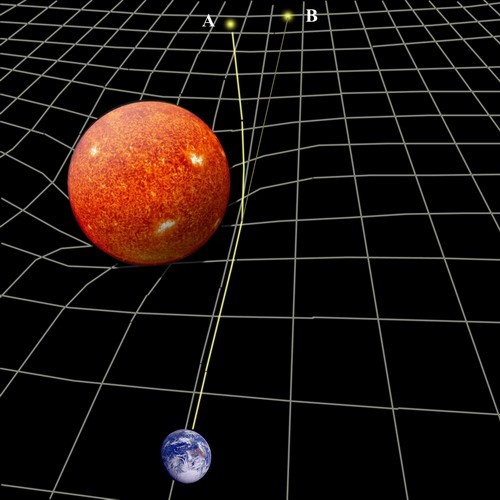
In his General Theory of Relativity, Einstein showed that matter causes space to curve, as in this illustration of starlight being bent by the sun's gravity.

But Einstein did not stop there. As early as 1911, he had predicted that light passing near a large mass, such as a star, would be bent. That idea led to his General Theory of Relativity in 1916. This paper established the modern theory of gravitation and gave us the notion of curved space. Einstein showed, for example, that small masses such as planets form dimples in space-time that hardly affect the path of starlight. But big masses such as stars produce measurably curved space.

The fact that the curved space around our sun was measurable let other scientists prove Einstein’s theory. In 1919, two expeditions organized by Arthur Eddington photographed stars near the sun made visible during a solar eclipse. The displacement of these stars with respect to their true positions on the celestial sphere showed that the sun’s gravity does cause space to curve so that starlight traveling near the sun is bent from its original path. This observation confirmed Einstein’s theory, and made Einstein a household name.

Interestingly, Einstein’s theories contained elements he himself could not accept. In some ways, he was loathe to break too much from the Newtonian/Maxwellian theories upon which his work was built.

He never accepted some of the precepts of quantum mechanics, for example, such as the idea ofindeterminacy. By the late 1920s, quantum mechanics had moved to the forefront of modern physics, yet Einstein never fully accepted many of the new theories. He declared:God does not play dice.

Also, Einstein’s 1916 theory suggested that the universe should be either expanding or contracting. Einstein could not accept that notion, and so in 1917 he introduced a cosmological constant into his theory, which would allow the universe to be stationary. In 1929, however, Edwin Hubble obtained observational evidence that the universe is indeed expanding. Einstein was forced to revise his theory. He called introducing the cosmological constant his greatest blunder.

This part of the Einstein legend illustrates, perhaps, a reason for his global popularity. The great genius could envision mechanisms of the universe in a way many of us have trouble even grasping. His imagination gave him answers to questions most of us would not think to ask.

Yet he remained prone to biases and frailties and thereby thoroughly human … just like the rest of us.

Bottom line: Albert Einstein was born on March 14, 1879. He published his Special Theory of Relativity in 1905 and his General Theory of Relativity in 1916. His work capped off the work of several previous centuries of science … and launched modern physics.

SOURCE:::::www.earthsky.org

Natarajan