Every Day a Group of pigeons wait for me to serve Food to them on their Table and Floor . of my Terrace.
On one such day i videographed their presence thro my mobile camera .
May like to see and Share
K.Natarajan
03/06/2019

வாழை மர நட்புக் கரங்களில் மாங்கனிக் கொத்து தன் இலைகளுடன் …. மாவாழை … ஒரு பசுமையான காட்சி …. உடனே “கிளிக் ” செய்தேன் என்
அலைபேசி கேமரா மூலம் …என் வீட்டு மாடியிலிருந்து !
நடராஜன் K
31/05/2019
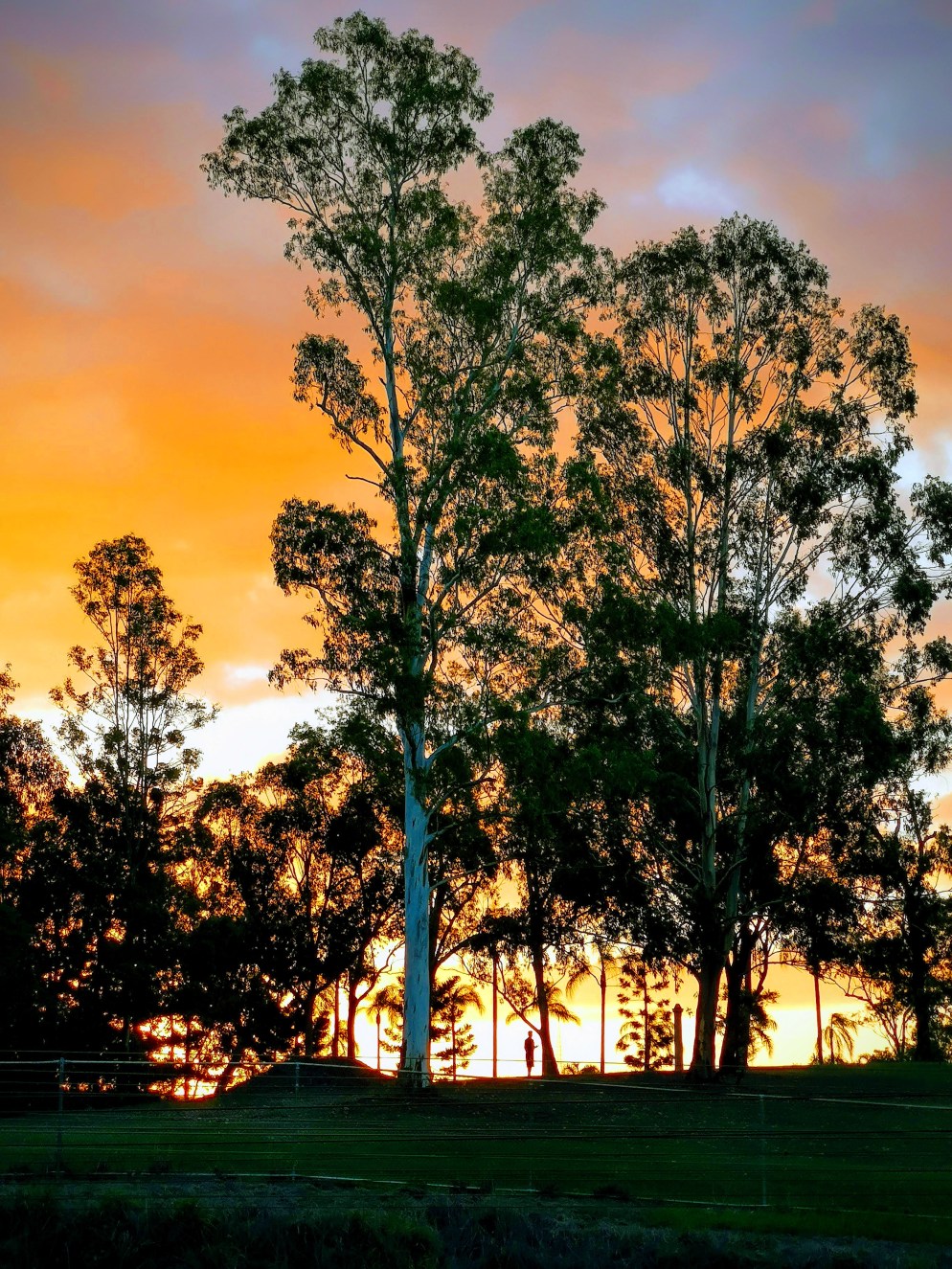 Sky.with.Golden color tempted me to click this photo thro my mobile camera on a charming evening…. Location…Brisbane Australia
Month.May.2019
Natarajan.K
Photographer John Moore, who took the picture that has come to symbolise the horror of the new family-separation policy in the United States, reveals what happened that night.

A two-year-old girl in a bright pink shirt is crying. It’s the middle of the night, and she’s only visible thanks to bright lights, likely from cars and cameras. She’s sobbing, her head tilted back in fear as she looks up at a strange man touching her mother. But nobody can soothe her.
This image of a Honduran girl crying as United States Border Patrol agents search her mother has come to represent the heartbreak being experienced by illegal immigrants separated from their children.
Pulitzer prize-winning photographer John Moore has been documenting the immigrant experience for a decade, riding along with both Border Patrol agents and immigrant trains in order to get the story.
Speaking of the image, he speaks about the June 12 ride-along that resulted in the emblematic picture — not to mention the other heartbreaking photos he captured of this mother and child.
That fateful night
On June 12, after seeking access, he accompanied Border Patrol agents to the banks of the Rio GrandeRiver on the outskirts of McAllen, Texas.
Waiting with the guards for hours, he finally heard rafts coming across the river. They waited a little longer and then suddenly moved in to see nearly dozen of them – mostly women and children.
Describing that moment itself, Moore says, “Most of these families were scared, to various degrees. “I doubt any of them had ever done anything like this before — flee their home countries with their children, travelling thousands of miles through dangerous conditions to seek political asylum in the United States, many arriving in the dead of night.”
While the agents were trying to get the families into buses, he finally spoke to one woman who identified herself as a Honduran. She was travelling with her two-year-old. “The mother told me they had been travelling for a full month and were exhausted,” says Moore, who speaks Spanish. “They were taken into custody with a group of about 20 immigrants, mostly women and children, at about 11 pm,” he was quoted as saying to Getty Images FOTO.
Describing what happened next, Moore says, “Before transporting them to a processing center, transportation officers body searched everyone and the mother was one of the last. She was told to set the child down, while she was searched. The little girl immediately started crying. While it’s not uncommon for toddlers to feel separation anxiety, this would have been stressful for any child. I took only a few photographs and was almost overcome with emotion myself. Then very quickly, they were in the van, and I stopped to take a few deep breaths.”
Moore says he doesn’t know what became of the 2-year-old Honduran girl, adding that the asylum seekers he photographed likely had no idea of the new “zero tolerance” policy that has led to families being separated from their children, since they had been travelling for a month under harsh circumstances.
Source….www.rediffmail.com
Natarajan

Approximately 224 km north of Sydney, just off the New England Highway, in New South Wales, Australia, is a hill that has been burning for the last 6,000 years. The fire burns underground, at a depth of about 30 meters, fueled by a coal seam that runs through the sandstone. The aborigines called the mountain Wingen, which means ‘fire’, and used its heat for warmth in the winter months, for cooking and for the manufacture of tools. They believed that the mountain was set on fire by a tribesman to warn others when the Devil carried him off deep into the earth. European explorers and early settlers knew of the Burning Mountain but they thought the smoke coming out of the ground was volcanic in origin. It was not until 1829 that a geologist identified it as a coal seam fire.

Photo credit: NSW National Parks and Wildlife Service
Coal seam fire, as it happens, are incredibly common, and thousands of them are burning underground across the world. In the US state of Pennsylvania alone, as many as 45 fires are burning, the most famous being the Centralia mine fire which has been burning since 1962. In India, more than seventy individual fires are burning beneath a region of the Jharia coalfield in Jharkhand. The fires, which started in 1916, are rapidly destroying the only source of prime coking coal in the country. The problem is more acute in coal-rich nations such as China, where underground fires are consuming at least 10 million tons of coal annually—with some estimate putting the figure to twenty times more. Beside losses from burned and inaccessible coal, these fires contribute significantly to air pollution and increased levels of greenhouse gases in the atmosphere. A geologist from the University of Alaska at Fairbanks calls them “a worldwide catastrophe with no geographic territory, and if we don’t take care of them they’re going to take a toll on us.”
Underground coal-seam fires are the most persistent fires on Earth and can burn for thousands of years. There is geological evidence that coal seam fires existed as early as the Pleistocene era, although modern-day coal fires are usually the result of human undoing, such as mining accidents or open coal seams unintentionally coming in contact with oxygen. Some coals ignite spontaneously at temperatures as low as 40 °C. Once fire gets hold, temperatures climb rapidly. The permeability of the coal allows oxygen to reach the fire but poor ventilation traps the heat inside. Some coal fires exceed temperatures of 500 °C.
Coal fires are very difficult to extinguish. It’s like a frustrating, expensive version of whack-a-mole, writes Dan Cray for Time. “You put one down, then 300 feet later another one picks up,” says Mark Engle, a geologist with the U.S. Geological Survey. Many governments have completely given up on the effort.
One of the most visible changes coal seam fires make is upon the landscape and on the environment. For example, near a coal fire in Germany, elevated ground temperatures allowed many insects and spiders to survive the cold winter. In Australia’s Burning Mountain, the heat has killed off all vegetationexcept those in the periphery of the burning seam, which actually thrives from run-off from the brunt soil. Large areas of the land has collapsed as a result of the burnt-out coal seam, and smoke vent from many cracks on the ground. The heat has turned the soil red.
Unlike Pennsylvania’s Centralia, Burning Mountain is actually pretty safe for tourists. There is a 4 km-long walking trail through the region with information panels along the track unpacking the story of Burning Mountain and the fascinating Aboriginal heritage. A viewing platform at the climax of Burning Mountain walk provides a safe vantage point to view the exhaust vents and rocks transformed by extreme temperatures.
Source….. Kaushik in http://www.amusing planet.com
Natarajan
The Peekskill meteorite car sitting at a collector’s garage in Peekskill. Photo credit: Ryan Thompson/Flickr
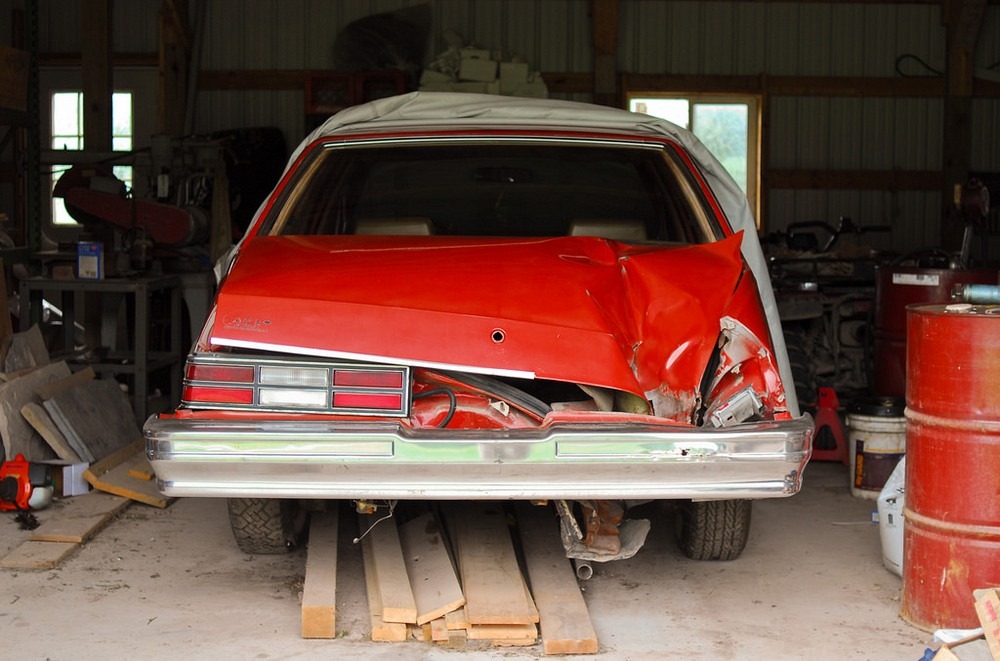
On October 9, 1992, a brilliant fireball flashed across the evening sky over eastern United States startling thousands of spectators attending the weekly high school football matches being played across the East Coast. The fireball, that witnesses described as being brighter than the full moon, was travelling almost horizontally and heading northeast. In just forty seconds, the meteorite had crossed four states travelling 700 kilometers through the atmosphere. The intense heat and friction broke the space rock into more than 70 pieces, several of which were large and fast enough to produce their own glowing trails. A considerably weighty chunk of the meteorite, about the size of a bowling ball, eventually touched ground at Peekskill, New York, with a loud boom.
17-year-old high-school student Michelle Knapp was watching television in her parents’ living room when she heard a thunderous crash outside. Knapp ran outside to investigate the noise. There she found, standing on the driveway, her 1980 Chevy Malibu. The Malibu’s trunk was twisted and battered with a hole through it. A sizeable rock over 12 kilograms in weight lay under the car, embedded in the asphalt. It was still smoking and smelled of rotten eggs. The rock had narrowly missed the fuel tank.
Understandably, Michelle was not happy; she had recently bought the car for $400 and now it was totaled. Michelle did what anybody else would have done—she called the cops and reported an act of vandalism. It was a neighbor who reasoned that vandals can’t throw rocks through cars and surmised that the rock was from outer space. The suspicion proved correct when the very next day, a curator from the American Museum of Natural History in New York City confirmed that the object was indeed a meteorite, the same one that streaked across the northeastern sky distracting coaches and parents from their kid,s football games.
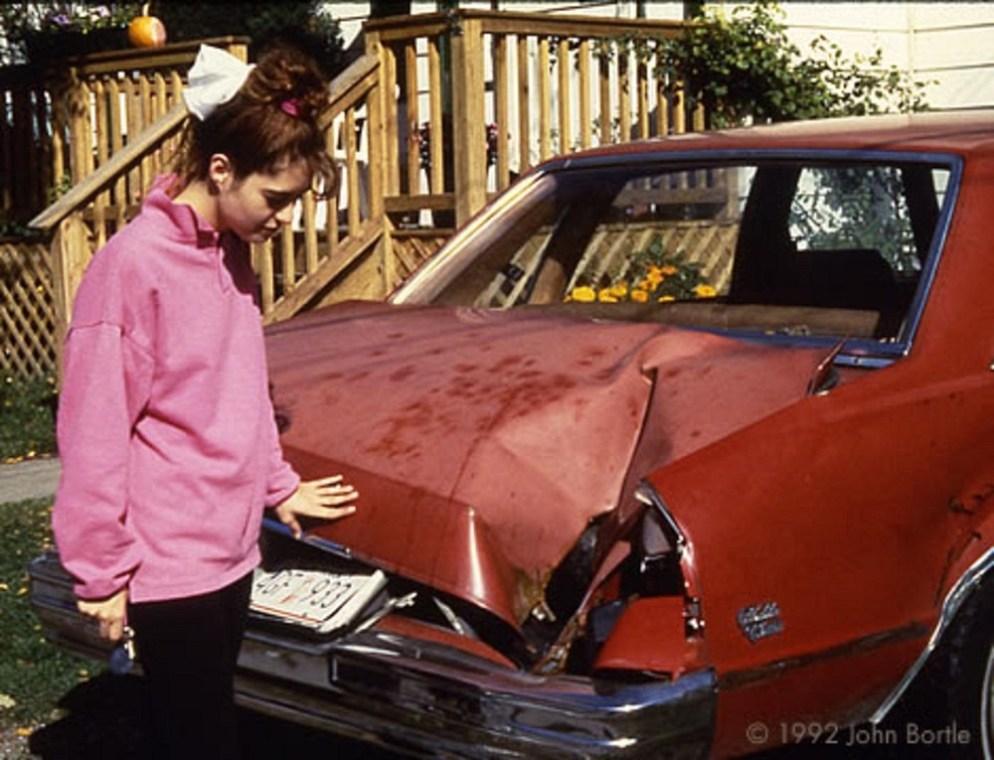
Michelle Knapp in the driveway with her Malibu taken only days after the historic impact. Photo credit: John Bortle
It was this impeccable timing of the Peekskill meteorite that made it one of the most witnessed and most recorded meteorite events in history. Dozens of spectators to the high school football games had brought camcorders with them, and when the meteorite flashed over their heads many of these cameras turned skywards, towards the brief but more exciting event. As many as 16 different observers from various locations recorded the event on tape—a record that was not broken until 2013 when a meteor exploded over Russia. The sixteen videos of the fireball taken from multiple perspectives made it possible for scientists to determine the exact trajectory of the meteorite. Indeed, Peekskill is one of the few meteorites whose orbit is precisely known.
As for the car, Michelle spent no time securing a deal with a renowned meteorite collector for an amount that was nearly two orders of magnitude more than what Michelle had paid. Since then, the car has been on display in numerous cities throughout the world, including Paris, Tokyo, Munich and more.
Source……Kaushik in http://www.amusing planet .com
Natarajan
On a cold, snowy December night in 1598, about a dozen men armed with swords, daggers and axes quietly broke into a recently vacated theater in Shoreditch, located just outside the city of London. With the aid of what modest light their lanterns could throw, the men worked tirelessly all throughout the night, dismantling the theater beam by beam and nail by nail, and loading the stripped timber onto wagons. By the time the darkness of the night gave way to the first light of dawn, the theater was gone.
The vandals in question were the Lord Chamberlain’s Men, the theatrical troupe to which William Shakespeare belonged. For the past several years, the Chamberlain’s Men had been playing at Shoreditch’s Theatre. This theater, built in 1576, was the second permanent theater ever built in England, and the first successful one to be built for the sole purpose of theatrical productions.

Shakespeare’s Globe theater in London. Photo credit: Diego Delso/Wikimedia
The Lord Chamberlain’s Men was founded in 1594, and within a short period of time it became one of the leading theatrical companies in London. Shoreditch’s Theatre was their home, and over the years, the Chamberlain’s Men played many of Shakespeare’s most famous plays on this stage.
In 1596 the lease for the property on which the Theatre was built expired, and the Chamberlain’s Men tried hard to negotiate an extension with the stubborn owner, Giles Allen. Not only Allen refused to renew the lease, he threatened to take possession of the theater as well. The dispute dragged on for two years, during which time the company performed at the nearby Curtain playhouse. It was at Curtain Theatre that Shakespeare debuted what is arguably his most famous play, Romeo and Juliet.

The Theatre of Shoreditch, the one that Shakespeare’s men dismantled.
When it became clear that Giles Allen wasn’t going to give back the land, the Chamberlain’s Men leased a new plot by the Thames, and on 28 December 1598, while Allen was celebrating Christmas at his country home, the men stole into the Theatre and carefully tore it down. A talented carpenter named Peter Street, who would later build another historic London theater named Fortune Playhouse, recycled the old pieces of wood into an astonishing new theatre—the Globe, capable of holding up to 3,000 spectators.
The romanticized version of the story holds that the Theatre was dismantled during the course of a single night, but historians believe the job could not have been completed in such a short time. Also, there is no proof that Shakespeare was present during the night, although he most certainly would have been following the proceedings closely, for he did have a tremendous interest in having this job done right.
Initially the timber was stored in a warehouse near Bridewell, until the following spring, when the materials were ferried over the Thames and used to construct the much larger Globe.

Reconstruction of the Globe theatre based on archeological and documentary evidence.
The Globe was up and running by early 1599, and for the next 14 years it presented many of Shakespeare’s greatest plays. In 1613, during a performance of Henry VIII, a misfired stage cannon ignited the thatched roof and the theatre burned to the ground. Although the theatre was quickly rebuilt, Shakespeare probably never wrote for the second Globe. Eventually, like all the other theaters in London, the Globe was closed down by the Puritans in 1642.
A modern reconstruction of the Globe, named “Shakespeare’s Globe”, now stands on the Thames approximately 750 feet from the site of the original theater. It was built in 1997, based on an approximation of the original design, but with only half the capacity.
The new theater was designed to be as authentic as possible to Shakespeare’s 16th century theater. The structure is made of timber alone without any steel support, and it is the only building in London with a thatched roof, since that material was banned after the Great Fire of 1666. Seats are simple benches, although spectators can request cushions during shows. No spotlights, microphones or any kind of modern audio equipment are used. All music is performed live, most often on period instruments, just like it was in the 16th century. Only recently, the Globe began experimenting with lighting and sound rig.
Source….. Kaushik in http://www.amusingplanet.com
Natarajan



 Take off with Natarajan
