Most Vulnerable PASSWORDS of 2014 !!!

Your password may not be as safe as you think.

Your password may not be as safe as you think. Source: ThinkStock

PASSWORDS offer a sense of security for your personal data, although it appears some people just can’t grasp the concept.

In what is fast becoming one of the most entertaining annual reports, SplashData has released the worst passwords of 2014.

Compiled from more than 3.3 million leaked passwords held by users in North America and Western Europe, the company has listed the 25 most common passwords found on the internet.

Despite constant warnings that common passwords make it easier to be hacked, “123456”and “password” continue to hold the top two spots that they have held since the list first emerged in 2011.

Number combinations dominated the top 25 with “12345,” “12345678,” “123456789” and “1234” all landing in the top 10.

Favourite sports also ranked highly with “baseball” and “football” appearing in top 10, while “hockey,” “soccer” and “golfer” were listed in the top 100.

The password management application provider offered three simple tips for those wanting to remain safe from hackers.

They recommend using passwords of eight characters or more with mixed types of characters, avoiding using the same username/password combination for multiple websites and using a password manager to protect passwords.

SOURCE:::: http://www.news.com.au

Natarajan

Jan 23 2015

Best Cities to Live in The World ….

Some cities are just easier to live in than others.

Global consulting firm ECA International came out with a list of the most livable cities around the world for North Americans.

The ranking objectively evaluates a bunch of factors that contribute to the overall quality of living, including climate, availability of health services, housing and utilities, isolation, access to social network and leisure facilities, personal safety, air quality, infrastructure, and political tensions.

So if you’re thinking about moving somewhere, may we recommend that you check out the following cities. Canada, Northern Europe, and the United States dominated the list.

1. Toronto, Canada

‘Good air quality, solid infrastructure, decent medical facilities, low crime and health risks have contributed to Toronto topping the global ranking for quality of living for American assignees,’ said Michael Witkowski, vice president of ECA International.

Toronto has a huge services industry, including law, accounting and advertising. Over 56% of employees in Toronto’s multifaceted economy have post-secondary degrees or certificates. It’s also the major design center of Canada’s design economy, and has a ‘fast-moving‘ fashion industry, which has contributed to the 550% increase of Canadian apparel exports since 1994.

The longest street in the world — Yonge Street — runs through Toronto.

Toronto

Toronto is a delightful place to live.


2. Dublin, Ireland

In the past, Dublin was a major food processing and manufacturing city, but it has attracted major global pharma and tech companies, including Microsoft, Google, Amazon, and Yahoo!.

Guinness originated in Dublin, and is still brewed there.


3. Copenhagen, Denmark (tied)

Copenhagen is a business, finance and commercial center in Scandinavia. Big industries includepharma, biotech, computer science, and telecommunications.

One of the most popular tourist attractions in Copenhagen is a bronze statue of the little mermaid, based on the Hans Christian Anderson fairy tale.


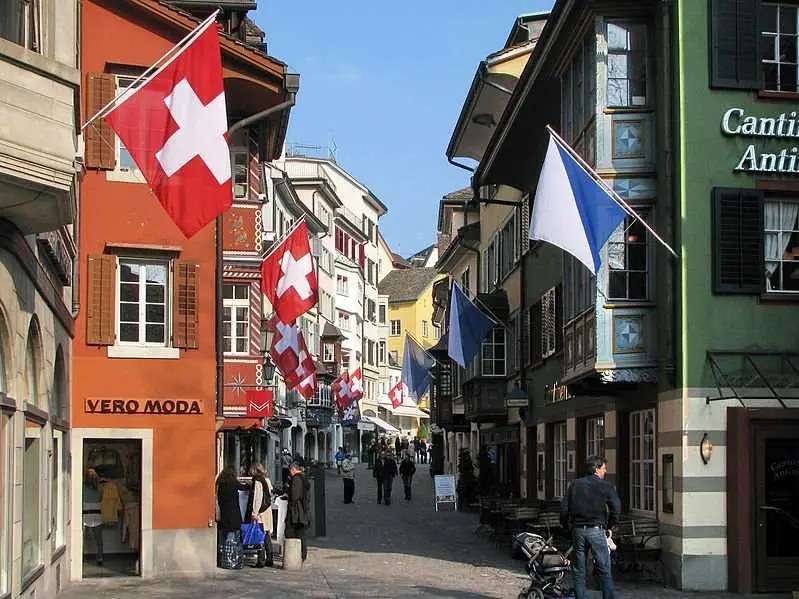
3. Zurich, Switzerland (tied)

Zurich is another financial hub in Europe — about a quarter of the jobs in the city are finance related. Biotech and life sciences are also big industries, while the small aerospace and automotive supplier industries are rapidly expanding.

Zurich’s St. Peter Church has the largest clock face in Europe (not Big Ben, like most people think.)


3. Ottowa, Canada (tied)

Ottawa’s economy centres around two major sectors: technology and the federal government. The two sectors account for 37% of the city’s GDP.

There is a 30-foot-high spider sculpture called ‘Maman‘ in Ottowa’s National Gallery of Canada.


Vancouver, Canada (tied)

Vancouver has one of the most active startup scenes, and it was ranked ninth in the world on the Startup Ecosystem Report 2012. Both HootSuite and Avigilon have their headquarters in the city.

Vancouver also has the third-largest film industry in North America.


Bern, Switzerland (tied)

The service sector is Bern’s major industry, but tourism is also a driver of the city’s economy.

Watch giant Swatch is headquartered in Bern.


Stockholm, Sweden (tied)

Stockholm is Sweden’s major industrial center, including metal and machine manufacturing, as well as paper, printing and chemicals.

Stockholm became the capital of Sweden in 1436.


Seattle, Washington, US (tied)

Seattle’s major industries include aerospace, information and communications technology and healthcare. Additionally, tech and clean energy are increasingly becoming more dominant industries.

Microsoft founder Bill Gates was born in Seattle.


Boston, Massachusetts, US (tied)

Boston is a major intellectual center in the US, housing numerous universities and medical centres. Other major industries include the financial services, creative industries, and renewable energy.

The Boston Red Sox sold out a record 820 consecutive games in a row.


Greenwich, Connecticut, US

Greenwich has a large community of financiers. The city houses hedge funds, as well as Wall Streeters and their families.

Greenwich is one of the wealthiest areas in the US, but is also part of the most unequal place in the country.


Geneva, Switzerland (tied)

The headquarters for the UN, the Red Cross, and the World Health Organisation are all located in Geneva (not to mention other international organisations such as the WTO and WEF). And the city’s also known as a major financial hub.

The uber-luxury watch company Patek Philippe was founded in Geneva in 1852.


The Hague, The Netherlands (tied)

The Hague is a major international city, with over 150 international organisations located there. Notably, it houses the International Criminal Court and the International Court of Justice.

Everyone’s always buzzing over Amsterdam, but you can legally smoke weed in The Hague, too


Stavanger, Norway (tied)

Stavanger is the center of the oil and gas industry in Norway, and one of the biggest energy hubs in Europe. Half of the people living in Norway who work in energy are located in Stavanger.

Every May, Stavanger hosts a huge international jazz festival called MaiJazz.


Gothenburg, Sweden (tied)

Major sectors in Gothenburg include technology, engineering, and several industrial companies. Additionally, the city serves as a major port.

In August, you can go to a three-day musical festival in the city called Way Out West.


Basel, Switzerland (tied)

Carnival of Basel.UBS and the Bank for International Settlements are headquartered in Basel. The city also has a large watch-making industry, as well as pharmaceuticals, biotech, and nanotechnology.

Basel in a major cultural center in Europe, and houses a huge art collection in the Kuntsmuseum Basel.


Vienna, Austria (tied)

A large proportion of workers in Vienna are white-collar workers, public employees, and civil servants — and that percentage continues to grow. Over half of the employees in Austria’s service industry live in Vienna. Overall, Austria’s most important and fastest-growing industry istourism.

Vienna is known for its famous sachertorte, a thick chocolate cake with a thin layer of apricot jam.


Berlin, Germany (tied)

Berlin houses big names like Borsig, AEG, and Siemens, but is always advancing in the sciences and academics. Additionally, the city has established a major film industry, and tourism has skyrocketed in recent years.

A three day international beer festival with over 300 breweries and 2,000 sorts of beers takes place in Berlin. Oh, and it’s held in a 1.4-mile-long beer garden — the longest in the world.


Luxembourg City, Luxembourg (tied)

Luxembourg’s economy runs on the steel, banking, and industrial industries. In fact, the largest steel company in the world, ArcelorMittal, is based in Luxembourg City.

Although Luxembourg has three official languages: French, German, and Lëtzebuergesch (‘Luxembourgish.’)


Eindhoven, Netherlands (tied)

Although it’s not a particularly large city, Eindhoven has grown into one a leading city in the 21st century by getting ahead in both technological innovation and design. Additionally, it’s a university city with a number of undergraduate schools.

In 2011, the city was named the most intelligent community by the Intelligent Community Forum.


Montreal, Canada (tied)

Montreal’s economy is extremely diversified. Major industries include aerospace, electronic goods, pharmaceuticals, engineering, finance, and research and development.

Montreal also happens to have the second largest French-speaking population in the world (it’s behind only Paris).


SOURCE::::  ELENA HOLODNY  in  www.businessinsider.com.au

Natarajan

Jan 23 2015

Image of the Day…Largest Picture Ever Taken … !!!


Did you see the largest picture ever taken, released on January 5? The picture has a staggering 1.5 billion pixels, so you’d need 600 HD television screens to display it. It shows the neighboring Andromeda galaxy, closest spiral galaxy to our Milky Way. Now daveachuk on YouTube has created this wonderful fly-through video, showing detail in the gigantic Andromeda pic. Enjoy feeling small! And remember … each one of those white dots? Each one is a sun, much like the sun that powers all life on Earth.

Enjoy the video! And be sure to watch until the end!

The NASA/ESA Hubble Space Telescope captured the full image, which is made up of 411 Hubble images, takes you through a 100 million stars and travels over more than 40,000 light years. Our thanks to Alex Grossman on G+ for sharing! As he said:

Wow. Just wow.

Bottom line: Fly-through video of the largest image ever taken, of the Andromeda galaxy, nearest spiral galaxy to our Milky Way. Prepare to feel small!

SOURCE:::: www. earthskynews.org and You Tube

Natarajan

Jan 22 2015


World”s Most Spectacular New Airports …

Changi airport, Singapore (opening 2018)

Architect Moshe Safdie – who designed the iconic Habitat 67 housing complex in Montreal – began construction on a new development at Singapore’s Changi airport in December 2014. Featuring a ‘Forest Valley’, ‘Jewel Gardens’ and a 130ft-high (40m) waterfall called a ‘Rain Vortex’, it looks more like the Land of Oz than an air hub; trees, palms and ferns are enclosed within a 134,000sq m glass dome. Scheduled for completion in 2018, the Jewel complex will be linked by pedestrian bridges to existing terminals, offering space for shops and restaurants alongside the foliage. Safdie has said that the project is “the prototype of a new kind of urban place”. (Safdie Architects)


Mexico City international airport, Mexico (opening 2018)

In September 2014, British architecture firm Foster and Partners won a competition to design what will be one of the world’s largest airports when it is completed in 2018. Working with Mexican firm Fernando Romero Enterprise, Foster and Partners unveiled plans for a 555,000 sq m terminal enclosed within a lightweight shell. The new international airport for Mexico City has been designed to accommodate increasing passenger numbers and has echoes of Foster’s plans for the world’s first private spaceport in New Mexico. The structure is pre-fabricated, allowing for rapid construction without scaffolding. The new building will harness the sun’s energy as well as collecting rainwater and maintaining interior temperatures using natural ventilation. (Foster and Partners/Fernando Romero Enterprise)


Mumbai’s Chhatrapati Shivaji international airport, India (opened 2014)

Designed to reference the feathers in a peacock’s tail – and mirror traditional Indian open-air pavilions – the concrete canopy on this new terminal is part of a wider trend to reflect local architecture within airports. This addition to Mumbai airport was opened in February 2014 and is the vision of US firm SOM, whose website says that “just as the terminal celebrates a new global, high-tech identity for Mumbai, the structure is imbued with responses to the local setting, history, and culture”. (Robert Polidori/SOM)


Shenzhen Bao’an international airport, China (opened end of 2013)

Covered with a honeycomb pattern and a whopping 1.5km (0.9 miles) long, the new terminal at Shenzhen Bao’an was designed to evoke the shape of a manta ray, according to its architects Studio Fuksas. The architects rather poetically describe it as “a fish that breathes and changes its own shape, undergoes variations, turns into a bird to celebrate the emotion and fantasy of a flight”. The design continues into the interiors, its hexagonal skylights allowing natural light in with a dappled effect. (Archivio Fuksas)


Chongqing Jiangbei international airport, China (opening 2015)

Architects ADPI continue the trend towards green space in airports in their plans for a new terminal at Chongqing Jiangbei. With two wings referencing Chongqing’s two rivers, the structure is set within a park: once completed, the terminal will be able to handle 55m passengers a year, ranking the airport among the world’s 15 largest. (ADPI)


Pulkovo International Airport, Russia (opened 2014)

Designed by Grimshaw architects to work with the extremes of climate in St Petersburg, the new terminal at Pulkovo airport features monumental folded ceilings clad in metal panels that recall the gilded spires of churches in the city. A series of linked zones is intended to reflect St Petersburg’s landscape of islands and bridges. Opening in February 2014, the building has a large flat roof with folded structures beneath that distribute weight away from the middle to offer support during heavy snowfall. Once construction on a second and final phase of the project is completed in 2015, the airport will cater for 17m passengers a year. (Grimshaw)


Istanbul New Airport, Turkey (opening 2019)

Grimshaw is also in charge of a team designing a new six-runway airport in Istanbul which aims to accommodate 90m passengers a year once it opens in 2019, before increasing its capacity to 150m after completion. Featuring a vaulted canopy, the airport’s Terminal One will cover a site of nearly 100 hectares (0.4 sq miles) – the architects say it will become the “world’s largest airport terminal under one roof” once finished. “We were inspired by the local use of colours and patterns, the quality of light and how it penetrates buildings, as well as by traditional architecture such as the Süleymaniye Mosque,” claims Tomas Stokke, the director of Haptic, which is collaborating with Grimshaw and Nordic Office of Architecture on the project. (Grimshaw/Nordic Office of Architecture/Haptic) 


Mount Fuji Shizuoka airport, Japan

Pritzker Prize-winner Shigeru Ban is designing a terminal for the airport at the base of Mount Fuji. Inspired by the tea plantations surrounding the mountain, his plans include green barrel vaults. Inside, natural light is diffused by a roof canopy made out of twisted laminated wood – latticing being a signature style of the Japanese architect. (Shigeru Ban)

SOURCE::::


Amazing Paintings…Something Different !!!

The Unreal Paintings of Robert Gonsalves

Canadian artist Robert Gonsalves creates beautiful paintings. However, his paintings go a step further than beautiful, they each play with the border between reality and the surreal. his work has also been influenced by Salvador Dali and Rene Magritte, who he had the pleasure of meeting.
A quick glance at one of his paintings will never do, because there is always more than one image on the canvas, depending on how you look at it. This is among my favorite types of creative art, the kind that unfolds in both meaning and beauty.
rob gonsalves surreal

rob gonsalves surreal

rob gonsalves surreal

rob gonsalves surreal

rob gonsalves surreal

rob gonsalves surreal

rob gonsalves surreal

rob gonsalves surreal

rob gonsalves surreal

rob gonsalves surreal

SOURCE:::: http://www.ba-bamail.com

Natarajan

Jan 21 2015

Image of the Day…” Sunset Over The Atlantic…”

Dramatic sunset over the Atlantic, seen near Rio

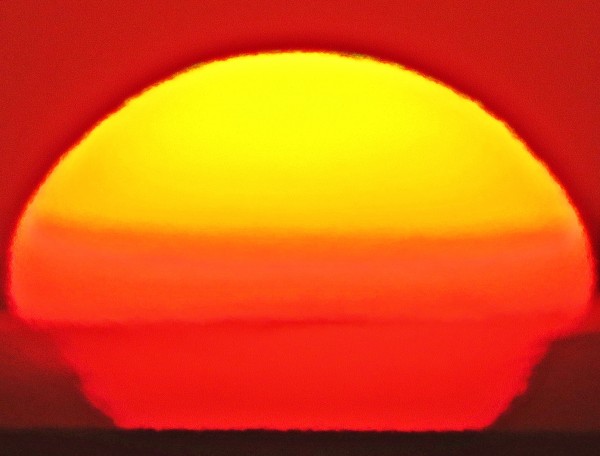
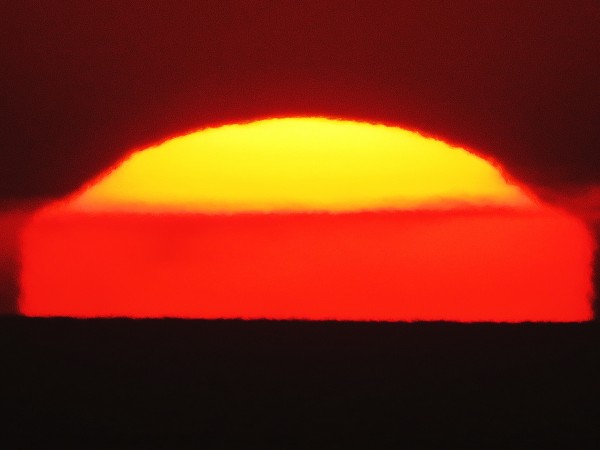
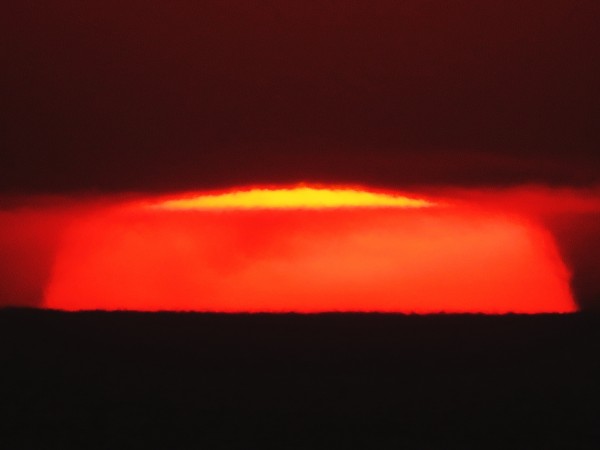
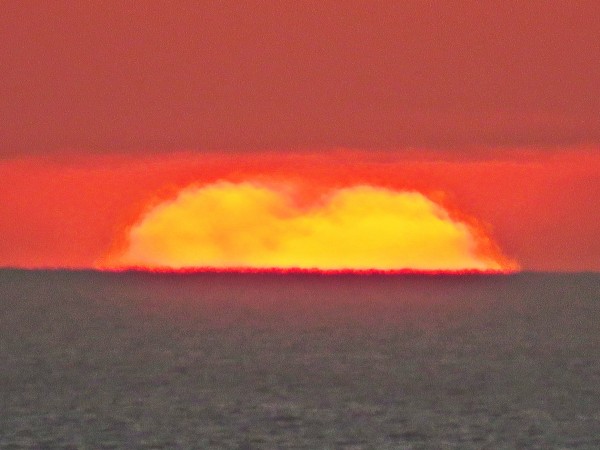
Cool air on the sea surface strongly refracted the setting sun, seen Saturday night from a small town near Rio de Janeiro, Brazil. Cool series of images!

January 17 sunset by Helio de Carvalho Vital.  Shot 1 of 6.

Helio de Carvalho Vital wrote:

That the strong refraction next to the horizon flattens the image of the setting sun is no surprise to anyone. But what if the sun suddenly becomes shaped like a mushroom? Saturday evening [January 17, 2015], I took some photos of the sun setting over the Atlantic Ocean from Saquarema, a small city 100 km east of downtown Rio de Janeiro.

The local air temperature was 34°C but the seawater was only 21°C. Thus a layer of cooler air formed on the surface of the sea.

As sunlight crossed that layer to reach my camera, it underwent a complex series of refractions and reflections that severely distorted the image of the sun, making it acquire very unusual shapes.

A Canon Powershot SX60 HS was used for all the shots, taken at 21:39-41 UTC.

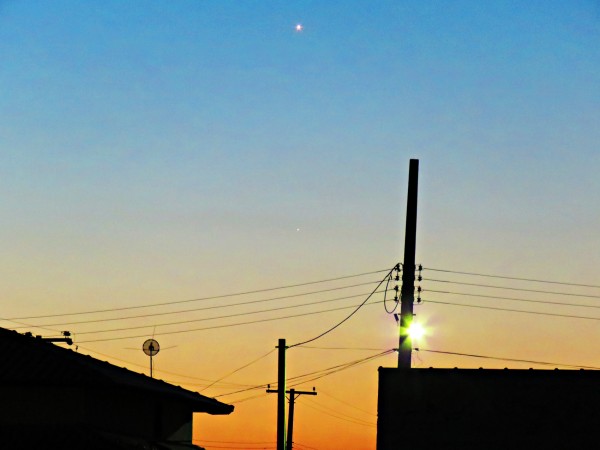
After sunset that same evening, Venus and Mercury appeared!

January 17 sunset by Helio de Carvalho Vital.  Shot 2 of 6.

January 17 sunset by Helio de Carvalho Vital.  Shot 3 of 6.

January 17, 2015 sunset by Helio de Carvalho Vital.  Shot 4 of 6.

January 17, 2015 sunset by Helio de Carvalho Vital.  Shot 5 of 6.

After sunset on January 17, as the sky began to darken, Venus and Mercury popped into view in the western sky.  Photo by Helio de Carvalho Vital.

Bottom line: Series of images of Saturday night’s amazing sunset, seen over the Atlantic from a small town near Rio de Janeiro, Brazil.

SOURCE::: http://www.earthskynews.org

Natarajan

Jan 21 2015

“Let Your Kite Fly High … With Strings Attached … ” !!!

Father is flying a kite. His son is watching him carefully. After some time son says,

“Dad, Because of the string the kite is not able to go any further higher. “

Hearing this, the father smiles and breaks the string. The kite goes higher after breaking f the thread and then shortly after that it comes and falls on the ground.

The child is very dejected and sad.

The father sits next to him and calmly expalains ” Son, In life we reach a certain level of prosperity and then we feel that there are certain things in our life that are not letting us grow any further like Home, Family, Culture Friendship etc. We feel we want to be free from those strings which we believe are stopping us from going higher.
But, remember Son,  Going higher is easier than staying at the higher level. And friends, family and culture etc are the things that will help us stay stable at the high heights that we have achieved. If we try to break away from those strings our condition will be similar to the kite.”…

~ Never go away from culture, family, friends and relationships as they help keep you stable while you are flying high…

~ Let your Kite always soar high

SOURCE:::: unknown….input from a friend of  mine

Natarajan

Jan 20 2015

” 320 Pound Woman … How She will Look Like ” !!!

Amazing!

The question is, What does a 320 pound woman look like? 


Now, before you scroll down to look at her pictures, get a mental image of what you think a woman who weighs 320 looks like…


Got it?


Ready?


Amazing!001
 
 
Amazing!002

Not exactly what you were expecting is it??!!


The tallest and best proportioned woman in the world lives in Holland .

She is 7’4′ and weighs 320

What a relief! Now we ALL know we aren’t overweight; we’re just too short! 

SOURCE:::: http://www.fundstuffpeoplesendme.wordpress.com

Natarajan

Jan 20 2015

Image of the Day… Milky Way Over Todd Lake Basin, Oregon…

Milky Way over Todd Lake Basin, Oregon

Here in the midst of our northern winter, a beautiful shot of the summer Milky Way.

Photo by Jason Brownlee.  Visit Jason Brownlee Design on Facebook

Jason Brownless captured this view last August of the Todd Lake Basin in Oregon, with Mt. Bachelor – a stratovolcano, since 1958 the site of a ski lodge – and the Milky Way in the background.

SOURCE:::     in http://www.earthskynews.org

Natarajan

Jan 19 2015

Image of the Day…. Year 2014 Ranks as The Warmest on Record Since 1880 !!!


The year 2014 now ranks as the warmest on record since 1880, according to an analysis by NASA scientists.
Image Credit:
NASA’s Goddard Space Flight Center

The year 2014 ranks as Earth’s warmest since 1880, according to two separate analyses by NASA and National Oceanic and Atmospheric Administration (NOAA) scientists.

The 10 warmest years in the instrumental record, with the exception of 1998, have now occurred since 2000. This trend continues a long-term warming of the planet, according to an analysis of surface temperature measurements by scientists at NASA’s Goddard Institute of Space Studies (GISS) in New York.

In an independent analysis of the raw data, also released Friday, NOAA scientists also found 2014 to be the warmest on record.

“NASA is at the forefront of the scientific investigation of the dynamics of the Earth’s climate on a global scale,” said John Grunsfeld, associate administrator for the Science Mission Directorate at NASA Headquarters in Washington. “The observed long-term warming trend and the ranking of 2014 as the warmest year on record reinforces the importance for NASA to study Earth as a complete system, and particularly to understand the role and impacts of human activity.”

This video shows a time series of five-year global temperature averages, mapped from 1880 to 2014, as estimated by scientists at NASA’s Goddard Institute for Space Studies (GISS) in New York.
Image Credit:
NASA’s Goddard Space Flight Center
global temperature anomaly data from 2014
This color-coded map displays global temperature anomaly data from 2014.
Image Credit:
NASA’s Goddard Space Flight Center

Since 1880, Earth’s average surface temperature has warmed by about 1.4 degrees Fahrenheit (0.8 degrees Celsius), a trend that is largely driven by the increase in carbon dioxide and other human emissions into the planet’s atmosphere. The majority of that warming has occurred in the past three decades.

“This is the latest in a series of warm years, in a series of warm decades. While the ranking of individual years can be affected by chaotic weather patterns, the long-term trends are attributable to drivers of climate change that right now are dominated by human emissions of greenhouse gases,” said GISS Director Gavin Schmidt.

While 2014 temperatures continue the planet’s long-term warming trend, scientists still expect to see year-to-year fluctuations in average global temperature caused by phenomena such as El Niño or La Niña. These phenomena warm or cool the tropical Pacific and are thought to have played a role in the flattening of the long-term warming trend over the past 15 years. However, 2014’s record warmth occurred during an El Niño-neutral year.

“NOAA provides decision makers with timely and trusted science-based information about our changing world,” said Richard Spinrad, NOAA chief scientist. “As we monitor changes in our climate, demand for the environmental intelligence NOAA provides is only growing. It’s critical that we continue to work with our partners, like NASA, to observe these changes and to provide the information communities need to build resiliency.”

Regional differences in temperature are more strongly affected by weather dynamics than the global mean. For example, in the U.S. in 2014, parts of the Midwest and East Coast were unusually cool, while Alaska and three western states – California, Arizona and Nevada – experienced their warmest year on record, according to NOAA.

The GISS analysis incorporates surface temperature measurements from 6,300 weather stations, ship- and buoy-based observations of sea surface temperatures, and temperature measurements from Antarctic research stations. This raw data is analyzed using an algorithm that takes into account the varied spacing of temperature stations around the globe and urban heating effects that could skew the calculation. The result is an estimate of the global average temperature difference from a baseline period of 1951 to 1980.

NOAA scientists used much of the same raw temperature data, but a different baseline period. They also employ their own methods to estimate global temperatures.

GISS is a NASA laboratory managed by the Earth Sciences Division of the agency’s Goddard Space Flight Center, in Greenbelt, Maryland. The laboratory is affiliated with Columbia University’s Earth Institute and School of Engineering and Applied Science in New York.

NASA monitors Earth’s vital signs from land, air and space with a fleet of satellites, as well as airborne and ground-based observation campaigns. NASA develops new ways to observe and study Earth’s interconnected natural systems with long-term data records and computer analysis tools to better see how our planet is changing. The agency shares this unique knowledge with the global community and works with institutions in the United States and around the world that contribute to understanding and protecting our home planet.

The data set of 2014 surface temperature measurements is available at:

http://data.giss.nasa.gov/gistemp/

The methodology used to make the temperature calculation is available at:

http://data.giss.nasa.gov/gistemp/sources_v3/

For more information about NASA’s Earth science activities, visit:

http://www.nasa.gov/earthrightnow 

SOURCE:::::www.nasa.gov

Natarajan

Jan 18 2015