
source::::glasbergen.com
Natarajan

The X-37B is a kind of robotic space plane, built by the US. It’s been in Earth’s orbit for more than 500 days. And its real purpose is a complete mystery. Intrigued?
Constructed in California, the Boeing-built X-37B Orbital Space Vehicle was built for the US Air Force as a test vehicle; not intended to reach production. It is a quarter the size of the Endeavour Space Shuttle. It is equipped with heat-shield protection for re-entry to Earth’s atmosphere.
Currently the X-37B is orbiting at 28,044km/h, at a distance of around 350km in the sky. It can land, but no one will say when that will be.
It’s been in the sky before, after being launched on April 22, 2010, on a rocket. It then landed on December 3, 2010 – blowing a tire and suffering minor damage to its underbelly.
It took off again from Cape Canaveral on December 11, 2012 – now reaching 500 days in orbit.
The Air Force also launched a second model of X-37B on March 5, 2011. Described by the U.S. military as an “effort to test new space technologies”, it landed safely at Vandenberg Air Force Base on June 16, 2012, after 469 days in space. This third mission has now smashed this previous record.
X-37B’s actual functions are still heavily classified.
As you’d imagine, conspiracy theorists are having a field day, and here’s why:
Powered by a solar panel that unfurls once in orbit, X-37B can open with small, shuttle-like payload bay in its middle – think of a clamshell opening from underneath. There’s room for more than just a solar panel too. Exactly what items it carries, and why they need to be in space so long, has proved elusive for analysts, the space community, and the media.
To add further intrigue, the plane is classified as a secret project, yet maker Boeing has released pictures and more than two pages of details on the X-37B. That’s not how secrets are usually dealt with. By contrast, the secretLockheed SR-71 Blackbird was not declassified until decades after it had been flown in the Vietnam War.
The X-37 started life way back in 1999 when NASA asked Boeing’s Phantom Works division to develop an orbital test vehicle. This was a civilian project, and the X-37 was originally spec’d as an unmanned, robotic spacecraft that would rendezvous with satellites to refuel, repair them, or crash them back to Earth once their lifecycle was complete. But, in 2004, the project was transferred to DARPA and since then, it has been highly classified.
The amateur skywatching community that documents satellites say it’s orbiting between 43.5 degrees north latitude to 43.5 degrees south latitude. That’s a band around the middle of Earth that takes in much of the US, Middle East, and Asia, but is away from Russia, and Europe. Spotters suggest that at the altitude of 350km, it is ideal altitude for spying, but too low to refuel or fix other satellites.
It’s versatile, and has worked well enough that Boeing is contracted to create the next model, the X-37C. It will be at least 65% larger and have the ability to carry up to six astronauts, while operating unmanned.

The two most popular theories suggest the vehicle is simply running an extended duration test – a marathon in space. The other theory is that the two previous missions prove the testing phase is complete, and it is now on an extended operation running a mission, or multiple missions.
The long endurance run theory has credit; proving that new, experimental critical components can work reliably for a long-duration in space, close to Earth.
The running-mission has credit too – with two previous missions complete, X-37B can now operate at length. And perhaps it is – observing, spying, experimenting, hosting space-weapons, or collecting data for the NSA. We just don’t know.
Both theories are plausible.
Plenty of conspiracy theorist have posed the question of X-37B carrying a nuclear payload, to guarantee a ‘first strike’ opportunity (or to have a counter-option in place).
If you have any hope for humanity, that can’t be right. The US is a signatory to The Space Treaty, which is no joke. Space-based weapons of mass destruction are banned.
(One curious example of a space-based weapon that isn’t banned is a Kinetic strike, where objects whizzing around the Earth at great speed are intentionally sent to the ground, causing a meteorite-like impact and widespread damage. This type of attack is also known as ‘Rods from God’.)

Natarajan
A new illustration of the seafloor, created by two of the world’s leading ocean floor mapping experts, details underwater terrain where the missing Malaysia Airlines flight might be located.

Seafloor topography in the Malaysia Airlines flight MH370 search area. Dashed lines approximate the search zone for sonar pings emitted by the flight data recorder and cockpit voice recorder popularly called black boxes. The first sonar contact (black circle) was reportedly made by a Chinese vessel on the east flank of Batavia Plateau (B), where the shallowest point in the area (S) is at an estimated depth of 1637 meters. The next reported sonar contact (red circle) was made by an Australian vessel on the north flank of Zenith Plateau (Z). The inset in the top left shows the area’s location to the west of Australia. Image credit: Walter H.F. Smith and Karen M. Marks
Seafloor experts have created a new topography map that could shed additional light on what type of underwater vehicles might be used to find the missing airplane and where any debris from the crash might lie.
The seafloor topography map illustrates jagged plateaus, ridges and other underwater features of a large area underneath the Indian Ocean where search efforts have focused since contact with Malaysia Airlines flight MH370 was lost on March 8. The image was published today in Eos, the weekly newspaper of the Earth and space sciences, published by the American Geophysical Union.
The new illustration of a 2,000 kilometer by 1,400 kilometer (1,243 miles by 870 miles) area where the plane might be shows locations on the seafloor corresponding to where acoustic signals from the airplane’s black boxes were reportedly detected at the surface by two vessels in the area. It also shows the two plateaus near where these “pings” were heard.
It points out the deepest point in the area: 7,883 meters (about five miles) underneath the sea in the Wallaby-Zenith Fracture Zone – about as deep as 20 Empire State buildings stacked top to bottom. Undersea mountains and plateaus rise nearly 5,000 meters (about three miles) above the deep seafloor, according to the map.
The illustration, designated as Figure 1 of the Eos article, was created by Walter H.F. Smith and Karen M. Marks, both of the National Oceanic and Atmospheric Administration’s Laboratory for Satellite Altimetry in College Park, Maryland, and the former and current chairs, respectively, of the Technical Sub-Committee on Ocean Mapping of the General Bathymetric Chart of the Oceans, or GEBCO. GEBCO is an international organization that aims to provide the most authoritative publicly available maps of the depths and shapes of the terrain underneath the world’s oceans.
Satellite altimetry has made it possible to depict the topography of vast regions of the seafloor that would otherwise have remained unmapped, Smith said. To illustrate the topography of the search area, Smith and Marks used publicly available data from GEBCO and other bathymetric models and data banks, along with information culled from news reports.
Smith said the terrain and depths shown in the map could help searchers choose the appropriate underwater robotic vehicles they might use to look for the missing plane. Knowing the roughness and shape of the ocean floor could also help inform models predicting where floating debris from the airplane might turn up.
Smith cautions that the new illustration is not a roadmap to find the missing airplane. Nor does the map define the official search area for the aircraft, he added.
“It is not ‘x marks the spot’,” Smith said of their map. “We are painting with a very, very broad brush.”
Search efforts for the missing airplane have focused on an area of the southern Indian Ocean west of Australia where officials suspect that the plane crashed after it veered off course. After an initial air and underwater search failed to find any trace of the airplane, authorities announced this month that they will expand the search area and also map the seabed in the area.
Smith pointed out that the search for the missing plane is made more difficult because so little is understood about the seafloor in this part of the Indian Ocean. In the southeast Indian Ocean, only 5 percent of the ocean bottom has been measured by ships with echo soundings. Knowledge of the rest of the area comes from satellite altimetry, which provides relatively low-resolution mapping compared to ship-borne methods.
“It is a very complex part of the world that is very poorly known,” Smith said.
A lack of good data about Earth’s seafloors not only hinders search efforts, it also makes it harder for scientists to accurately model the world’s environment and climate, Smith noted. Today, our knowledge of our planet’s undersea topography is “vastly poorer than our knowledge of the topographies of Earth’s Moon, Mars and Venus,” Smith and Marks write in Eos. This is because these other planetary bodies have no oceans, making their surfaces relatively easy to sense from space.
Smith said he hoped that “the data collected during the search for MH370 will be contributed to public data banks and will be a start of greater efforts to map Earth’s ocean floor.”
source:::: Earth SKY News site
Natarajan
A champion jockey is about to enter an important race on a new horse. The horse’s trainer meets him before the race and says,
“All you have to remember with this horse is that every time you approach a jump, you have to shout, “ALLLLEEE OOOP!” really loudly in the horse’s ear. Providing you do that, you’ll be fine”.
The jockey thinks the trainer is mad but promises to shout the command. The race begins and they approach the first hurdle. The jockey ignores the trainer’s ridiculous advice and the horse crashes straight through the center of the jump.
They carry on and approach the second hurdle. The jockey, somewhat embarrassed, whispers “Aleeee ooop” in the horse’s ear. The same thing happens — the horse crashes straight through the center of the jump.
At the third hurdle, the jockey thinks, “It’s no good, I’ll have to do it” and yells, “ALLLEEE OOOP!” really loudly. Sure enough, the horse sails over the jump with no problems. This continues for the rest of the race, but due to the earlier problems the horse only finishes third.
The trainer is fuming and asks the jockey what went wrong. The jockey replies,
“Nothing is wrong with me — it’s this bloody horse. What is he — deaf or something?”
The trainer replies, “Deaf?? DEAF?? He’s not deaf — he’s BLIND!”
source:::: joke a day.com
natarajan
This Day In History: November 24, 1971
An unidentified man referred to as D.B. Cooper hijacked a Boeing 727 airplane between Portland, Oregon and Seattle, Washington. Cooper bought a one-way ticket on a Northwest Orient Airlines, Flight 305 to Seattle, Washington leaving Portland, Oregon at 2:50 p.m. He brought with him aboard the plane a black suit-case supposedly containing a bomb.
During the 30 minute flight, Cooper handed a ransom note to the nearby flight attendant telling her he had a bomb and was going to use it if necessary. He demanded $200,000 in unmarked $20 dollar bills, along with two front parachutes and two back parachutes. His demands were delivered to the pilot William Scott, who then delivered them to the air traffic control center at the Seattle-Tacoma Airport. Cooper’s flight landed at the SEA-TAC Airport at 5:45 p.m. After his money and parachutes were delivered, the passengers were released along with two of the flight attendants. The hijacker then delivered his flight plan to the cockpit crew. The plane was to take a course heading southeast to Mexico City and was to maintain an altitude of 10,000 feet. The crew was ordered by Cooper to remain in the cockpit for the duration of the flight.
At 7:40 p.m., the aircraft took off heading south. At approximately 8:00 p.m., the instruments on the plane indicated that the door had been opened and the stairs lowered. Outside at 10,000 feet the temperature was around 10 degrees below zero, the weather was stormy, and the wind speed would have been around 200 mph. Around 10:15 p.m., the aircraft landed in Reno with FBI Agents, state troopers, sheriff’s deputies, and the Reno police surrounded the aircraft. After a quick search, it was confirmed that Cooper was no longer on the airplane and his approximant departure happened between 8:00 p.m. and 8:13 p.m. Even with a thorough search and an exhaustive FBI investigation, the hijacker has never been located nor positively identified. Originally, they had tried to tail the plane, but chose military F-106 fighter jets to do it with, which could not fly as slow as the airline plane was required to fly by Cooper.
It is believed that he probably didn’t survive the jump. First, the F.B.I. had trouble locating parachutes for Cooper in the time they had allotted. Because of this, out of the four chutes they gave him, they accidentally gave him one non-functional practice parachute and one parachute that was quite old. They had not intended to give him bad parachutes at the time, because they thought there was a chance he’d be taking some of the crew with him. He didn’t, but did pick the old primary parachute and the secondary non-functional, practice chute. Further, Cooper had no jacket or rain protective gear and jumped on a cold stormy, pitch-black night into hilly terrain filled with trees. Finally, no spent money has ever been recovered with the serial numbers matching those given to Cooper. There has been $5,800 recovered though, which was found near the Columbia River about 40 miles from the predicted landing site, still bundled. However, this isn’t seen as conclusive evidence that he didn’t survive because it could have just as easily been blown out of the bag during the jump or accidentally left there, if Cooper took a boat downstream. In addition to that, there were ten bills missing from the bundles, which would likely have had to be manually taken out of the tightly bound bundles. Further, the parachutes were very brightly covered and should have been easy to spot had he not survived. So the mystery continues on whether he survived and who exactly he was in the first place. Even recent DNA samples from evidence left in the plane have failed to turn up any leads.
source::::Today i foundout.com
natarajan
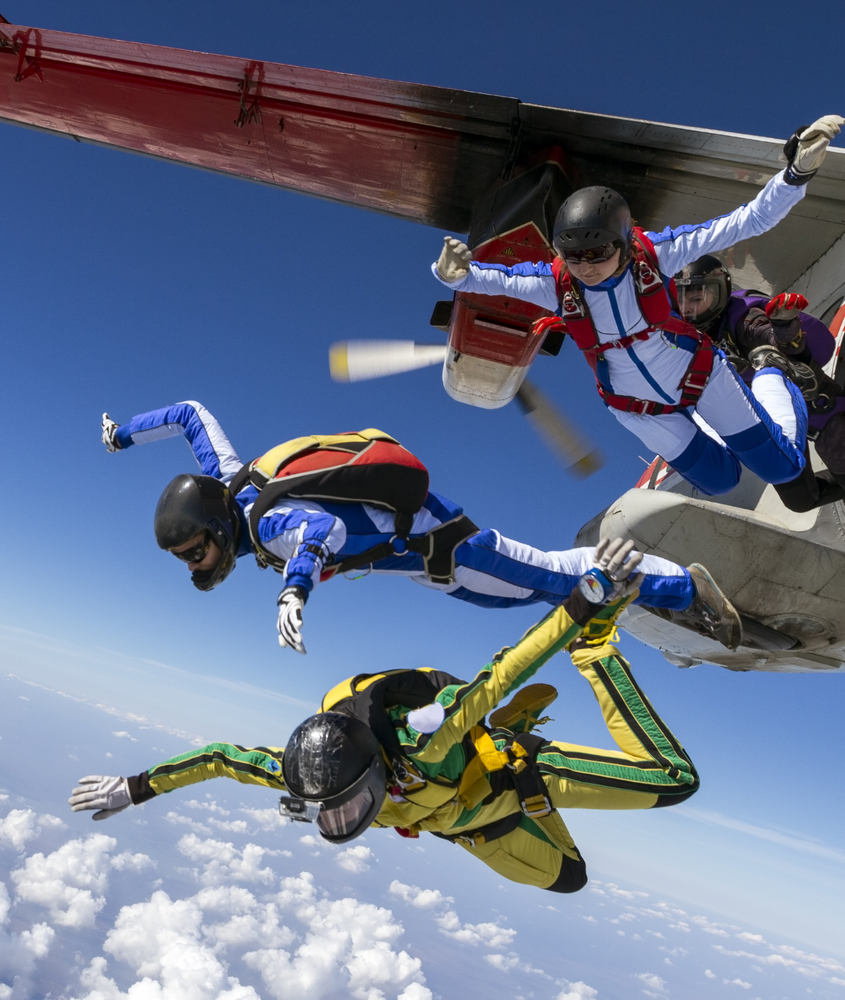 Seatbelts and airbags in cars save passengers lives. Parachutes save people who, for a variety of reasons, exit a plane in mid-flight. So why aren’t parachutes provided to passengers on commercial airline flights, in case of emergencies?
Because they almost certainly would not save anyone’s life.
Parachuting Basics
When your average daredevil skydives for fun, the plane is typically travelling at between 80 and 110 mph when the skydiver jumps.Tandem and accelerated free fall (AFF) jumps occur between 10,000 and 13,000 feet, while static jumps can be as low as 3,500 feet.
Student divers choosing the easiest, tandem jump, where the newbie is physically and securely attached to an experienced instructor, are still required to undergo “a half hour of basic ground instruction.”
Braver neophytes who wish to fly untethered will have to endure:
Four to five hours of intense ground instruction, including learning body flight maneuvers and hand signals that instructors use to coach the student as they fly alongside.
For an AFF jump, although not harnessed together, freshman flyers are accompanied by two instructors who “hold onto the student’s harness until” it’s deployed.
Those who choose a static line jump also have to take four + hours of training prior to the jump, although the parachute is deployed as the rookie flyer leaves the aircraft.
When skydivers leave a plane, they do it alone or in small groups. When successive groups will be jumping, they try to keep separated by anywhere between 500 and 1500 feet; this is often accomplished by waiting until the preceding group is “back under the tail to 45 degrees behind the airplane” or several seconds in between groups.
Experienced skydivers can make even riskier jumps, although when descents begin at higher than 15,000 feet, “the risk of hypoxia and being significantly affected by altitude” increases dramatically and divers are less able “to make effective safe decisions at critical times.” Therefore, divers who jump from 15,000 feet or higher carry supplemental oxygen.
Further, each parachute weighs around 40 pounds and the equipment is expensive. To be fully outfitted with “rig, main, reserve, ADD, altimeter, jumpsuit, helmet [and] goggles” can run between $5,900 and $9,000.
Commercial Airplane Basics
Perhaps the most popular commercial jetliner is the Boeing 737 family. Its 737-800 can carry nearly 200 people (including the crew).
Although speeds can vary slightly, the 737-800 travels at approximately 600 mph when at its cruising altitude of 35,000 feet. Cruising altitudes are assigned by air traffic controllers and are usually up to 39,000 feet, except for longer flights that may fly higher.
Individual Parachutes Won’t Improve Passenger Safety
Doing the math . . .
Passenger Training
Since four hours of training just to board a plane is unrealistic, passengers would have to read and execute detailed skydiving instructions including how to properly strap the chute on in order to benefit from the parachute. Not everyone is good at following detailed, technical instructions even when time and stress aren’t a factor. In a situation where the plane is going down and one has only a moment to get the parachute properly strapped on (likely while keeping an oxygen mask firmly attached and perhaps also needing to keep the seat belt on to keep from being thrown about in the cabin), it’s unlikely most would be able to even get this far.
Every Man for Himself
Unless passengers wanted to fly suited up and tethered for a static jump, parachuting from a commercial airplane will be an AFF jump; however, unlike the conditions that students get – training and trained instructors to assist, commercial passengers will just have to learn as they go.
In addition, they will have to keep calm and proceed in an orderly fashion, which will require most to patiently wait their turn to exit. This is not likely to happen.
Parachuting Equipment is Bulky
Adding just parachutes (not counting helmets, altimeters, etc.) for each passenger would add another 8,000 pounds or so to the flight’s weight. In addition, that equipment would take up space, that is already at a premium.
Parachuting Only Makes Sense if Something Happens in Mid-Flight
The only feasible time for people to jump from the plane is while it’s cruising. However, most fatal airline accidents occur on airplanes during takeoff and landing.
Consider that between 2003 and 2012, only 9% of all fatal accidents on commercial flights, seven total, occurred while the plane was cruising; moreover, at least one of those accidents happened as a result of wind shear or thunderstorm. This is a situation where parachuting is extremely dangerous even if you’re an expert.
So even if parachuting were feasible from a jetliner, the conditions in which parachutes could theoretically save lives are almost never apparent in fatal commercial accidents. But even if they were, it still wouldn’t be a good idea.
Jetliners Cruise Very High and Very Fast
At 35,000 feet (three times higher than a typical jump) every passenger would need high altitude equipment (HALO) that includes an oxygen tank, mask and regulator, flight suit, ballistic helmet and altimeter just to manage the thin air. Or they could just pass out from hypoxia and wake up later, hopefully when the parachute automatically deployed at under 15,000-20,000 feet.
Of course, none of this would matter since the plane is moving so fast (600 mph), and it is so large, that many passengers would almost certainly smash into it and suffer debilitating if not fatal injuries.
Whole Plane Parachutes May Save Lives
There is hope, however. Over the past few years, many small planes have been equipped with whole-plane parachutes that slow the craft’s descent. As of late 2013, the largest planes equipped with these safety devices carry five people, but plans are in the works for putting them on larger crafts. As one manufacturer said, “There is no doubt that big commercial airlines of the future will be equipped with some kind of parachute recovery system.”
source:::: Today i foundout.com
natarajan
This Day In History: February 29, 1504

On this day in history, 1504, Christopher Columbus convinced a group of Native Jamaicans that his god was angry with them for ceasing to provide his group with supplies and that god would show his anger with a sign from the heavens. The sign was a lunar eclipse that Columbus knew was imminent.
This event occurred on Columbus’ fourth and final voyage to the Americas, which began in Cadiz in 1502. Columbus landed near the north coast of Jamaica on June 20, 1503 with only two of his original four caravel ships still afloat, but barely sea worthy due to a shipworm infestation. At first, the natives welcomed Columbus and his crew, providing them with food and other supplies in exchange for various trinkets, generally welcoming the sailors into their community with open arms.
This arrangement didn’t last very long. Over the next several months, the natives became discontented with the guests of their island. Columbus’ crew repaid the generosity of the natives by frequently stealing and cheating them, as well as raiding villages for supplies, among many other indiscretions committed by the crew (murder, rape, etc.). As a result of this, by January of 1504, the indigenous peoples decided to stop supplying the stranded Europeans, regardless of what they might offer in trade.
Without a significant source of food or means to leave, Columbus’ expedition was in serious trouble. Luckily for his crew, Columbus had certain astronomical tables with him including the ephemeris compiled by the German astronomer Johannes Müller von Königsberg, better known today by his Latin name, Regiomontanus. In this almanac, Regiomontanus predicted there would be a total lunar eclipse on the evening of February 29, 1504. He also gave an estimation of what time it would occur, though this start time was based on Nuremberg, Germany time, so Columbus had to do a bit of estimating. Regiomontanus even included fairly accurate information as to how long the eclipse would last.
Armed with this knowledge, which Columbus was choosing to gamble would be extremely accurate, he called a meeting with the chiefs of the nearby tribes shortly before the eclipse was to take place. In this meeting, he told them his god was angry with them for ceasing to give him supplies. As a result, his god would take away the moon as a sign of his anger and subsequently punish them for their actions.
Luckily for Columbus, the predicted lunar eclipse took place more or less on schedule and according to Columbus’ son, Ferdinand, who was 13 and had made the voyage with his father:
The Indians observed this [the eclipse] and were so astonished and frightened that with great howling and lamentation they came running from every direction to the ships, laden with provisions, praying the Admiral to intercede by all means with God on their behalf; that he might not visit his wrath upon them… and promising they would diligently supply all their needs in the future.
Columbus agreed to take their case before his god and went into his cabin to “pray”. What he actually did in there was watch an hour glass. Columbus knew the moon would stay completely in the Earth’s shadow for around 48 minutes, so he waited for the appropriate time for the moon to begin to emerge. Shortly before this took place, he came back out and told the natives that he had asked his god to forgive them and god had acquiesced. The moon began to reappear and Columbus no longer had trouble getting the provisions he needed. He and his crew were picked up a few months later when a ship from Hispaniola arrived in Jamaica on June 29, 1504. They arrived back in Spain on November 7, 1504.
source:::: Today i foundout.com
natarajanChri


 Take off with Natarajan