Imaginative Photos Of Toy Plane Soaring in the Sky !!!


Macau-based web designer and developer Varun Thota (@vnthota) has an Instagram feed full of photos depicting dynamic metropolitan life, but his series My Toy Plane (#mytoyplane) takes his creative vision to new heights. The imaginative photos show a hand guiding a toy airplane overhead in various locations. If it weren’t for the hand, the images would be quite convincing as shots of a real plane soaring in the sky, flying over tall buildings, or preparing to land on a runway.

What makes Thota’s photos even more fun to look at are the glimpses of urban life in Macau, Hong Kong, and other bustling cities in Asia. His toy plane weaves in between tall skyscrapers, over lively streets, and above vibrant downtown bays, taking the viewer on a mini-voyage of their own. Looking at the creative shots, you can almost imagine yourself sitting in the plane itself, gazing down at the beautiful sights below.

Drawing inspiration from the hashtag #putaplaneonit, Thota decided to start this series after his father found a toy plane inside a chocolate Kinder egg. Through the photos, he not only gets to explore his interest in aviation, but also to build relationships with the people around him. He says, “The thing I enjoy most about the series is how fun it is to include other people in it. It’s always fun to show people the plane, tell them the story and then ask them for a helping hand in taking the shot.”


Varun Thota Website

source:::::::::::::::http://www.mymodernmet.com/profiles/blogs/varun-thota-my-toy-plane natarajan

How to Spot the International Space Station ….


Every so often, the International Space Station (ISS) becomes visible in your night sky. Here’s how you can spot it.

Is it a meteor? Is it a plane? It might be the International Space Station (ISS).

Every so often, the ISS becomes visible in the night sky. To us on Earth, it looks like a bright star moving quickly above the horizon. The ISS is so bright, it can even been seen from the center of a city. Then, just as suddenly as it appeared, it disappears. How do you know when you can see the ISS in your night sky?

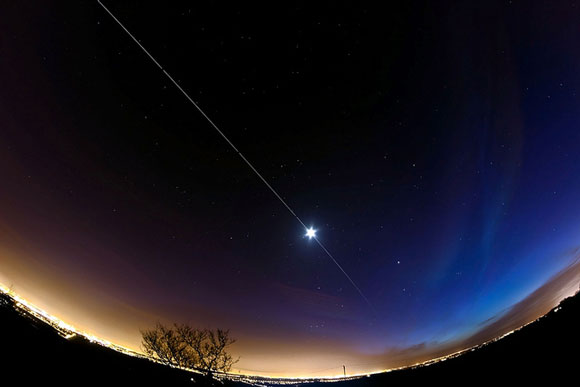
A composite photograph of the International Space Station from Earth. Image Credit: Dave Walker.

NASA has started a Spot the Station program where people from around the world can sign up to receive alerts when the ISS will be visible from your location. You can receive alerts via email or a text message to your phone. Typically, alerts are sent out a few times each month when the station’s orbit is near your location. Visit the Spot the Station website here to sign up, and view a list of upcoming sighting opportunities.

Notices will only be sent to you when the ISS will be clearly visible from your location for at least a couple of minutes. If you live north of 51.6 degrees latitude (for example, in Alaska), you will likely have to visit the website to find sighting opportunities because notifications in this region would be rare.

The notices contain information on where to look for the ISS in the night sky. Just note where the sun sets and you can easily find the direction where the station will appear (for example, in the southwest or in the northwest). The height at which the station will appear is given in degrees. Just remember that 90 degrees is directly over your head. Any number less than 90 degrees will mean that the station will appear somewhere between the horizon and the 90 degree mark. The station is so bright that it is really hard to miss if you’re looking in the correct direction. Alternatively, you can stretch out your fist at arm’s length toward the horizon, which is equivalent to about 10 degrees. Then, just use the appropriate number of fist-lengths to find the location marker, e.g., four fist-lengths from the horizon would be equivalent to about 40 degrees.

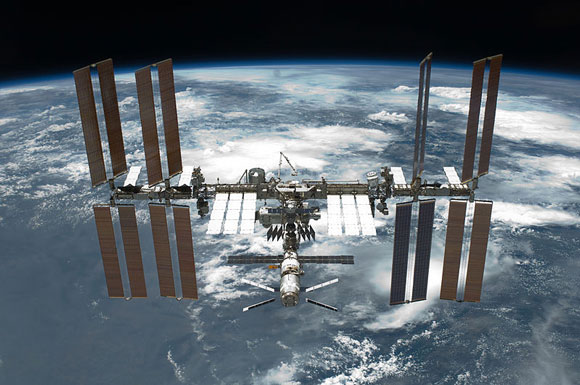
Photograph of the International Space Station taken from the space shuttle Endeavour on May 30, 2011. Image Credit: NASA.

So far, more than half a million people have signed up to receive alerts from NASA’s Spot the Station program. I’ve seen the station fly over twice now and it’s a pretty amazing experience—gets you thinking about how far our technology has advanced.

The first module of the ISS was launched into space in 1998 and the initial construction of the station took about two years to complete. Human occupation of the station began on November 2, 2000. Since that time, the ISS has been continuously occupied and over 214 people have visited to date. The ISS serves as both an orbiting laboratory and a port for international spacecraft. The primary partnering countries involved in operating the ISS include the United States, Canada, Europe, Japan and Russia.

Astronauts Robert Curbeam, Jr. and Christer Fuglesang working on the International Space Station. Image Credit: NASA.

The ISS orbits at approximately 220 miles above the Earth and it travels at an average speed of 27,724 kilometers (17,227 miles) per hour. The ISS makes multiple orbits around the Earth every day. So far, the ISS has traveled more than 1.5 billion miles through space.

Bottom line: Check out the ISS in the night sky the next time it flies over your location. You can sign up to receive alerts with NASA’s Spot the Station program or visit that website to view a list of viewing opportunities.

source:::::Earth skynews site

natarajan

A Tribute to India’s Natural Heritage ….


India is home to an amazingly wide variety of wild animals native to the country. This video subtly inspires us to be mindful guardians and reminds us of our responsibilities towards them.

A nicely shot film with a complementary track. Jai Hind.

source:::: You Tube & Story Pick

natarajan


Animal Photos Of the Week…


Tiger plays with dog

Two dogs have become best friends with a tiger. The dogs – mother Lia, pictured, and her male pup Hugo – are inseparable from new-born tiger cub Suria. Suria was born at the Oasis of the Siberian Tiger, in Senec, Slovakia – a protected area that aims to breed ussurian tigers. Suria soon became friendly with Lia and Hugo, who live on the site.Picture: LUCIA ZUSTAKOVA / CATERS NEWS  


These fluffy ducklings had a lucky escape when quack-thinking staff at the Knowsley Safari Park, Merseyside, spotted them in the lion enclosure. A keeper distracted the big cats so the babies - nicknamed Ant and Dec - could be moved to safety.

These fluffy ducklings had a lucky escape when quack-thinking staff at the Knowsley Safari Park, Merseyside, spotted them in the lion enclosure. A keeper distracted the big cats so the babies – nicknamed Ant and Dec – could be moved to safety.Picture: KNOWSLEY SAFARI PARK  


Hedgehog with head stuck

This hedgehog in the western German city of Saarbruecken had a lucky escape after being tempted to try and eat the remains of a pudding at the bottom of a plastic carton and getting its head stuck.The trapped hedgehog was spotted walking in the middle of the street by a motorist. He was worried that it was likely to be run over, despite stopping and attempting to divert drivers around the animal.He called police to alert them to the fact that there was a hedgehog on the road which motorists were swerving to avoid. When officers arrived they managed to find the animal and free it from the pudding container.  


A lion cub stretches as the rain begins to fall in the Masai Mara National Reserve in Kenya

A lion cub stretches as the rain begins to fall in the Masai Mara National Reserve in KenyaPicture: Mark Bridger/Solent News 


Curious cheetahs peer into a sunroof in the Masai Mara National Reserve, Kenya

Curious cheetahs peer into a sunroof in the Masai Mara National Reserve, KenyaPicture: Elmar Weiss/HotSpot Media 


Beefy the four-day-old giant lamb stands next to another lamb the same age at Cannon Hall farm in Barnsley

Beefy the four-day-old giant lamb stands next to another lamb the same age at Cannon Hall farm in BarnsleyPicture: ROSS PARRY


A polar bear cub and its mother Uslada play after leaving their winter shelter in St.Petersburg's zoo

A polar bear cub and its mother Uslada play after leaving their winter shelter in St.Petersburg’s zooPicture: EPA/ANATOLY MALTSEV


An Afghan nomad, called Kuchi, leads his camel across a road in Jalalabad-Kabul highway east of Kabul, Afghanistan

Kuchi, an Afghan nomad, leads his camel across a road in Jalalabad-Kabul highway east of Kabul, AfghanistanPicture: Rahmat Gul/AP 


A curious leopard cub toys with Ranger Roan Ravenhill's GoPro camera, in MalaMala Game Reserve in Mpumalanga Province, South Africa

A curious leopard cub toys with ranger Roan Ravenhill’s GoPro camera in MalaMala Game Reserve in Mpumalanga Province, South AfricaPicture: Roan Clive Ravenhill/Barcroft 

SOURCE:::: The Telegraph UK

natarajan

Image of the Day …


Jacob Baker created this cool composite image of the moon and Venus rising in the east this morning, Friday, April 25, 2014.  He said it took him about three hours to complete.

Jacob Baker created this cool composite image of the moon and Venus rising in the east this morning, Friday, April 25, 2014. He said it took him about three hours to complete. “Phew!” he said. It was worth it, Jacob.  

The waning crescent moon is now sweeping past the sky’s brightest starlike object – the planet Venus – n the eastern predawn sky. They were closest on Friday morning – April 25, 2014 – but you might catch the moon and Venus on Saturday, too. Click here for a chart and info about Saturday’s moon and Venus.


source::::Earth Sky News

natarajan


How Krishnans Brought Wimbledon Home …!!!


Ramanathan Krishnan and Lalitha Krishnan at their natural grass court patterned on those at Wimbledon. Photo : R Ravindran.


The English championship is two months away and fans are making plans to be there. But the first family of Indian tennis has other ideas

No sprightly girls and boys to chase the yellow balls. No linesmen to yell out calls. No electronic board to flash the scores. But superlative matches are played every day at this grass court, where tall trees fill in for spectators.

These ‘matches’ defy the humdrum order of time, space and sequence. One moment, an iceberg-cool Borg and a fiery McEnroe are locked in a nail-biting tie-breaker. In the next, Ashe gets the better of Connors with a clever mix of slice and spin. Then come Nadal and Federer fighting a war of attrition, which is followed by an emotion-soaked final where a kind Duchess of Kent offers her shoulder to a teary-eyed Jana Novotna, disconsolate after her loss to Steffi Graf.

Welcome to the private grass court at Oliver Road in Mylapore, maintained by Indian tennis’ first family, the Krishnans, as a tribute to Wimbledon. For the Krishnans, this natural grass court, which borrows features from the hallowed courts of Wimbledon, serves as a mind screen to replay and relive the timeless matches from the prestigious English championship. (Also significant is that this court is one of the very few natural grass courts in the country.)

 “Wimbledon is dear to every member of our family. We have followed the championship closely for decades,” says Ramanathan Krishnan, 77 now.

 The Krishnans not only tracked Wimbledon, they also excelled in it — a fact that largely shaped their deep attachment to the championship and also the decision to design a natural grass court patterned on those at Wimbledon. Ramanathan Krishnan is a two-time semi-finalist (1960 and 1961) at Wimbledon and his son Ramesh Krishnan, the winner of the 1979 Wimbledon juniors title and a quarter-finalist in the men’s section in 1986.

 “It was our son Ramesh’s idea to design a Wimbledon-type grass court at our house on Oliver Road. Around four years ago, he came up with this plan and everyone was excited about it. Ramesh got all the necessary information from Wimbledon. My wife Lalitha assisted in executing the project. And when it was done, we knew we had brought Wimbledon home,” declares Ramanathan, who spends the evening hours with Lalitha at this private grass court, both of them merrily parked in broad, deliciously comfortable bamboo chairs.  “When Wimbledon is on, we bring out the television set and watch the matches sitting here,” says Lalitha, 70.

The Krishnans are going to a lot of trouble to make Wimbledon more immediate for themselves: they have put two men, A. Shanmugam and M. Manickam, on the job of maintaining the court. Natural grass court maintenance is costly and cumbersome, the reason we don’t have many of them around.

Notably, this grass court is not used regularly — for ‘real’ matches, that is. “Once in two months, Ramesh, who lives in R.A. Puram, brings some of his friends along for a game,” says Ramanathan.

Besides the love of Wimbledon, there are other sentiments that spur the desire to keep the court in shape and working order. Beneath the grass, lie clayey memories of long practice hours and family bonding. “This was a clay court for well over three decades, before it was turned into a grass court four years ago. We set up the clay court in 1975. It was a training ground for Ramesh,” says Ramanathan.

 “Father would train Ramesh from 10 a.m. to 5 p.m. at this court,” recalls Gowri Krishnan-Tirumurti, Ramanathan’s daughter, who also trained at the court and is the 1982 Indian national juniors champion.

In its clayey days, the court saw five south Indian champions play and practise the sport — T.K. Ramanathan, Ramanathan Krishnan, Ramesh Krishnan, Gowri Krishnan and Shankar Krishnan (a cousin of Ramesh and Gowri). “Just like my dad and brother, Shankar went on to play Davis Cup,” says Gowri.

This private tennis court may have created champions, but its charm lies in the sense of togetherness it has fostered among the Krishnans. “I remember when we would be practising, our mother would sit on the sidelines and peel oranges for us,” says Gowri.

The bonding has extended to the youngest generation. Ramanathan’s grandchildren — Gayathri, Nandita, Bhavani and Vishwajit — are in their twenties and studies have taken some of them away from home; yet, when they visit their grandparents, they love to sit around this clay-turned-grass court. Says Gowri, “Successive generations have learnt many things around this court. Discipline is one of them.”

 And, surely, also what it takes to be a winner.

Keywords: KrishnansWimbledon


source:::: The Hindu…

natarajan


இரண்டாம் வாய்ப்பு !!!….


மின்சார பல்பைக் கண்டுபிடித்தது யார் என்று கேட்டால், தாமஸ் ஆல்வா எடிசன் எனப் பட்டெனக் கூறிவிடுவீர்கள். அவர் மின்சார பல்பைக் கண்டுபிடிப்பதற்கு முன்னர் ஆயிரம் முறையாவது சோதித்துப் பார்த்திருப்பார்.

ஒரு நாள் எடிசனின் சோதனை வெற்றிபெற்றது. அவரது உதவியாளர்கள் மகிழ்ச்சியில் திளைத்தனர். அப்போது எடிசன், அலுவலகப் பையனை அழைத்தார்.

‘‘இந்த பல்பைச் சோதனை செய்’’ என்றார் எடிசன்.

எடிசன் சொன்னவுடன் அவனுக்கு ஒரே பதற்றம். பல்பை வாங்கும்போதே தவறுதலாகக் கீழே போட்டுவிட்டான். எடிசனுக்குக் கோபம் வந்தது. ஆனால், ஒன்றும் சொல்லவில்லை. எடிசன் தன்னை வேலையை விட்டு அனுப்பிவிடுவார் என்று அந்தப் பையன் பயந்தான்.

எடிசன் மீண்டும் ஒரு புதிய பல்பை உருவாக்கினார். மறுபடியும் அதே அலுவலகப் பையனை அழைத்தார்.

‘‘இந்தப் பல்பையாவது சரியாக வாங்கிச் சோதனை செய்’’ என்று சொன்னார் எடிசன்.

எடிசனின் இந்தச் செயல் அவரது உதவியாளர்களுக்கு ஆச்சரியத்தை அளித்தது. அவர்களுள் ஒருவர், ‘‘ஏற்கெனவே ஒருமுறை பல்பை உடைத்துவிட்டான், மீண்டும் அவனுக்கு எதற்கு வாய்ப்பு தர வேண்டும்?’’ என்று கேட்டார்.

இன்னொரு உதவியாளரோ, “மீண்டும் அவன் பல்பை உடைத்துவிட்டால் உங்கள் உழைப்பு வீணாகிவிடாதா’’ என எடிசனிடம் கேள்வி எழுப்பினார்.

அதற்கு எடிசன் பொறுமையாகப் பதில் கூறினார். “இந்தப் புதிய பல்பை உருவாக்குவதற்கு எனக்கு ஒரு நாள்தான் ஆனது. மீண்டும் அது கீழே விழுந்து உடைந்துவிட்டால், ஒரே நாளில் என்னால் புதிதாக இன்னொரு பல்பை உருவாக்கிவிட முடியும். ஆனால், இந்த வேலையை மறுபடி அவனிடம் ஒப்படைக்காவிட்டால், அவன் தன்னுடைய தன்னம்பிக்கையை இழந்துவிடுவான். அதை மீண்டும் அவ்வளவு எளிதாக அவனிடம் உருவாக்க முடியாது. அப்படி நடப்பதை நான் விரும்பவில்லை” என்று சொன்னார்.

source:::::The Hindu… Tamil…
natarajan

Take 2 For Terminal 2 of Heathrow ….Ready For Take off On June 4 …

  • The new Terminal 2 is to be rebranded to become ‘The Queen’s Terminal’ when it opens on June 4
  • Spacious new air transit facility will be able to handle 20million passengers a year, flying to 51 destinations

By DAMIEN GAYLE   in mailonline.com UK

NATARAJAN


Heathrow Airport’s new Terminal 2 is set to open in months, giving the capital a spacious new air transit point able to handle 20million passengers a year.

Replacing the old, overcrowded Terminal 2 which had stood since the Fifties, the new facility was today hailed as a cornerstone of Heathrow’s revitalisation ahead of its opening on June 4.

Shafts of natural light and high quality acoustics should make the building a calm space for travellers accustomed to high anxiety at dark, noisy airports, said lead architect Luis Vidal.

Spacious: British artist Richard Wilson's sculpture Slipstream dominates this view of the new Terminal 2 at Heathrow Airport on April 23, 2014 in London, England. The rebuilding of the transit point has taken five years at a cost of £2.5billion, but it is finally slated to open on June 4

Spacious: British artist Richard Wilson’s sculpture Slipstream dominates this view of the new Terminal 2 at Heathrow Airport on April 23, 2014 in London, England. The rebuilding of the transit point has taken five years at a cost of £2.5billion, but it is finally slated to open on June 4

Gateway to the world: The departure area of the new 'Queen's Terminal', which is expected to manage up to 20million passengers every year

Gateway to the world: The departure area of the new ‘Queen’s Terminal’, which is expected to manage up to 20million passengers every year

Breath of fresh air: Visitors walk past a doorway at the new building, which replaces the old, overcrowded Terminal 2 which had stood since the Fifties

Breath of fresh air: Visitors walk past a doorway at the new building, which replaces the old, overcrowded Terminal 2 which had stood since the Fifties

‘If you make it intuitive, pleasant, joyful, you can take away a completely different memory of the terminal,’ Mr Vidal told The Associated Press.

‘You can never completely erase your memory of the former Terminal 2, because it was a dreadful experience. This will be completely the opposite. This will be a destination. People will want to come here.’

In an effort to dispense with those past bad associations, the new Terminal 2 will be rebranded as ‘The Queen’s Terminal’. Queen Elizabeth will open the building herself – just as she did the original Terminal 2 in 1955.

The completion of the £2.5billion project, in conjunction with the relatively new Terminal 5 that opened in 2008, gives Heathrow two modern terminals. It is part of an £11billion refurbishment designed to keep London’s biggest airport competitive with other major European hubs including Amsterdam, Frankfurt and Paris.

 
The Slipstream sculpture is the centrepiece of the development, hanging 18m above the ground with a design intended to evoke the path of a plane in flight

The Slipstream sculpture is the centrepiece of the development, hanging 18m above the ground with a design intended to evoke the path of a plane in flight

Luxurious: With London increasingly becoming a destination of choice for the world's super-rich, Terminal 2 will have no shortage of pricey shops

Luxurious: With London increasingly becoming a destination of choice for the world’s super-rich, Terminal 2 will have no shortage of pricey shops

World of possibility: A construction worker puts the finishing touches to a sign at Terminal 2, which is to be rebranded 'The Queen's Terminal' when it opens this summer

World of possibility: A construction worker puts the finishing touches to a sign at Terminal 2, which is to be rebranded ‘The Queen’s Terminal’ when it opens this summer

The Queen’s Terminal will host 26 airlines, including United, Air Canada, Singapore Airlines and others that are part of the global Star Alliance, and offer flights to 51 destinations.

Of course, with London increasingly becoming a destination of choice for the world’s super-rich, Terminal 2 will have no shortage of pricey shops.

Officials say Terminal 2 will be the first in the world to offer a ‘complimentary personal shopping lounge where trained stylists will present a curated range of products for each client.’

The interior of the new terminal is dominated by a huge aluminium sculpture hanging 18m above the ground that is inspired by the flight path of a stunt place.

British artist Richard Wilson’s ‘Slipstream’ weighs 77 tonnes and is 78m in length, its vast bulk looming above the terminal’s main lobby and escalators, evoking the journeys that those who see it are set to embark on.

Slipstream weighs 77 tonnes and is 78m in length, its vast bulk looming above the terminal's main lobby and escalators

Slipstream weighs 77 tonnes and is 78m in length, its vast bulk looming above the terminal’s main lobby and escalators

Airport officials chastened by the chaos that plagued the opening of Terminal 5 in 2008 are planning a 'soft' opening of the new terminal

Airport officials chastened by the chaos that plagued the opening of Terminal 5 in 2008 are planning a ‘soft’ opening of the new terminal

Only one flight is planned the first day so, even if things go awry, the number of people affected will be small

Only one flight is planned the first day so, even if things go awry, the number of people affected will be small

The new terminal will gradually be brought to full capacity over six months

The new terminal will gradually be brought to full capacity over six months

Chastened by the problems that plagued the opening of Terminal 5, which included chaos when the luggage handling system broke down, airport officials are planning a ‘soft’ opening of the new terminal.

Only one flight is planned the first day so, even if things go awry, the number of people affected will be small.

The new terminal will gradually be brought to full capacity over six months.

Queues at the old Terminal 2: The old, overcrowded terminal building had stood since the Fifties

Queues at the old Terminal 2: The old, overcrowded terminal building had stood since the Fifties

Old fashioned: The building suffered from poor design and a lack of natural light, problems exacerbated by its handling far more passengers than it was ever intended to

Old fashioned: The building suffered from poor design and a lack of natural light, problems exacerbated by its handling far more passengers than it was ever intended to

Passengers try to sleep on uncomfortable seats at Terminal 2 after the UK's then newly privatised air traffic control system crashed

Passengers try to sleep on uncomfortable seats at Terminal 2 after the UK’s then newly privatised air traffic control system crashed

Heathrow officials say they are still pushing to build a controversial third runway, which is opposed by London Mayor Boris Johnson and influential environmental groups.

John Holland-Kaye, Heathrow’s development director, said the completion of the new terminal shows Heathrow has complied with the last Labour government’s directive that Heathrow should improve without growing.

‘Our challenge now is to make the case to expand,’ he said, admitting that getting permission would be ‘politically complex.’

Mr Holland-Kaye said private money is available to pay for a third runway, which would greatly add to Heathrow’s capacity.

He also claimed the new Terminal 2 would reduce the ‘stacking’ problem over Heathrow that often causes delays as planes await permission to land.


Google Street View… Now Lets You To Go Back in Time !!!

Every day, Google’s Street View cars capture massive amounts of data and the company then publishes them on Google Maps at regular intervals. Until now, the only images you could see on Google Maps were the latest images. Starting today, however, you will also be able to go back in time and see older images.

When you’re in the Street View interface, you will now see a small clock icon on the page. Once you click that, a preview image with a timeline underneath it will appear and allow you to see the older images.

It looks like Google’s Street View cars pass by most locations about twice per year. There is a bit of variation here, however, and some urban areas especially have more historical images available while some rural areas may have fewer. In many regions of the world, Google only started collecting this imagery in the last few years (it launched in the U.S. in 2007), so that may also limit the availability of historical images.

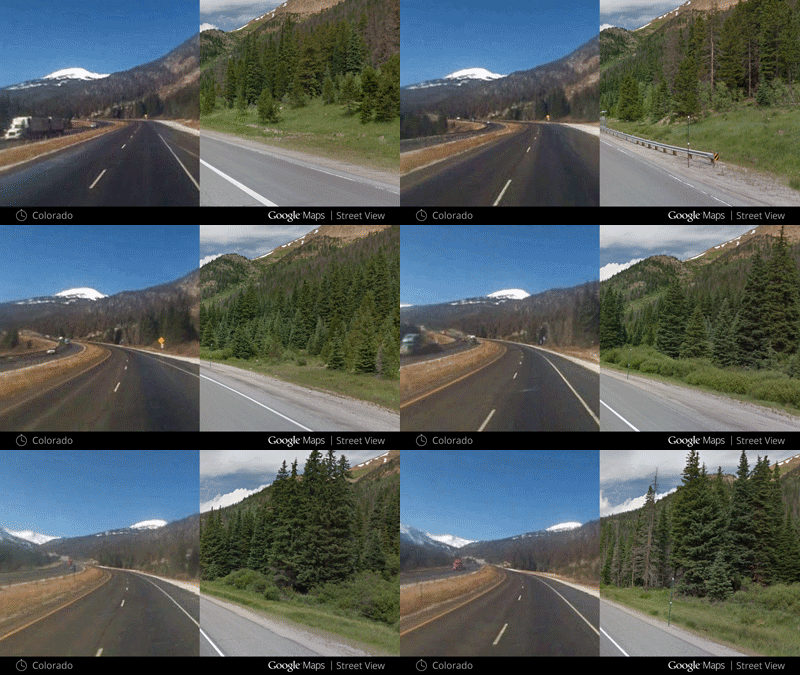
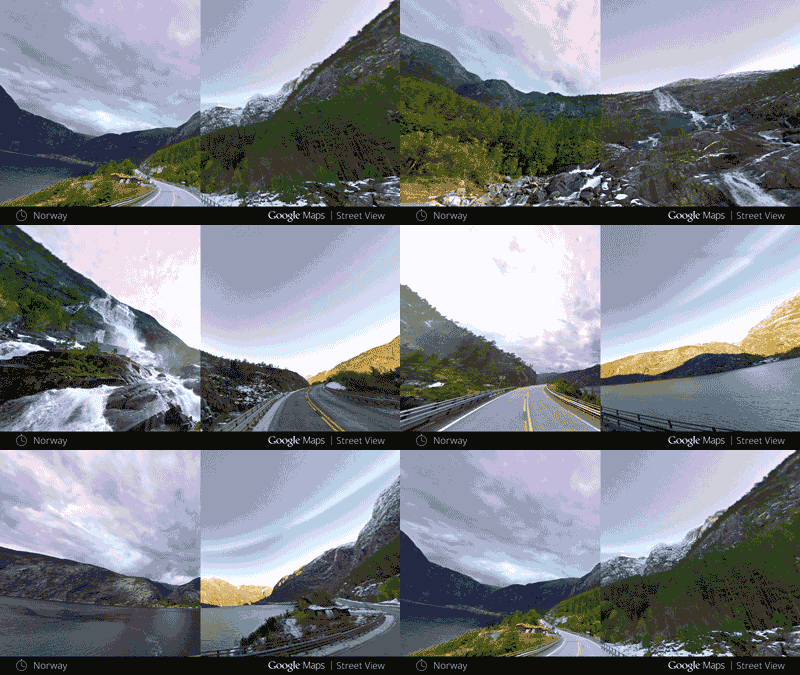
SeasonalChange_NorwayGoogle tells me this update is meant to be part of the company’s effort to “create a digital mirror and true record of the world.”

The update is going live globally today. For now, it will only be available in the desktop version of Google Maps and it is unclear if Google plans to bring this feature to other versions of Maps later.

Here is an  example of what these images look like:


source:::: Tech Crunch .com
natarajan