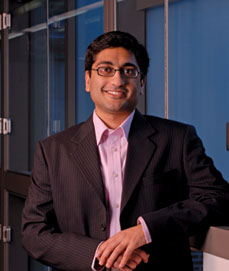
A Kashmiri Boy Dreamed of Playing Cricket Even After Losing His Arms. Today, He Plays for His State….!!!

Amir Hussain Lone was eight year old when he lost his arms in an accident with a bandsaw when he visited his father’s sawmill to deliver lunch to his brother.

Today, at the age of 26, he is the captain of the Jammu and Kashmir state para-cricket team.

amir

“I was taking some food for my brother who worked at my father’s sawmill. I used to play with the sawmill machine, but on this occasion both of my arms got entangled in the machine,” he told Mail Online. Ironically, the sawmill used to manufacture cricket bats.

Amir never let his misfortune come in the way of his dreams. Cricket has been his passion since childhood, and he worked extremely hard to make himself capable of playing. But the journey till here was not an easy one. Amir’s father had to sell his sawmill to arrange the money for his treatment, and the society started treating him like someone who would not be able to achieve anything in life. His treatment took three years and when he resumed school after that, his teachers told him to stay at home. This was when Amir started his journey of becoming self-reliant by selling walnuts to purchase books and by practising his sport. He holds the bat between his neck and shoulder and bowls with his toes.

“When I tried to play cricket for the first time after the accident, people used to make fun of me. Now they are very supportive,” he says.

He wants to play like Sachin Tendulkar one day. Watch Amir’s inspiring journey here:

The video was originally published here.

Source…Tanaya Singh in http://www.the betterindia.com

Natarajan

” One-Year Crew Returns to Earth…”

Soyuz capsule with parachute deployed descends through clouds on the way to landing

The Soyuz TMA-18M spacecraft is seen as it lands with Expedition 46 Commander Scott Kelly of NASA and Russian cosmonauts Mikhail Kornienko and Sergey Volkov of Roscosmos near the town of Zhezkazgan, Kazakhstan on Wednesday, March 2, 2016 (Kazakh time). Kelly and Kornienko completed an International Space Station record year-long mission to collect valuable data on the effect of long duration weightlessness on the human body that will be used to formulate a human mission to Mars. Volkov returned after spending six months on the station.

Photo Credit: (NASA/Bill Ingalls)

Source….www.nasa.gov

natarajan

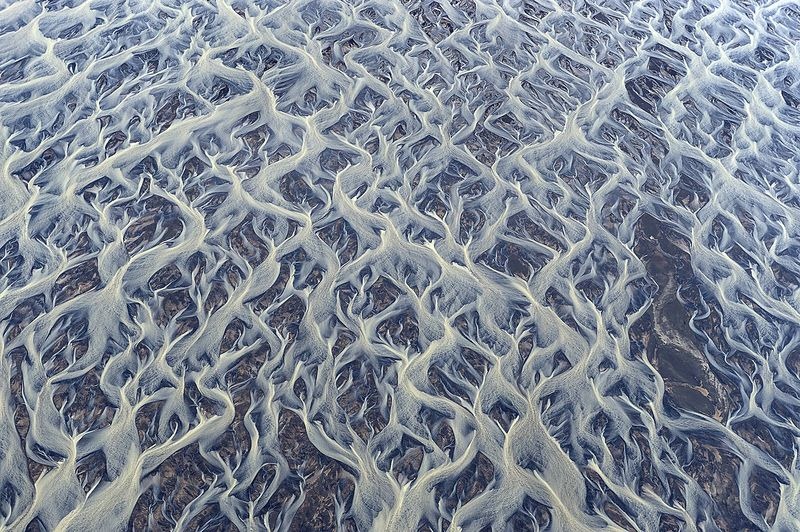
The Stunning Beauty of Braided Rivers….!!!

Most rivers flow in one broad channel of water, but some rivers split into lots of small channels that continually split and join each other to give a braided appearance. These are called braided rivers.

Braided rivers are usually wide but shallow. They typically form on fairly steep slopes and carry large amount of coarse-grained sediments. When the river’s flow decreases, these sediments get deposited on the river bed leaving behind small temporary islands of sands that cause the river’s channel to split. Aside from a steep gradient and abundance of sediments, a variable water discharge rate is essential to their formation. Consequently, braided rivers exist near mountainous regions, especially those with glaciers. Braided channels are also found in environments that dramatically decrease channel depth, and hence channel velocity, such as river deltas, alluvial fans and peneplains.
iceland-braided-river-3

A braided river in Iceland. Photo credit: Andre Ermolaev/500px

The pattern of the braided channels will change over time as the sediment islands get eroded away and deposited in new islands as the speed and amount of water in the river changes.

Rivers with braided channels look stunningly beautiful in satellite images or from airplanes. Here are some of the most beautiful examples of braided rivers.

rakaia-River

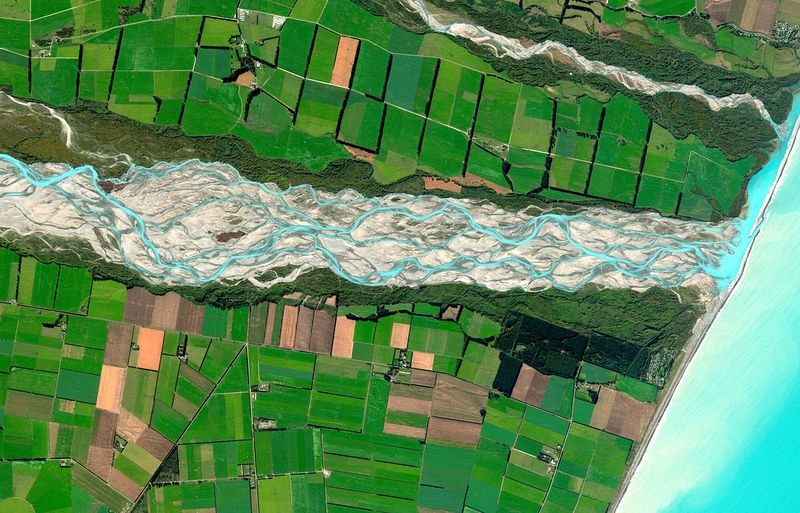
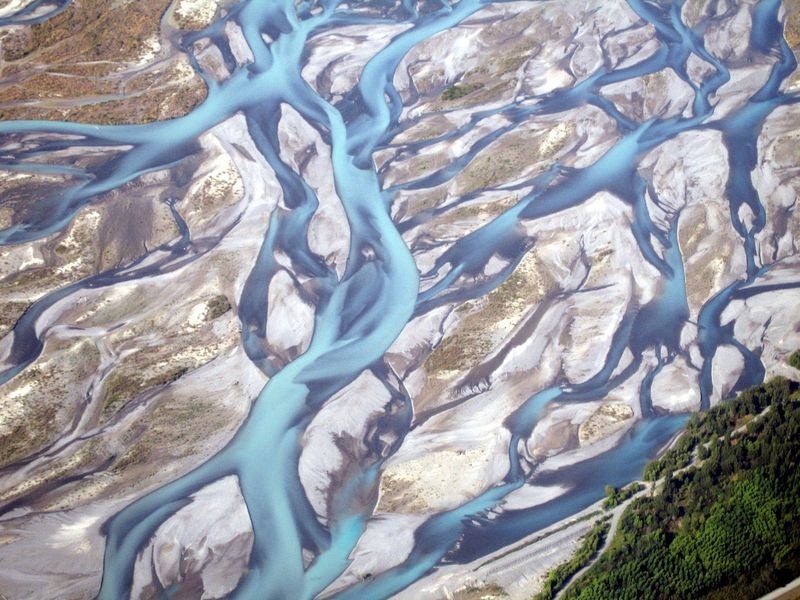
The Rakaia River in the Canterbury Plains in New Zealand’s South Island is a beautiful example of a braided river. It is one of the largest braided rivers in New Zealand. Photo credit: Andrew Cooper/Wikimedia
rakaia-river-braided-2

Rakaia River. Photo credit: www.digitalglobeblog.com
rakaia-river-braided-1

Rakaia River. Photo credit: Geoff Leeming/Flickr
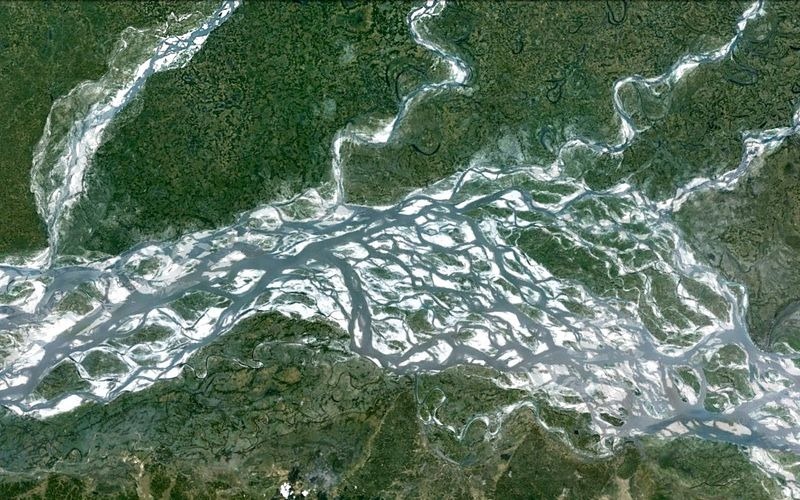
brahmaputra-braided-river-1

The Brahmaputra River in Tibet, India and Bangladesh is another classic example. The river originates in Tibet and enters India through the state of Arunachal Pradesh. The river gets intricately braided once it enters the state of Assam where it acquires its common name Brahmaputra. For the next 700 km of its braided course through the valley, it gets mighty big even in the dry season. During rains, its banks are more than 8 km apart. Photo credit:Google Earth/patternsofnatureblog.com
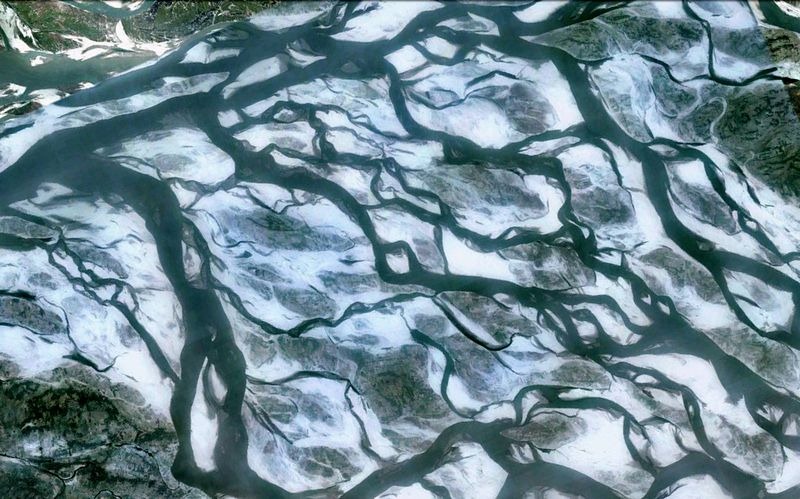
brahmaputra-braided-river-2

Brahmaputra River. Photo credit: Google Earth/patternsofnatureblog.com
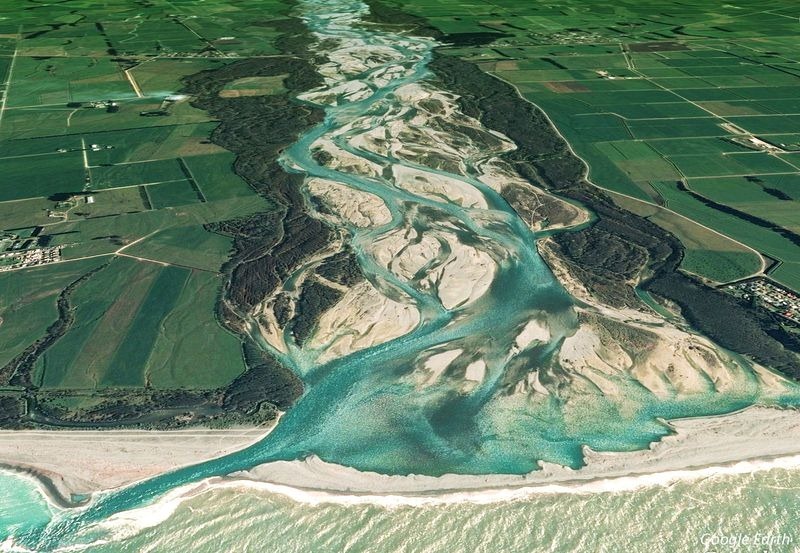
waitaki-braided-river-1

The Waitaki River is another large braided river in the South Island of New Zealand. It drains the Mackenzie Basin and runs some 110 kilometers south-east to enter the Pacific Ocean between Timaru and Oamaru. Photo credit: Google Earth
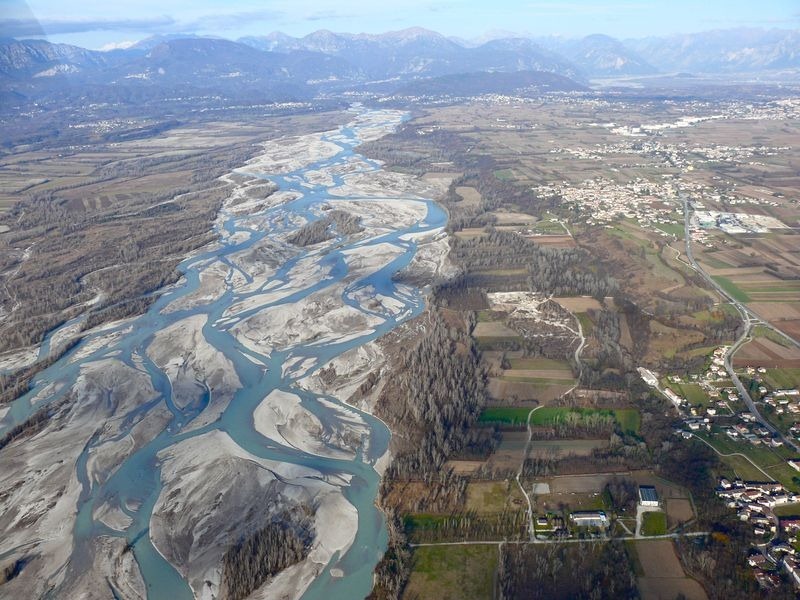
tagliamento

The Tagliamento River in north-east Italy is braided as it flows from the Alps to the Adriatic Sea. Photo credit:www.udine20.it
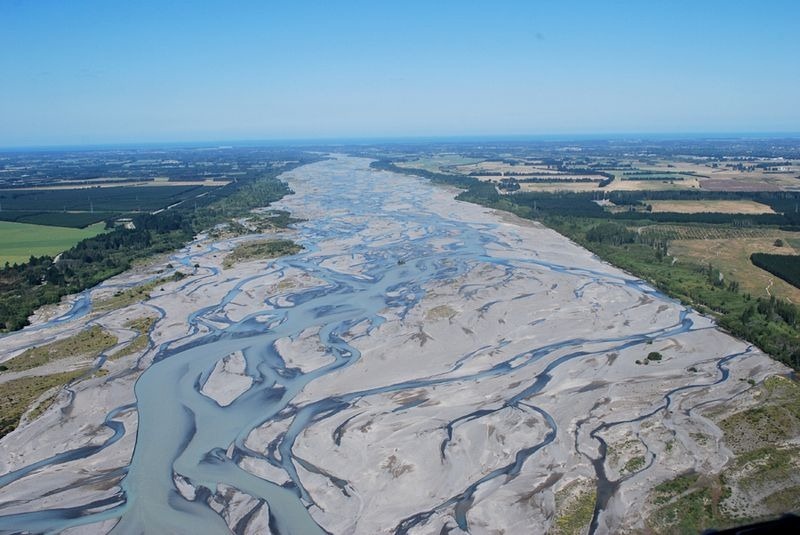
waimakariri-braided

The Waimakariri River in the South Island of New Zealand, is a braided river, about a kilometer wide with many changing channels cutting through the shingle. Photo credit: unknown/spacebattles.com
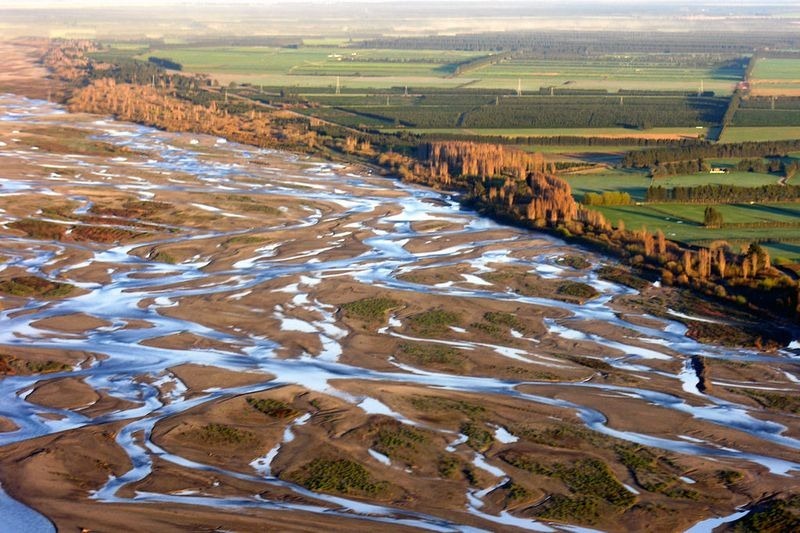
waimakariri-river-braided-1

The Waimakariri River. Photo credit: Philip Capper/Flickr
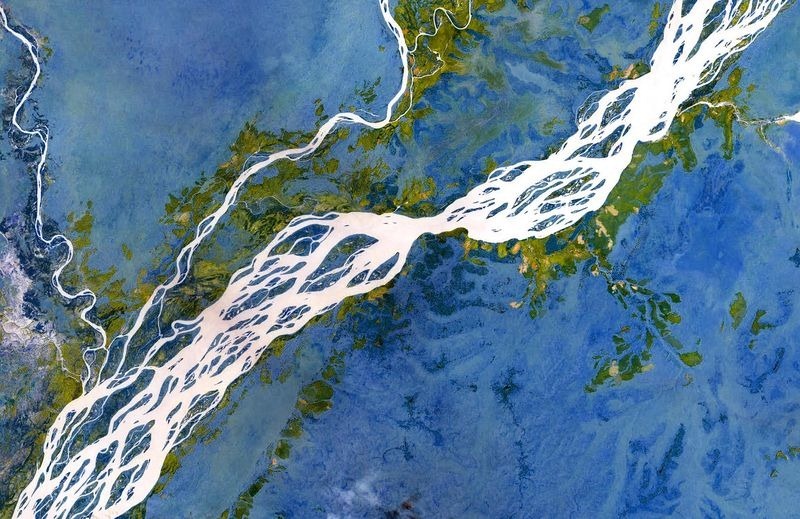
congo-braided-river-1

A Landsat image of a braided section of the Congo River. Photo credit: Wired
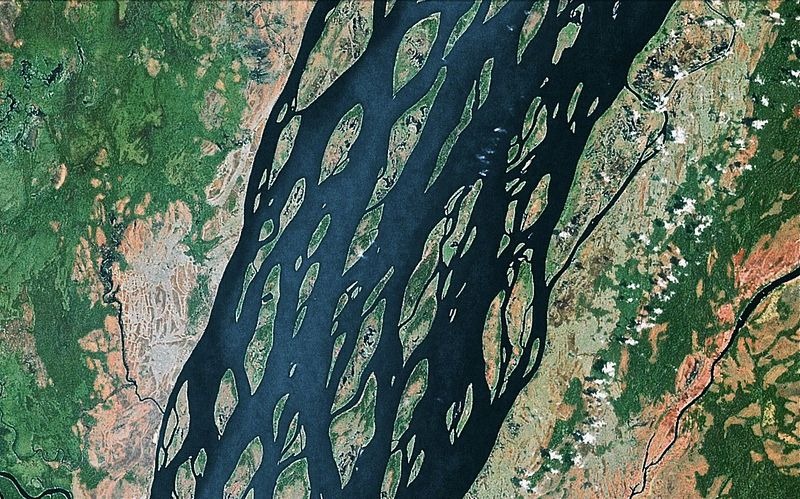
congo-braided-river-2

The Congo River. Photo credit: Google Earth/patternsofnatureblog.com
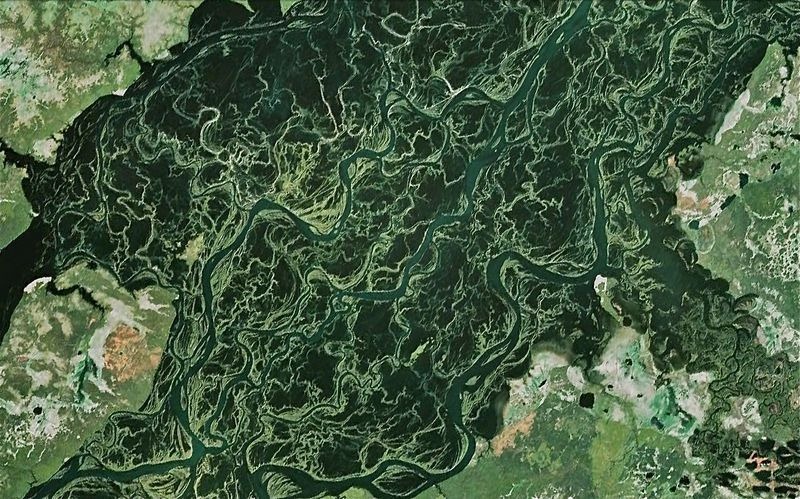
ob-river-braided-1

The Ob River in western Siberia, Russia, is the world’s seventh longest river. Photo credit: Google Earth/patternsofnatureblog.com
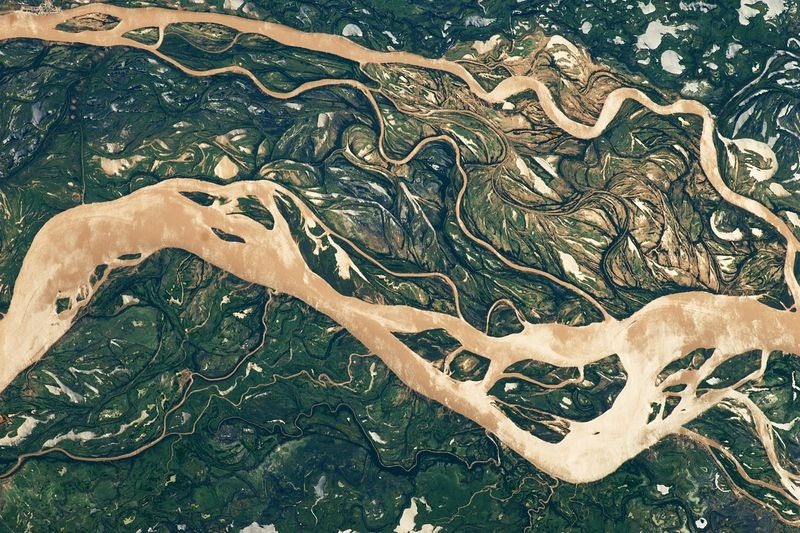
parana-river-braided-1

The Paraná River in South America. This photograph shows a 29-kilometer stretch of the Paraná, downstream of the small city of Goya, Argentina. Photo credit: NASA
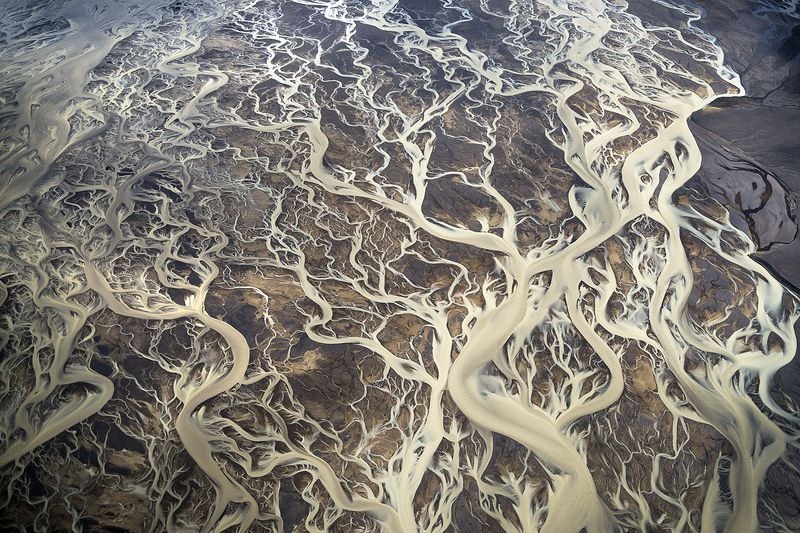
iceland-braided-river-1

A braided river in Iceland. Photo credit: Andre Ermolaev/500px
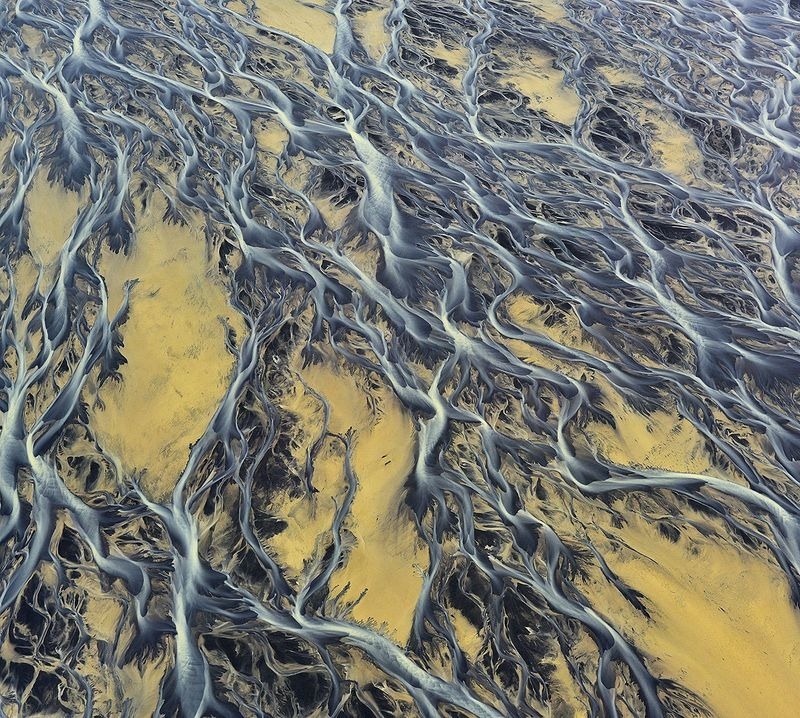
iceland-braided-river-2

A braided river in Iceland. Photo credit: Andre Ermolaev/500px

Source….www.amusingplanet.com

Natarajan

Here’s what the ‘i’ in iPhone means…..

42-30016373

Apple CEO Steve Jobs is pictured during the presentation of the iPhone in Berlin, 19 September 2007.

IMAGE: PEER GRIMM/DPA/CORBIS
We’ve been seeing it for years. The iMac, iPod, iTunes, iPhone, iPad — the omnipresent “i” prefix has marked most Apple products since the release of the iMac in 1998. But why? What does it mean?

The Internet has been abuzz recently with remembering exactly what Apple’s “i” stands for. At an Apple event in 1998, Steve Jobs introduced the iMac, explaining the link between “i” and “Mac.”

“iMac comes from the marriage of the excitement of the Internet with the simplicity of Macintosh,” he said. “We are targeting this for the no. 1 use that consumers tell us they want a computer for, which is to get on the Internet simply and fast.”

In 1998, the “i” in iMac stood for Internet. Jobs followed these statements with a slide that expanded upon what else the “i” means to Apple:

iAppleSlide

At an Apple event in 1998, Steve Jobs breaks down what the “i” in iMac stands for.

VIDEO: YOUTUBE, EVERYSTEVEJOBSVIDEO

Besides Internet, Apple’s prefix also stood for individual, instruct, inform and inspire.

Since then, the “i” has moved beyond its Internet-centric meaning; Apple probably didn’t have the Internet in mind when naming the original iPod.

When the iPhone was announced in 2007, one of its three key ingredients was Internet communication, bringing the “i” back to its original intended meaning of Internet. (The other two fundamentals were music and phone calls.)

Since then, nearly every device has had some form of Internet connectivity built in, and the “i” has lost its association with that specific meaning and has come to represent the Apple brand.

But as Apple continues to grow into other markets, including smartwatches and TV boxes, its famous prefix seems to be falling to the wayside. Instead of iWatch and iTV, we have Apple Watch and Apple TV. Perhaps this is because we no longer need to know our devices connect to the Internet — it’s something we’ve come to expect.

Source…..www.stumbleupon.com

Story Credit from….

Kellen Beck

Tech news reporter intern at Mashable and senior journalism major at Ithaca College. Computer lover and aspiring professional wrestler. Follow me at https://twitter.com/Kellenbeck
Natarajan
 

This date in science: John Glenn first American to orbit Earth….

On February 20, 1962, John Glenn became the first American to orbit the Earth. He made three turns around the planet before returning safely.

John Glenn and Friendship 7

February 20, 1962. John Glenn became the first American to orbit the Earth on this date. He made three turns around the planet before returning safely in his space capsule, which was called Friendship 7. He followed two Russian cosmonauts in making this early orbit of our planet: Yuri Gagarin ( April 1961) and Gherman Titov (August 1961).

While Glenn was in orbit, NASA controllers received an indication that the heat shield on his craft had come loose. They instructed Glenn not to jettison the rockets underneath the heat shield during re-entry, because the rockets might be able to hold the shield in place. Fortunately, the indication turned out to be a false alarm.

Glenn returned to space at age 77 aboard the space shuttle Discovery in 1995, making him the oldest person to fly in space. His mission’s primary scientific aim at that time was to study the effects of spaceflight on seniors.

John Glenn climbs into the Friendship 7 spacecraft just before making his first trip into space on February 20, 1962. Photo via NASA

John Glenn and Friendship 7

John Glenn and Friendship 7

Here's What John Glenn saw on February 20, 1962.  Just 5 minutes and 44 seconds after launch, Glenn offered his first words about the view from his porthole: “This is Friendship 7. Can see clear back; a big cloud pattern way back across towards the Cape. Beautiful sight.” Three hours later, at the beginning of his third orbit, Glenn photographed this panoramic view of Florida from the Georgia border (right, under clouds) to just north of Cape Canaveral. His American homeland was 162 miles (260 kilometers) below. “I have the Cape in sight down there,” he noted to mission controllers. “It looks real fine from up here. I can see the whole state of Florida just laid out like on a map. Beautiful.”  Image via NASA

Here’s what John Glenn saw on February 20, 1962. Just 5 minutes and 44 seconds after launch, Glenn offered his first words about the view from his porthole: “This is Friendship 7. Can see clear back; a big cloud pattern way back across towards the Cape. Beautiful sight.” Three hours later, at the beginning of his third orbit, Glenn photographed this panoramic view of Florida from the Georgia border (right, under clouds) to just north of Cape Canaveral. His American homeland was 162 miles (260 kilometers) below. “I have the Cape in sight down there,” he noted to mission controllers. “It looks real fine from up here. I can see the whole state of Florida just laid out like on a map. Beautiful.” Image via NASA

Bottom line: John Glenn became the first American to orbit Earth on February 20, 1962. His space capsule was called Friendship 7.

Source……www.earthsky.org

Natarajan

These 6 Indian Americans to Receive One of the Highest Scientific Honours in US from Obama…

US President Barack Obama has decided to honour a group of 106 people with the Presidential Early Career Awards for Scientists and Engineers. Six Indian Americans too will be the recipients of the US government’s highest honour for young independent researchers. The awards were established by Bill Clinton in 1996.

According to NDTV, President Obama said, “These early-career scientists are leading the way in our efforts to confront and understand challenges from climate change to our health and wellness. We congratulate these accomplished individuals and encourage them to continue to serve as an example of the incredible promise and ingenuity of the American people.”

He will present these awards during a ceremony at Washington D.C. this spring.

The Indian Americans selected for the award are:

Milind Kulkarni

milind kulkarni\

Photo source: engineering.purdue.edu

Milind Kulkarni is an associate professor with the School of Electrical and Computer Engineering at Purdue University. His research focuses on Programming Languages and Compilers. He graduated with a B.S. in Computer Science and Computer Engineering from North Carolina State University.

Kiran Musunuru

kiran

Photo source: news.harvard.edu

Kiran Musunuru is an Assistant Professor of Stem Cell and Regenerative Biology at Harvard University, and Associate Physician at Brigham and Women’s Hospital. He has developed a ‘genome editing’ approach to permanently reduce cholesterol levels.

Sachin Patel

sachin patel

Photo source: medschool.vanderbilt.edu

Sachin Patel is an assistant professor of psychiatry, molecular physiology, and biophysics at Vanderbilt University Medical Centre. His research is to understand the intricate role of brain function in psychological disorders. He did his B.S. at the University of California.

Vikram Shyam

vik

Vikram Shyam works at NASA’s Glenn Research Centre. He is a member of the Turbo-Machinery and Heat Transfer Branch.  His research includes computational and experimental analysis of  biomimetics, energy harvesting, engine flow physics, flow visualisation, and water purification.

Shwetak Patel

ShwetakPatel

Photo source: Wikipedia

Shwetak N. Patel is a Professor in Computer Science and Engineering and Electrical Engineering at the University of Washington. His work includes developing new sensor systems and new interaction technologies. He is also a member of  World Economic Forum’s Global Shapers Community – a group of high achievers.

Rahul Mangharam

mangha

Photo source: seas.upenn.edu

Rahul Mangharam is an Associate Professor in the Department of Electrical and Systems Engineering at the University of Pennsylvania. His interests are in real-time scheduling algorithms for networked embedded systems. He received his Ph.D. in Electrical & Computer Engineering from Carnegie Mellon University.

Source……Meryl Garcia in http://www.the betterindia.com

Natarajan

This Engineer Earns for finding faults from Software Bugs in Facebook, Twitter & Zomato !!!

From hacking into the social media accounts of his friends, to finding more than 90 security flaws for Facebook – Anand Prakash has come a long way with his love for technology and interest in ethical hacking. This is his story.

It was while preparing for his engineering entrance exams in Kota, Rajasthan that Anand Prakash first became interested in hacking. “I had a smartphone and Internet packs were very costly at that time. I came across some kind of proxy setting and figured out a way to use the Internet for free,” he says. The service provider rectified the loophole after some time when many users came to know about it. But for Anand, it was the beginning of a very eventful journey towards building a career in the field of hacking – the kind that’s ethical.

“What I do now is called security research, not hacking,” he is quick to correct.

Today, the 23-year-old is a security engineer with Flipkart, uses the Internet in a more responsible manner, and has been rewarded by many organizations for finding flaws in their software or technology setups.

ethical hacking

Anand Prakash

Anand, who is from the town of Bhadra in Rajasthan, was always interested in computers.

“It was always the same with me. I used to score better in technical subjects, but when it came to subjects like geography, environmental studies, etc., I used to face a lot of problems,” he recalls.

As a student, Anand strengthened his newly acquired knowledge of hacking by experimenting among friends.

“I used to practice phishing on my friends’ accounts with their permission. It is the most basic process in hacking. It involves extracting information like usernames, passwords, etc., by sending out emails to the victims in a way that they will trust them enough to open the links,” he says. Getting access to the password of a friend’s Orkut account was Anand’s first hack.

After Kota, he joined Vellore Institute of Technology to pursue a course in computer science engineering. Anand continued to polish his knowledge about ethical hacking and different programming languages in college, and practiced whatever he learned among friends.

“Up till then, I only knew about hacking processes that involved using some automated tools. And that did not interest me after a point. Finding security flaws in systems is completely different from what I was doing then,” he says.

In the third year of college, Anand came to know about Facebook’s Bug Bounty Program. It offers recognition and compensation to security researchers who find vulnerabilities in Facebook and report them according to the organization’s responsible disclosure policy.

By then, Anand was well-versed in languages like PHP, JavaScript, etc.

“I liked to analyse codes. And when I learnt that Facebook has given monetary compensation to someone for finding a bug in their technology, I thought of giving it a try,” he says.

He utilised the Open Web Application Security Project (OWASP), which is an initiative by OWASP Foundation for the improvement of software security in different organizations around the world. The project provides users with open source study materials to understand application security over the Internet.

“I started learning with the help of OWASP, followed experts on Twitter, and read up a lot about security research. Fortunately, I found a bug on Facebook in just a month. It was a loophole that enabled me to find people online even if they had turned off their chat,” he says. Anand received his first bounty of USD 500 for reporting this issue.

Then he learned that many such organizations welcome people who find security vulnerabilities for them. And the work turned out to be so interesting that there was no turning back for the technology enthusiast. To date, he has found about 90 bugs for Facebook, and ranks fourth in the Facebook wall of fame 2015.

The highest bounty Anand received from Facebook was a sum of USD 12,500 for finding a major security flaw because of which a user could post anything on his/her profile using someone else’s account. “For example, I could post a picture, a video, or text, and it would be visible on my Facebook wall as a post from your side,” he explains.

After college, he did an internship with the Cyber Police Investigation Branch of Gurgaon Police. There he worked on finding the different strategies used by cyber criminals.

ethical hacking

After the internship

He has also reported issues to companies like Twitter and Google and has earned Rs. 1.2 crore in the process. He was able to hack into the systems of the restaurant discovery and search application Zomato to gain access to the accounts of their 62 million users. He disclosed this issue to the company and they fixed it in two day, appreciating his efforts.

“I always first report the issue to the organization without exposing it elsewhere. It is called responsible disclosure. Then I take permission from them and post about it on my personal blog if they allow it.”

But Anand is not very happy about the way many Indian companies treat security researchers:

Some companies are very responsive. They fix the bugs immediately and also give monetary compensation without much delay. But if you report bugs to many companies in India, they reply saying they will take legal action against you. The condition is very bad in terms of security here. But it is changing slowly. I have come across some companies that are now open to security research.”

With new technologies coming up every day, Anand’s hunger for learning keeps developing. His advice to those who want to pursue a career in security research: “Try and report bugs to companies in a responsible manner. And do not disclose the issue unless you have permission. Security research is a great thing if done ethically.”

Find out more about how he finds different bugs, here.

Source……Tanaya Singh in http://www.the betterindia.com

Natarajan


Images for the Day….

A picture might be worth a thousand words but National Geographic photographs leaves us speechless. Known for their captivating daily pictures, they also offer an opportunity to dive into the archives of previously unpublished or forgotten images.

The project called Found was established in 2013 to honor NatGeo’s 125th anniversary. The project’s team says that their mission is to bring the pictures back to life by sharing them to new audiences. And even some of the dates or locations are missing, the images capture perfect moments making them timeless.

The photographs are dug up by Guardian of the Collection William Bonner, who still finds them highly inspiring even after years spent in the archives. Together with editor Janna Dotschkal’s love for aesthetics, they make the vintage material shine as new.

More info: NatGeo Found (h/t: DeMilked)

A White Fallow Stag Stands In A Forest In Switzerland, 1973

A White Fallow Stag Stands In A Forest In Switzerland, 1973

Loggers And The Giant Mark Twain Redwood Cut Down In California, 1892

Loggers And The Giant Mark Twain Redwood Cut Down In California, 1892


Boys Dressed Up In School Uniforms Pose With King Penguins At The London Zoo, 1953

Boys Dressed Up In School Uniforms Pose With King Penguins At The London Zoo, 1953

A Man Stands Dwarfed Under The Ape-ape Leaves Of Puohokamoa Gulch In Maui, Hawaii, 1924

 A Man Stands Dwarfed Under The Ape-ape Leaves Of Puohokamoa Gulch In Maui, Hawaii, 1924

Source……www.boredpanda.com

Natarajan


Earth in True Perspective….

Everything is relative. You don’t need to be Einstein to understand that. A human is as big to an ant, as a building may be to a human. The world is vast and large – it’s size is dominated by massive oceans and continents.

But ever since we’ve developed the ability to look beyond our atmosphere, it became more and more apparent that the earth is in fact small. Too tiny to even comprehend, when compared to other planets, stars, galaxies and the universe itself. So just to give you an idea of how tiny we really are, here are some visual aids.

size of earth

size of earth

size of earth

size of earth

size of earth

size of earth

size of earth

size of earth

size of earth

size of earth

size of earth

size of earth

size of earth

size of earth

size of earth

size of earth

size of earth

size of earth

size of earth

size of earth

size of earth

size of earth

size of earth

size of earth

size of earth

size of earth

size of earth

Source…..www.ba-bamail.com

Natarajan

These Miniature Models Are Created Using – Hold Your Breath – Pen Refills!..

Sreenivasulu M.R. has always had a fascination for the arts. He started painting at the age of seven. He enrolled himself in a dance school and is now accomplished in Bharatnatyam, Kuchipudi, and folk dance. However, his biggest fascination is making miniature models.

Sreenivasulu honed his skills as a child by making miniature house models from wedding invitation cards. He also had a habit of collecting pen refills from his friends.

Being an environmentalist, he conducts various programmes to spread awareness on global warming.  At the ‘Say No to Plastic’ programmes, which he organises in schools and colleges, he keeps pen refill collection boxes.

These refills later turned into raw materials and Sreenivasulu started making monuments out of them.

Through this, Sreenivasulu is driving home the idea of recycling. He began by making a model of the Eiffel Tower. It took him eight months and over 200 refills to create it. Since then, there has been no stopping Sreenivasulu.

Today, this software professional has made the Charminar, Big Ben, Taj Mahal, Leaning Tower of Pisa, Gateway of India, Seattle Space Needle, and Sydney Harbor Bridge from used pen refills.  His miniature Taj Mahal, made from 700 pen refills, even found a place in the ‘India Book of Records’ in the year 2012.

Take a look at some of his models:

The Better India (58)

The Better India (59)

The Better India (60)

The Better India (62)

The Better India (63)

The Better India (64)

The Better India (65)

The Better India (57)

The Better India (66)

The Better India (67)

Source……Meryl Garcia in http://www.the betterindia.com

Natarajan