Message for the Day…” One should use Sweet, Pleasant, and Soft words …”

Inclinations (vasanas) won’t disappear as long as one’s heart is full of the illusion of egotism, even if one is immersed in many heart-purifying spiritual disciplines. Such people, if they want to get rid of the feeling of ‘I’ and ‘mine’, must worship the Lord. One whose heart is ruled by the group of six passions can have only ego as counselor! Those who have such a counselor are worse than foolish, however great they claim to be as pundits, aspirants, or renunciants. People experience joy and misery through the ear. Therefore avoiding the cruel arrows of hard words, one should use sweet, pleasant and soft ones — and with that softness, add the sweetness of truth. Making the word soft by adding falsehood only clears the way for more misery. A person who has become a spiritual aspirant should use very soft, sweet, true, and pleasant words. Such a person can be recognised by their good qualities.  

Sathya Sai Baba


Message For the Day…” How to Achieve the Spiritual Progress in One’s Life …” ?

The minute hand of the clock is the individual soul. It goes round and round – the hour hand does move, silently and slowly, with dignity. The hour hand is the Supreme Soul. Once in an hour, these two meet, but the individual soul does not get that consummation fixed forever. It loses the precious chance, and so has to go round and round again. Liberation happens when the two merges and there is just one. Like the silkworm that spins from out of itself the cocoon that proves to be its tomb, people spin from out of their own mind, the cage in which they get trapped. Assign your mind the task of serving the Lord and it will grow tame. Give your mind to the Lord. Forget the past and don’t worry about errors in future. Bring to memory only those things that are worth remembering and assiduously follow your spiritual practices. You will achieve spiritual progress.

Sathya Sai Baba

” If You Want Change , You Must get Your Hands Dirty…” Says Young Achiever Srikar Gullapalli

“We already have engineers and medical graduates, but we need more IAS and civil service professionals, we need lawyers and political experts to spearhead this cause.

“We need more people to write open letters to the President and Prime Minister.

“The RTI Act is your weapon. Use it to get facts and information you want.

Former Watson Fellow and social entrepreneur Srikar Gullapalli talks about the issues affecting India’s growth and tells us why he wants more people to actively participate in building a bright future and put India on the global map.

Srikar Gullapalli

When his peers were keen on studying engineering and medicine, Srikar Gullapalli was bitten by the ‘social upliftment’ bug.

The 23-year-old has stayed committed to the cause.

His life took a U-turn when he got the opportunity to travel to seven countries, between 2013 and 2014, to study citizen-state relationship as part of the Watson scholarship (instituted in the memory of Thomas J Watson, the founder of IBM).

Through the assignment, he interviewed key political figures and compiled crucial data that would help him understand how to deal with issues like tribal rehabilitation, militant movements and marginalised communities back home.

Having graduated in mathematical economics and political science from Colgate University, in the US, the young achiever is now readying to pursue a post-graduation degree in Public Administration at Princeton University.

In March 2015, he received admission offers from six international universities: Princeton, Harvard, Maxwell Institute, Duke University, Georgetown University and Carnegie Mellon University.

He picked Princeton because he felt it was best when it came to his subject of interest — public administration.

His comparative study on ‘Politics of Performance: A Comparative Study of Delivery of Good Governance by different Political Parties in India’ under the guidance of Vinay Sahasrabudde, director, Public Policy Research Centre (PPRC), New Delhi was released by Prime Minister Narendra Modi this year. (external link)

Since December 2014, he has been working with the ministries of health, drinking water and sanitation, in Delhi, researching the institutional gaps that exist in the current policies and how citizens can avail of better facilities.

We caught up with the young achiever who will be travelling to Princeton in September 2015, to find out how he plans to build a better India.

What are the problems coming in the way of India’s development?

We have a lot of policies, but the problem lies in execution.

Take, for example, the Land Acquisition Bill.

No one seems to understand the cause and effect of this Bill.

One needs to understand why the displacement is taking place and what are we doing about it.

Most of them (the displaced) do not have land of their own.

Besides, 50 per cent of the people in villages, including youngsters, want an urban job so they relocate to the cities and most of them never go back.

There is migration happening across villages in India.

Add to this the number of projects that are lying unattended.

At least 40 per cent of land development projects in India are currently behind schedule.

I feel we must have a system where unless we execute the existing projects, we don’t start or approve new ones.

Then there is the cultural divide, population expansion, and political debates that further delay projects.

Our collective aim must be to try and address these institutional gaps and bring in more clarity and transparency in execution.

We need to find out where the money goes and bring in more accountability in the whole process – perhaps a website where all this data can be uploaded and tracked.

Also, some of the policies and colonial laws haven’t been reformed since the time they were made. We need to reform our laws and policies to meet the present day requirements.

Why did you choose to go to college abroad and not in India?

At the age of 17, I wasn’t sure about my career.

I was looking for a flexible course that allowed me to study civics, advanced English and political science. Indian universities did not offer me that flexibility.

I did not want to be pigeon-holed and take up a course for the sake of completing my graduation.

At the same time, I wanted to study how things are managed internationally. So I picked Colgate University.

But whenever I had the chance, I preferred to work in India.

When I was chosen for a National Geographic project, I could have picked any country.

I chose to work on the Ganga rejuvenation and spent months interacting with seers and political leaders, trying to understand how we can bring positive change.

Tell us more about Shuddhify and what you achieved through it.

In 2011, I started Shuddhify as a social blog, funded by The World Bank Institute and British Council.

I would collect strategic data on corrupt practices in and around Bangalore.

For two years, I conducted a survey across nine government agencies and found large gaps in the system.

I compiled a report on this and submitted it to the Karnataka government.

When I was compiling this data, I received a lot of threatening calls from police officers.

I did not stop or heed them and went ahead with the report. In these times of corruption, civic activism is very risky, but someone has to start and lead the change.

Shuddhify’s findings on development policies were published in the Times of India‘s Bangalore edition, in August 2012.

The research findings were picked by the state government as one of the best policy papers which is part of the recommendations of the Sakala scheme of the Karnataka government (the scheme provides guarantee of service to citizens). This was an achievement in itself.

Srikar interviewing the next Shankaracharya as part of a NatGeo project in Allahabad, India

Srikar Gullapalli (right) interviews the next Shankaracharya as part of a NatGeo project in Allahabad, India.

What did you learn from your international assignments?

When I was picked for the Watson scholarship there were 40 other students from the US.

More than 1000 had applied for it.

Through the scholarship, I got to travel to diverse countries such as New Zealand, Thailand, Turkey, Syria and Spain.

I picked these countries because I felt they all had something in common with India.

The issues are more or less the same the world over — poverty, separatist movements, health and sanitation etc.

But each country has a different way to solve it.

We need to learn from the positives from other countries and work out a way to implement them in our country.

In your opinion, how can we bring about change?

We need more youngsters to take part in policy making.

We already have engineers and medical graduates, but we need more IAS and civil service professionals, we need lawyers and political experts to spearhead this cause.

People need to understand that the constitutional law is for real and it is there for everyone to touch and feel.

In Bangalore, there is incredible amount of civic engagement happening with the involvement of local bodies.

We need more people to write open letters to the President and Prime Minister, write more editorials in newspapers and start meaningful political debates that will educate and inspire people to join the campaign.

The RTI Act is your weapon. Use it to get facts and information you want.

In India, we see all the hype and energy from youngsters only pre and during the elections.

The period between elections has little or no engagement from the citizens. This needs to change.

What would be your advice to young readers?

As I mentioned, we need more young leaders in Parliament.

Between 1952 and ’57, about 33 per cent of representation in the Lok Sabha was from those under the age of 40.

Today, the average age of members is 50-plus and only 13 per cent are under the age of 40.

A person who is 75 years old is too old to be making decisions for a country where more than 50 per cent of the population is below the age of 30.

There has to be a healthy mix of ideas and experience — a mix of smart young people with ideas, and experts with experience.

Much as people disregard it as corrupt and apathetic, politics affects each one of us.

If you want change, you must get your hands dirty.

It’s not a choice but a responsibility we all share for the country we belong to.

There is a famous line in the Bhagwad Gita: ‘It is better to live your own destiny imperfectly than to live an imitation of somebody else’s life with perfection.’

Your advice to students who are looking to study abroad?

• Be prepared to negotiate for a lot of things that you were comfortable with in your home country — the luxury of food, relaxation from daily chores etc. You are mostly on your own and will have to learn to do things independently.

• Develop organic ways to solve your problems.

• Explore your academic freedom — make the most of the flexibility your international programme offers.

• Look for work opportunities and see if you can get people to fund projects and ideas in your home country.

• Do not restrict yourself to Indian friends and communities. Network with people beyond nationalities and cultures; be tolerant and humble.

Photographs: Kind courtesy Srikar Gullapalli/Facebook

Divya Nair / Rediff.com

Source…..www.rediff.com

Natarajan


Message For the Day…” Start Today the Spiritual Discipline that has to be Done Tomorrow…”

What is the use in planning a well when the house is on fire? Where is the time to dig now? When will water become available? When is the fire to be extinguished? It is an impossible task! If, at the very start, a well was ready, how helpful it would be on such critical occasions! Beginning to contemplate on God during the last moments is like beginning to dig the well when the house is on fire. Therefore equip yourself right now, by contemplating on God off and on, so that it will stand you in good stead when the end approaches. Start today the spiritual discipline that has to be done tomorrow! Start now what has to be done today! One doesn’t know what is in store the next moment; therefore there should be no delay in engaging in spiritual practices. For this physical stamina is also necessary, so the body has to be tended to, though over-tending causes damage. To the degree that is essential, the body should be looked after with great care.

Sathya Sai Baba

” Ayurveda Has Solutions for Digestion and Stomach related Ailments….”

  • Gut problems are one of the most common reasons people go to the GP
  • Ancient Indian healing practice of Ayureveda has solutions for digestion
  • Includes drinking warm water with lime or grated ginger in the morning 
  • Also recommends using spices like fennel, tumeric and black pepper 

Do you often feel bloated and sluggish?

Whether it’s a bout of diarrhoea, heartburn after a heavy meal, or aches and pains, gut problems affect nearly all of us at some point.

In fact, they are one of the most common reasons we go to the pharmacy or see our GP.

Writing for Healthista, Eminé Ali Rushton, author of The Body Balance Diet Plan, explains how methods from Ayurveda, the ancient Indian healing practice, can help.

From using digestive-friendly spices like fennel and ginger, to eating fruit on an empty stomach, here, she shares her tips for banishing bloating…

Gut problems are one of the most common reasons we go to the pharmacy or see our GP (file photograph)

WARM WATER AND LIME IN THE MORNING

Before you do anything in the morning, boil your kettle and fill half a mug with boiling water, then the other half with room temperature filtered water.

Drink as it is, or with a squeeze of lime if you’re feeling bloated or constipated, or with grated ginger if you’re feeling very lethargic.

The feeling of warm water hitting the stomach first thing in the morning is quite incredible because it’s pouring down a pipe that’s not been used in hours.

Try and leave at least 20 minutes before breakfast. It’s the quickest and easiest perk- and pick- me-up there is.

TRY TRIPHALA

Drinking warm water with lime in the morning can kick-start digestion

Drinking warm water with lime in the morning can kick-start digestion

A traditional Ayurvedic remedy for gentle gut cleansing, Triphala is made from three traditional Indian fruits (haritaki, amla and bibhtaki).

It also contains psyllium, liquorice, fennel and linseed – gold- standard gut-clearers.

It can also help your body absorb nutrients from your food.

It’s available in health food stores.

GET SMART ON DIGESTION-FRIENDLY SPICES

Whenever I had an upset tummy as a child, my mother would boil up a generous pinch of fennel seeds in water (the water should boil up and turn a pretty yellow-green colour) and get me to drink it.

Within minutes my stomach used to start to feel better.

Fennel is a truly great gut-calmer, as is ginger, which can be added to all foods or boiled up in hot drinks.

Other spices that are great to add to your diet when you’re feeling off-colour are ginger, ground coriander, turmeric, cumin and black pepper – all of which are Ayurveda’s secret weapons for stoking and restoring digestive fire.

EAT FRUIT AT ROOM TEMPERATURE – ON AN EMPTY STOMACH

Ayurveda is specific about fruit and suggests it is always best eaten on an empty stomach.

So after your glass of warm water in the morning, enjoy ripe fruit at room temperature.

This is how we were meant to eat it – sun-warmed, first thing, fresh from the tree.

When fruit is refrigerator-cold it shocks the stomach, which hinders optimal digestion.

Eating gut-friendly spices like tumeric, ginger, fennel and black pepper can soothe stomach problems

Eating gut-friendly spices like tumeric, ginger, fennel and black pepper can soothe stomach problems

Almost all fruits taste better and sweeter at room temperature – particularly berries, peaches, apricots and melon.

Get into the habit of taking fruit out of the refrigerator the night before and eating it about 40 minutes before breakfast.

Another good time to enjoy fruit is mid-morning, as a snack before lunch, as you want to try to leave a couple of hours on either side – so breakfast before 9am, fruit between 10 and 11am and lunch around 1pm won’t tax those digestive juices.

Always eat fruit at room temperature and on an empty stomach

Always eat fruit at room temperature and on an empty stomach

EAT SLOWER

In Ayurveda, body types are classified into three types, or doshas, called vata, pitta and kapha.

Some doshas really do need to take more time than others over their meals.

Kapha, with their sluggish digestion, benefit from spending a longer time chewing.

Pitta, with their tendency for internal fire, do well to eat quietly in a peaceful spot.

Vata types, who often suffer digestive upset and loose bowels, need to slow down the eating process completely.

They also need to savour each mouthful, and never eat on the go (which is a common tendency with airy, and busy, Vata types).

PROBIOTICS

Achieving optimal gut health (and digestive fire) is at the heart of Ayurveda.

One of the simplest ways to aid digestive fire is to boost your stomach’s healthy bacteria with a proven probiotic blend, particularly after a course of antibiotics or during illness.

I am calling on modern wisdom here.

Obviously ancient Ayurveda doesn’t have a stance on probiotics – but I’ve found, from trial and error, that my digestive fire is always strongest when I support it with probiotics and enzymes.

Eating slowly and savouring each mouthful helps people digest their food and avoid bloating (file photo)

We often hear that our immune system is situated in our gut: what this means is that 70 per cent of the antibacterial and antiviral cells within our body are situated in the walls of the stomach and intestines.

Our stomach also produces acid, which kills off most pathogens, and our small intestine produces mucus, which blocks further potential pathogens from entering our bloodstreams.

So, when your gut lining is weakened, your immunity will also be compromised. I really cannot overstate the importance of a healthy stomach in the pursuit of good overall health!

Eminé Ali Rushton is founder of balanceplan.co.uk 

This article originally appeared and has been reproduced with the permission of Healthista.

Source….www.dailymail.co.uk

Natarajan

“Kids are Capable of Doing More than We Expect From Them…Watch this video clip…!!!


A compilation of incredible talented and fearless kids, demonstrating their skills at everything from skateboarding and weightlifting to surfing and basketball trick shots!

Source….www.ba-bamail.com and http://www.youtube.com

Natarajan

Age …No Bar For Dancing and Rocking…!!!…Watch this Video Clip …

What Happens When a Group of Seniors Goes on Live TV?

If you’ve never heard of the ‘The Zimmers’ you’re in for a surprise, as these delicate looking old folk’s performance will have you in stitches. This incredible group of happy-go-lucky golden agers has wowed people on live television, so if you missed it, here’s your chance.

BGT pensioners The Zimmers rock the stage with Beastie Boys
classic Fight For Your Right. How will the groovy granparents go down with
Britain’s Got Talent Judges David Walliams, Alesha Dixon, Simon Cowell and
Amanda Holden?

Source….www.ba-bamail.com and http://www.youtube.com

Natarajan

Jokes For the Weekend….!!!


A guy bought a new fridge for his house.
To get rid of his old fridge (still working), he put it in his front yard and hung a Sign on it saying: ‘Free to good home. You want it, you take it.’
For three days the fridge sat there without anyone looking twice.
He eventually decided that people were too mistrustful of this deal.
So he changed the sign to read: ‘Fridge for sale $50.’
The next day someone stole it!
…………….
One day I was walking down the beach with some friends when someone shouted…..
“Look at that dead bird!”
Someone looked up at the sky and said…”Where?”
……………….
While looking at a house, my brother asked the estate agent which direction was north because he didn’t want the sun waking him up every morning.
She asked, ‘Does the sun rise in the north?’
My brother explained that the sun rises in the east
And has for some time. She shook her head and said,
‘Oh, I don’t keep up with all that stuff……’
,………….
Source….Input from a friend of mine
Natarajan

Joke of the Day….” Do You Sell these Medicines…” !!!

Bob, age 92, and Mary, age 89, are all excited about their decision to get married. While out for a stroll to discuss the wedding they pass a drugstore. Bob suggests they go in.
Bob asks to speak to the pharmacist. He explains they’re about to get married, and asks, “Do you sell heart medication?”
“Of course we do,” the pharmacist replies.
“Medicine for rheumatism?”
“Definitely,” he says.
“Medicine for memory problems, arthritis, jaundice?”
“Yes, the works.”
“What about vitamins, sleeping pills, Geritol, antacids?”
 “Absolutely.”
“Do you sell wheelchairs and walkers?”
“All speeds and sizes.”
“Good,” Bob says to the pharmacist. “We’d like to register for our wedding gifts here, please.” ….
Source…..www.ba-bamail.com
natarajan


World’s Tastiest Vegetarian Dish….

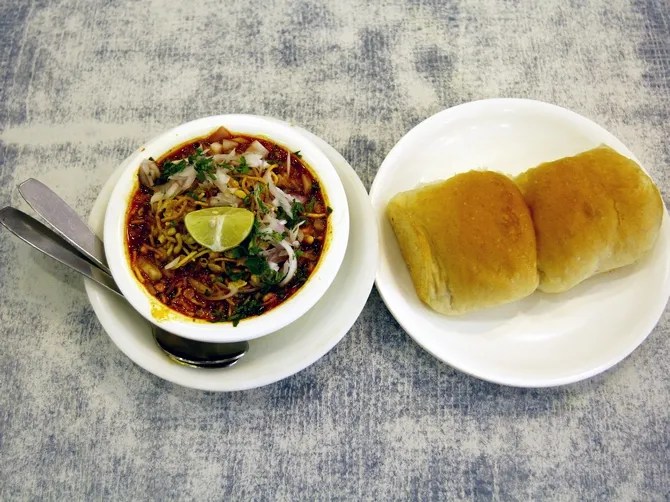
Misal Pav, the delicious Maharashtrian snack served at Mumbai’s Aaswad restaurant won the prize at the global Foodie Hub Awards in London. 

The humble misal pav served at Dadar’s Aaswad restaurant has been named the world’s tastiest vegetarian dish at the Foodie Hub Awards in London.

Misal is a spicy curry made of moth beans or dried peas and served with boiled potatoes and garnished with raw chopped onions and farsan.

Often served with curds and pav (or bread), misal is a breakfast snack that is also eaten at lunchtime.

With its roots in the Kolhapur region of Maharashtra, the dish has several variations across the state.

Some variations get their names from the ingredients that go into it: Dahi Misal is misal served with curds and Shev Misal is, well, served with sev.

But most variations simply take the name from the region they are served in:

Puneri misal: Pune.

Khandheshi misal has its roots in Khandesh, the region in northwestern Maharashtra.

Nagpuri misal: Nagpur.

In Pune the spices are toned down but Mumbaikars prefer it spicy, says Kalyan Karmarkar who is the Foodie Hub Expert for Mumbai and who nominated Aaswad’s misal for the awards.

Kolhapur, largely believed to be the home of the misal, serves the spiciest variation of it and is called the Kolhapuri misal.

Located in the heart of Dadar in central Mumbai, just a hop-skip-and-jump from the headquarters of the Maharashtrian right wing political party, Shiv Sena, Aaswad was inaugurated by the late Bal Thackeray in 1986.

Today, Aaswad serves some 400 plates of misal pav every day.

Suryakant Sarjoshi, Aaswad’s owner who seems rather chuffed with this honour, tells us that it earns the restaurant about Rs 19,000 daily.

Then there is Vilas Taral who gives us a crash course in making the misal:

First moth beans, garlic and onions are boiled in water along with curry leaves.

Add grated coconut and misal masala and continue to boil.

Separately heat two tablespoons of oil and add mustard seeds, asafoetida, cumin seeds and garlic and add to the curry.

The final flourish comes in the form of farsan, sev, onions and tamarind chutney.

The dish is typically served with bread and butter.

Among several patrons of the restaurant is Vilas Gurav (62), a former police officer who was enjoying the dish when we arrived.

“I travelled all the way from south Mumbai just to have this misal. The quality is outstanding,” he says.

It is a sentiment that Kalyan Karmarkar echoes.

“Aaswad’s misal is always fresh, the amount of spices added is perfect and the quality of the farsan is very good. It doesn’t make you feel heavy because they don’t use inferior oil,” he says.

Besides misal, Aaswad is also famous for several other Maharashtrian dishes such as the thalipith, kothambir wadi, piyush and aam panna.

Aaswad
Shivaji Park, Dadar (W)
Mumbai
Tel: 022-2445-1871/2445-1876

As with all Indian dishes, misal is made differently across the state.

Every home has its unique misal recipe.

Source……www.rediff.com

natarajan