Doggie Wants Its Toy Back !!!
In our adorable moment of the day, this little pup wants his toy back, but the mean cat won’t give, what can a poor pup do? This whole thing is very frustrating
Source:::: You Tube and ba-ba mail site
Natarajan
Doggie Wants Its Toy Back !!!
In our adorable moment of the day, this little pup wants his toy back, but the mean cat won’t give, what can a poor pup do? This whole thing is very frustrating
Source:::: You Tube and ba-ba mail site
Natarajan
 Today I found out about Violet Jessop, “Miss Unsinkable,” the woman who survived the sinking of the sister ships the Titanic and the Britannic, and was also aboard the third of the trio of Olympic class vessels, the Olympic, when it had a major accident.
Violet Jessop enjoyed incredible “luck” from a young age. Born in 1887 in Argentina to Irish immigrants, she contracted tuberculosis as a young child and was given just a few months to live. Somehow, she managed to fight the disease and went on to live a long, healthy life.
When her father passed away, her mother moved the family to Britain, where she took a job as a stewardess on a ship. While her mother was working, Violet attended a convent school. Unfortunately, her mother became ill, and to provide for her siblings Violet decided to follow in her mother’s footsteps and become a ship stewardess herself.
The first in a long line of struggles for Violet was finding a ship that would take her. She was just 21 years old at the time and most women working as stewardesses in the early 1900s were middle-aged. Employers believed that her youth and good looks would be a disadvantage to her, “causing problems” with the crew and passengers. (Over the course of her career, she did get at least three marriage proposals while working on various ships, one from an incredibly wealthy first-class passenger.)
Eventually, Violet solved the problem by making herself look frumpy with old clothes and no make-up, and experienced more successful interviews after this. After a brief stint aboard the Orinoco, a Royal Mail Line steamer, in 1908, she was hired by the White Star Line.
Violet started out on the line’s Magestic, switching to the Olympic in 1910. Despite the long hours and minimal pay (£2.10 every month or about £200 today), she enjoyed working aboard the massive ship. She had initially had some concerns about the rough weather conditions while traveling across the Atlantic, but she reportedly liked that the Americans treated her more like a person while she served them.
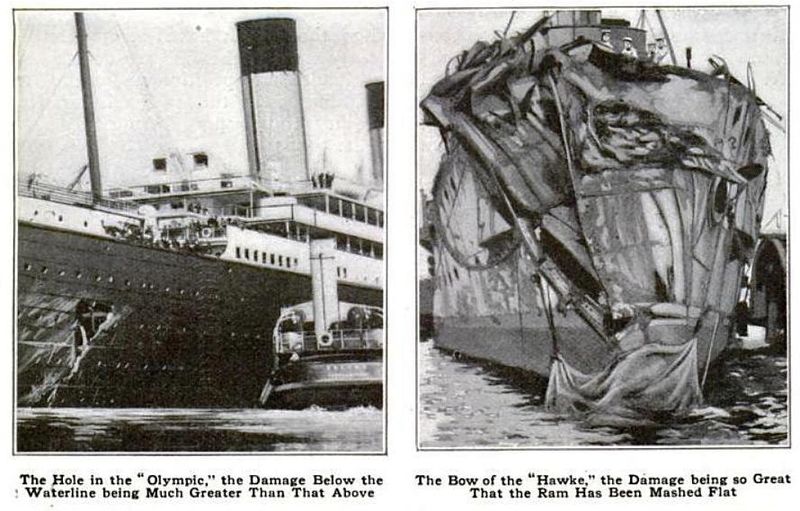 It was just one year later when the trouble started. In 1911, the Olympic collided with theHMS Hawke (a ship designed to sink ships by ramming them). Both ships sustained considerable damage, including the Olympic having its hull breached below the water line, but miraculously didn’t sink. They were able to make it back to port, and Violet disembarked without being harmed.
A couple of years later, the White Star Line was looking for crew to cater to the VIPs aboard the unsinkable ship, the Titanic. It took a while for her friends and family to convince her that it would be a wonderful experience, but Violet eventually decided to take a job on board the ship. As you already know, the Titanic struck an iceberg and sunk, killing more than 1500 people.
Violet was able to escape the disaster on lifeboat 16. In her memoir, she recalls,
I was ordered up on deck. Calmly, passengers strolled about. I stood at the bulkhead with the other stewardesses, watching the women cling to their husbands before being put into the boats with their children. Sometime after, a ship’s officer ordered us into the boat first to show some women it was safe.
As she was jumping into the lifeboat, she was handed a baby to care for. When they were rescued by theCarpathia, the baby’s mother (or at least Jessop thought it must be) found her and whisked the baby away (literally grabbing the baby out of Jessop’s arms and running off).
Once again, Violet lived to sail another day. Although, she did later state the first thing she missed after the Titanic sank was her toothbrush that she’d left on board.
You’d think she’d stop getting on ships at this point, or at least ships of the Olympic class, but not Violet. In the lead-up to World War I, she decided to serve as a nurse on board the Titanic’s other sister ship,Britannic, which was operating in the Aegean Sea. Given her track record, you can probably guess what happened next. The Britannic ran into a mine that had been planted by a German U-boat. The ship sustained substantial damage and quickly started sinking.
This time, Violet wasn’t lucky enough to jump into a lifeboat as the ship was sinking too fast. Instead, she jumped overboard. In her own words,
I leapt into the water but was sucked under the ship’s keel which struck my head. I escaped, but years later when I went to my doctor because of a lot of headaches, he discovered I had once sustained a fracture of the skull!
She joked that she only survived because of her thick hair, which cushioned the blow. She also stated this time she remembered to grab her toothbrush before evacuating, unlike with the Titanic.
Even this latest disaster was not enough to deter Violet. After the war, ships were becoming a more and more popular form of transport. Even cruise ships were starting to emerge. Violet left the White Star Line for the Red Star Line and worked on a ship doing world cruises for several years.
Luckily for Violet and everyone traveling on the ships she was aboard later, no such vessel she worked on ever sustained significant damage again. She did take a clerical job for a while after World War II, but went back to working on Royal Mail ships for a few years before she retired at the age of 61. The rest of her life was spent gardening and raising chickens. She died in 1971 of congestive heart failure at the ripe old age of 84.
Source::: Today i foundout .com
Natarajan
The Man Who Saved the World
In 1962, the U.S. and the Soviet Union were on the brink of possible mutual destruction- the world as a whole was facing a possible nuclear winter and all the devastation that would come with it. The Cold War had been escalated to “tepid” and was close to becoming hot with the failure of the Bay of Pigs in 1961 and the ensuing Cuban Missile Crisis.
In May 1962, Soviet President Nikita Khrushchev and Cuban President Fidel Castro reached a “secret” agreement that allowed the Soviets to start building missile sites in Cuba, including stocking them with nuclear missiles- 42 of them.
It should be noted here that the U.S. at this time had nuclear missiles in Turkey and Italy that could hit Moscow within 16 minutes of being launched. On the flip-side, the Soviets had plenty of nukes pointed at and perfectly capable of destroying the U.S.’ allies throughout Europe. However, the Soviets did not have nearly the capability to destroy targets in the U.S. itself. Certainly they had enough nukes and intercontinental ballistic missiles to destroy all the major cities in the U.S. and more, but their missiles at this point weren’t extremely accurate at those distances, so weren’t as good as a “mutual destruction” deterrent. Indeed, there were some among the U.S. brass that felt the loss of allies throughout Europe and the lesser direct causalities from long range nukes that managed hit their targets in the U.S. were acceptable losses given the payoff would be the annihilation of the Soviet Union and the end of that threat to the United States. So if the Soviet Union had nukes in Cuba, that tipped the balance in the Cold War back to near even, rather than in the U.S.’s favor as before.
In the fall of 1962, the United States sent a US U-2 aircraft to fly over Cuba to attempt to confirm the rumors that they had heard about the Soviet missile sites in Cuba. On October 14th, 1962, the U-2 arrived back with pictures of these missiles sites. A day later, the pictures were presented to President Kennedy. Tensions rose and alarms were sounded. And, thus, on October 15th, 1962 the 13-day ordeal that became known as the Cuban Missile Crisis began.
Vasili Arkhipov was born on January 30th, 1926 to a poor, peasant family near Moscow in the town of Staraya Kupavna. At the age of 16, he began his education at the Pacific Higher Naval School. Vasili saw his first military action as a minesweeper in the Pacific Theater at the tail end of World War II. In 1947, he graduated from the Caspian Higher Naval School and served on submarines in the Soviet Black Sea, Northern, and Baltic fleets. In 1961, Vasili got his first taste of crisis management in an incident that, while extremely momentous, wasn’t even close to what he’d help with later.
This first incident happened when Vasili was appointed deputy commander of the new K-19 sub (known today as “the Widowmaker”), one of the first Soviet nuclear subs, which was also equipped with a nuclear ballistic missile. On July 4th, 1961, as the sub was conducting exercises near Greenland, a major leak was discovered in the radiant cooling system. Since no backup cooling system was installed pre-sail, the reactor on the sub was in real danger of a nuclear meltdown. In order to prevent a nuclear accident unlike any the world had ever seen before, the captain of the sub sent workers into high-radiation areas to build a cooling system on the spot. Every member of the sub did what they could to prevent disaster. Vasili, lending his engineering expertise, helped contain the overheating reactor. The crew succeeded, but not before these workers and many on the crew developed radiation sickness. Every worker that was sent as first responders into the high-radiation areas died within days. Due to this, a mutiny nearly erupted on board the K-19 sub. Vasili backed his captain in continuing the work and was, eventually, awarded a medal for his bravery in a time of crisis and loyalty to the Soviet Union. All of this, though, was a precursor to the day Vasili Arkhipov saved the world.
After his time on the K-19 sub, Vasili was made second in command on the B-59, one of four attack submarines that was ordered to travel to Cuba on October 1st, 1962. The sub contained 22 torpedoes, one of which was nuclear, holding the same strength as the bomb that was dropped on Hiroshima. The captains of each of the four subs were given permission to fire their nuclear torpedoes at their own discretion, so long as they had the backing of the political officer on board. Unknown to the crew of the B-59, the United States began their naval blockade of Cuba on October 24th and informed the Soviets that they would be dropping practice depth charges (think warning shots) to force subs to surface and be identified.
Moscow could not communicate this information to the B-59 due to it being too deep underwater to receive radio transmissions. On October 27th, 1962, US destroyers and the aircraft carrier USS Randolph located the sub, trapped it, and began dropping depth charges to force it to surface. The sub’s crew, which had been traveling for nearly 4 weeks with very little communication with Moscow, was very tired and not aware of circumstances. The sub’s captain, Valentin Savitsky, believed that nuclear war had already broken out between the Soviet Union and the US and wanted to fire the nuclear torpedo.
Fortunately, particularly given the heightened tensions at the time, in this case, one other person had veto power over firing besides the captain and the political officer, the second in command Vasili Arkhipov. Vasili, despite being second in command on the B-59, was the leader of the fleet of the four Soviet subs sent. Had Vasili not been present, nuclear war would have likely happened as both the captain and the political officer wanted to launch the nuclear torpedo. Vasili vehemently disagreed, arguing that since no orders had come from Moscow in a long time, such a drastic action was ill-advised and the sub should surface to contact Moscow. A heated argument broke out- legend, probably false- says punches were thrown. Eventually, though, Vasili won the day (his reputation as a hero in the K-19 mutiny reportedly helped in the debate) and the sub surfaced. Upon meeting their American enemies, they were instructed to head back to Russia. They obliged, (additionally, they began to have mechanical issues on board the sub) and headed east. Nuclear war was averted. Vasili Arkhipov was a hero… again.
When the sub arrived back in Russia, the crew of the B-59 were met with trepidation. After all, they had pretty much surrendered to the Americans. Said one Russian admiral to the submariners, “‘It would have been better if you’d gone down with your ship.”
Despite the not-so-hero’s welcome he originally received from the Soviets upon his return, to his wife, Olga, Vasili was always the man who saved the world,
“The man who prevented a nuclear war was a Russian submariner. His name was Vasili Arkhipov. I was proud and I am proud of my husband, always.”
Source:::: Today i foundout.com
Natarajan
Astronaut’s view of New York, New York.

Check out the way the narrow island of Manhattan, between the Hudson River and the East River, looks from the International Space Station (ISS). The photo was taken on May 5 by the Expedition 39 crew. Central Park looks pretty green – playing fields appear as white dots. The two darker zones are where the tallest buildings of Midtown and the Financial District cast long shadows even in this early afternoon view.
Source:::: earth sky news site
Natarajan
Why We Love Children… |
| There are a number of reasons we love kids! And it isn’t just because they’re adorable, laugh out loud most of the time, and look great in photos. It’s also about how much they make us laugh, forget whatever worries we were going on about, and give in to the charm that is the innocence of a child. (And then we laugh some more…) |
 |
| NUDITY
I was driving with my three young children one warm summer evening when a woman in the convertible ahead of us stood up and waved. She was stark naked! As I was reeling from the shock, I heard my 5-year-old shout from the back seat, ‘Mom, that lady isn’t wearing a seat belt!’
|
 |
| OPINIONS
On the first day of school, a first-grader handed his teacher a note from his mother. The note read, ‘The opinions expressed by this child are not necessarily those of his parents ..’
|
 |
|
KETCHUP
A woman was trying hard to get the ketchup out of the jar.. During her struggle the phone rang so she asked her 4-year-old daughter to answer the phone.. ‘Mommy can’t come to the phone to talk to you right now She’s hitting the bottle.’
|
 |
|
MORE NUDITY
A little boy got lost at the YMCA and found himself in the women’s locker room. When he was spotted, the room burst into shrieks, with ladies grabbing towels and running for cover. The little boy watched in amazement and then asked, ‘What’s the matter, haven’t you ever seen a little boy before?’
|
 |
|
POLICE # 1
While taking a routine vandalism report at an elementary school, I was interrupted by a little girl about 6 years old. Looking up and down at my uniform, she asked, ‘Are you a cop? Yes,’ I answered and continued writing the report. My mother said if I ever needed help I should ask the police. Is that right?’ ‘Yes, that’s right,’ I told her. ‘Well, then,’ she said as she extended her foot toward me, ‘would you please tie my shoe?’
|
 |
| POLICE #2
It was the end of the day when I parked my police van in front of the station. As I gathered my equipment, my K-9 partner, Jake, was barking, and I saw a little boy staring in at me. ‘Is that a dog you got back there?’ he asked.
‘It sure is,’ I replied.
Puzzled, the boy looked at me and then towards the back of the van. Finally he said, ‘What’d he do?‘
|
 |
| ELDERLY
While working for an organization that delivers lunches to elderly shut-ins, I used to take my 4-year-old daughter on my afternoon rounds. She was unfailingly intrigued by the various appliances of old age, particularly the canes, walkers and wheelchairs. One day I found her staring at a pair of false teeth soaking in a glass. As I braced myself for the inevitable barrage of questions, she merely turned and whispered, ‘The tooth fairy will never believe this!‘
|
 |
| DRESS-UP
A little girl was watching her parents dress for a party. When she saw her dad donning his tuxedo, she warned, ‘Daddy, you shouldn’t wear that suit.’
‘And why not, darling?’
‘You know that it always gives you a headache the next morning!’
|
 |
| DEATH
While walking along the sidewalk in front of his church, our minister heard the intoning of a prayer that nearly made his collar wilt. Apparently, his 5-year-old son and his playmates had found a dead robin. Feeling that proper burial should be performed, they had secured a small box and cotton batting, then dug a hole and made ready for the disposal of the deceased.
The minister’s son was chosen to say the appropriate prayers and with sonorous dignity intoned his version of what he thought his father always said: ‘Glory be unto the Father, and unto the Son, and into the hole he goes.’
|
 |
| SCHOOL
A little girl had just finished her first week of school. ‘I’m just wasting my time,’ she said to her mother. ‘I can’t read, I can’t write, and they won’t let me talk!’
|
 |
| BIBLE
A little boy opened the big family Bible. He was fascinated as he fingered through the old pages. Suddenly, something fell out of the Bible. He picked up the object and looked at it. What he saw was an old leaf that had been pressed in between the pages.
‘Mama, look what I found,’ the boy called out.
‘What have you got there, dear?’
With astonishment in the young boy’s voice, he answered, ‘I think it’s Adam’s underwear!’
|
Source:::: ba-ba mail site
Natarajan
It has been discovered that the average American watches television about 5 hours a day. That’s a lot of programming being consumed and that number doesn’t even include how many hours of movies we see in theaters or in our own homes. Every day we are being entertained, but every day we are being lied to (but not in a harmful way). Most people would never catch how it’s being done.
Special effects and CGI (computer generated imagery) is a useful tool in the entertainment industry. Over the years, the techniques have improved. Now, when most television shows or movies use CGI, the viewers can’t even tell what’s real and what’s not…
HINT: Most of it’s not.
You should never trust anything you see in the movies or television shows. “Movie magic” has been around for decades, but now the magic is almost seeming… magical.
Source:::: viral nova trending site
Natarajan


 Take off with Natarajan