Image of the Day… ” International Year of Light … 2015…”

The year of 2015 has been declared the International Year of Light (IYL) by the United Nations. Organizations, institutions, and individuals involved in the science and applications of light will be joining together for this yearlong celebration to help spread the word about the wonders of light.

NASA’s Chandra X-ray Observatory explores the universe in X-rays, a high-energy form of light.  By studying X-ray data and comparing them with observations in other types of light, scientists can develop a better understanding of objects likes stars and galaxies that generate temperatures of millions of degrees and produce X-rays.

To recognize the start of IYL, the Chandra X-ray Center is releasing a set of images that combine data from telescopes tuned to different wavelengths of light. From a distant galaxy to the relatively nearby debris field of an exploded star, these images demonstrate the myriad ways that information about the universe is communicated to us through light.

In this image, an expanding shell of debris called SNR 0519-69.0 is left behind after a massive star exploded in the Large Magellanic Cloud, a satellite galaxy to the Milky Way. Multimillion degree gas is seen in X-rays from Chandra, in blue. The outer edge of the explosion (red) and stars in the field of view are seen in visible light from the Hubble Space Telescope.

> More: Chandra Celebrates the International Year of Light

SOURCE::::  www.nasa.gov

Natarajan

Bitter Experience of a British Journalist with British Airways …


British airways boeing 747

A British Airways Boeing 747.

First-class airline tickets are expensive. Prices can easily reach $US15,000 a flight, and that’s not even for the really opulent first-class suites that have become more prevalent on the most prestigious carriers.

Those go for as much as $US30,000.

Just for the sake of comparison, Mercedes-Benz is offering its CLA sedan — an entire car — for $US29,995.

For that kind of money, passengers in first class expect a fine glass of champagne, in-flight entertainment, and an environment free from … dried-on stains and thick layers of dust.

That’s why a YouTube video posted by British journalist Owen Thomas last weekend was so shocking. (CNN originally reported Thomas’ experience.)

In the 29-second video — which has garnered more than 1 million views — Thomas documented his “filthy” first-class experience on board a British Airways jet from London to St. Lucia.

Thomas grows increasingly annoyed as he shows off the “cheap, motel-esque” dried stains and deep layers of dust that encrust his very expensive seat.

“This is British Airways first class and it is absolutely filthy,” the enraged journalist says in the video. “You see the marks on here you can just scrape off with you finger.”

“It’s when you open your seat, the real horror begins. This is first class. This is British Airways first class. It’s disgusting,” Thomas added.

British Airways didn’t let the video pass without comment.

“We have contacted our customer to apologise. We are very sorry that on this occasion we have fallen short of our usual high standards,” a representative for the airline told the Telegraph.

“We pride ourselves on delivering a relaxing and pleasant experience in first class, and are taking immediate action to address this issue.”

Thomas’ encounter with what looks like a fairly offensive level of filth is alarming, given that BA has built a solid reputation in recent years for quality service, especially in the first class cabins. After all, the airline’s motto is “To Fly, To Serve.”

But this incident seems to be the exception rather than the rule. British Airways is a Skytrax four-star airline, and reviews for the carrier’s service are generally positive.

And besides, it’s not as if YouTube is jammed with videos about poorly cleaned first-class seats — on BA’s planes or anyone else’s.

SOURCE::::: BENJAMIN ZHANG  in  www.businessinsider.com .au  and YOU TUBE

Natarajan

Jan 24 2015


Portland Airport Carpet … Most Sought After and a Social Media Star too !!!

Portlanders REALLY love their airport carpet.

Portlanders REALLY love their airport carpet. Source: Facebook 


THE carpet at the Portland Airport has a cult-like following and has become a social media superstar.

That’s right. The people of Portland love the kitsch pattern that lines the flooring of their provincial airport so much that it has its own Facebook, Instagram and Twitteraccounts.

The carpet’s celebrity has spread through the internet as a growing number of travellers partake in a ritual of photographing themselves on the famed flooring. Currently there are nearly 30,000 photos on Instagram with the hashtag #PDXcarpet.

This airport carpet has a cult following

This is what you’re supposed to do at Portland Airport. Picture: adamdachis. Source: Flickr 


The popularity of the carpet’s pattern has spawned an online store where one can pick up shirts, mugs, bags and even posters designed in the carpet’s likeness.

But such is the adoration and dedication to the carpet that those not content with a bag have even gone as far as getting the renowned pattern tattooed on them.

If you’re a tad perplexed, you’re not alone.

A spokesperson for PDX, Kama Simonds, seems equally baffled by the carpet’s stardom.

“Yes, other airports have carpets, but right now people seem to think we have a masterpiece of a welcome mat,” she told USA Today.


It seems the affection felt for the carpet lies in the nostalgic sentiment it holds for Portland residents returning to their beloved city.

When it was announced that the carpet would be getting replaced this month (albeit with a somewhat similar pattern) people’s reaction on social media was closer to disappointment than despair. But only just.

In an effort to comfort travellers and commemorate the beloved carpet, the airport has installed an artistic display which hangs on the wall over one of the gates entitled “Carpet Diem!”

The 3 metre by 5 metre collage is made of — you guessed it — pieces of that sacred carpet from throughout the terminal.


Public demand for the old carpet is likely to be high with an airport spokesperson telling the LA Times they are “offering a very limited number of 1,000-square-yard (304.8 metres) increments of the carpet to interested parties through a formal public advertisement.”

By all accounts, it will be a very competitive sale. !!!

SOURCE:::: http://www.news.com.au

Natarajan

Jan 23 2015


” What the Customer Wants …. Customer Gets … ” !!!

Airbus A380 Emirates

Emirates is not only the A380′s biggest customer, it can be argued that the airline is the superjumbo’s only customer that matters.

And what the customer wants, the customer gets. At least that’s what Emirates is hoping for.

Emirates wants an A380 “neo” — a superjumbo with newer, more fuel-efficient engines.

(“Neo” is the designation that Airbus gives to aircraft models that have had their engines and aerodynamics upgraded.)

As Business Insider reported last September, Emirates’ CEO Tim Clark said the airline could order another 60-70 non-neo superjumbos, valued at a whopping $US29 billion.

This figure seems to have changed.

This week at the World Economic Forum in Davos, Switzerland, the outspoken airline boss said that his company would up the potential order to 100 additional A380s, if a new engine option becomes available, Bloomberg reported.

In an interview with Bloomberg TV, Clark essentially told Airbus that “if you build it, we will buy it.”

The total value of those 100 superjumbos? $US43 billion.

Although some airlines have had a hard time filling the seats on the massive double-decker plane, Emirates doesn’t seem to be one of them.

According to Bloomberg, flights on the airline’s fleet of A380s are putting money in the bank. Routes to popular destinations, such as London, are operating at 90% capacity. Emirates is also increasing A380 flights on its US and South Asia routes.

Clark believes upgraded engines could save his airline 10-13% in costs.

This latest development should comes as welcome news to the Airbus superjumbo program.

In short, the A380 is struggling.

Airbus didn’t sell a single superjumbo to an airline in 2014. And Amedeo, the leasing company that did buy 20 A380s in 2014, can’t seem to find anybody to rent them to.

Emirates Airline's Airbus A380

Fortunately, Airbus has Emirates. Of the 317 A380s ever ordered, 140 of them have been by the official airline of Dubai.

And of the 152 aircraft that have actually been delivered, 57 have gone to Emirates. The airline has even agreed to take delivery of its A380s early, in order to give Amedeo more time to find customers willing to lease the superjumbo.

Which makes Emirates a critical partner in the future of the A380. If Airbus wants to keep its superjumbo program going, it’s going to need Emirates.

And what about that $US43 billion price tag?

That’s just the sticker price. With Emirates quite literally flying the plane on the deal, don’t expect Tim Clark’s airline to pay anything more than $US30 billion.

Under the circumstances, that would be a great outcome for both parties.

SOURCE:::: BENJAMIN ZHANG   in  www.businessinsider.com

Natarajan

Jan 23 2015

Image For the Day… Astronaut Buzz Aldrin in the Apollo 11 Lunar Module !!!

 Astronaut Buzz Aldrin in the Apollo 11 Lunar Module

This July 20, 1969 photograph of the interior view of the Apollo 11 Lunar Module shows astronaut Edwin E. “Buzz” Aldrin, Jr. during the lunar landing mission. The picture was taken by astronaut Neil A. Armstrong, commander, prior to the landing.
Buzz Aldrin was born in Montclair, New Jersey, on Jan. 20, 1930. Aldrin became an astronaut during the selection of the third group by NASA in October 1963. On Nov. 11, 1966 he orbited aboard the Gemini XII spacecraft, a 4-day 59-revolution flight that successfully ended the Gemini program. During Project Gemini, Aldrin became one of the key figures working on the problem of rendezvous of spacecraft in Earth or lunar orbit, and docking them together for spaceflight. Aldrin was chosen as a member of the three-person Apollo 11 crew that landed on the moon on July 20, 1969, fulfilling the mandate of President John F. Kennedy to send Americans to the moon before the end of the decade. Aldrin was the second American to set foot on the lunar surface.

Image Credit: NASA 

SOURCE::::: http://www.nasa.gov

Natarajan

Jan 22 2015


Image of the Day…Largest Picture Ever Taken … !!!


Did you see the largest picture ever taken, released on January 5? The picture has a staggering 1.5 billion pixels, so you’d need 600 HD television screens to display it. It shows the neighboring Andromeda galaxy, closest spiral galaxy to our Milky Way. Now daveachuk on YouTube has created this wonderful fly-through video, showing detail in the gigantic Andromeda pic. Enjoy feeling small! And remember … each one of those white dots? Each one is a sun, much like the sun that powers all life on Earth.

Enjoy the video! And be sure to watch until the end!

The NASA/ESA Hubble Space Telescope captured the full image, which is made up of 411 Hubble images, takes you through a 100 million stars and travels over more than 40,000 light years. Our thanks to Alex Grossman on G+ for sharing! As he said:

Wow. Just wow.

Bottom line: Fly-through video of the largest image ever taken, of the Andromeda galaxy, nearest spiral galaxy to our Milky Way. Prepare to feel small!

SOURCE:::: www. earthskynews.org and You Tube

Natarajan

Jan 22 2015


World”s Most Spectacular New Airports …

Changi airport, Singapore (opening 2018)

Architect Moshe Safdie – who designed the iconic Habitat 67 housing complex in Montreal – began construction on a new development at Singapore’s Changi airport in December 2014. Featuring a ‘Forest Valley’, ‘Jewel Gardens’ and a 130ft-high (40m) waterfall called a ‘Rain Vortex’, it looks more like the Land of Oz than an air hub; trees, palms and ferns are enclosed within a 134,000sq m glass dome. Scheduled for completion in 2018, the Jewel complex will be linked by pedestrian bridges to existing terminals, offering space for shops and restaurants alongside the foliage. Safdie has said that the project is “the prototype of a new kind of urban place”. (Safdie Architects)


Mexico City international airport, Mexico (opening 2018)

In September 2014, British architecture firm Foster and Partners won a competition to design what will be one of the world’s largest airports when it is completed in 2018. Working with Mexican firm Fernando Romero Enterprise, Foster and Partners unveiled plans for a 555,000 sq m terminal enclosed within a lightweight shell. The new international airport for Mexico City has been designed to accommodate increasing passenger numbers and has echoes of Foster’s plans for the world’s first private spaceport in New Mexico. The structure is pre-fabricated, allowing for rapid construction without scaffolding. The new building will harness the sun’s energy as well as collecting rainwater and maintaining interior temperatures using natural ventilation. (Foster and Partners/Fernando Romero Enterprise)


Mumbai’s Chhatrapati Shivaji international airport, India (opened 2014)

Designed to reference the feathers in a peacock’s tail – and mirror traditional Indian open-air pavilions – the concrete canopy on this new terminal is part of a wider trend to reflect local architecture within airports. This addition to Mumbai airport was opened in February 2014 and is the vision of US firm SOM, whose website says that “just as the terminal celebrates a new global, high-tech identity for Mumbai, the structure is imbued with responses to the local setting, history, and culture”. (Robert Polidori/SOM)


Shenzhen Bao’an international airport, China (opened end of 2013)

Covered with a honeycomb pattern and a whopping 1.5km (0.9 miles) long, the new terminal at Shenzhen Bao’an was designed to evoke the shape of a manta ray, according to its architects Studio Fuksas. The architects rather poetically describe it as “a fish that breathes and changes its own shape, undergoes variations, turns into a bird to celebrate the emotion and fantasy of a flight”. The design continues into the interiors, its hexagonal skylights allowing natural light in with a dappled effect. (Archivio Fuksas)


Chongqing Jiangbei international airport, China (opening 2015)

Architects ADPI continue the trend towards green space in airports in their plans for a new terminal at Chongqing Jiangbei. With two wings referencing Chongqing’s two rivers, the structure is set within a park: once completed, the terminal will be able to handle 55m passengers a year, ranking the airport among the world’s 15 largest. (ADPI)


Pulkovo International Airport, Russia (opened 2014)

Designed by Grimshaw architects to work with the extremes of climate in St Petersburg, the new terminal at Pulkovo airport features monumental folded ceilings clad in metal panels that recall the gilded spires of churches in the city. A series of linked zones is intended to reflect St Petersburg’s landscape of islands and bridges. Opening in February 2014, the building has a large flat roof with folded structures beneath that distribute weight away from the middle to offer support during heavy snowfall. Once construction on a second and final phase of the project is completed in 2015, the airport will cater for 17m passengers a year. (Grimshaw)


Istanbul New Airport, Turkey (opening 2019)

Grimshaw is also in charge of a team designing a new six-runway airport in Istanbul which aims to accommodate 90m passengers a year once it opens in 2019, before increasing its capacity to 150m after completion. Featuring a vaulted canopy, the airport’s Terminal One will cover a site of nearly 100 hectares (0.4 sq miles) – the architects say it will become the “world’s largest airport terminal under one roof” once finished. “We were inspired by the local use of colours and patterns, the quality of light and how it penetrates buildings, as well as by traditional architecture such as the Süleymaniye Mosque,” claims Tomas Stokke, the director of Haptic, which is collaborating with Grimshaw and Nordic Office of Architecture on the project. (Grimshaw/Nordic Office of Architecture/Haptic) 


Mount Fuji Shizuoka airport, Japan

Pritzker Prize-winner Shigeru Ban is designing a terminal for the airport at the base of Mount Fuji. Inspired by the tea plantations surrounding the mountain, his plans include green barrel vaults. Inside, natural light is diffused by a roof canopy made out of twisted laminated wood – latticing being a signature style of the Japanese architect. (Shigeru Ban)

SOURCE::::


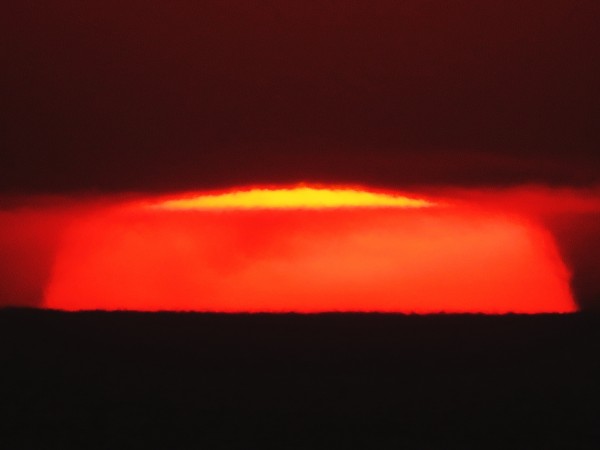
Image of the Day…” Sunset Over The Atlantic…”

Dramatic sunset over the Atlantic, seen near Rio

Cool air on the sea surface strongly refracted the setting sun, seen Saturday night from a small town near Rio de Janeiro, Brazil. Cool series of images!

January 17 sunset by Helio de Carvalho Vital.  Shot 1 of 6.

Helio de Carvalho Vital wrote:

That the strong refraction next to the horizon flattens the image of the setting sun is no surprise to anyone. But what if the sun suddenly becomes shaped like a mushroom? Saturday evening [January 17, 2015], I took some photos of the sun setting over the Atlantic Ocean from Saquarema, a small city 100 km east of downtown Rio de Janeiro.

The local air temperature was 34°C but the seawater was only 21°C. Thus a layer of cooler air formed on the surface of the sea.

As sunlight crossed that layer to reach my camera, it underwent a complex series of refractions and reflections that severely distorted the image of the sun, making it acquire very unusual shapes.

A Canon Powershot SX60 HS was used for all the shots, taken at 21:39-41 UTC.

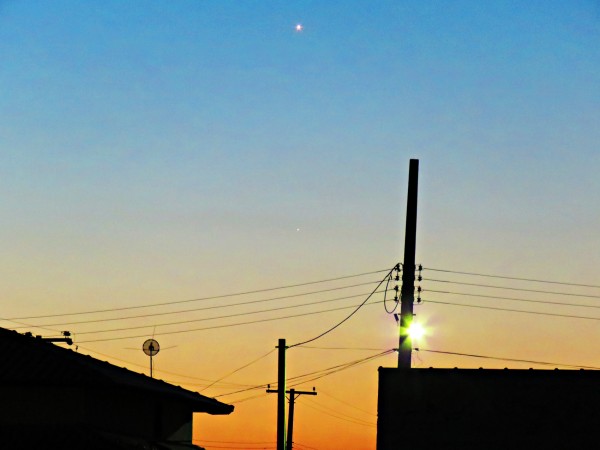
After sunset that same evening, Venus and Mercury appeared!

January 17 sunset by Helio de Carvalho Vital.  Shot 2 of 6.

January 17 sunset by Helio de Carvalho Vital.  Shot 3 of 6.

January 17, 2015 sunset by Helio de Carvalho Vital.  Shot 4 of 6.

January 17, 2015 sunset by Helio de Carvalho Vital.  Shot 5 of 6.

After sunset on January 17, as the sky began to darken, Venus and Mercury popped into view in the western sky.  Photo by Helio de Carvalho Vital.

Bottom line: Series of images of Saturday night’s amazing sunset, seen over the Atlantic from a small town near Rio de Janeiro, Brazil.

SOURCE::: http://www.earthskynews.org

Natarajan

Jan 21 2015

Image of the Day… Milky Way Over Todd Lake Basin, Oregon…

Milky Way over Todd Lake Basin, Oregon

Here in the midst of our northern winter, a beautiful shot of the summer Milky Way.

Photo by Jason Brownlee.  Visit Jason Brownlee Design on Facebook

Jason Brownless captured this view last August of the Todd Lake Basin in Oregon, with Mt. Bachelor – a stratovolcano, since 1958 the site of a ski lodge – and the Milky Way in the background.

SOURCE:::     in http://www.earthskynews.org

Natarajan

Jan 19 2015

Beagle 2 Spacecraft… Lost in 2003 … Found in Mars in 2015 !!!

Long-Lost Spacecraft Spotted on Mars

Long-Lost Spacecraft Spotted on Mars

IT turns out the Beagle has landed after all — but it never called home.

The gone-but-not-forgotten spacecraft Beagle-2 went AWOL on Christmas Day, 2003, when it was supposed to land on Mars and start transmitting data back to Earth.

Instead, the British-built craft went dark. After several months, it was declared lost — presumed to have been destroyed during its approach or while trying to land on the red planet.

On Friday, more than 11 years later, European Space Agency officials reported that the Beagle-2 had been finally found — thanks to extensive detective work based on new photos taken by the high-resolution camera on NASA’s Mars Reconnaissance Orbiter.

DISCOVERY: Have scientists solved the Beagle 2 mystery?

The photos show the craft landed safely on Mars and partially deployed — but was unable to fully deploy and start communicating.

Still, it was a vindication of sorts for space scientists who had wondered for more than a decade about the fate of their pet project, which was designed to search for signs of life on Mars.

Rudolf Schmidt, ESA’s Mars Express project manager at the time, called the finding “excellent news.”

He said not knowing what happened to Beagle-2 had “remained a nagging worry.”

Soon after Beagle-2’s disappearance, NASA landed both Spirit and Opportunity near the Martian equator.

Both sent back troves of images and discoveries, providing the sort of information astronomers had been seeking when the first Mars probes began.

There it is ... This NASA annotated image shows a bright feature interpreted as the Beagl

There it is … This NASA annotated image shows a bright feature interpreted as the Beagle 2 Lander with solar arrays at least partially deployed on the surface of Mars. Pic: AFP PHOTO/NASA Source: AFP

Mars is notoriously hard to reach. In a half-century of launch attempts, more than half of the missions by various countries have failed to get off the ground on Earth or overshot Mars.

Landing on the red planet is particularly treacherous because of the thin atmosphere.

Incoming spacecraft travelling at 19,300kph have only minutes to slow to a stop.

The Martian terrain is also full of obstacles — boulders, cracks and cliffs — and a wrong move can doom a spacecraft.

The Mars Reconnaissance Orbiter, which has circled the planet since 2006, has periodically searched for spacecraft missing in action.

Still missing is NASA’s Mars Polar Lander, which lost contact during its arrival at the south pole in 1999.

Officials said careful analysis of the high-resolution photos showed the Beagle-2 had landed within its expected landing area in a basin close to the Martian equator. Signs of key entry and descent components were also spotted.

Identifying the craft was made more difficult by its small size — it is just over 1.8 metres wide with its solar panels unfurled.

 An undated computer generated image made available in London, Sunday June 1 2003 by the the European Space Agency, of the Ma...

Lost in space … A computer generated image of the Mars Express in orbit around Mars. Pic: AP Photo/European Space Agency Source: AP

The 143-pound Beagle-2 was named for the ship that carried naturalist Charles Darwin on his voyage of discovery in the 1830s.

It is shaped like an oversized pocket watch and was designed to descend through the Martian atmosphere, deploy parachutes, and “bounce” to a safe landing on inflatable bags.

Experts who helped identify the lander at the University of Arizona’s Lunar and Planetary Lab said the photographs are “consistent” with only a partial deployment of the Beagle-2 upon landing.

They said a failure to fully deploy would explain why no data or signals from the craft were ever received, since a complete deployment of all of its solar panels would have been needed for successful transmissions.

Alfred McEwen, chief investigator of the project, said the special camera had been used to search for all of the landers that have tried to descend to the surface of Mars.

“This the first time we found one that didn’t send a signal after it landed,” he said.

The Beagle has landed ... A computer-generated image showing the Beagle 2 Probe on surfac

The Beagle has landed … A computer-generated image showing the Beagle 2 Probe on surface of Mars. Pic: AP Photo/European Space Agency Source: AP

“If the landing sequence works correctly, the probe sends a radio signal, and you can use that to pinpoint where it is coming from, even if it broadcasts only very briefly. But in the case of Beagle-2, we didn’t get anything. All we had to go by was the target landing area.”

Experts who worked on the project said the Beagle-2 mission can now be classified a partial success — even if it never provided information about possible life on Mars.

UK Space Agency chief executive David Parker said the discovery of the craft showed its complex landing procedures had worked.

“This finding makes the case that Beagle-2 was more of a success than we previously knew and undoubtedly an important step in Europe’s continuing exploration of Mars,” he said.

The Beagle-2 was launched on ESA’s Mars Express orbiter. It was released from its mother ship on December 19, 2003, and was supposed to land six days later, but no communications with the lander were ever established.

Professor Mark Sims of the University of Leicester, who worked on the project, said the new information shows the team came extremely close to its goal of getting data from Mars, with the deployment failing only in its final stage.

“To be frank, I had all but given up hope of ever knowing what happened to Beagle-2,” he said, admitting he was troubled every Christmas Day by the unknown fate of the craft.

SOURCE:::: http://www.news.com.au

Natarajan

Jan 17 2015